


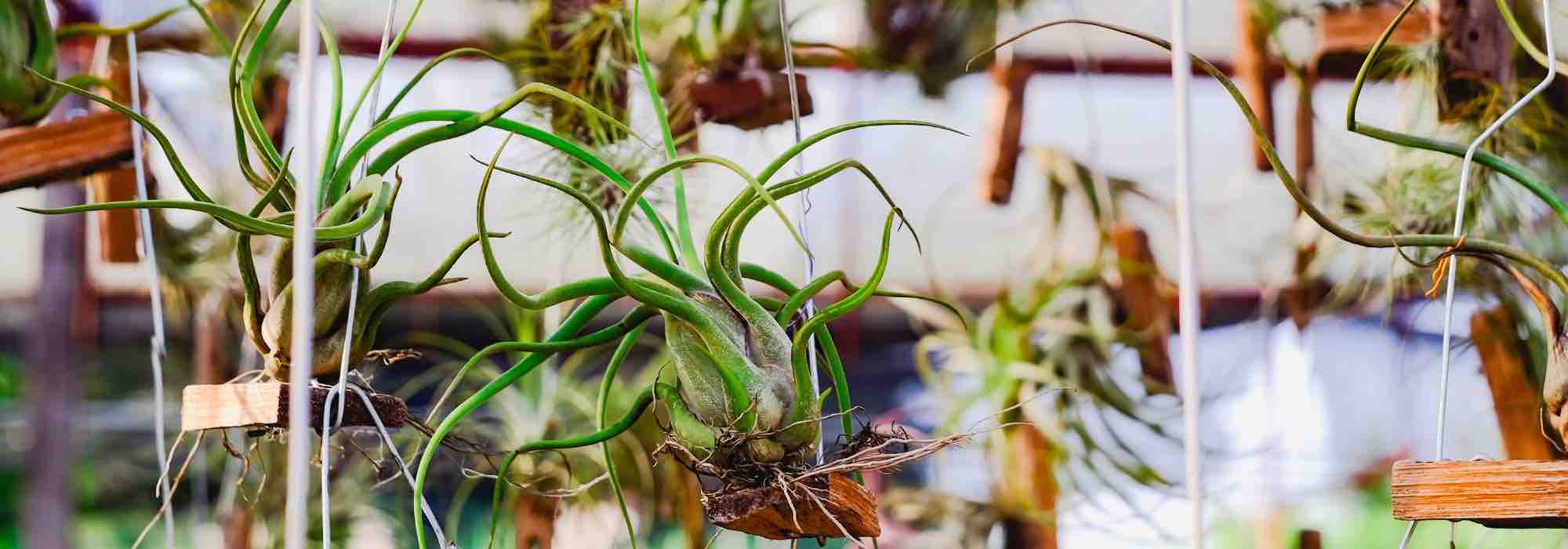
Epiphytic plants: aerial wonders that live without soil
Discover these hanging plants
Contents
Get ready to dive into the mysterious and fascinating world of epiphytic plants. These botanical marvels have developed unique survival strategies that enable them to thrive on other plants without parasitising them. From the famous orchids to the lesser-known tillandsias, epiphytic plants offer an extraordinary display of biodiversity. In this guide, we will explore the precise definition of epiphytic plants and present iconic examples that will broaden your perception of the world’s flora. Buckle up, the epiphytic adventure starts now!
Discover these unique plants: who they are, what their advantages are, how to succeed in growing them and easily caring for them.

What is an epiphytic plant?
An atypical way of functioning
To be able to grow, plants first require light. But they also have two other fundamental needs, like any living being: they depend on food and water. These two essential elements must be available in greater or lesser quantities, depending on the species. Most plants thus find their nutrients in the soil (organic matter, minerals…). They develop directly in the soil (or in a container in which we reproduce these conditions).
But with epiphytic plants, the substrate that serves as the growing support is different: it can be another plant, a piece of wood, but also inert material, such as a stone. Therefore their roots do not need direct contact with the soil. Generally, they attach themselves to a tree, at the level of the bark or the branches. This allows them to capture the amount of nutrients necessary for their growth.
However, note that these plants are not parasites: they do not ‘steal’ their hosts’ food or water and do not impact their healthy development. It is also not a mutualistic relationship, since the host plant does not gain any particular benefit from the presence of the epiphyte. This is rather a ‘commensal’ relationship, beneficial to only one of the parties.
In addition, epiphytic plants also need water, which they capture thanks to rain, dew or directly from the air (atmospheric humidity). This water also allows them to obtain additional minerals.
The word ‘epiphyte’ comes from Greek and means ‘on a plant’. Plants that have this characteristic can be terrestrial or aquatic, as is the case with certain types of algae. There are said to be more than 20,000 highly diverse species, most originating from humid tropical forests. There they developed this original mode of growth, in a natural medium subject to strong competition regarding available resources. Due to a high plant density, nutrients, water and light are indeed scarce and precious. By not needing to grow in the soil, where space is limited, but by developing on supports that can be very tall, epiphytic plants have found a way to survive. They thus have greater access to sunlight and rainwater. This height also favours their multiplication: they are more accessible to insects or pollinating animals, and more exposed to the wind, which will be responsible for dispersing seeds, spores or pollen.
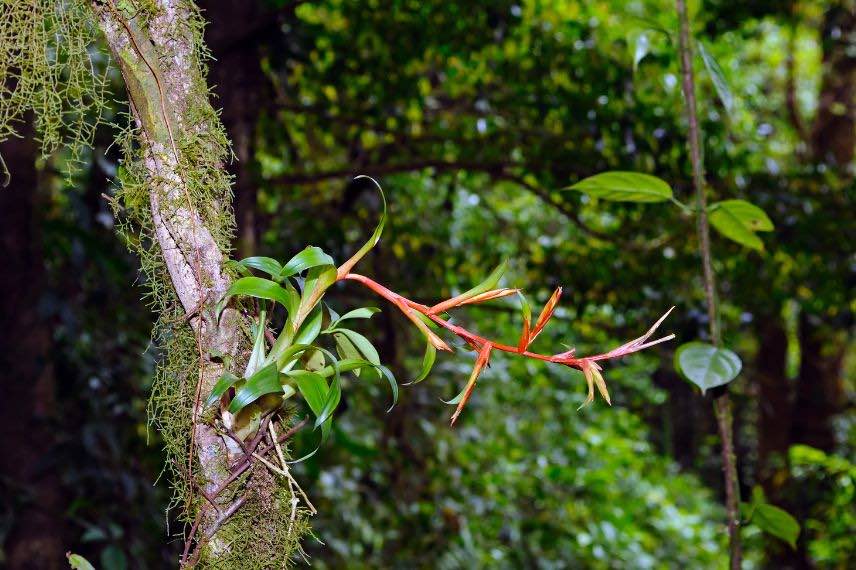
A bromeliad, an epiphyte, growing on a tree trunk in its natural environment
The advantages of epiphytic plants
If epiphytic plants have many enthusiasts, it is because they have several qualities.
- They are often striking plants, in their silhouette or their flowering. They can add a graphic, exotic or sophisticated touch.
- They take up little space: with them you do not need a large container, large planters or planting beds. They generally do not require much space and can adapt to very different supports, creating original plant displays. They can even be grown high up, in a very airy fashion.
- These plants generally do not require pruning and repotting will be less frequent than with conventional plants.
- They make very good indoor plants.
Their drawbacks
Although epiphytic plants are undemanding in their natural medium, cultivating them in our latitudes can be more complex. These plants require suitable supports and substrates that reproduce their original conditions.
Water management can also be more delicate: some species need a certain level of humidity and will not tolerate the overly dry atmospheres of our interiors. They will require very regular misting or will do better in a terrarium, heated greenhouse and conservatory.
Finally, because of their origins, these plants are often sensitive to cold. They require a minimum ambient temperature throughout the year (generally > 10°C).
Read also
Hardy orchids to grow in the gardenGrowing epiphytic plants
To successfully grow your epiphytic plants, provide:
- bright light without direct sunlight;
- a warm temperature, which generally confines them to indoor cultivation (except during the summer);
- high humidity;
- possible fertilisation, particularly for species grown for their flowering.
These factors may then vary depending on the species.
Orchids
Orchids and their particularly sophisticated flowers are certainly among the best-known epiphytic plants, belonging to the largest family. Some species, like the garden orchids, are terrestrial and grow in soil. But other tropical species, such as Phalaenopsis, for their part do not need soil. They indeed develop directly on the trunk of trees, drawing nutrients from crevices in the bark (humus, decomposing plant debris…). They have aerial roots covered with absorbing velamen or velum, which forms a kind of sheath allowing them to capture ambient air and water.
For cultivating these plants at home, you will need a container that will act as a support, but above all a specific substrate. It should be porous and well draining, often made from pieces of bark and fibres. The important thing is that it does not stick to the roots, whose tips are very fragile. Avoid the standard horticultural potting compost or garden soil.
You can make your own mix with pine bark, cork, pumice, perlite, coconut fibres or charcoal. There are also specific potting composts for orchids. Additional fertilisation (in the form of sticks or liquid fertiliser) will also be appreciated to support the growth and flowering of orchids.
Finally, orchids need humidity, but cannot tolerate stagnant water. Always empty any cache-pots or saucers a few minutes after watering. Watering can also be done by soaking the roots: to do this, place the plant in a basin with a little water in the bottom for a few minutes for deep rehydration, but not excessively.
For more information: How to repot an orchid?
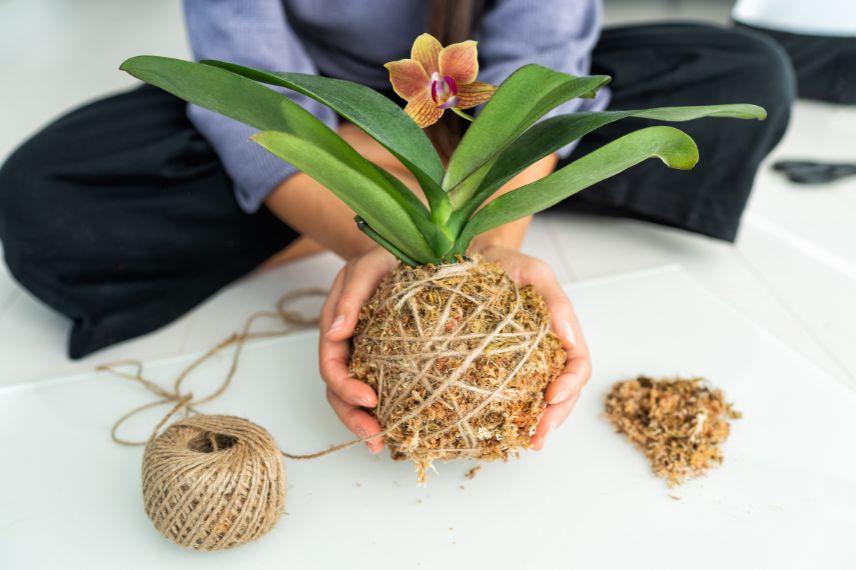
As the orchid is epiphytic, it grows in a substrate made of bark rather than potting compost, which also allows it to be grown here in a kokedama
Bromeliads
This family includes plants that are generally tropical, most of which are epiphytes.
Aechmea and Guzmania
Aechmea have natural cup-shaped reservoirs, thanks to their rosette foliage. This allows them to store water, but also to collect dead leaves and plant debris, which they convert into nutrients. It’s the same principle found in fleshy or succulent plants, which also store water in their tissues. These plants are also given the pretty name ‘silver vase’, in reference to their shape and the silvery deposit that coats the leaves.
Guzmania also has funnel-shaped foliage, which serves as a water reservoir. This indoor plant forms rosettes of leaves and unveils a pretty flowering display in colourful bracts.
The shape of these plants is more difficult to hang on a support, which is why they are often grown in small containers. Watering is generally limited to filling the rosette.
Regular fertilisation will allow the plant to flower. The rosette dies after flowering, but will have produced offsets, which will ensure the plant’s survival. They can easily be detached from the mother plant and then repotted individually.
Tillandsia or ‘air plants’
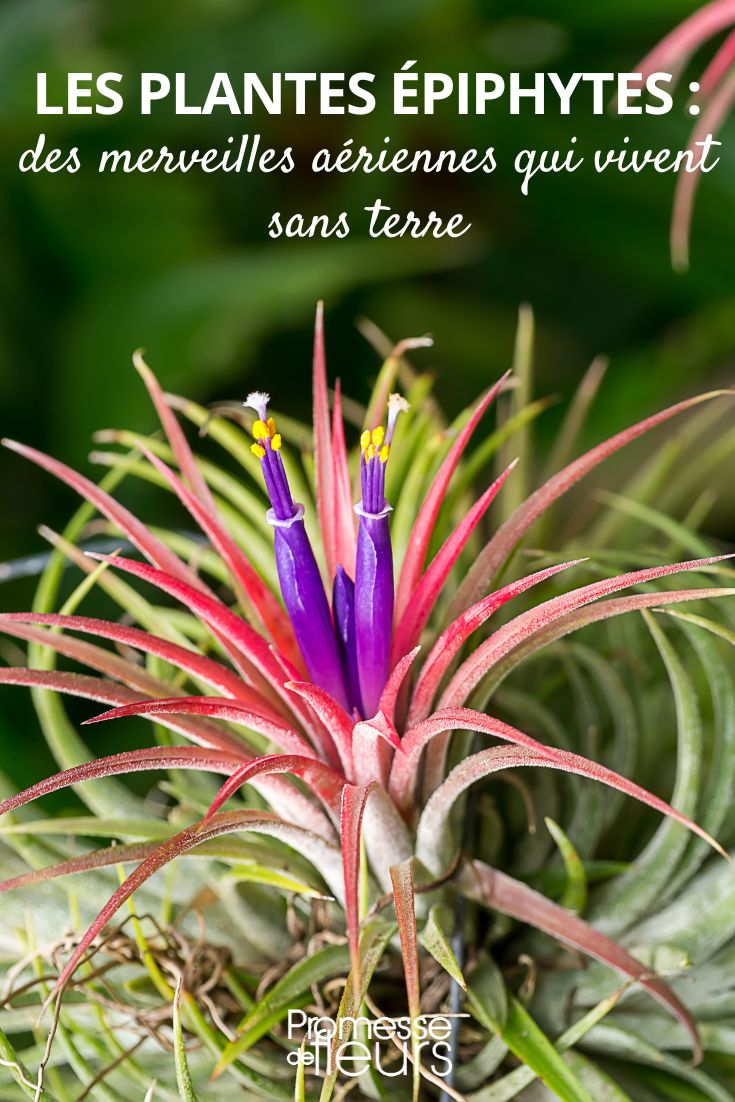
These plants have leaves covered with hairs, which absorb moisture and minerals from the air. They can be easily attached to a wide variety of supports (pieces of wood, stone, simple wires…).
To ensure their development, they need to be misted regularly, preferably with rainwater.
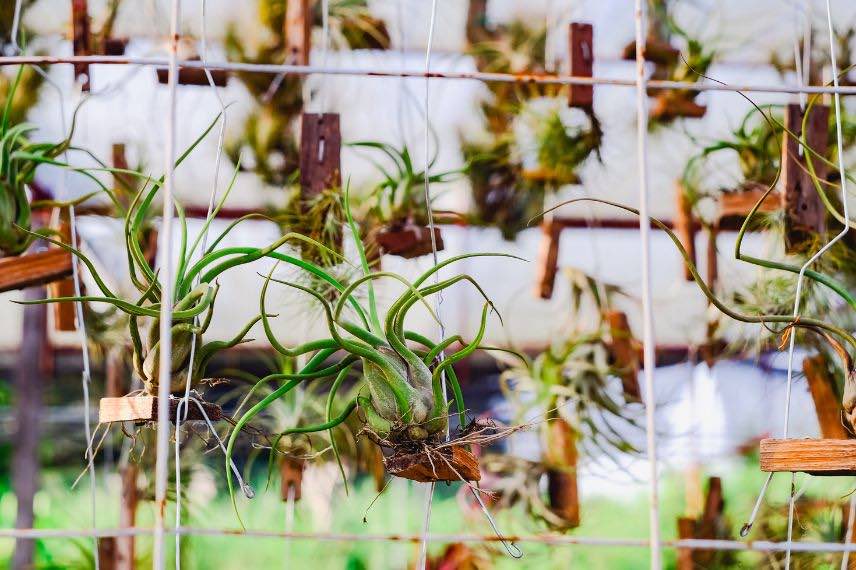
The Tillandsias
Mosses
You have probably already noticed mosses in forests or in your garden, observing that they can develop on many surfaces: tree bark, but also patio slabs, low walls, roof tiles, etc. These damp places indeed allow them to absorb the water necessary for their growth. They are among the few epiphytes, along with lichens and ferns, that can be found naturally at our latitudes.
Growing them successfully indoors is rather difficult, due to their significant humidity requirements. In the garden, they can appear and develop spontaneously if they receive enough water and are sheltered from the sun’s scorching rays. They can create true moss gardens with a Japanese-inspired look.
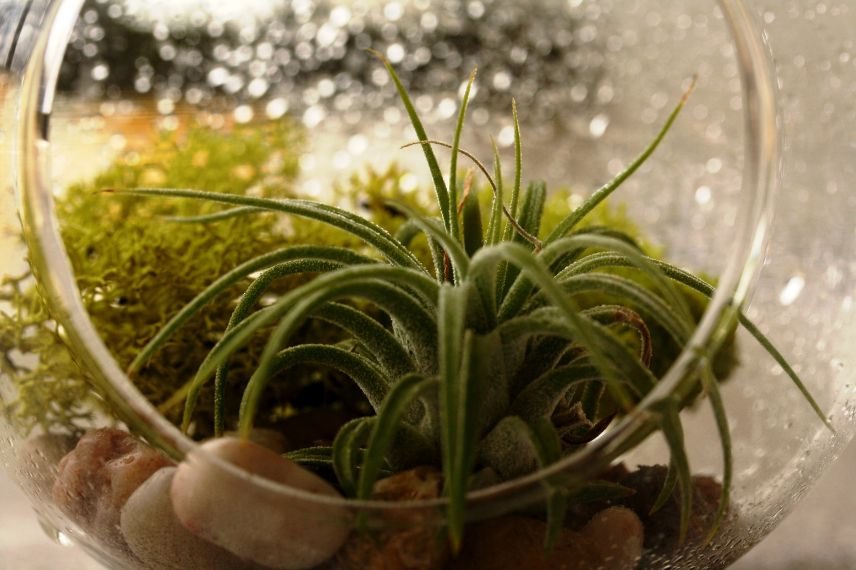
Mosses are difficult to keep indoors; they tend to dry out. A terrarium allows them to be grown at a high level of humidity (here, behind a tillandsia)
Ferns
Certain species of ferns are also epiphytic plants, even though we are used to seeing them growing at ground level in our damp forests. They can indeed develop on tree trunks, colonise a stump or sometimes even on damp stones.
The Virginia blue fern (Phlebodium pseudoaureum) is, for example, one of the epiphytic species, as are many Asplenium. The same applies to the striking Platycerium, including the famous staghorn fern (Platycerium bifurcatum). The latter makes a very attractive houseplant, with its decorative fronds.
Ferns can be grown in the garden or in pots, in moist, partly shaded conditions. They require little care.
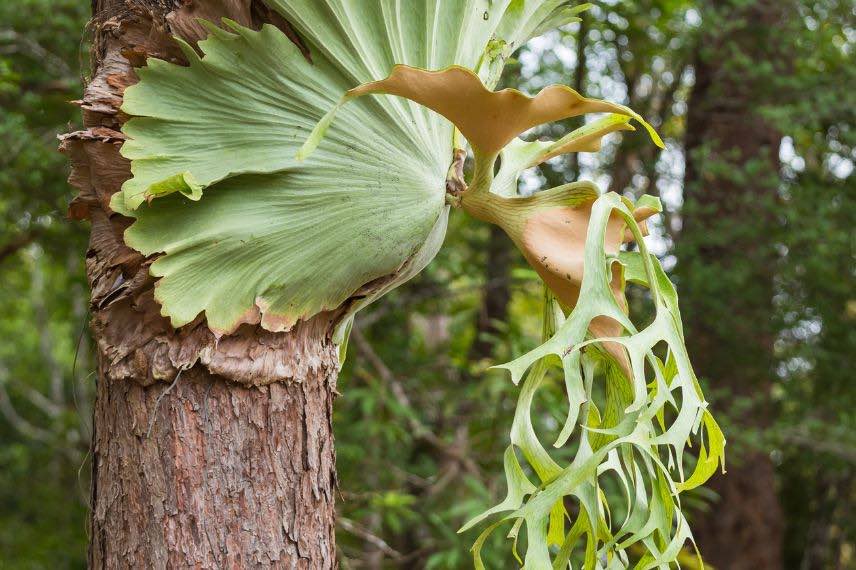
A platycerium in its natural environment; it grows well indoors here
Other examples of epiphytic plants
This list is not exhaustive, as there are many other plants that grow without soil :
- Rhipsalis, such as Rhipsalidopsis (Easter cactus), but also Schlumbergera and Epiphyllum in the family of Cacti;
- Philodendron and Anthurium, beautiful indoor green plants in the Araceae family;
- some begonias, such as Begonia rhizocarpa.
- Subscribe!
- Contents
Comments