





























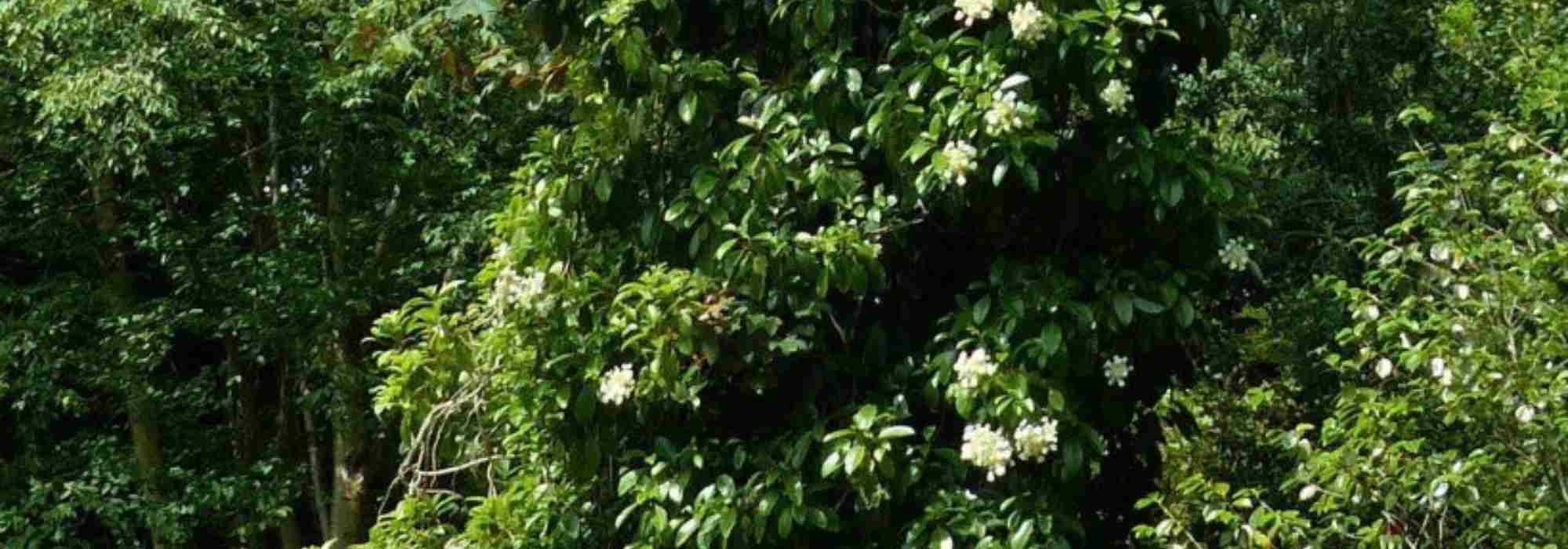
Evergreen and semi-evergreen hydrangeas
Decorative hydrangeas for shade all year round
Contents
Bloom throughout the summer; we love hydrangeas for their range of colours pink, blue or white flowers brightening the shade, or for some of them, heat-tolerant.
Most are deciduous, but a few hydrangeas have evergreen or semi-evergreen foliage, depending on the mildness of the climate and winter. These are mainly climbing hydrangeas with flat white flowers that really brighten up these areas of the garden.
Come and discover these little wonders to plant in dense shade or partial shade, depending on your region.

Hyndragea seemanii
Let’s start with the most common type species, a Mexican-origin hydrangea, the Hydrangea seemanii. Resembling strongly the type species Hydrangea petiolaris, Seemanii, for its part, is evergreen, with a more erect habit and longer leaves.
It is perfect for covering an unsightly wall or climbing along a large dead tree, which will serve as both a support and an anchor for its adventitious roots, natural crampons. Hydrangea seemanii indeed grows to a height of between 3 and 5 metres in maturity (and perhaps more!), and spreads to a width of up to 4 m. Its lanceolate, dark, glossy and leathery leaves persist through winter.
The originality of its flowering lies in the large flower buds, resembling those of peonies, before blooming from July to August into white, flat-topped umbels, composed of sterile flowers and four oval sepals.
When it comes to planting, don’t confuse all these hydrangeas with plants grown in heath/heather soil. Hydrangeas, including those with evergreen foliage, are happy with neutral soil and any good garden soil, as long as it remains sufficiently moist, especially in summer, and rich in humus (for example, give them compost or leaf mould, which they love!).
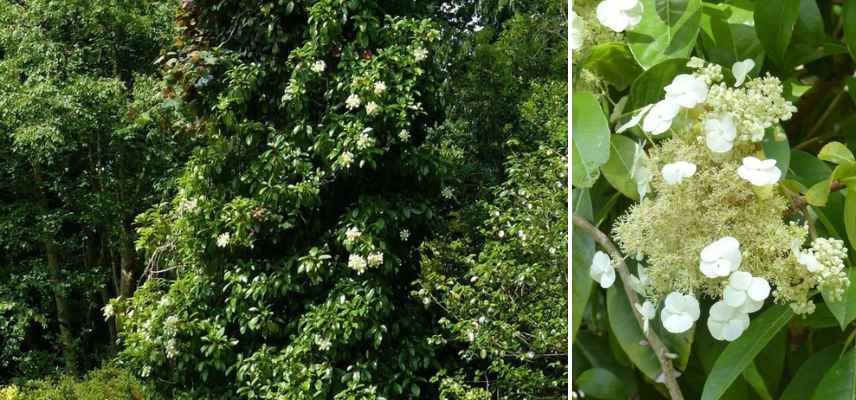
© Leonora Enking-Flickr
Read also
Climbing hydrangeas: our top 7Hydrangea (anomala petiolaris) Semiola
Also known as Hydrangea x Semiola R ‘Inovalaur’ cov, this climbing hydrangea is evergreen or semi-evergreen depending on the region. It is the result of a hybridization between Hydrangea anomala subsp. petiolaris and the Hydrangea seemanii. It inherits copper-red shoots in spring and a pretty dentate foliage. Spectacular in spring, it indeed blooms a little earlier, as its elder brother Hydrangea anomala petiolaris, between May and June, sometimes until July if the summer stays cool.
It is covered with white sterile and fertile flowers.
As with the seemanii hydrangea and the other hydrangeas in this selection, this white-flowered hydrangea with flat blossoms is planted in shade or partial shade.
Growing to between 3 and 6 m in height, very vigorous, it is also handy for effectively cloaking a bare concrete-block wall, facing north, north-east or east.
Notably, its frost resistance is noteworthy, hardier than seemanii.
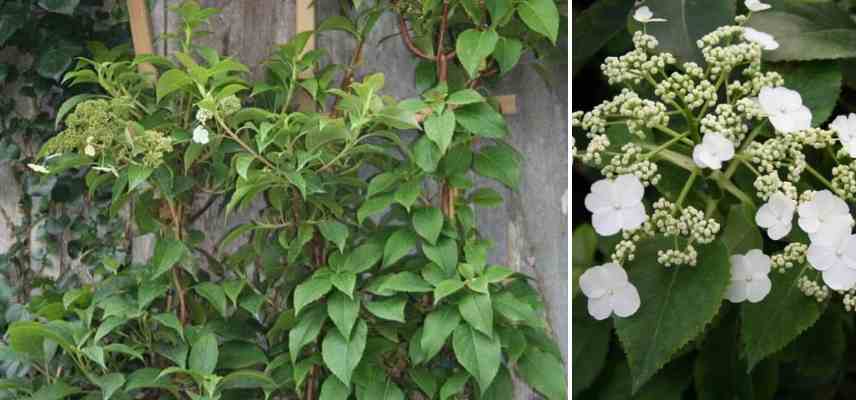
The Pileostegia viburnoides
Although it is not strictly part of the hydrangeas, Pileostegia belongs to the Hydrangeaceae family and resembles them somewhat. It is sometimes called the false viburnum or Pileostegia false viburnum. This large, vigorous climbing plant comes from India and was introduced to Europe in 1908. It grows to a height of between 3 and 5 m, with a spread of about 3 m.
Its dark, evergreen, glossy foliage differs from that of hydrangeas, being longer, more pointed and much thicker, even leathery. Young growth unfurls pinkish. The white-cream flowering, unscented but melliferous, in the form of fluffy panicles, appears late compared with climbing hydrangeas, between August and September, extending to October. It also clings to the support you provide with its adventitious (aerial) roots.
Pileostegia viburnoides is hardy down to -18°C, which earns it a place in many gardens.
A point to note: it grows slowly, and flowers well only after a few years, so please be patient!
For planting, this evergreen climbing plant requires humus-rich soil, neutral to slightly acidic. Maintenance is summarised, as for Hydrangea petiolaris, by pruning in late winter, around March.
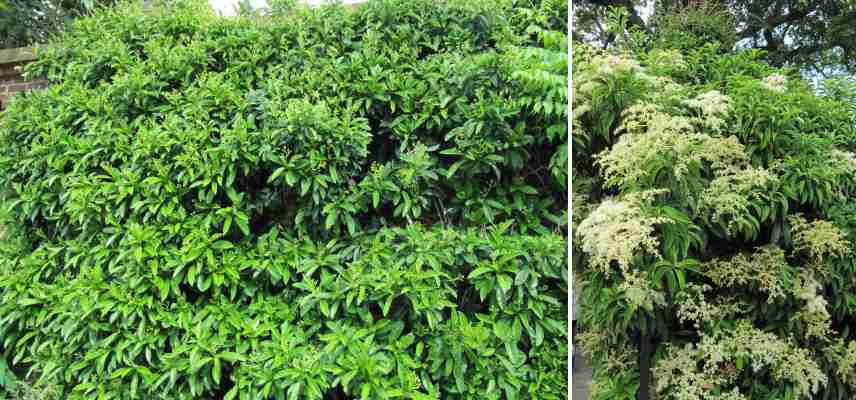
Pileostegia viburnoides : foliage in June and flowering in September(© Leonora Enking-Flickr)
Hydrangea integerrima
Here’s another Hydrangea from Latin America, more precisely from the eastern part of Chile. Endemic to Argentina and Chile, it is now available from a few nurserymen in France. Also called Hydrangea serratifolia, it is also a climber, and, in addition to its summer flowering in large white umbels, this distinctive species features foliage unusually striking for the genus, about fifteen centimetres long, broad and elliptical in shape. The lateral branches are often trailing in older specimens. The flowering, cream-coloured, occurs in June–July, formed into rounded, compact cymes, 5 to 12 cm in diameter. Another peculiarity: its flowers are all sterile.
This rare Hydrangea will slowly climb to a height of 6 m with a maximum spread of 2 m. Cultivate it in neutral to slightly acidic soil, in partial shade or in full shade. It also clings to its support (wall, trellis…).
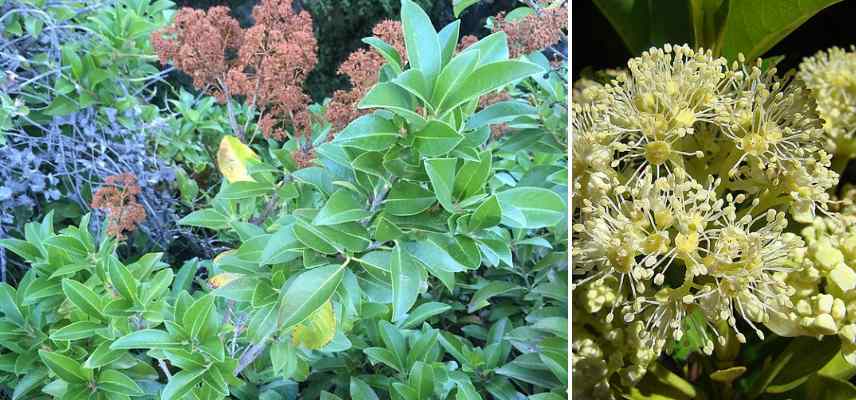
Hydrangea serratifolia : on the left the foliage (©Patricio Nova Quezada-Flickr), on the right the flowers (©Dick Culbert-Flickr)
Semi-evergreen varieties among classic or hybrid hydrangeas
A recent Anjou-bred cultivar offers Hydrangea ‘R Renaissance’, a hybrid between Hydrangea macrophylla and Hydrangea scandens, with large flat dentate flowers pink or pale blue — depending on soil pH — and white. Its foliage is semi-evergreen to evergreen, depending on the climate, and it keeps its leaves if grown in pots and brought into a conservatory for winter or in mild climates. This compact habit cultivar has the advantage of flowering for a very long time (at least 6 months between April and October) and is ideal in pots.
The Hydrangea anomala petiolaris ‘Winter Surprise’, native to the Himalayas, is also known for its small decorative foliage, semi-evergreen to evergreen, with white flowering in July and colours its leaves crimson to purple in mid-winter. It should be planted in shade or partial shade; it remains small, reaching about 1.5 m at maturity.
Finally, during unusually mild winters as this year, some Hydrangea quercifolia (oakleaf hydrangeas) do not shed all their leaves in autumn, and keep them, often in sumptuous colours turning orange, bronze, purple or rust, as long as hard frosts are not to be feared. Mild-climate regions are therefore preferred for growing these hydrangeas which then have a semi-evergreen habit. This is the case with Hydrangea quercifolia ‘Alice’ for example, which grows in partial shade or in sun that is not scorching.
→ Read our article on this topic: Autumn-coloured hydrangeas.
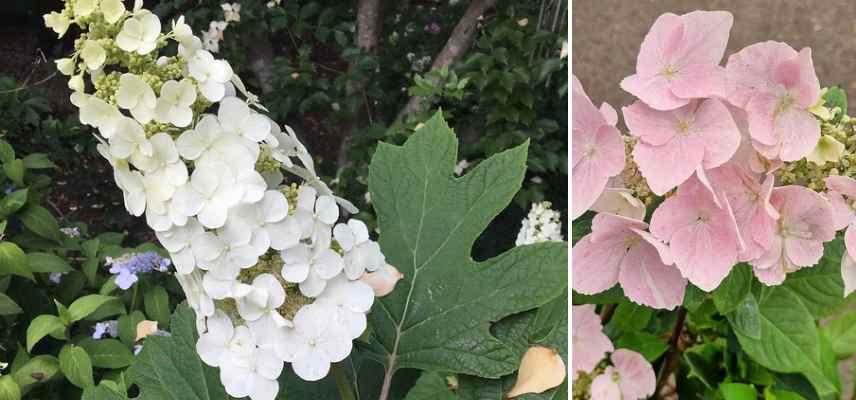
Hydrangea quercifolia ‘Alice’ (©Michele Dorsey Walfred) in summer, and flowering of Hydrangea ‘Renaissance’.
- Subscribe!
- Contents
Comments