


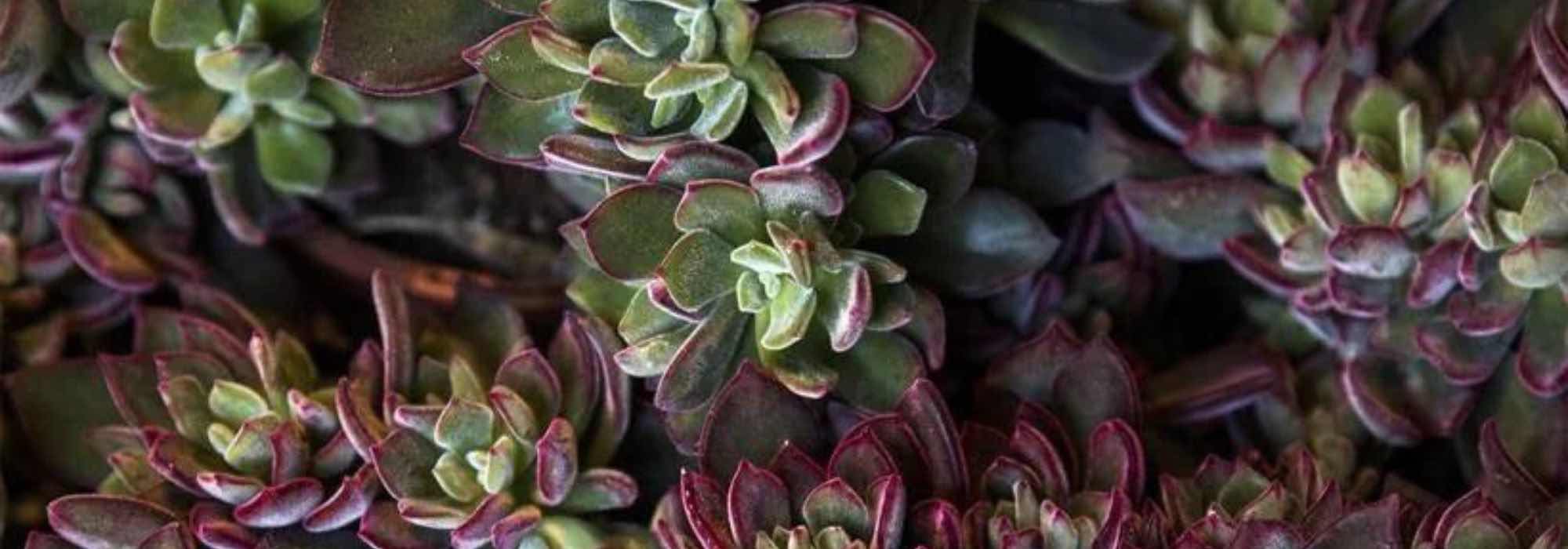
Exotic and easy-care: discover the rosette-forming succulent plants
Easy-to-grow plants with graphic, evergreen foliage
Contents
If the succulent plants are so popular, it’s because they offer many advantages. They are, first and foremost, very easy to grow, even for beginner gardeners.
Undemanding, they are low-maintenance plants capable of withstanding the harshest conditions: drought, heat, poor soil, lack of care. Thanks to their sap-filled tissues, which earn them their other name of ‘succulent plants’, these plants can indeed withstand aridity and go without water for a long period.
Finally, succulent plants are ideal for adding a touch of the exotic, both to the garden and in pots, even indoors.
In this well-diversified family of plants, the leaves can take different shapes, but rosette-form leaves are certainly the most iconic. The leaves spread out and nestle into a circle from the base of the plant, immediately adding a graphic and modern touch. Discover our five favourites!

Agaves
The agave is one of the most popular succulents. Most agaves are native to Mexico, which explains their good tolerance to drought and heat. But some species are also frost-tolerant (sometimes down to -15°C), which will allow them to be grown outdoors in the garden if protected from damp in winter.
These succulents feature a tough, architectural rosette, often with a dentate margin. The number of leaves making up the rosette can vary greatly depending on the species.
You will no doubt have encountered the famous Agave americana, an impressive plant that immediately adds structure and an exotic touch.
But there are other equally ornamental species.
Discover, for example, the Agave attenuata or the swan-neck agave (60 cm high with a 1 m spread), with a rosette that is somewhat more curved, soft and spineless. It is composed of soft green leaves with a bluish tint. It has the characteristic of flowering annually after a few years of growth, but also of developing on a short, thick trunk.
Adopt also the Agave victoriae reginae (50 cm high with a 40 cm spread), even more graphic with its rosette of leaves edged with white, highlighted by a black spine.
Also mention Agave ‘Mediopicta Alba’, an American agave with bluish-green foliage traversed by a broad central white band (1 metre across).
On the other hand, the Agave filifera stands out with a rosette of long leaves edged by twisted white filaments (50 cm across).
And if you’re looking for a cold-tolerant variety, turn to the Agave parryi (60 cm across) with a cauliflower-shaped rosette coloured green with grey and blue tones.
The flowering of agaves occurs after several years of growth and is never inconspicuous: the flowering stalk then rises majestically from the centre of the rosette. After this display, the rosette dies but will have produced offsets that take over.
Give agaves a hot, sunny exposure, even scorching, in poor, well-drained soil.
For more information: Agave : planting, growing, and care.
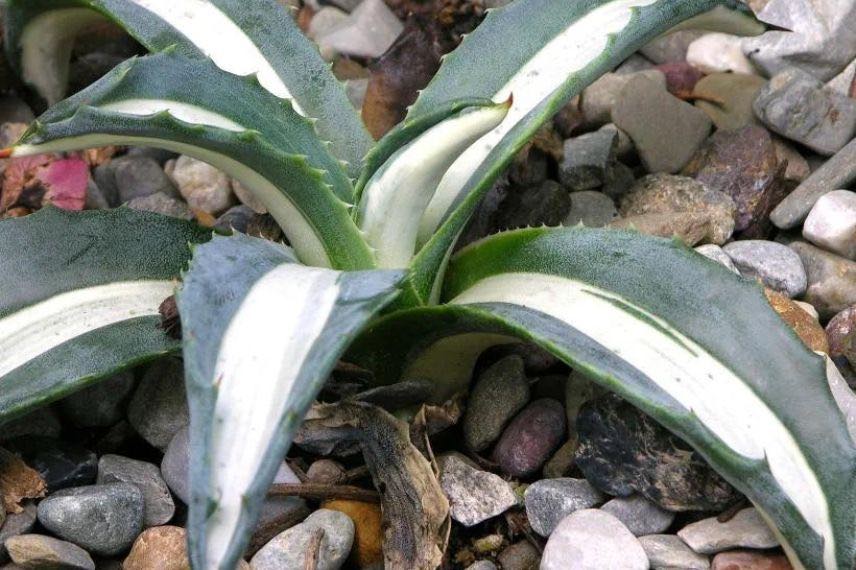
The Agave ‘Mediopicta Alba’
Sempervivum or houseleeks
Sempervivum are these adorable little rosette-forming plants. Barely reaching 15 cm in height, they fit anywhere in the garden or in pots. They have the advantage of needing only a small amount of substrate and minimal care to grow, which makes it possible to dress up the tiniest mineral gap, a shallow saucer or even the hollows of old stumps.
Among these small plants, diversity is evident in colours and textures, leaving room for each gardener’s creativity. They all form small fleshy rosettes, giving them the look of tiny artichokes.
You will be spoilt for choice among:
- the Sempervivum arachnoideum, with rosettes covered in shimmering woolly filaments;
- the Sempervivum ‘Chick Charms Gold Nugget’, a variety with evolving colours, shifting from green to orange-red and gold;
- ‘Chick Charms Berry Blues’, which rewards us with rosettes ranging from blue-grey to purple-mauve
- the Sempervivum ‘Commander Hay’, with red and apple-green two-tone rosettes in summer;
- ‘Dark Beauty’, a houseleek with foliage in a rich dark purple.
The summer flowering reveals small, star-shaped and colourful flowers.
Hardy, undemanding and easy to propagate, these rosette-forming succulents are essential for any garden and will delight all gardeners.
For more information: Sempervivum, houseleek: planting, growing and care.
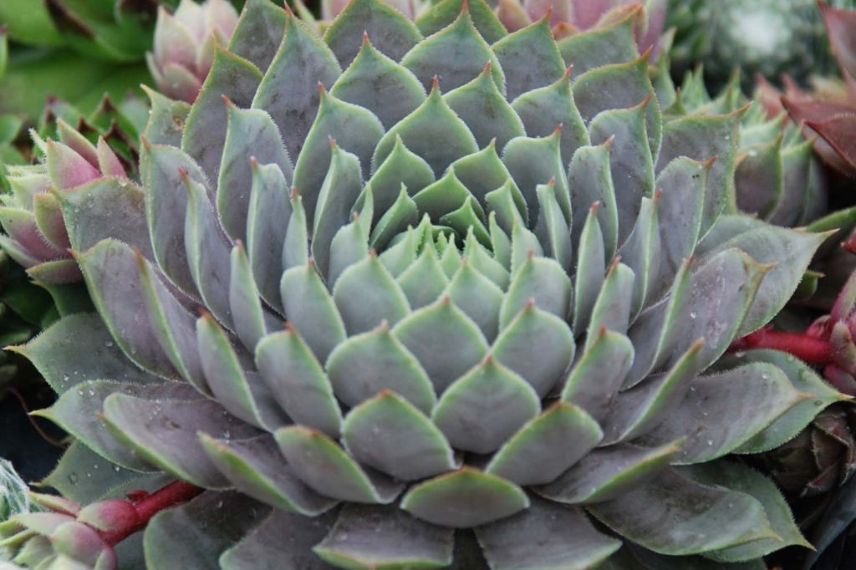
Sempervivum Chick Charm ‘Cherry Blue’
Aeoniums
Aeonium is part of the succulent plants in the Crassulaceae family. Most of them originate from the Canary Islands, Madeira, Morocco or Ethiopia.
These succulents are prized for their rosette-forming, imbricate leaves, which can take on a range of colours. From classic green to blue-green, through red, yellow or pink you’ll certainly find an Aeonium to suit you! In terms of texture, the leaves can be leathery, as is the case with many succulents, but they can also have a softer or more delicate texture.
In terms of habit, some Aeonium form a tuft creating a pretty groundcover, while others are more ramified, resembling real small bushes. The smallest varieties reach about 15 cm. The shrubby varieties can exceed 1 metre.
In spring or summer, a flowering stem rises from the centre of the rosette, producing small star-shaped flowers in yellow, white or pink.
With Aeonium, for example, choose from:
- Aeonium x occidentale, a hybrid variety wider than tall (20 cm high by 30 cm across), with its fleshy green rosettes striped with red;
- Aeonium arboreum ‘Du Rozzen’, with its rosettes made up of lanceolate leaves displaying a rich dark purple (40 cm high by 60 cm across) ;
- Aeonium arboreum ‘Schwarzkopf’, which produces shiny rosettes in a reddish-brown that would look almost black (80 cm high by 50 cm across).
In terms of cultivation, these frost-hardy (hardiness 0 to -5°C) plants will be grown in pots in most regions, so that they can be sheltered from the winter cold. Give them a sunny position in well-drained soil. Easy to care for, they will tolerate occasional missed watering and heat.
For more information: Aeonium: planting, growing and care
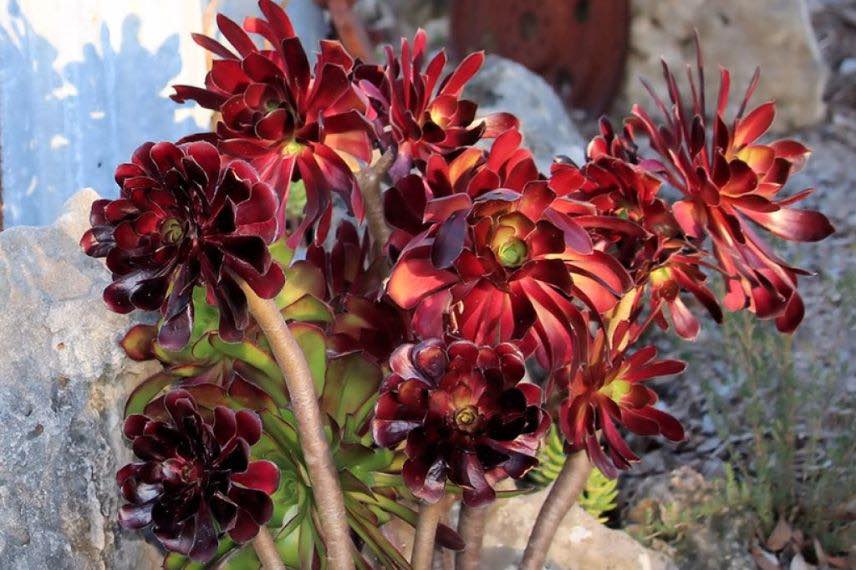
Aeonium arboreum ‘Du Rozzen’
Aloes
We know Aloe vera well, this succulent plant with multiple virtues. But within the Aloe family, other species with fleshy, rosette-forming leaves are worth a look.
For example, this is the case with the Aloe striatula (1.5 metres tall with a 2-metre spread), a shrub-form species that produces rosettes of long, graphic leaves.
The small Aloe rauhii ‘Cleopatra’ stands out for its rosette of leaves speckled with white and surprisingly rough to the touch (20 cm high with a 30 cm spread). Always among the compact varieties, the Aloe ‘Safari Sunrise’ treats us to a rosette with dark green, very slender leaves, edged with small teeth (30 cm in all directions). Also mention the Aloe polyphylla, with its rosette forming an incredibly graphic spiral (30 cm in all directions).
For its part, the Aloe harlana (1 metre across) features a rosette of fleshy, variegated leaves, blending olive green and light green.
The flowering consists of handsome spikes in warm colours that rise from the heart of the rosette and offer a real visual display.
On the cultivation side, aloes are among those plants that are easy to grow and to look after. Here again, favour warm spots, even dry ones, as well as well-drained soils, even poor and stony. Not very hardy (except Aloe striatula and Aloe aristata), they will be cultivated in the ground only in regions with dry winters and where frost does not occur. Otherwise, container cultivation will allow you to bring them indoors for shelter during the cold season, or keep them indoors year-round.
For more information: Aloes: planting, growing and care
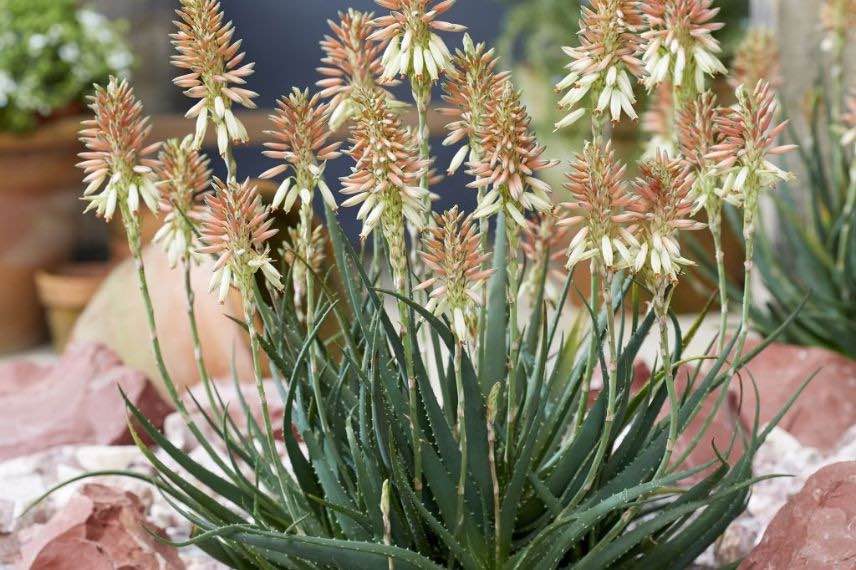
Aloe ‘Safari Sunrise’
Echeverias
Echeveria forms rosettes of thick leaves, offering a waxy or velvety appearance. They come in a range of colours and shapes, all very ornamental.
Among ‘Perle Von Nürnberg’, spoon-shaped leaves blend pale grey, purplish and reddish tones. They are covered with a light white coating.
TheEcheveria agavoides ‘Ebony’ prefers more pointed leaves, with red at the tips and margins, and chocolate-coloured.
Meanwhile, TheEcheveria hybrid ‘Devotion’ forms rosettes of velvety-looking leaves. They are green with purple margins, then turn burgundy in the sun.
Their small silhouettes, not exceeding 30 cm in height, make them easy to grow anywhere. However, their limited hardiness means container cultivation in most regions.
For more information: Echeveria: planting, growing and care.
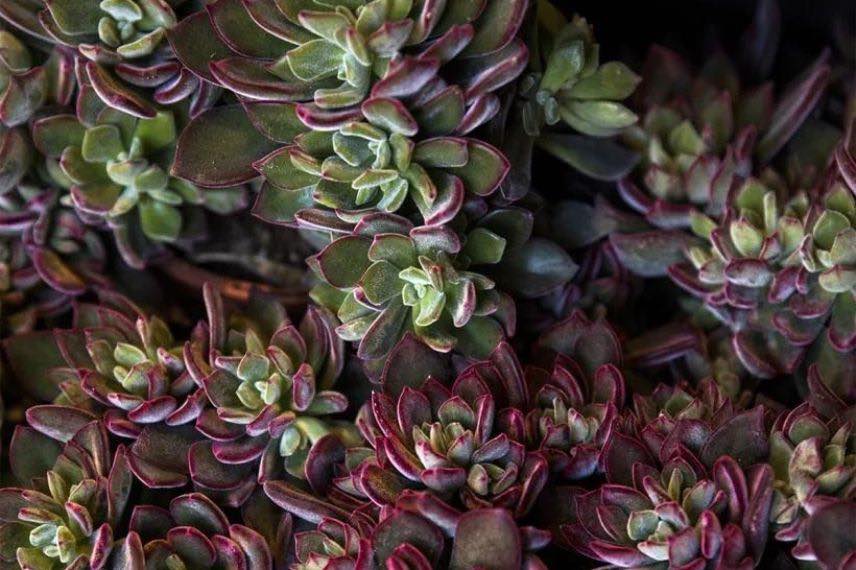
Echeveria hybrid ‘Devotion’
Other rosette-forming succulent plants to discover
The list doesn’t end here, as there are other rosette-forming succulent plants, such as:
- the yuccas, with their sword-shaped rosette leaves;
- the mangaves, which produce pretty, colour-patterned rosette leaves and are thornless;
- the Hesperaloe parviflora, with its rosettes of slender, leathery leaves.
- Subscribe!
- Contents
Comments