


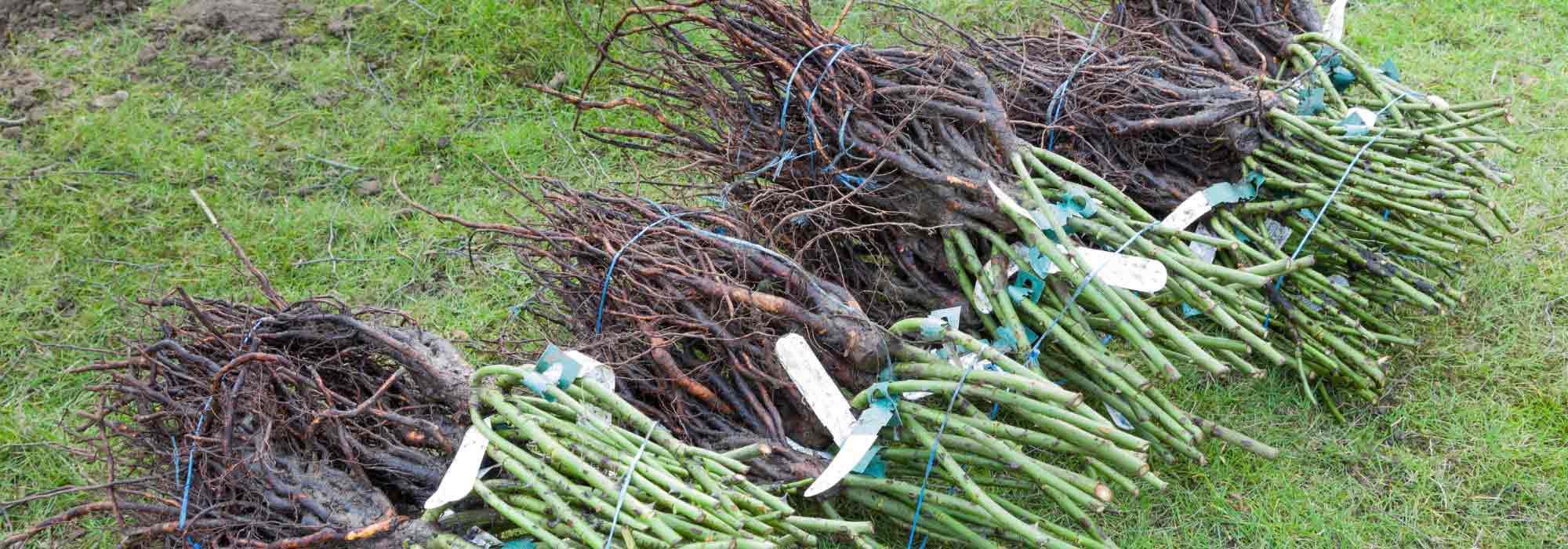
For your plantings, opt for bare roots!
An excellent choice for autumn and winter planting
Contents
When the time for autumn planting arrives, we offer you certain plants “bare roots”. What does this term, which may seem technical or perplexing to novice gardeners, really mean? Because there are no silly questions, you are likely asking yourself some of them: what is a plant with bare roots? How is it planted, when, and why?
We aim to explain all of this so that you can understand why it can be advantageous to buy and plant bare root plants once autumn arrives!

What is a plant with bare roots?
As their name suggests, plants sold as bare roots are offered without pots and without substrate; their roots are therefore completely exposed. These plants are grown directly in open ground in nurseries.
During the first fortnight of November, when temperatures drop and days shorten, these trees and bushes lose their leaves and enter dormancy for winter. They can therefore be uprooted and freed from the soil surrounding their roots without experiencing stress. They are then placed in trenches filled with sand to keep their roots cool, protected from the sun and dehydration until sold.
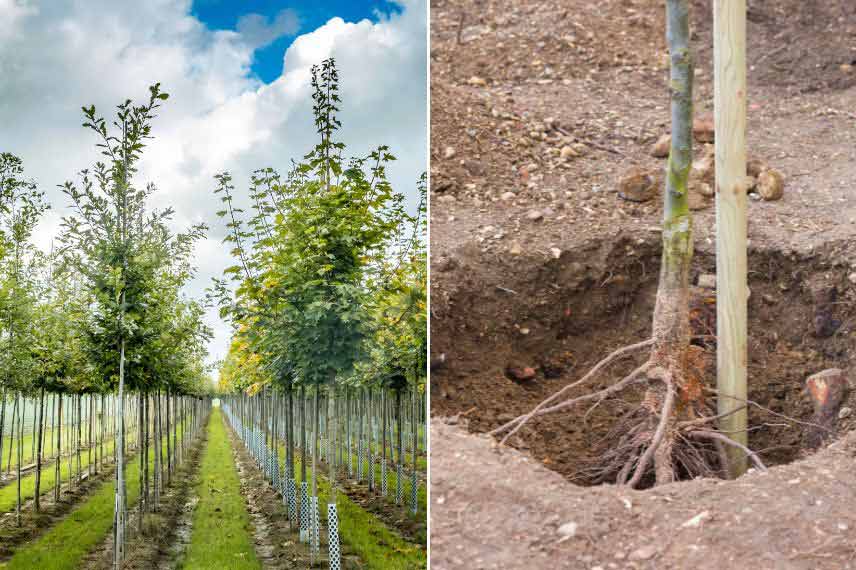
Once grown in open ground, some trees are uprooted and sold as bare roots
Read also
Planting trees and shrubs in bare rootsWhich plants are sold as bare roots and why?
The best-selling plants in bare roots are trees, whether they are fruit trees or ornamental. Given their development (both above ground and root), they thrive better in open ground where they have much more space than in containers.
You can also find bushes and small fruit trees (raspberries, redcurrants, strawberries…), roses as well as hedge plants (hornbeams, beeches, etc.) which also develop better in open fields, where the aesthetic of the silhouette at planting matters little since they will be pruned. Some perennials like peonies can also be offered in bare roots.
Thus, the vast majority of species available in bare roots are deciduous. Indeed, evergreen plants do not allow for this, as their cycle means they are never completely dormant or entirely devoid of foliage. However, there are a few exceptions, such as young plants of yew, boxwood, cotoneaster, or cherry laurel, for example. These particularly resilient and vigorous plants adapt very well to this mode of cultivation even though they are not deciduous.
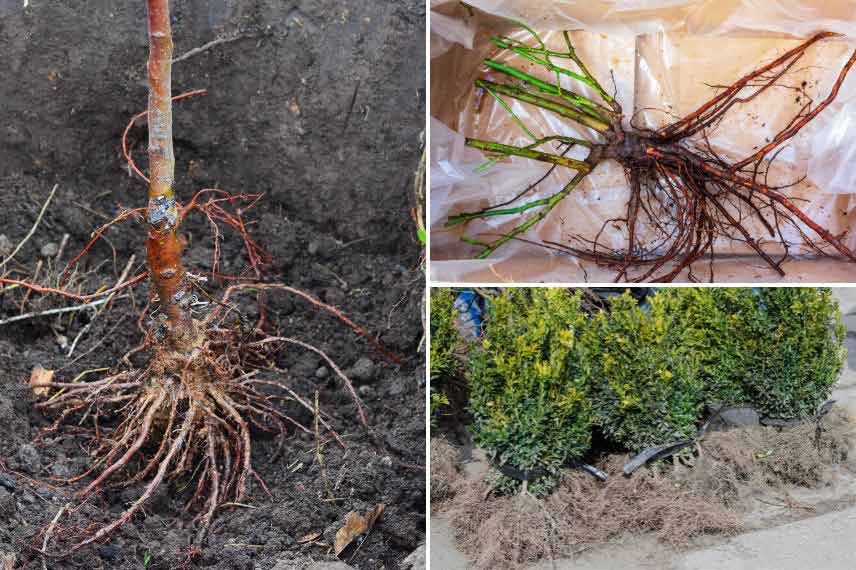
Tree, roses and boxwood in bare roots
Discover other Bare-root perennials
View all →
Available in 0 sizes
Available in 1 sizes
Available in 1 sizes
Available in 1 sizes
Available in 1 sizes

Available in 1 sizes
Available in 1 sizes
Available in 1 sizes
Available in 1 sizes
Available in 1 sizes
What are the advantages and disadvantages of bare roots?
Buying and planting a tree or a bush with bare roots has multiple advantages:
- plants grown this way are cheaper to produce (no containers or substrate, less maintenance, handling, and faster growth), thus cheaper to sell
- they are lightweight and easy to transport (for professionals, but also for gardeners)
- they are easy to plant
- their roots are clearly visible: you can ensure the quality of the young plants and discard any dubious stumps
- as their roots have not been compressed in a pot, they are well-developed, which promotes optimal rooting, very good recovery, and vigorous growth if planting is done carefully
- they are more environmentally friendly than plants grown in plastic pots with substrate, fertilisers, a lot of water, and sometimes heating. Their transport takes up less space and is much lighter than the same plants grown in pots
However, plants with bare roots also have some disadvantages:
- they are not available all year round and can only be planted in autumn-winter (from mid-November to early March)
- care must be taken not to damage their roots which have no protection
- planting must be immediate to avoid drying out or exposing the roots to frost. If this is not possible, bare roots must be stored in a heel
- they require some extra care at planting: dressing (slightly trimming the roots to stimulate the growth of root hairs), pruning branches to balance the aerial part and the root part, and puddling (soaking the roots in a muddy mixture to promote root recovery)
- their selection is much more limited than for varieties in pots
- it is nearly impossible to plant evergreen plants in this form.
To find out more
- Discover the benefits of mycorrhiza on bare root plantings.

- Subscribe!
- Contents
Comments