





























Garden Bird: the Wren
Small but sturdy!
Contents
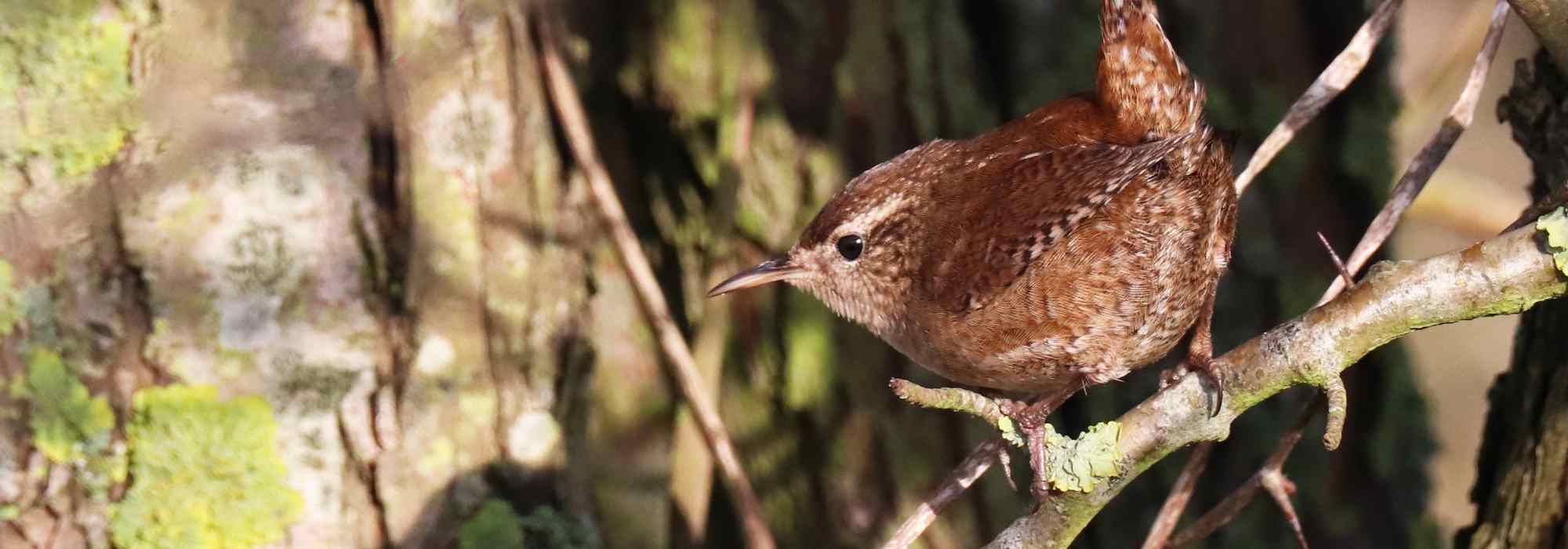
The Wren (Troglodytes troglodytes), sometimes confused with the kinglet, is a very common bird in nature and in our gardens, but can be difficult to observe. Indeed, it is one of the smallest birds in our wildlife, sporting brown plumage that allows for perfect camouflage among the branches, and it enjoys foraging for food at the base of bushes, well hidden by the foliage. Fortunately, it is very active and sings loudly in plain sight on a post, a wall, or a stump: one can then admire this little ball of feathers with its tail held vertically.
The wren loves gardens where it finds plenty of insects and nesting sites such as crevices in old walls, dense climbing ivy, or simply a pile of branches. Let’s discover this charming little bird in our advice sheet.
 Wren
Wren
How to recognise the Wren?
The Wren (Troglodytes troglodytes) is the only species of wren (family Troglodytidae) found in Europe. Other species inhabit the American continent. This species can also be found in North Africa and Asia.
It is a very small and lively passerine: it measures between 9 and 10.5 cm (from head to tail) with a wingspan of barely 15 cm. Its weight ranges from 8 to 13 g. It is one of the smallest birds in our avifauna, after the kinglets.
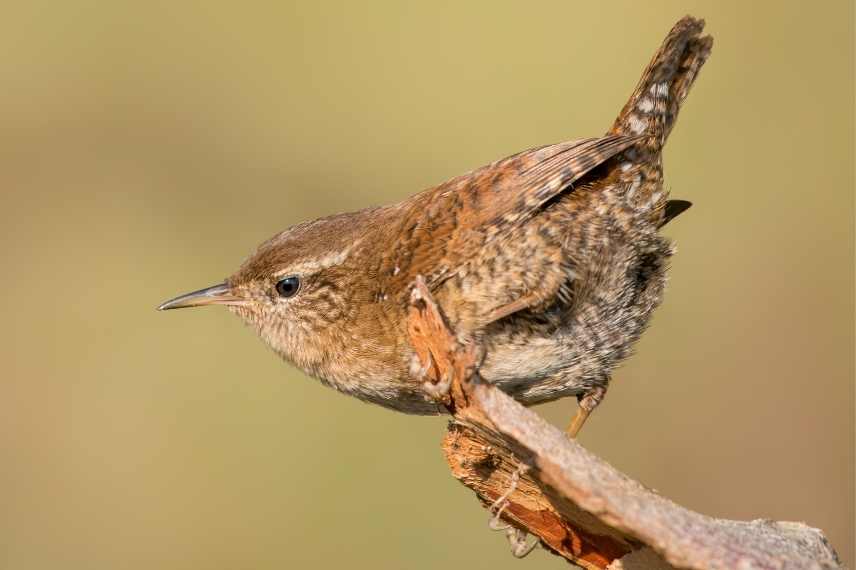
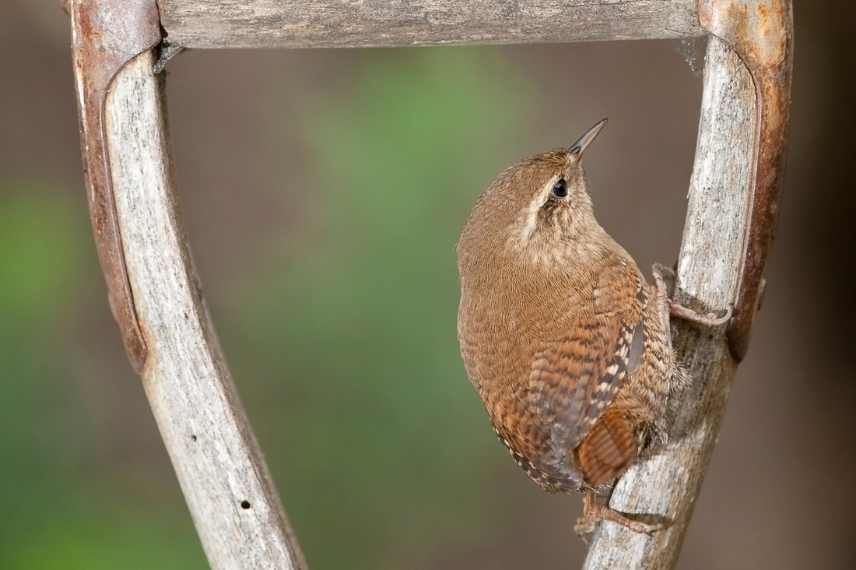
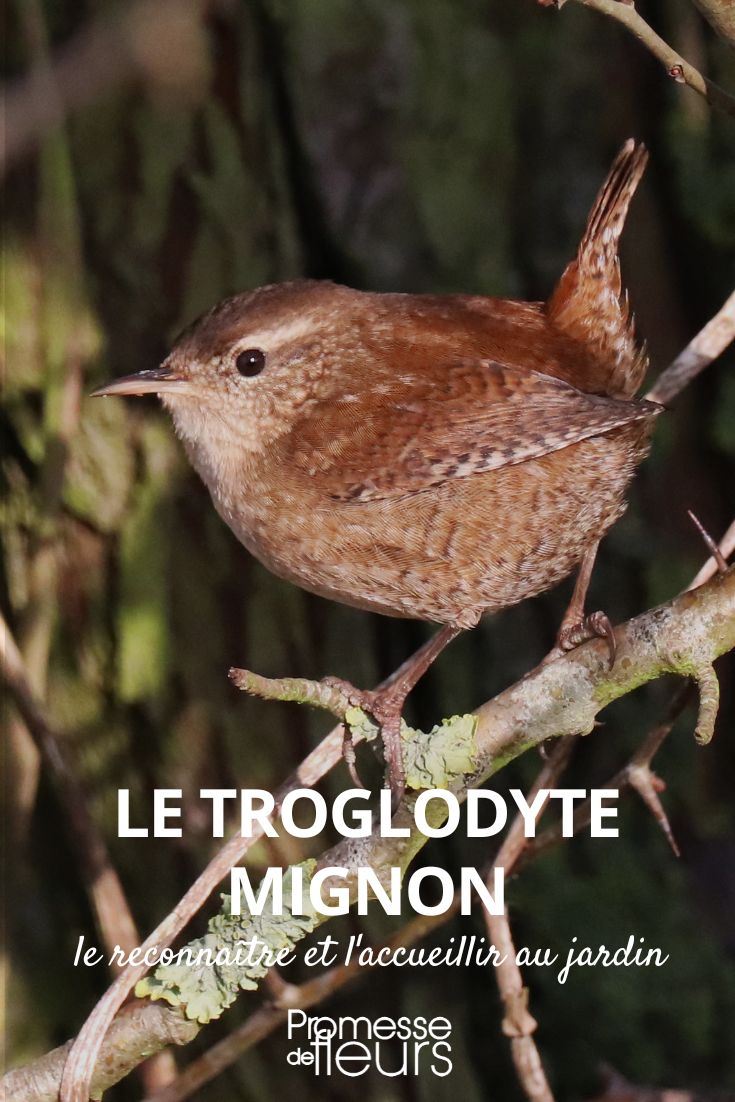
It resembles a small ball topped with an antenna: the plumage is brown, slightly striated with darker brown, and the tail is most often held vertically. The beak is slender and very pointed: an insectivorous beak. The wings are short and rounded, beating very quickly, which gives it a characteristic vibrato flight that is low and fast.
There is no apparent sexual dimorphism. Even juveniles are similar to adults.
Despite its small size, the Wren is hard to miss when it comes out into the open, due to its frantic behaviour and surprisingly powerful song. It often perches prominently to launch a very powerful song. It sometimes sings even in winter.
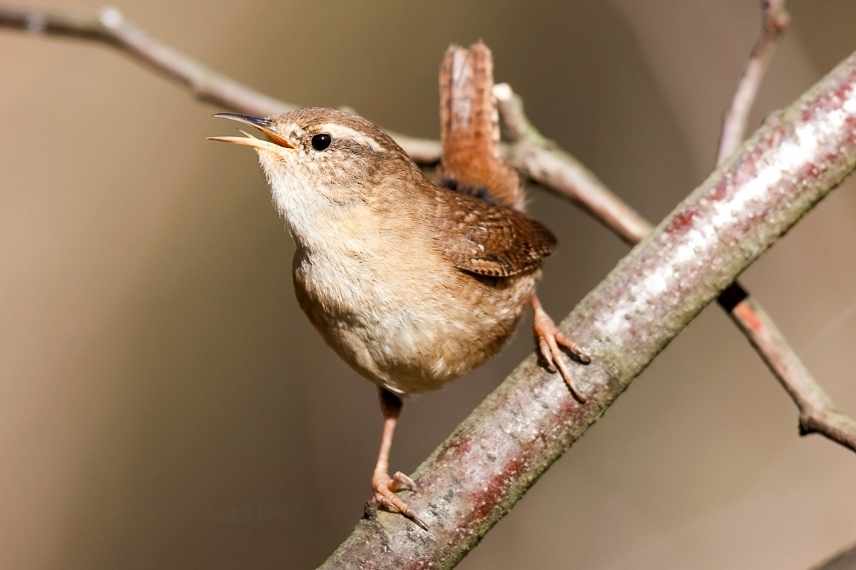
The Wren is a very small bird found in our gardens
Read also
Hedge for birds: which shrubs to choose?The life of the Wren
Habitat
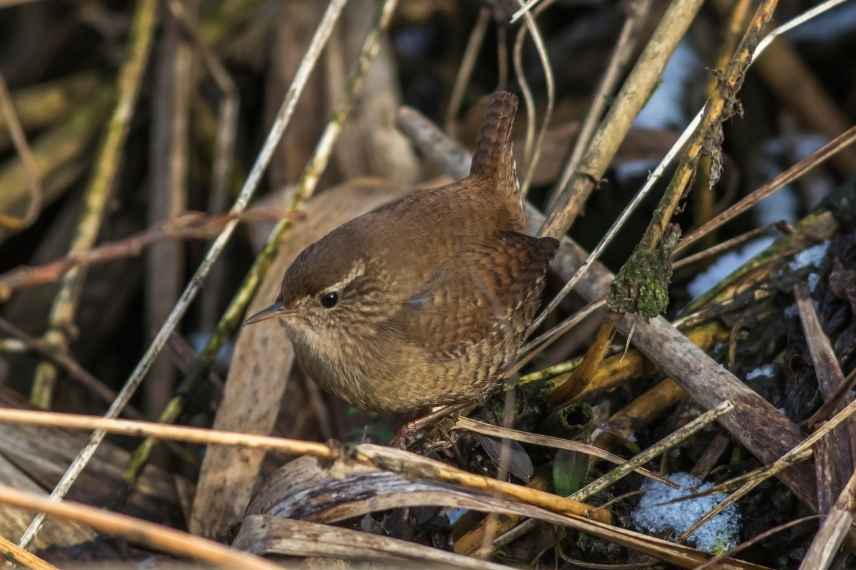
The wren primarily lives in leafy forests, where it frequents the lower stratum. It can also be seen in bocages, near water, and of course, in gardens, both in the countryside and in urban areas. It favours small, somewhat thorny and bushy shrubs, and appreciates being able to move on the ground without risk while foraging for food. The wren is considered sedentary in our regions. Therefore, it can also be found in our gardens during winter.
Food
It is an insectivorous bird. It feeds on insects (notably aphids), larvae, caterpillars, spiders, and other small terrestrial arthropods, making the wren a gardener’s ally. In times of scarcity during winter, the wren may resort to a few berries or small seeds, but this is anecdotal. Wrens living near water may also feed on small amphibians and fry.
Reproduction and Nesting
At the beginning of spring, the male will build several nests (between 6 and 12!). The wren’s nest is distinctive: large spherical nests made of moss and dead leaves with a side opening. The nest is always located at a low height, in the hollow of a tree, in a wall hole (which is how it got its name!), or tucked in ivy along a wall… However, in gardens, a pile of twigs or wood can make a happy home for a pair of wrens.
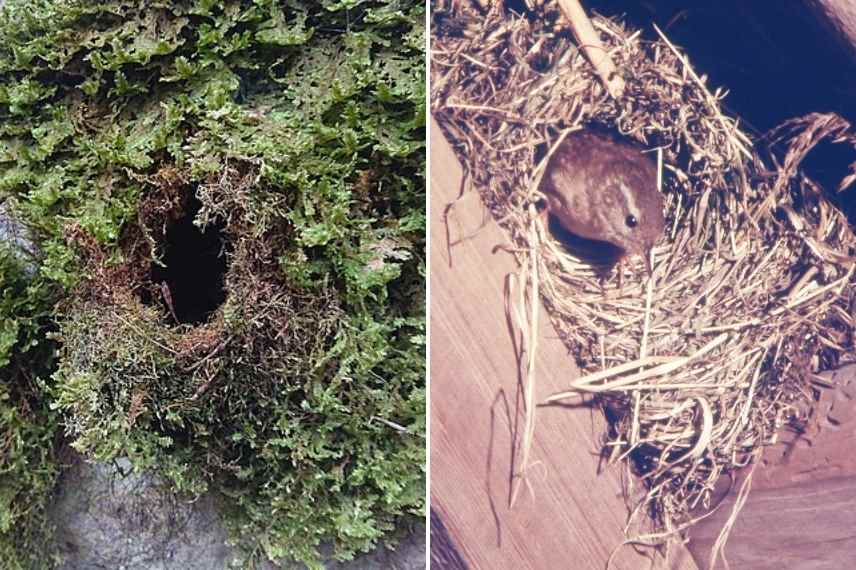
The nest can take several forms, but is elongated. On the left, made of moss (© Vianney Bajart), on the right, made of straw under a roof
The female will choose the nest that suits her. She will finish arranging it and then lay and incubate five to seven white eggs speckled with red. The male then lives in another nearby nest. Incubation lasts from fourteen to sixteen days. Both parents feed their young. The chicks remain in the nest for about fifteen days, then leave while still being fed by their parents for another fifteen days. If circumstances allow, the pair will raise another brood in the year.
The male wren is polygamous and territorial. He often looks after several females, which results in a substantial territory for this small bird. This is why he sings so loudly: he must proclaim loudly and clearly “This is my home!“.
How to attract the Wren to your garden?
The wren only requires two things: insects to feed itself and its offspring, and a place to nest.
In the garden, you can plant dense bushes or even a thorny hedge that will provide good shelter for it to forage on the ground in peace.
→ There are ready-to-plant defensive hedge kits.
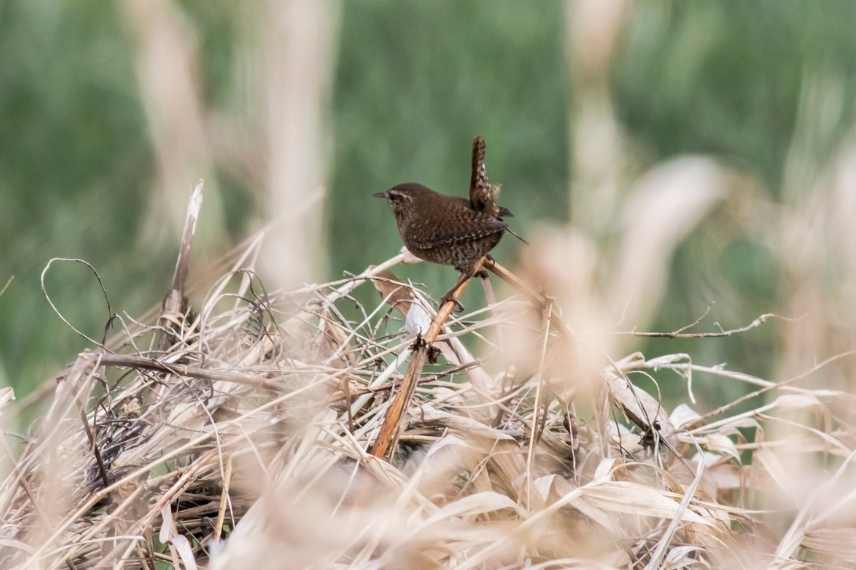
Troglodytes troglodytes
To help the wren find its food, here are some “improvements” to make in the garden: create very dense flower beds, leave leaf litter, make one or more compost heaps, and leave dead wood here and there… In short, leave insect hiding spots everywhere (especially for winter!). Of course, it is essential to ensure that insectivorous birds have enough insects in the garden: so no spraying of insecticides of any kind, let nature take its course in various places (back of the garden, unmown areas…), and plant or allow wildflowers to grow.
For nesting, the wren prefers holes in old walls, old trees, or stumps. But a climbing ivy, a pile of wood, or even a simple pile of branches will also suit it.
In winter and summer, a few small water points (like saucers) will be welcome: change the water daily to prevent diseases.
The wren rarely visits feeders in winter. It prefers to continue searching for insects.
- Subscribe!
- Contents
Comments