





























Green-leaved yarrows: how to use them and make the most of their benefits in the garden?
A plant with a bright future for our gardens
Contents
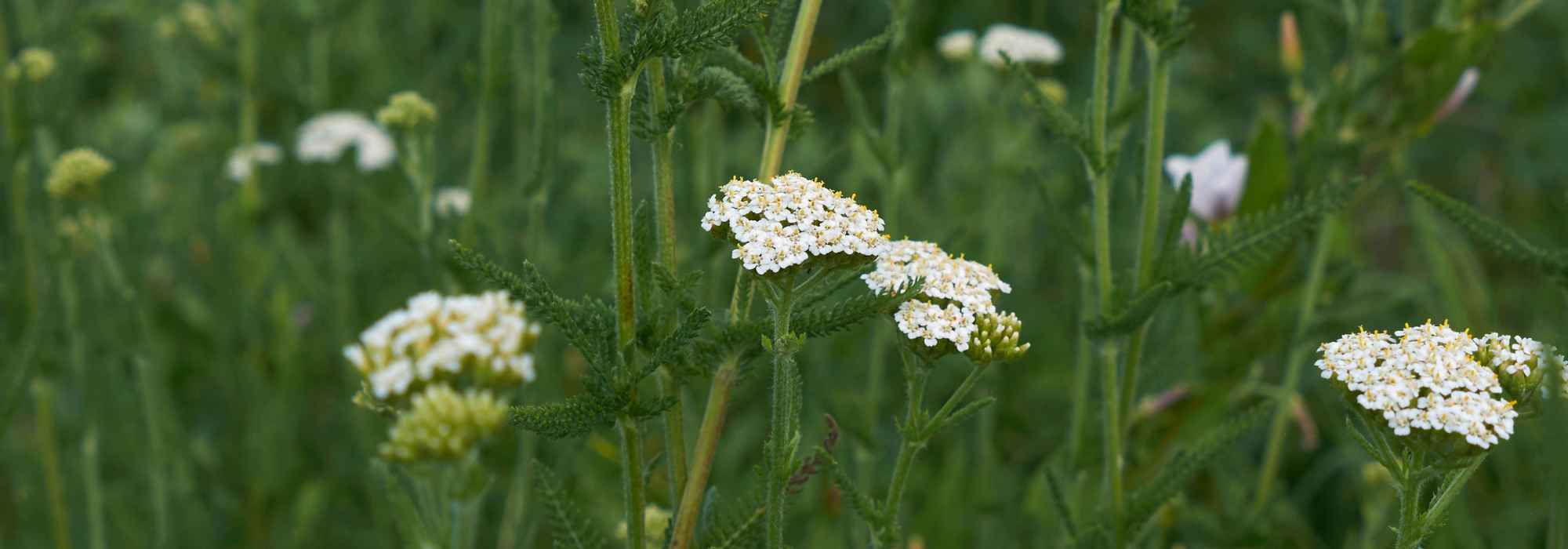
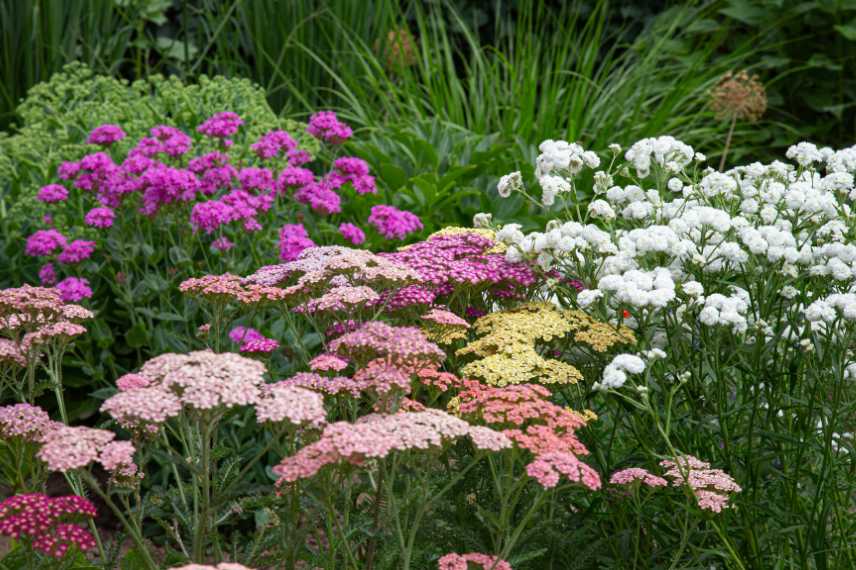
Plants that are both highly drought- and cold-tolerant, the yarrows are set to become a plant of the future with climate change. Many of them feature silver-grey foliage, well-suited to sun-drenched regions in summer, but some boast pretty green foliage and are grown everywhere. Their long flowering period comes in many shades, from white to orange, right through to deep red.
Get to know them better and discover their full potential for integrating into the ornamental garden or into the kitchen garden!
x

Their needs
Green-leaved yarrow are perennials that grow spontaneously from Europe to Asia in full sun or partial shade.
Yarrow should be planted in a very well-drained and light soil, ideally in full sun. This soil can be poor, they do not mind at all, on the contrary! After regular watering during the first few months, they become perfectly self-sufficient. The invasive character of Achillea millefolium when it thrives, as it colonises the ground by its stolons. In the garden, it is wise to plant at the back the taller species such as Achillea filipendulina, and along the border or in the foreground the smaller yarrows, such as all cultivars of Achillea millefolium. Some, such as Achillea ptarmica or A. asplenifolia, tolerate cooler soils.
→ Learn more in our comprehensive guide: Yarrow, Achillea: planting, growing and care.
Achillea filipendulina
Read also
7 red achilleas to have in your gardenThe most beautiful green-leaved yarrow varieties
Flowering for some varieties for a generous four to five months of the year, yarrow brightens borders with a touch of wild charm in summer. Whether you opt for the type species of Achillea millefolium, with white flowers, or any of the ornamental cultivars in warm hues, we appreciate the finely cut leaves, lace-like and recalling some ferns, giving a feathery look around the flowers.
If the yarrow with grey-green foliage are often dwarf, creeping perennials used as groundcover, green-leaved yarrow are generally taller and are mainly used in rockeries for the smaller ones, in the back of borders for the taller ones, such as the superb Achillea filipendulina or as cut flowers and in sunny borders and mixed borders for medium-sized yarrow.
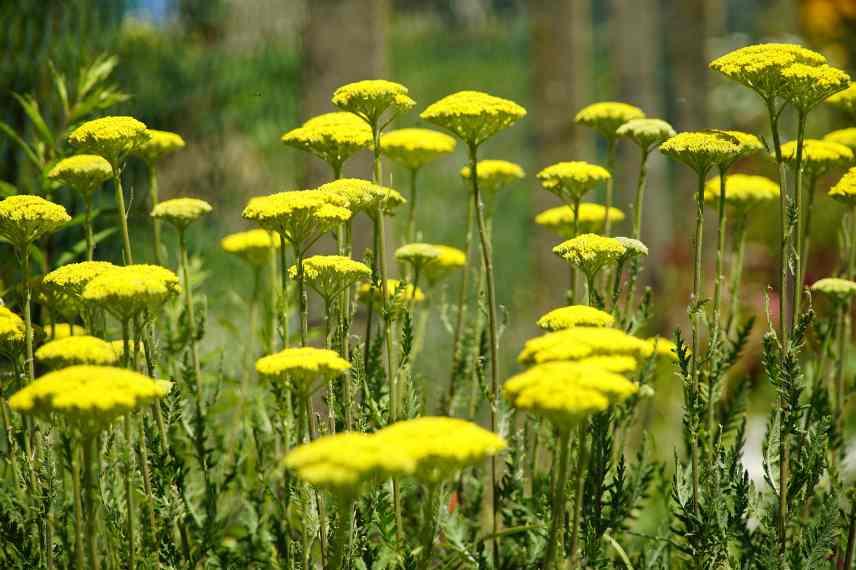
- Achillea filipendulina: originating from the Caucasus, it has given rise to a well-known cultivar ‘Cloth of Gold’. The yellow of its flower heads is dazzling! It brightens up any border and does very well in yellow-and-blue or yellow-and-purple combinations.
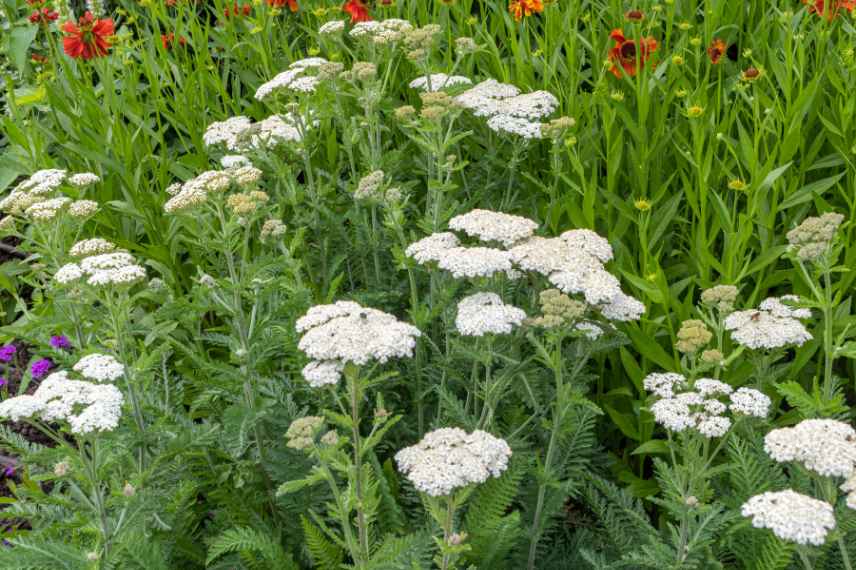
Its fresh foliage reappears in mild-climate regions, from the crown, in autumn, and stays in place until the next flowering. We also love the famous ‘Coronation Gold’ and ‘Gold Plate’, which also flower in a bright, solar yellow. - Achillea millefolium (commonly called millefoil yarrow) is the common species that grows spontaneously in meadows and banks, about which I’ll tell you a bit more below for all its qualities. With white flowers arranged in flat-topped cymes, its leaves are dark green and it can be invasive on lawns. Among the varieties of interest, we note ‘Kelwayi’ a carmine red fading as the summer progresses (60 cm), ‘Terracotta’ and ‘Paprika’ and their terracotta or orange-red colouring (70 cm), ‘Cerise Queen’ with cherry-red flowers and dark green foliage slightly greyed.
- Achillea asplenifolia which stands out with its pink-toned flowers and its ability to grow even in clayey or damp soil.
→ Also read: the most beautiful yarrow, 7 pink achilleas to have in your garden, 5 white yarrow varieties to have in your garden and 8 yellow achilleas to have in your garden.
Achillea millefolium and Helenium
A Swiss army knife plant
Virtues attributed to yarrow seem endless! As an herbal tea, it is reputed to relieve intestinal cramps and bloating, as well as pelvic discomfort. For these reasons it has been named “women’s plant” and more commonly “carpenters’ plant”, “military herb” or “soldier’s plant”, or even “herb of cuts” (due to its haemostatic properties), nicknames that also recur in English. Yarrow indeed takes its name from the Greek hero Achilles, who, according to legend, is said to have used the leaves of this plant to treat the wounds of his soldiers during the Trojan War, a use that would later be recognised as a first-aid plant in many wars.
But these therapeutic properties are not the only ones attributed to it. Here are a few more reasons to grow it in the garden:
- Biodiversity: their scented flowers and nectar attract many pollinators and beneficial insects, including hoverflies and bees, rose chafers, mourning cloak butterflies and Blue Argus, but also ladybirds.
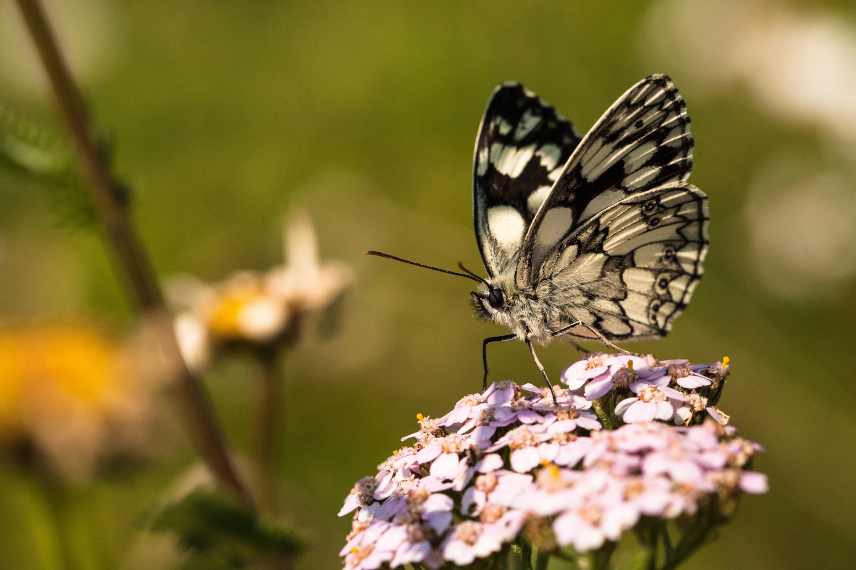
Mourning cloak butterflies are commonly seen on the inflorescences of yarrow
- Yarrow is also known for its repellent properties against certain insects or pests including the apple sawfly, ticks and mosquitoes. It is increasingly used in permaculture or biodynamics via macerations to combat downy mildew, particularly on vines.
- Edible aspect: the aromatic leaves, flowering tops and young shoots are edible! They have a bitter, yet aromatic flavour, which can be used in summer salads, provided you only cut the young spring shoots near the base of the plant, which are less bitter, and use them sparingly. Later in the season, it is recommended to consume the shoots just below the flowers.
- Finally, their deep and spreading root system to reach water helps loosen the soil.
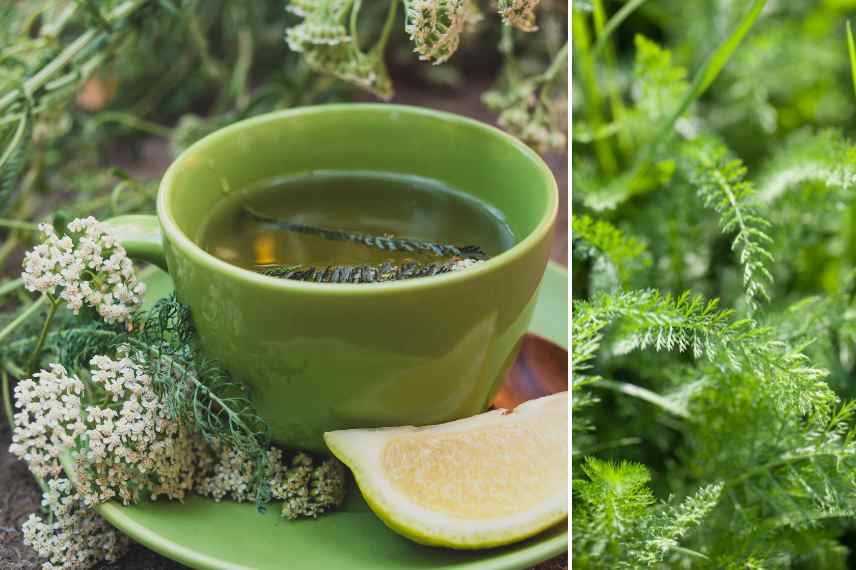
Yarrow can also be prepared by infusing its dried small flowers
Pascale revisits these various benefits in Yarrow: a plant to grow for its medicinal properties.
Read also
How to design a naturalistic garden?In which types of garden should green yarrow be used?
The finely cut, feathery foliage of yarrows and their corymbs of flowers create visually striking effects in a variety of configurations:
In a naturalistic or prairie-style garden
Their simple, understated charm works wonders in all naturalistic-style gardens. They mingle with Anthemis, Scabiosa, wild carrot, grasses and Echinacea…
→ Also read our inspiration: Sunlit naturalistic garden.
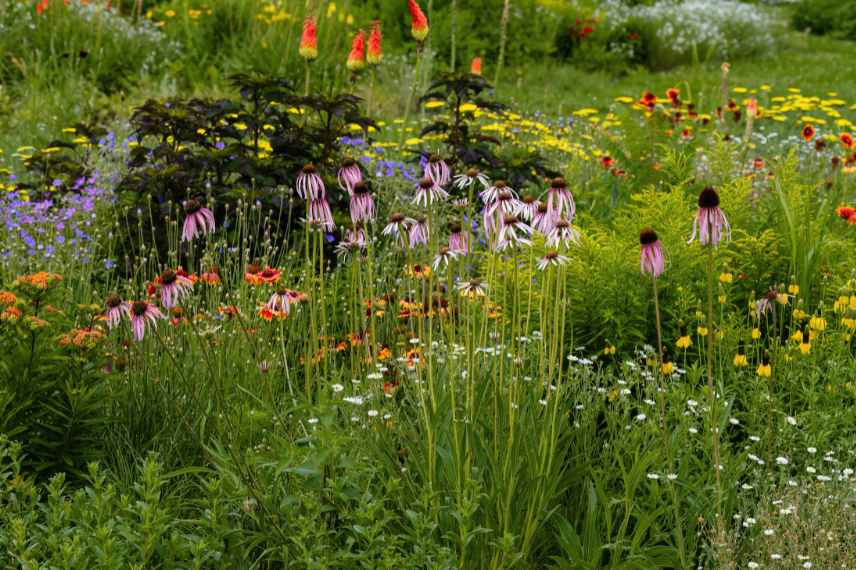
In a dry garden, a rock garden, garrigue or Mediterranean garden
The green-leaved yarrow is one of the ideal plants in this context, in gardens designed to be drought-tolerant as it tolerates droughts. We often seek to pair its bright yellow with the blue of santolines and lavenders, but also with the yellow flowers of Helichrysum, for example, or with rock-roses and rosemaries.
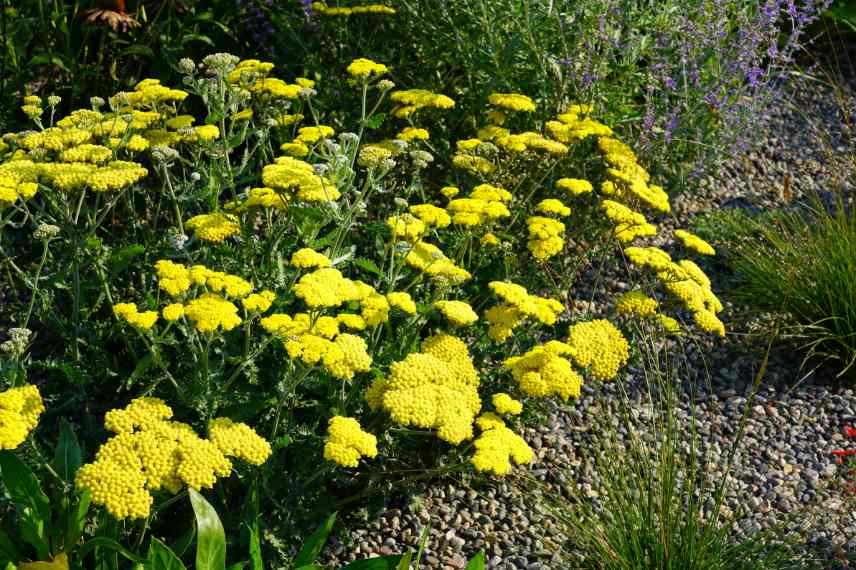
In a gravel garden
In a low-maintenance, second-home garden
Their self-sufficient character is ideal for integrating these gardens where you’re not always there to water or look after them. They also blend beautifully into large gardens, gradually spreading into wild areas.
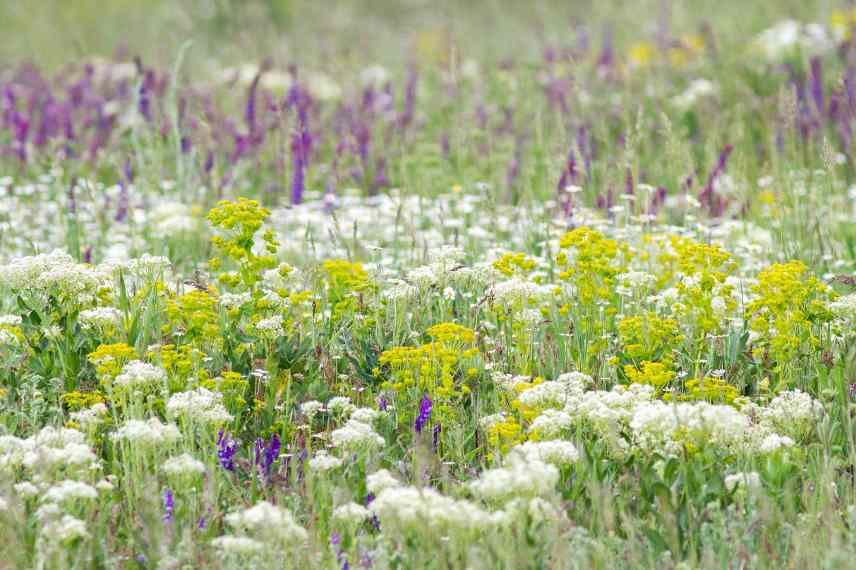
White yarrows, salvias and euphorbias
In a cottage garden, an English garden or a mixed-border
This is also an ideal garden for green-leaved yarrow, where one can play with their warmest tones to create hot borders or experiment with contrasts against blues and purples in sun-drenched borders.
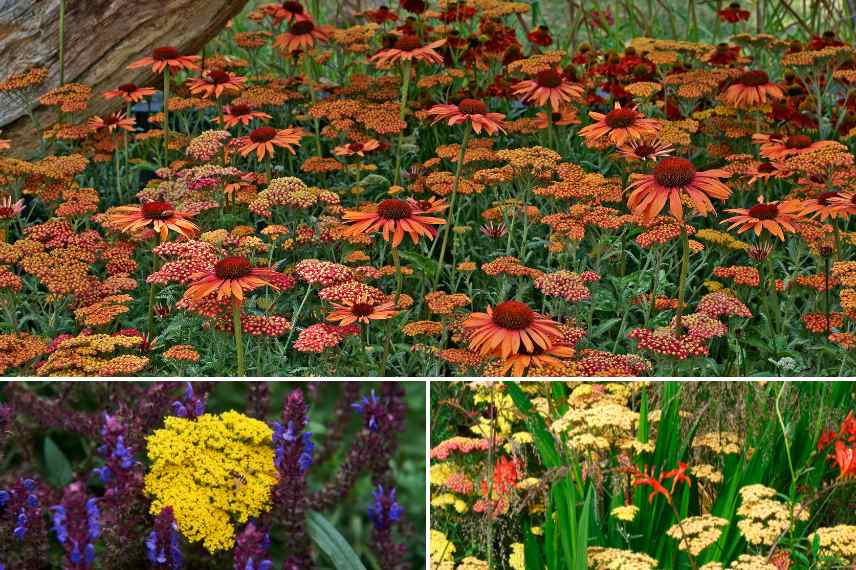 Achillea millefolium ‘Paprika’ and Echinacea ‘Sunset’, Achillea filipendulina ‘Coronation Gold’ and salvias, Achillea and Crocosmia ‘Lucifer'</caption]
In a mountain garden
For their hardiness, green-leaved yarrows like Achillea millefolium are well suited to harsh climate conditions. Yellow-flowering yarrows such as Achillea filipendulina withstand down to -20°C, allowing them to be grown in many gardens in cold climates.
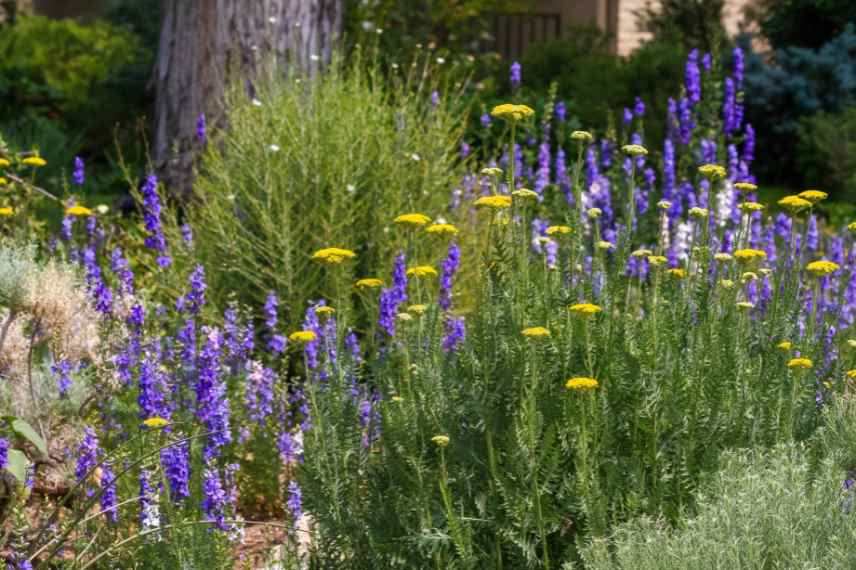 Green-leaved yarrows and larkspur
In the vegetable garden or the orchard
…or on its edges, to attract many pollinating insects and, in particular, to keep aphids at bay. Yarrow, often overlooked, is an excellent companion plant. The green foliage also serves as mulch once flowering has finished.
In a physic garden
Just like in the vegetable garden or the orchard, yarrow has its place in the herb garden or in a physic garden. It can join hyssop, sages, chamomile, immortelles, rosemary, etc.
→ Also read: Yarrow: 7 ideas for successful companion planting
- Subscribe!
- Contents

Comments