





























Grey-leaved yarrows: a refined and distinctive touch in the garden
Undemanding plants, which will bring a touch of light and elegance
Contents
Achilleas are among those perennial plants that are truly undemanding to grow, almost essential in dry gardens. They are among those undemanding species that are generally neither deterred by drought nor by heat.
To top it off, they offer us a fine diversity of colour, flowers and foliage. Among them, grey foliage is often less common, though they clearly do not lack advantages. Let’s see which ones and which grey-leaved Achillea to fall for.
For more on its cultivation, discover our guide: Achillea, Yarrow: planting, growing and care.

The many benefits of yarrow
Yarrow is one of those multifunctional plants that meet our current and future garden needs.
Firstly, these are very easy to grow, even for beginner gardeners. Undemanding, they thrive in soil that’s poor, rocky or sandy, where other plants would not dare to grow. They also tolerate a little lime in the soil. In terms of light, they enjoy sun, even intense sun. Light, by the way, helps to intensify the colours of their flowers. Partial shade can also be suitable. These are ideal allies for dry gardens, low-maintenance gardens or Mediterranean-inspired gardens. They are fairly drought-tolerant (for most of them), but also winter-hardy (hardiness around -20°C on average). Self-sufficient, they will require only a few waterings during the first two years after planting, and then they will look after themselves.
Next, their generous flowering lasts all summer. And it’s not only the gardener who benefits: melliferous flowers delight pollinating insects, true allies of the garden.
Finally, yarrow has medicinal properties. The flowers, and the foliage of yarrow (Achillea millefolium) in particular, are edible.
Hardy to extreme conditions, easy to live with and biodiversity-friendly: yarrow is a plant that has yet to fully establish itself in our gardens.
Why choosing grey-leaved yarrow?
Grey and silvery foliage have many benefits for the garden.
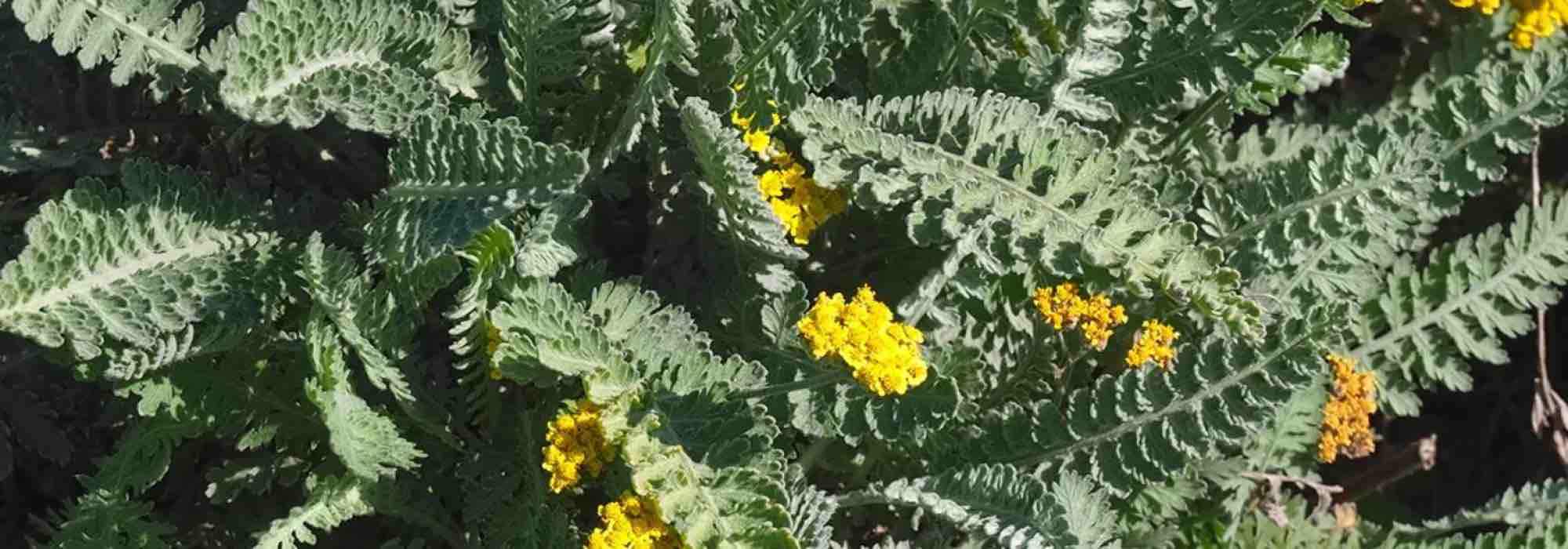
First of all, this colour is fairly neutral, which doesn’t upstage the others but helps to set them off. As a result, it is a colour very easy to pair with. It brings a note of brightness and elegance, but still has the advantage of standing out from the usual green foliage. Moreover, the foliage of yarrow has the feature of being very finely dissected, with a soft and velvety texture, which adds a further note of lightness.
If they may seem a touch dull at first, these grey foliages are actually quite bright and contrast well in the garden. Sunlight can also help to give them bright, ornamental reflections. The grey can range from the lightest shade, almost white, to the brightest, tending towards a silvery finish.
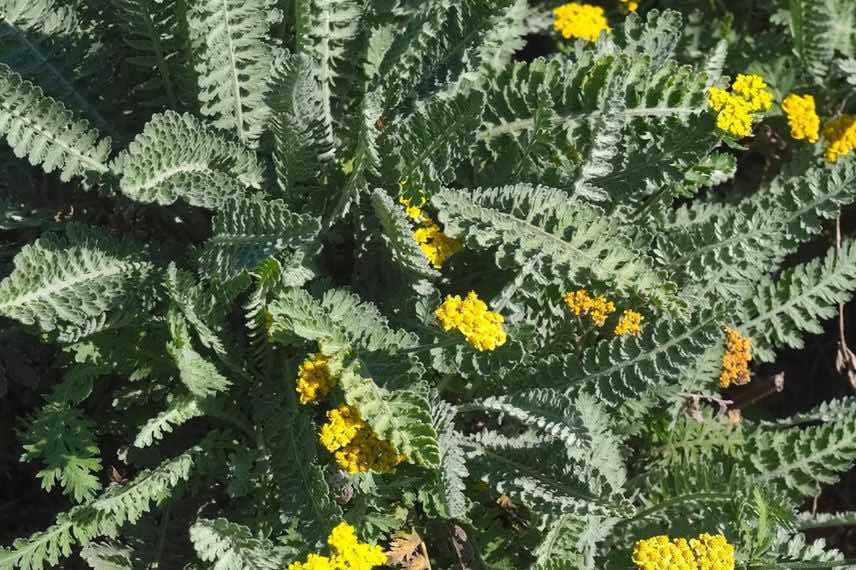
Plants with grey foliage subtly enhance the other plants
In which garden styles would grey-leaved yarrow be used?
As we’ve seen, yarrow is a perfect candidate for dry gardens. Its grey foliage will pair beautifully with mineral-inspired schemes made of gravel, large stones and other decorative pebbles. It is, therefore, clearly a plant to use generously in rock gardens. It will thrive beside Sedum, houseleeks and lamb’s ears.
In a romantic garden, yarrow with grey foliage will bring a great deal of softness and highlight colours even the lightest and pastel shades, such as pink, mauve or blue.
In a seaside garden, the yarrow’s tolerance to salt spray will be put to good use. For a Mediterranean-inspired ambience, the yarrows with grey foliage will pair beautifully in blocks with typical shrubs such as rosemary, the lavender, the Santolina, the sage, the Italian immortelle or the rockrose.
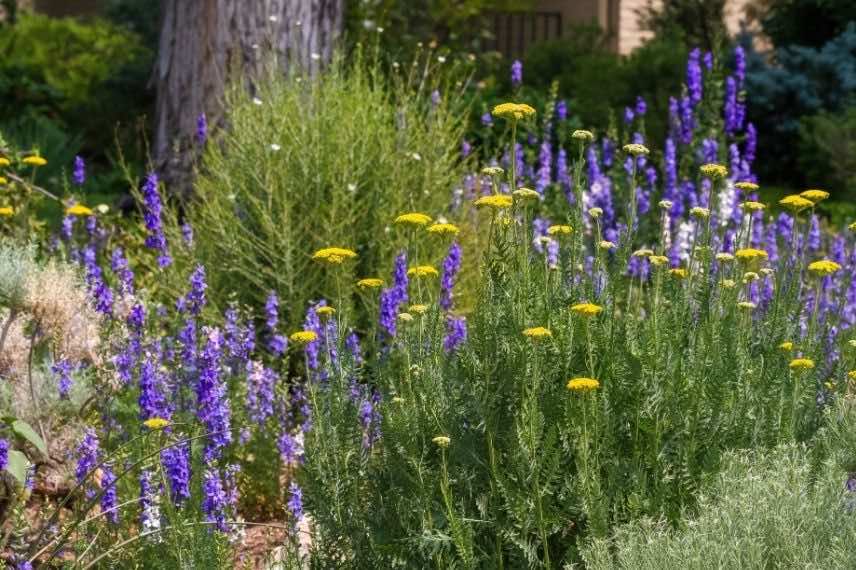
Next, yarrow is, of course, essential in a natural or cottage garden. In a flowering meadow, the grey foliage will perfectly enhance the colours of the other flowers. Plant them beside Echinacea, gold alyssum, ornamental grasses, Anthemis, blue cornflowers, Love-in-a-mist, etc. They are also perfect candidates for mixed borders with vibrant colours, tempered by the grey of their foliage.
Even in contemporary gardens, the grey foliage of yarrows will help create striking contrasts, notably with red or purple blooms. It will also bring a graphic touch, thanks to its ornamental cut.
Finally, in the vegetable garden or in a vicar’s garden, yarrow with grey foliage will have its place, due to its aromatic and medicinal properties, but also for its biodiversity value.
Read also
How to choose an achillea?Grey-leaved, white-flowering yarrow
They bring a touch of purity, plenty of clarity, and a real rustic style. White-flowering Achillea are particularly easy to pair with, thanks to their neutrality. You can, for example, opt for the Achillea umbellata. Its finely dentate foliage is a beautiful silvery-grey in winter, then almost white in summer. The same can be said for the Achillea kellereri and the Achillea ageratifolia, which both produce white umbels.
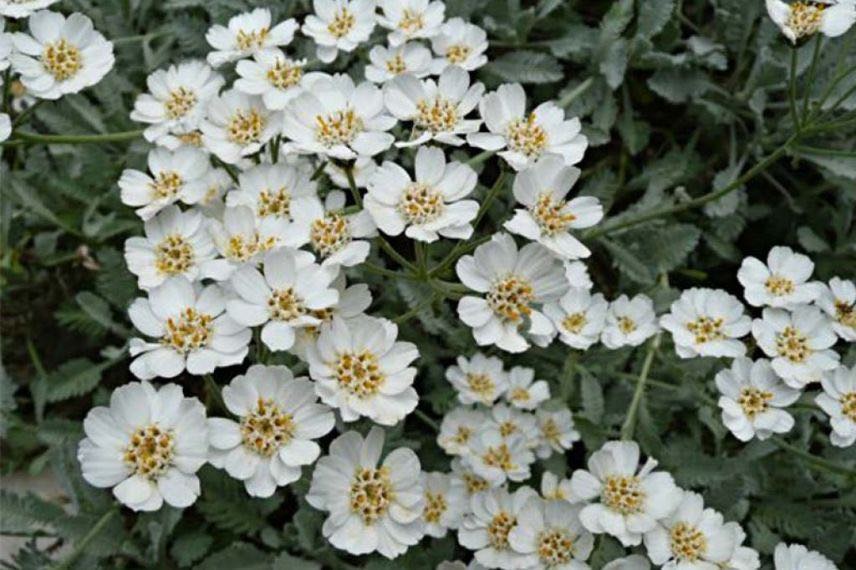
Achillea umbellata
Grey-leaved Achillea with yellow flowering
Here, the yellow colour of the umbels will contrast wonderfully with grey or silvery foliage. The hybrid yarrow ‘Moonshine’ for example displays a very bright yellow, highlighted by the silvery-green foliage. On Achillea taygetea, the umbels of flowers are more sulphur-yellow to lemon-yellow, accompanied by the lovely feathery foliage, blue-green and silvery. We also note Achillea clypeolata, with its flowers initially white, then yellow.
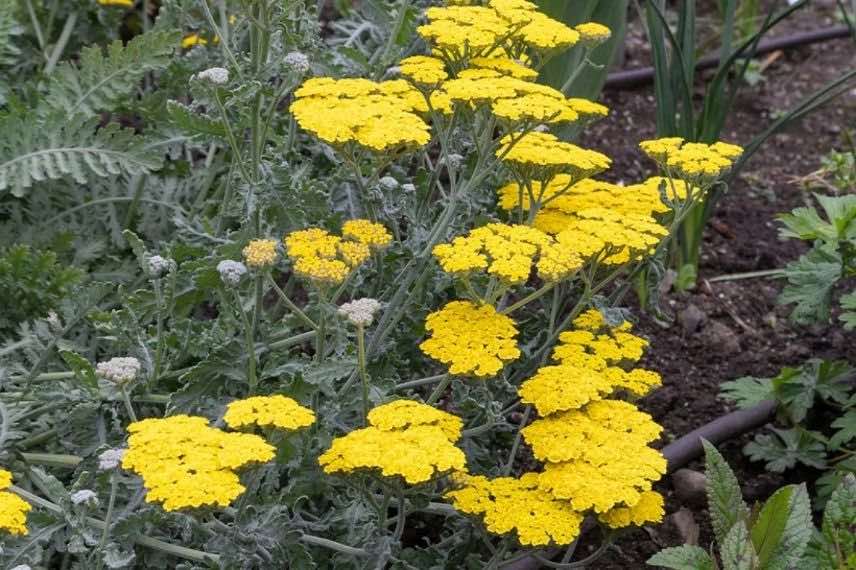 Yarrow ‘Moonshine’
Evergreen yarrow with silvery foliage
If you want to enjoy the beautiful decorative grey foliage of yarrow all year round, choose evergreen varieties. Their colour will pair beautifully with the frosty ambience of winter. Among them are the umbel-bearing yarrow and the Achillea kellereri.
Grey-leaved yarrows with a spreading habit
In borders, in a rock garden, or at the front of a perennial border, these small Achillea plants, measuring under 30 cm in height, will be perfect. They have a silhouette broader than tall, forming real little cushions of silvery foliage. Perfect as groundcover!
This is particularly the case with ‘Little Moonshine’, very compact and easy to incorporate, measuring 25–30 cm in all directions.
For its part, the Achillea umbellata does not exceed 15 cm in height and will form a silvery carpet as bright as it is soft to the touch.
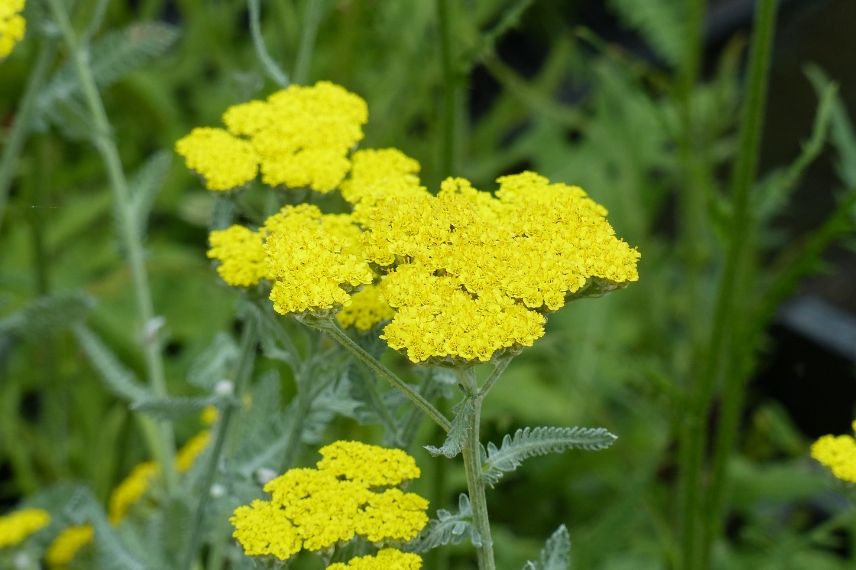
Achillea ‘Little Moonshine’
- Subscribe!
- Contents

Comments