





























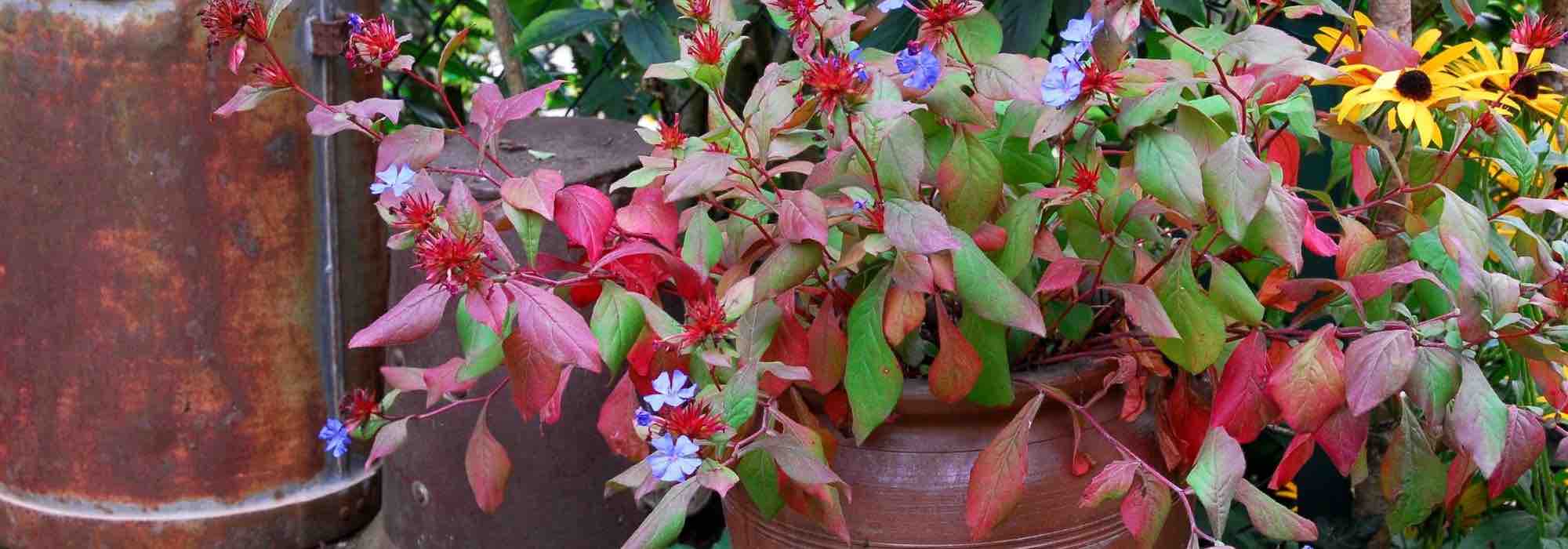
Growing Ceratostigma in a pot
Our tips for making the most of its beautiful blue flowering and colourful foliage
Contents
Ceratostigma, also known as Chinese Plumbago, is a genus of perennials and bushes, valued for its vibrant flowering and autumn foliage. Originating from the mountainous regions of Asia, Ceratostigma is distinguished by its small star-shaped flowers in dazzling electric blue, which bring a refreshing touch to late-season gardens. Grown in pots, Ceratostigma provides an ideal solution for urban gardeners or those with limited space, especially as it is a low-maintenance plant. To ensure it thrives in a pot, it is essential to observe certain specific conditions regarding the choice of container, the potting medium, exposure and appropriate care. Discover in this article all practical tips for growing Ceratostigma in a pot and enjoying its undeniable decorative appeal.
→ For further reading: Ceratostigma, Chinese Plumbago: planting, pruning and care.

Which Ceratostigma should I choose for growing in a pot?
All Ceratostigma can be grown in pots. Being frugal plants for dry, well-drained soil, they are not particularly high-maintenance in terms of watering and care.
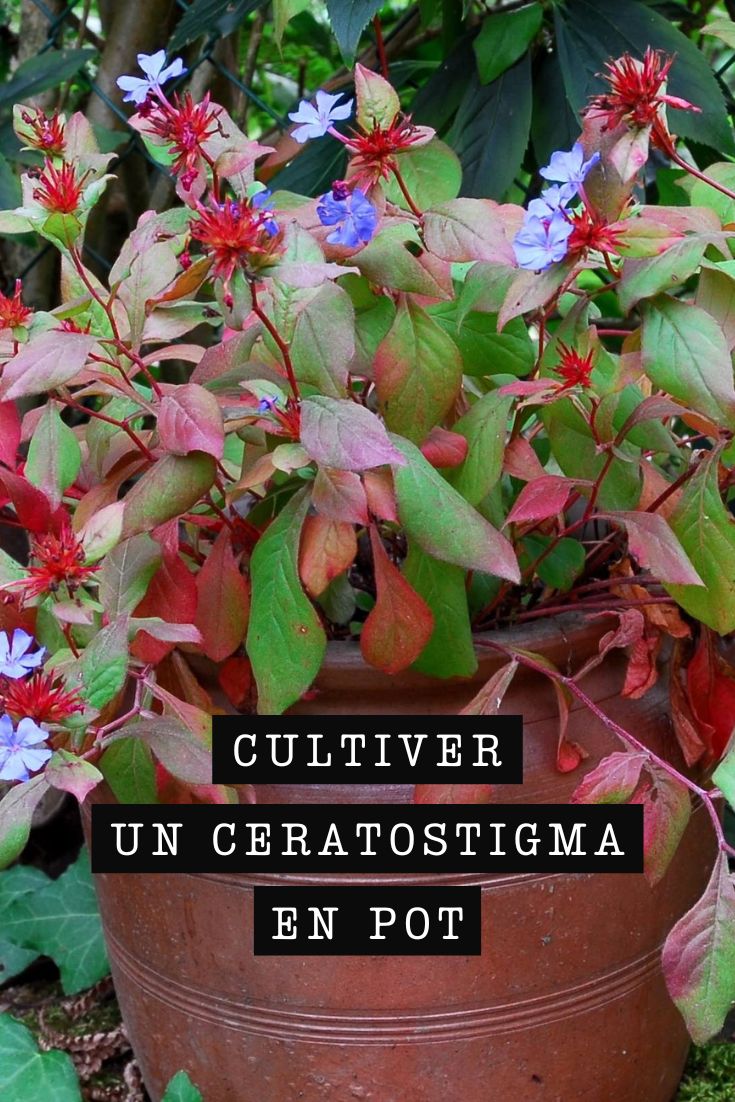
Simply, the Ceratostigma plumbaginoides with its spreading habit due to its rootstock and its low height, is used as ground cover in a pot, which will spill gracefully over the edges. It can be grown on its own to enjoy its summer flowering in gentian blue and its bronze- and red-toned foliage from September. It can also be used to underplant the base of another plant such as a shrub or upright perennial, all the more so since Ceratostigmas tolerate root competition well. This one does not exceed 30 cm in height and spreads over at least 50 cm or to the space you allow.
The other Ceratostigmas such as the Ceratostigma willmottianum or the Ceratostigma griffithii form medium-sized shrubs with a spreading habit, slightly wider than tall. They also grow well in pots.
If you’re looking for a compact variety, a criterion often sought for pot planting, as it thrives there longer without pruning or repotting, opt for Ceratostigma willmottianum ‘Forest Blue’.
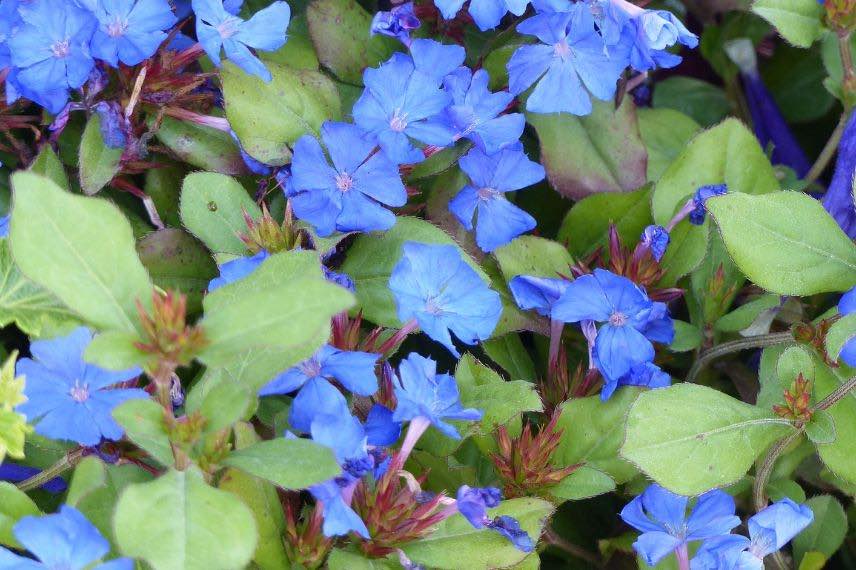
Ceratostigma flowers in intense blue
What kind of pot for Ceratostigma?
Pot type
Ceratostigma is a plant suited to dry soil and hot conditions. A terracotta pot is perfectly suited for its cultivation. Porous, it drains water more quickly, avoiding any risk of waterlogging in the pot in case of overwatering or heavy rainfall.
But any potted plant, even drought-tolerant, requires regular watering, as the substrate dries out much more quickly in a pot. Garden soil stays cooler for longer.
If you’d prefer to limit watering and are comfortable managing this aspect, you could consider choosing a plastic pot.
Pot size
For a Ceratostigma plumbaginoides, you need a wide and shallow pot, unless you plant it at the base of a shrub, in which case, calculate the pot depth according to the shrub in question. For it alone, a depth of 20 to 25 cm will be sufficient. Width will determine how much it can spread; no specific size is required, however give it at least a pot 30 cm in diameter.
For the shrubby and more bushy Ceratostigmas, choose a pot at least 30–40 cm deep and 50 cm wide.
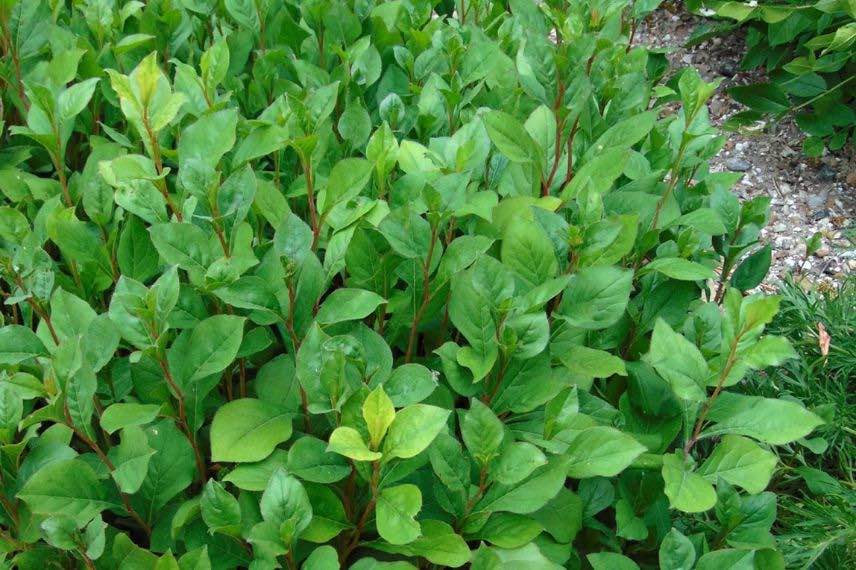
Ceratostigma plumbaginoides grows low to the ground with a spreading habit
What substrate for Ceratostigma?
Ceratostigma prefers light soil, even when poor, calcareous and stony, rather neutral to calcareous.
It’s therefore about composing a well-draining substrate, not too rich, not too acidic (potting composts are generally a little acidic and nutrient-rich).
Choose a Mediterranean plant potting compost, ideally designed to be more well-draining than a standard potting compost. You can, however, also choose a universal potting compost or a potting compost for planters and pots. Add around 30% drainage materials. Opt for perlite, vermiculite, for example, and river sand.
If you have access to garden soil, you can make a 50/50 mix of potting compost and garden soil. Add around 10–20% drainage material, adjusting according to the soil type.
Provide a drainage layer at the bottom of the pot in the form of clay balls, crushed terracotta shards, gravel, and pozzolana.
Read also
Pairing ideas with CeratostigmaWhen and how to plant Ceratostigma in a pot?
Plant Ceratostigma, preferably in spring in cold climates. In southern regions, opt for autumn to ensure deep rooting before facing the summer drought.
Proceed as follows:
- Pour a drainage layer of a few centimetres at the bottom of the pot in the form of clay balls, gravel or broken terracotta pieces.
- Soak the Ceratostigma root ball for about 30 minutes.
- In a separate bowl, mix the different components of the potting mix if necessary.
- Pour potting mix into the pot.
- Plant the Ceratostigma.
- Top up with potting mix, pressing down lightly and evenly.
- Fill to a few centimetres below the rim of the pot, and press down again.
- Water generously.
- When the water has been absorbed, add a little more substrate if necessary, if gaps have appeared.
- After a few minutes, water again.
Where should Ceratostigma be planted in a pot?
Plant Ceratostigma in full sun or partial shade. As they enjoy warm conditions, favour full sun in cooler regions. If you face intense summer heat, don’t hesitate to move the pot into the shade for a few days.
In the south, you can opt for partial shade or light shade.
Choose a wind-sheltered spot to make the most of its late-season flowering and to provide it with the warm conditions it appreciates.
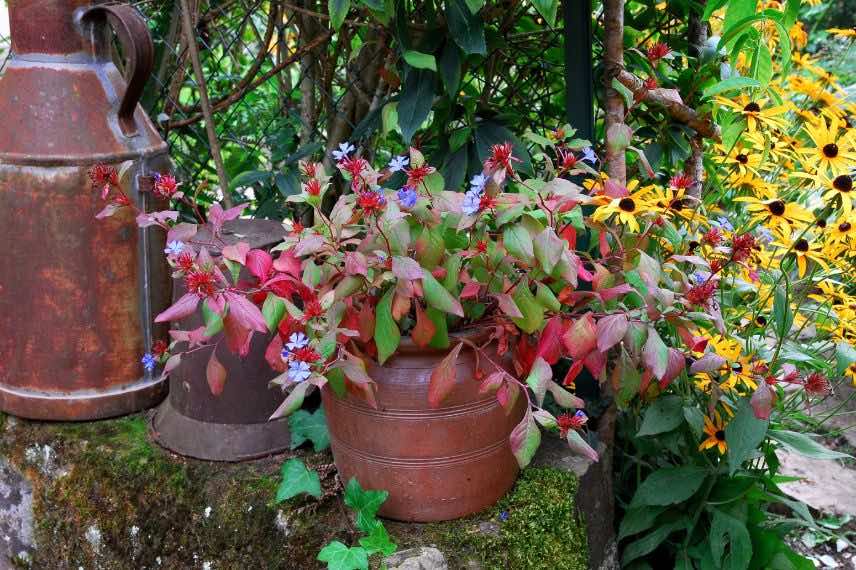
Ceratostigma wilmottianum in a pot
Watering and fertilising Ceratostigma in pots
Watering
Ceratostigma, a dry, poor-soil plant, is more dependent on you when grown in a pot. As it requires a well-draining substrate, it will retain water for shorter periods after watering.
It therefore needs regular waterings, which vary with your climate, pot size and, of course, the season. Adapt the following advice to your conditions and observations.
The species C. willmottianum has semi-evergreen foliage in mild climates, while the other species have deciduous foliage. Therefore, if it retains its leaves during winter, this species will need a few waterings in that season, roughly every 15 days on average.
For deciduous species, stop watering after the foliage disappears, late autumn.
In spring, as growth resumes, water infrequently at first, then increase watering as the clump densifies and prepares its flowering, which occurs in July at the earliest.
Water when the substrate is dry at the top few centimetres or at most halfway down the pot. This can range from watering once a week to watering every 2 or 3 days during prolonged drought. Do not allow the substrate to dry out completely (lift away from the edges of the pot) as it then becomes very difficult to rehydrate.
The species C. willmottianum prefers slightly cooler soil than the other species, especially when growth resumes.
Fertiliser
Not a heavy feeder, Ceratostigma does not need fertilising often; fertilisers contained in the potting compost can suffice for a season. Simply plan at the start of new growth, in spring, an application of organic fertiliser in the form of vermicompost for example.
Ceratostigma care
- At the start of the growing season, shorten with pruning shears the shoots of shrubby Ceratostigma by about a third to densify the clump. Simply pull off desiccated stems.
- Growth is generally quite rapid unless it lacks water.
- Plan a repotting every two to three years depending on the growth rate, or when roots appear at the bottom of the pot or when the plant’s development slows too much.
- In winter, place the pot against a sun-facing wall or bring the Ceratostigma into a garage if severe frosts are forecast. Depending on the species, the plant is frost-hardy to at least 12 to 15°C for the shrub forms and -20°C for the creeping form.
- This plant is not prone to diseases or parasites in our gardens.
- It begins to grow late in spring, generally from May. So don’t worry if you don’t see it emerge at the same time as most plants; it performs best mid- to late-season.
- Subscribe!
- Contents
Comments