





























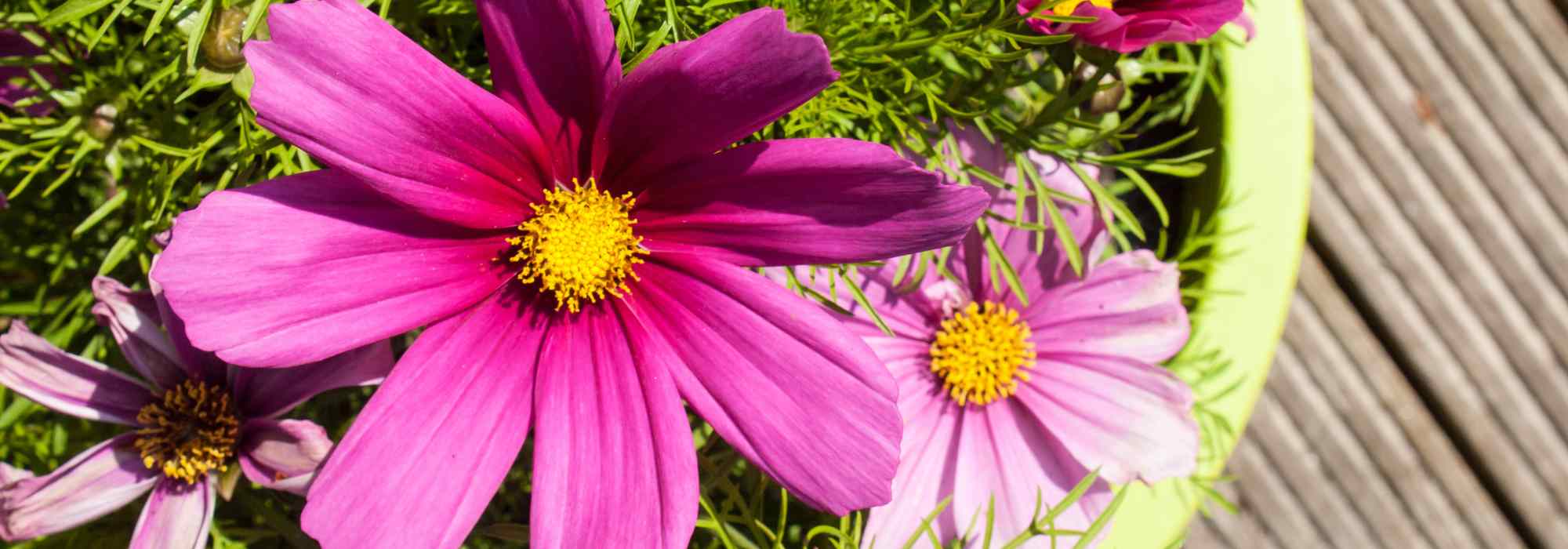
Growing cosmos in pots
for a colourful, light bouquet on a sunny terrace or balcony!
Contents
We love cosmos for the light, airy touch they bring to the garden all summer, the natural grace of their flowers, their colours ranging from white to deep pink, purple or vibrant colours, and their finely cut foliage. If you sow them in a border or in the vegetable patch, those without a garden can also enjoy their charm on a balcony or terrace.
Follow our tips to ensure your cosmos pot is a sure-fire success!

Which Cosmos varieties to choose for growing in pots?
The Cosmos bipinnatus we mainly use for garden ornament can grow quite tall, often between 1 m and 1.5 m. The Cosmos sulphureus, with bold colours, too. When grown in pots, we prefer suitable varieties, a little shorter and more compact up to 80 cm in height, as their stems remain relatively slender regardless of the cultivars.
The Sonata series offers cultivars with a semi-dwarf habit, generally not exceeding 60 cm in height, which are ideal for pot culture in small spaces, such as the charming Cosmos bipinnatus Sonata light pink. The yellow cosmos, such as the delightful Cosmos ‘Xanthos’ yellow also grow to around 60 cm in height, as does the Cosmos sulphureus ‘Mandarin’ with warm and vibrant colours (and many Cosmos sulphureus).
But on large terraces where the wind does not blow, a sheltered spot allows for larger varieties that will form a generous clump all summer: the airy effect is magical!
The Cosmos atrosanguineus are, for their part, perennials, like the popular Cosmos chocolate. It is possible to plant them in pots, but they will need to be overwintered correctly (see below).

Cosmos bipinnatus ‘Rosetta’, Cosmos bipinnatus ‘Xanthos’ yellow and Cosmos sulphureus ‘Mandarin’
Read also
How to sow cosmos?What type of pot should you choose?
For this delicate and light plant, a 30 cm diameter pot is sufficient. You can sow cosmos in a large container, even much larger, to achieve a striking massed effect and a cottage-garden look straight from the balcony!
As for the potting material, since it’s an annual plant, you have plenty of choice. Try to match this pot with your other balcony or terrace pots; it’s always more harmonious.
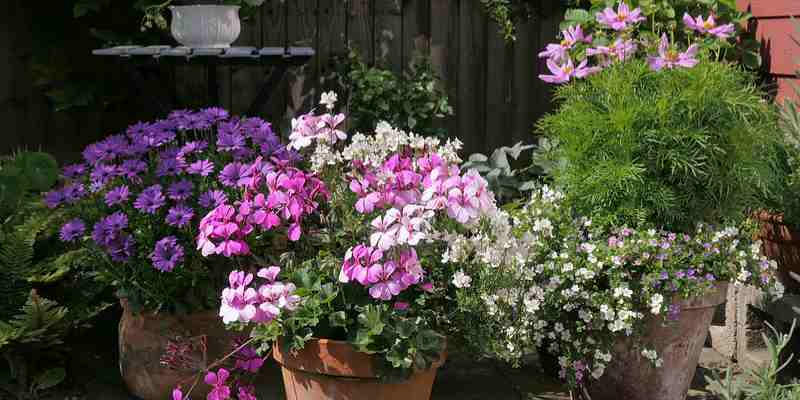
Here the cosmos on the right are planted in a large terracotta pot, to harmoniously accompany the other balcony pots (photo Amanda Slater).
Which substrate should I use?
Cosmos are annuals that prefer light soils. They readily thrive in the garden in poor, relatively dry soils, and for container culture you’ll want to pamper them a little more, without giving them a substrate that’s too rich, which would favour foliage growth at the expense of their lovely flowering.
The key to Cosmos success, whether grown in the ground or in pots, is that its soil is well-drained. We recommend an equal mix of good potting compost (type potting compost for flowering plants in containers) and sand to make this soil well-drained. Do not forget to place first a bed of clay balls (2–4 cm) at the bottom of the pot.
Read also
6 pairing ideas with cosmosWhen and how to grow cosmos in pots?
If you bought cosmos in pots:
Two plants per pot, 50 cm in diameter.
- Moisten the root balls well before planting by soaking them.
- Spread a good layer of drainage (gravel or clay pebbles) at the bottom of the pot.
- Plant into a mix of geranium compost (or good garden soil) and sand.
- Backfill and firm the soil.
- Water thoroughly.
- Position your pot in full sun.
- Water regularly throughout the season, but avoid overwatering.
Sowing in pots is carried out from April to May, depending on the region. Read Marion’s tips in How to sow cosmos?
Where should you place a potted Cosmos?
Only one exposure is suitable for it: full sun! With enough sunshine (at least six hours a day) and warmth, it will produce profusions of flowers right up until the frosts. You can grow it anywhere since it’s an annual that will die with the frosts and you’ll need to reseed or replant the following year. In southern regions, partial shade can be considered. A west-facing balcony or terrace is ideal.
This graceful and delicate flower does not tolerate draughts or strong winds. Avoid placing it by the sea or in areas where winds blow strongly in summer, and keep it sheltered from the wind on all balconies.
If you want to style your balcony or terrace in a country-style look or bohemian style, cosmos is the perfect plant!
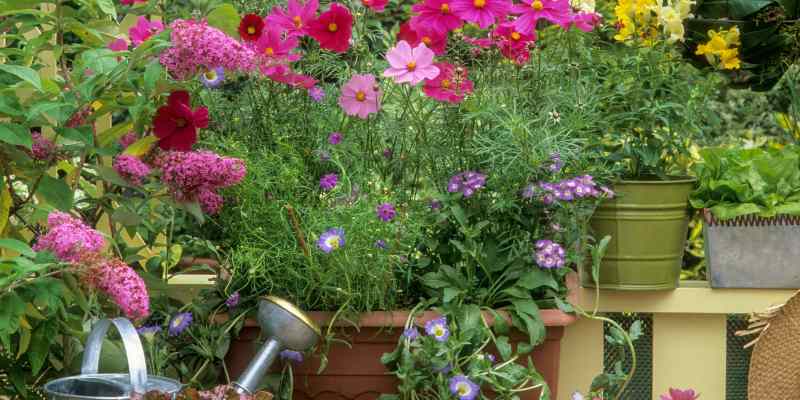
On a balcony, cosmos joins sun-loving perennials and annuals
Caring for Cosmos in pots
It is the same as for those grown in the ground, with careful watering, of course.
Pinch off faded flowers regularly to encourage Cosmos to produce new blooms. This also enhances the appearance of your container planting, as the many dried flowers are not the most attractive.
Be vigilant about watering: water as soon as the substrate dries down to a depth of a few centimetres (insert your finger a few centimetres into the soil to check whether the Cosmos needs watering), but it will in any case prefer a little less watering than too much. Be careful not to place the pot on a saucer that would retain too much moisture.
If you grow a Cosmos atrosanguineus* in a pot in a mild region, and in order to give it every chance of coming back strongly in spring, protect it from the first frosts (for example by placing it along a south-facing wall, and laying on a good thick layer of mulch, and possibly an extra protection around the pot). The ideal for these so-called perennial Cosmos is to store the pot in a bright and cool place. Some people completely dig up the stump to store it, as with Dahlias, in a frost-free location, this being the case for regions where this perennial Cosmos will be at the edge of hardiness (planted in a pot, it will withstand down to -1°C).
*such as ‘Chocamocha’ or ‘Eclipse’ for example, as these are perennial Cosmos, but still a touch frost-tender.
- Subscribe!
- Contents
Comments