


Growing imperial fritillaries in pots
Our tips for successful planting and care of these beautiful bulbous plants
Contents
We appreciate the imperial fritillaries (Fritillaria imperialis) for their elegant spring bloom in colourful bell-shaped flowers, as well as for their architectural silhouette. If they are also known by the name ‘crown imperial’, it’s in reference to the tuft of leaves surrounding the flowers like a crown. It is one of the largest spring bulbs, and it never goes unnoticed in the garden.
In terms of cultivation, this hardy perennial, easy to grow, can be grown in full sun or partial shade. Native to southern Turkey, it adapts very well to our climates.
The imperial fritillary can grow just as well in the ground as in containers, to brighten a small garden, terrace, balcony, inner courtyard or windowsill. It is also a good way to grow it in regions with wet winters, which this bulbous plant tends to dread. Discover therefore our tips for planting and caring for imperial fritillaries in pots.

Which varieties of imperial fritillaries should I choose?
Fritillaria imperialis are among the tall varieties, reaching up to 1.5 metres in height. For growing this plant in a pot, all varieties will suit. Choose, for example:
- the Fritillaria imperialis ‘Rubra’, which produces a crown of red-orange flowers (80–90 cm tall);
- ‘Striped Beauty’, with yellow-orange bell-shaped flowers striped with red (80–90 cm tall);
- ‘Argentea variegata’, with orange flowers and variegated cream-white foliage (75–80 cm tall);
- ‘Lutea’, which produces beautiful yellow bell-shaped flowers (90 cm tall);
- ‘Tchaikovsky’, with its striking black stems bearing a crown of salmon-orange flowers.
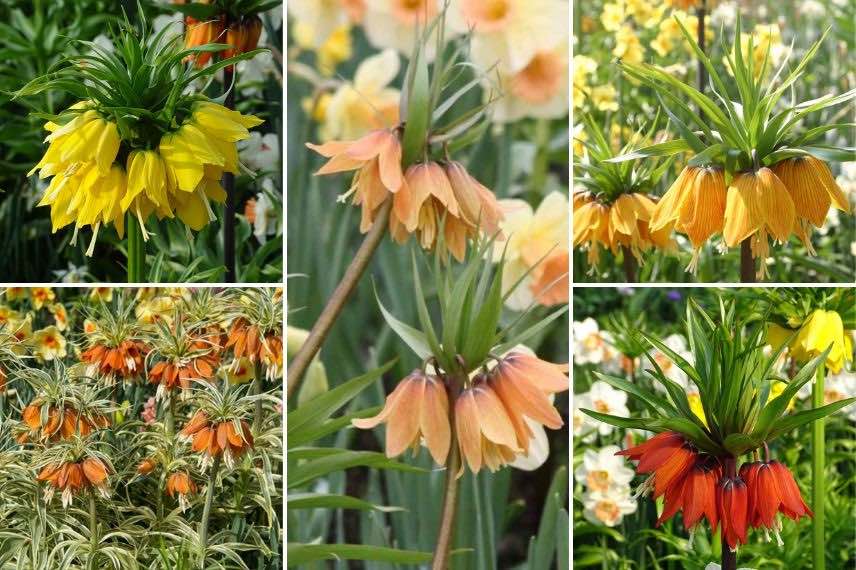
From the top left, clockwise: Fritillaria imperialis ‘Lutea’, ‘Tchaikovsky’, ‘Striped Beauty’, ‘Rubra’, ‘Argentea Variegata’
When is the best time to plant imperial fritillaries in pots?
Plant your fritillaries as soon as possible after purchase. The bulbs are indeed fragile and prone to drying out or rotting when exposed to air.
Generally, planting takes place between the end of summer and the beginning of autumn, that is between the end of August and mid-October.
Planting crown imperials in pots
Container
You can opt for a container of any shape, depending on how many fritillaries you wish to grow. However, choose a pot deep enough, at least 40 to 50 cm tall.
For the material, we always advise favouring terracotta containers, which allow the substrate to breathe better thanks to their natural porosity.
Be sure to opt for a container with a perforated bottom, so that watering or rainwater can drain away without stagnating.
Substrate
Fritillaries are easy-to-grow plants as long as their substrate is well drained, that is, it allows water to drain away easily. Stagnant moisture can indeed cause the bulbs to rot and promote the development of fungi. These spring bulbs also appreciate soils rich in organic matter.
For pot planting, mix therefore :
- Two-thirds of horticultural potting compost of good quality or garden soil;
- One-third river sand, from garden sand or gravel;
- A handful of compost well-decomposed household compost or leaf mould.
Planting
- Install a drainage layer of about 2 to 3 cm at the bottom of your container (clay balls, gravel, broken terracotta shards…).
- Top up with the substrate mix.
- Prepare the planting hole to a depth of around twenty centimetres (it is advised to count three times the size of the bulb to obtain the ideal depth). You can use a bulb planter to help you.
- Place the imperial fritillary bulb into the holes with the tip facing upwards, but slightly angled to avoid rotting. If you opt for grouped planting (3 or 5 plants), place the other bulbs in a staggered layout or in a row keeping a distance of 20 to 30 centimetres.
- Cover the bulbs with the substrate, then gently firm down with your hands.
- Mulch to retain moisture longer and limit the development of adventive weeds.
Exposure
Provide sunny exposure for your potted fritillaries. Our bulbous plants indeed require good light to bloom, but do not require direct sun. They are ideal outdoor plants for the terrace or balcony.
Keep them sheltered from strong winds, to avoid damaging their flowering stems or having to install supports in your pot. Some varieties may, however, naturally offer good wind resistance, such as ‘Tchaikovsky’.
During the dormant period (summer and winter), move your potted fritillary to a sheltered place away from precipitation.
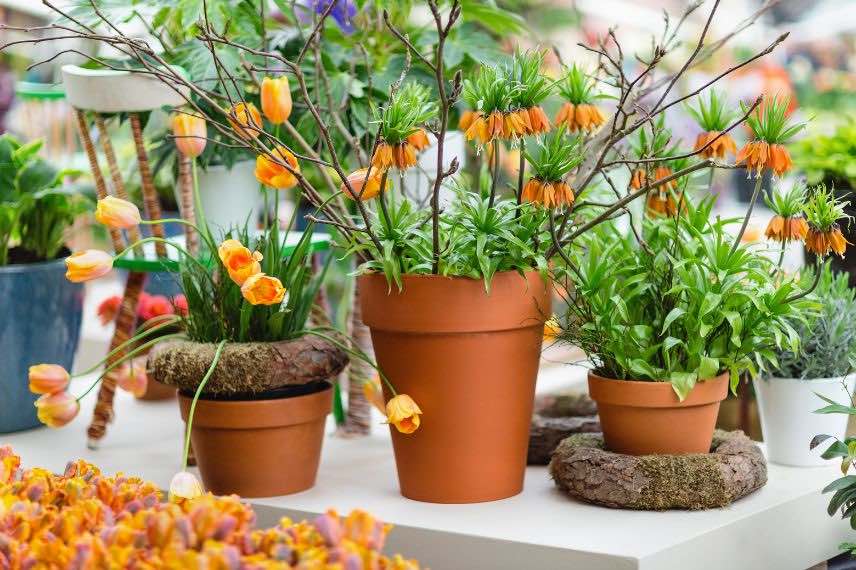
Imperial fritillaries lend themselves nicely to pot cultivation
Read also
Botanical fritillariasCaring for crown imperials in pots
Watering
The imperial fritillary’s ideal climate is a continental climate, with winters and summers fairly dry, paired with somewhat wetter springs.
Therefore, the emphasis should be placed on watering, particularly between February–March and May–June during the growing season. Water evaporates more quickly when grown in pots. So ensure that the substrate never dries out completely, by watering as soon as the surface is dry (about once a week in the absence of rain or in sheltered exposure).
If you have placed a saucer beneath your pot, remember to empty it after about thirty minutes.
In summer and winter, stop watering and leave your bulbs in dormancy.
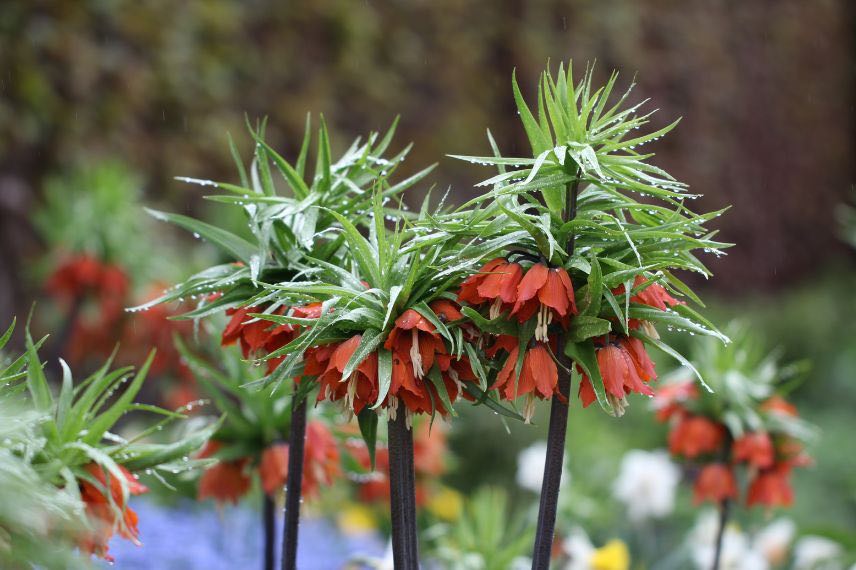
Fritillaries enjoy spring humidity
Fertilisation
In pots, the substrate quickly exhausts its nutrient reserves. We recommend fertilising during the imperial fritillary’s growth period, to support flowering. Choose fertilisers rich in potassium (rather than nitrogen, which promotes foliage growth).
Opt for a fertiliser specifically for flowering bulbs or bulbous plants. You can also use a fertiliser for containers and pot plants.
Liquid fertilisers have a rapid ‘boost’ effect, but of limited duration. Solid fertilisers (granules or sticks) diffuse more slowly. In all cases, always follow the dosages indicated by the manufacturers, which vary by product.
Another option: fertilisation based on household compost, manure, crushed horn or dried blood.
Pruning
Pruning is not necessary. Simply deadhead the faded flowers as they appear to prevent self-seeding.
After flowering, the foliage will yellow and dry naturally, before disappearing on its own in summer. Do not prune before fading, to allow the bulb to build up its nutrient reserves.
Pests and diseases
Imperial fritillaries are plants relatively hardy to diseases and pests. They are often used in gardens to deter moles, due to the strong odour emitted by the bulbs.
Our plant is particularly sensitive to waterlogged soils.
It generally has only two other enemies:
- watch out for gastropods, whose appetite can affect the young foliage in early spring;
- beware of the lily beetle, which also feeds on the leaves and flower buds.
Overwintering
Imperial fritillaries are hardy bulbous plants, generally down to -15°C. They can therefore tolerate winters in most parts of our regions and may stay outdoors, in a location protected from the weather.
As a complement, we still recommend protecting the base of the plant with a thick organic mulch, for example made from dead leaves. Pot-grown plants are indeed always more sensitive to cold.
Repotting and propagation
Repotting should take place every two years in autumn.
Take the opportunity to divide, separating the bulblets from the main bulb. This helps rejuvenate the plant, which gradually loses vigour with age. Note: it will take around three years for the new bulbs to flower.
- Subscribe!
- Contents
Comments