





























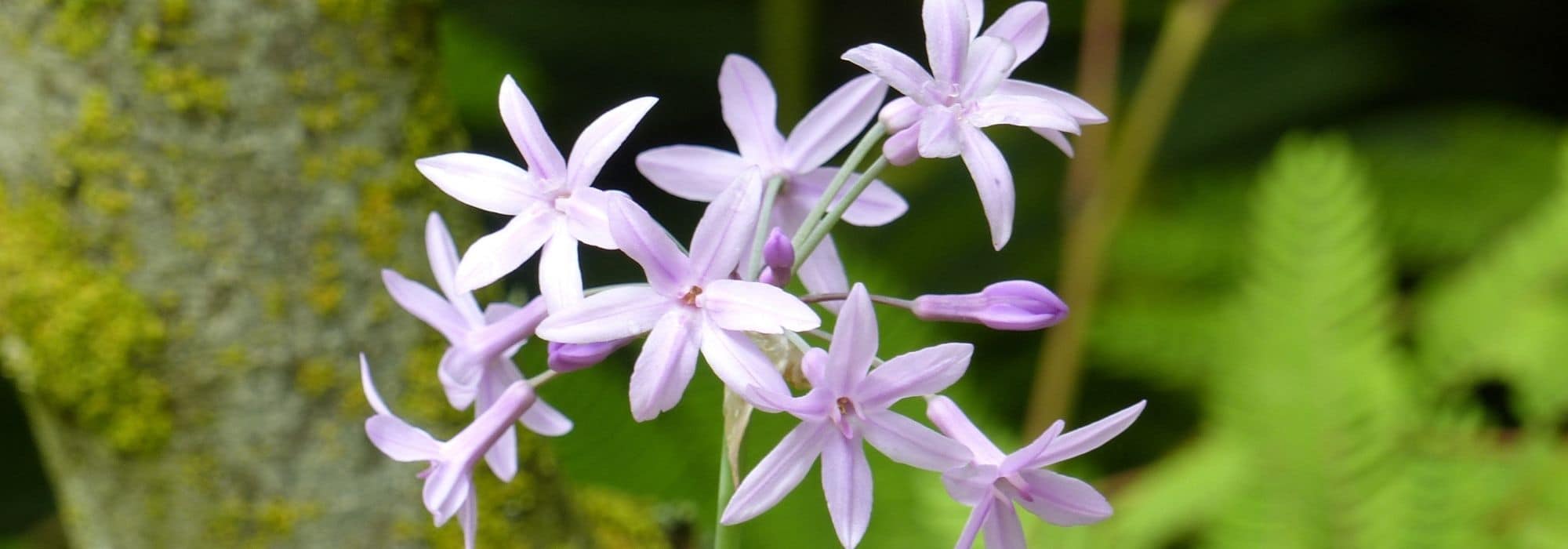
Growing Tulbaghia in pots
on the terrace or balcony
Contents
Tulbaghia is a lovely bulbous perennial notable for its long summer flowering, starting in July and lasting until October. Its delicate, elongated, star-shaped flowers resemble those of agapanthus but are smaller. Depending on the variety, its flowers can be white, pink, or lilac and are subtly fragrant. Its fine, narrow leaves form a lovely green tuft, sometimes variegated or grey-green. The foliage emits a garlic scent when crushed. In fact, its bulb, as well as its flowers and leaves, are edible and valued in cooking. Native to South Africa, this plant can thrive in the ground if winter temperatures do not drop below -7 °C in dry soil. In regions with cold or damp winters, it is advisable to grow it in a pot and bring it indoors during winter.
Discover all our tips for planting, growing, and maintaining a tulbaghia in a pot, on a terrace, or a balcony.
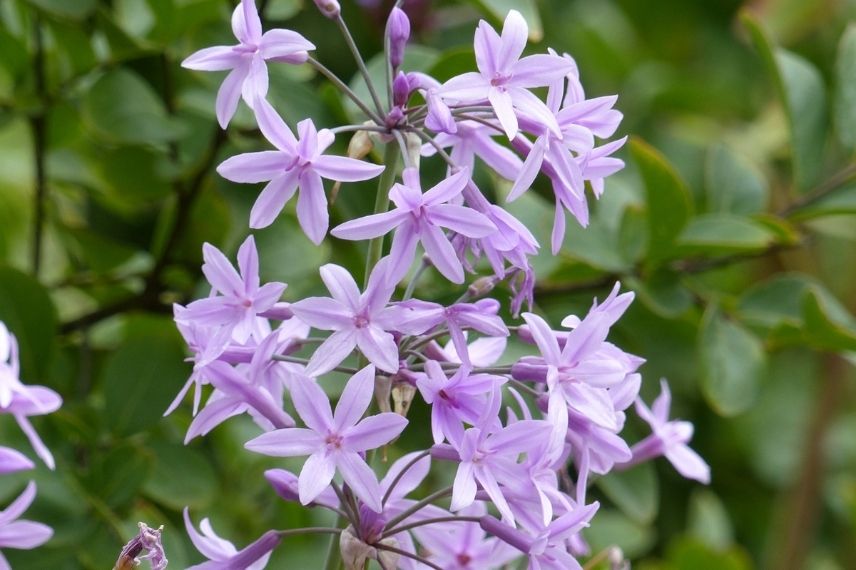
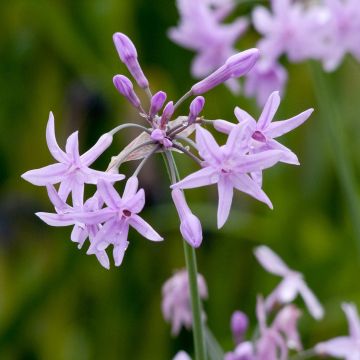
Tulbaghia violacea

Which pot to choose for a Tulbaghia?
For a thriving tulbaghia, choose a pot measuring at least 30, or even 40 cm in diameter. Its tubercles will spread a little year by year, without becoming invasive. If your pot needs to be moved to protect the plants from winter cold, it’s better to opt for a plastic or resin pot. Indeed, it will be lighter and easier to handle than a terracotta pot. Admittedly, terracotta allows for better root aeration, not to mention the charm of beautiful ceramic pots, but let’s be honest: they are heavier, unless you plan to use a wheeled board underneath. In any case, choose a container with drainage holes at the bottom to facilitate water drainage and excess watering. This will help prevent the development of mould on the tubercles. Finally, place a suitable saucer under your pot.
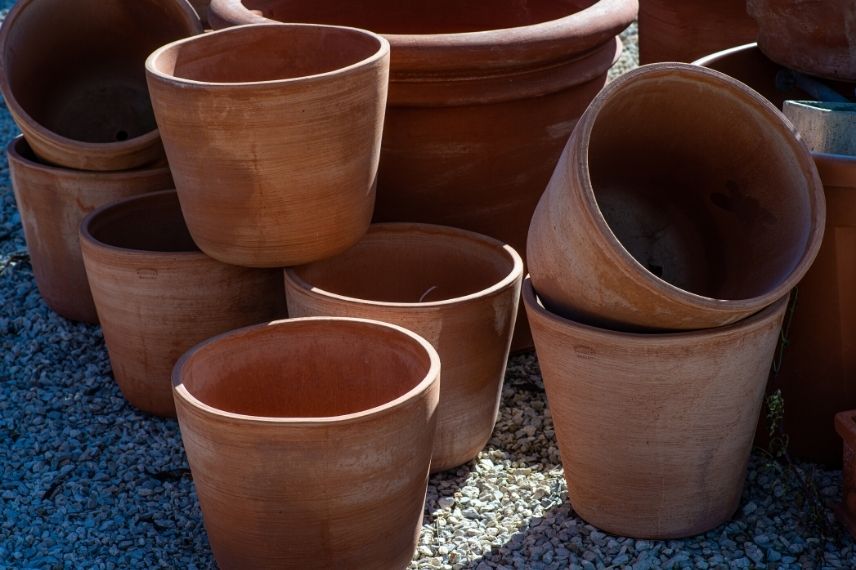
Terracotta pots offer certain advantages and disadvantages.
Read also
10 summer bulbs to plant in springWhich substrate to choose?
Easy to grow, tulbaghias prefer rather sandy soils, always slightly moist in spring and during flowering. They are sensitive to stagnant moisture, which could lead to the rotting of their bulb and roots. These bulbs therefore require well-draining substrate. It is worth noting that during their winter dormancy, the bulb prefers to be dry.
To facilitate water drainage, add a layer of 3 to 4 cm thick of clay balls at the bottom of your pot.
Then mix:
- 1/3 garden soil. If you do not have any available, replace it with horticultural compost.
- 1/3 of ordinary compost or for Mediterranean plants.
- 1/3 of planting sand.
- Add a handful of slow-release organic fertiliser, such as crushed horn and dried blood, to nourish your bulbs during flowering.
Discover other Tulbaghia
View all →
Available in 0 sizes
Available in 1 sizes
Available in 2 sizes
Available in 2 sizes
Available in 2 sizes
Available in 3 sizes
Available in 2 sizes
Available in 1 sizes
Available in 2 sizes
Available in 2 sizes
Which varieties of Tulbaghia to choose?
All varieties of tulbaghia will adapt well to pot cultivation. This gives you plenty of options. To guide you, here is a selection of our favourite cultivars:
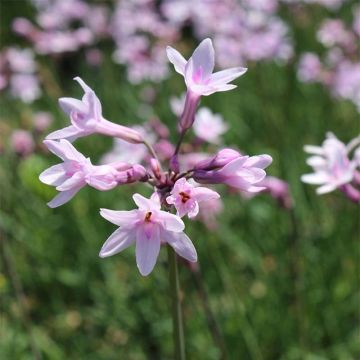
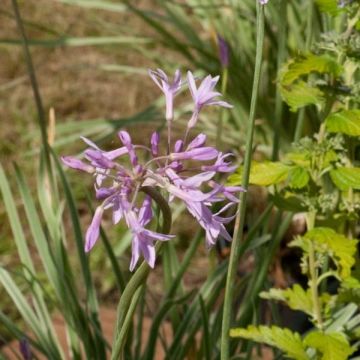
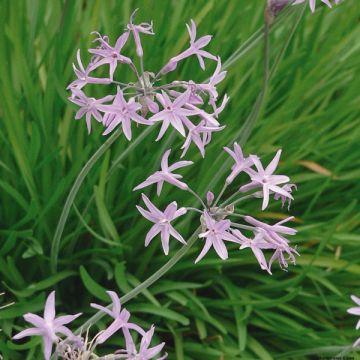
- Tulbaghia violacea produces numerous small mauve-pink star-shaped flowers in umbels throughout the summer. Its green leaves, tinged with grey, are semi-evergreen depending on the severity of the climate.
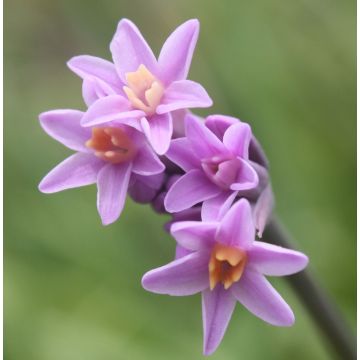
- Tulbaghia Himba stands out with its pink flowers, slightly violet with an orange centre. Its grey-green foliage is slightly arching. Its garlic scent is less pronounced than in other varieties, making it more tolerable for sensitive noses.
- Tulbaghia violacea ‘Savannah Lightning’ will bring brightness to a terrace or balcony with its white flowers, enhanced by yellow stamens. Its green-grey foliage is semi-evergreen depending on the regions and the intensity of winter cold. This is a highly aromatic variety.
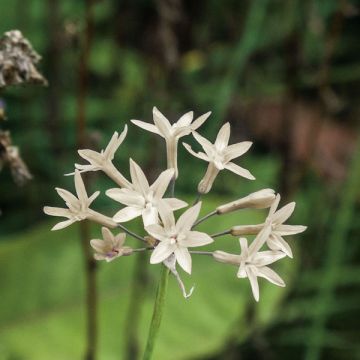
- Tulbaghia fragrans ‘Alba’ features entirely ivory-white flowers. Its grey-green foliage tends to arch and can be semi-evergreen in mild climates.
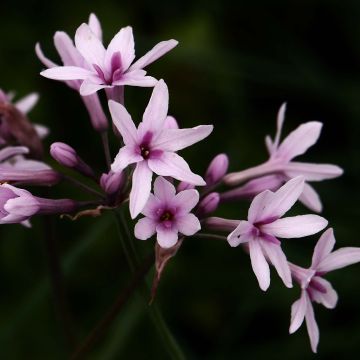
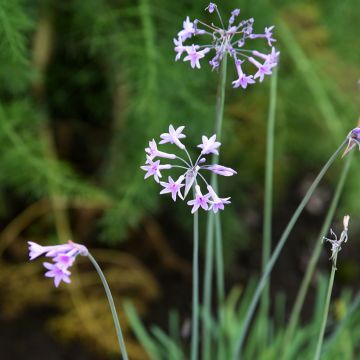
- Tulbaghia ‘Purple Eye’ is distinguished by its stunning star-shaped pink flowers with a violet heart, as well as its long flowering period that can begin as early as May in warm climates. Its green leaves, slightly grey, arch timidly and may remain in place depending on the severity of winter.
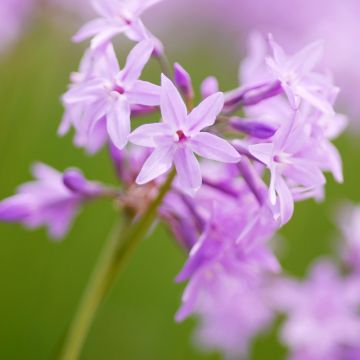
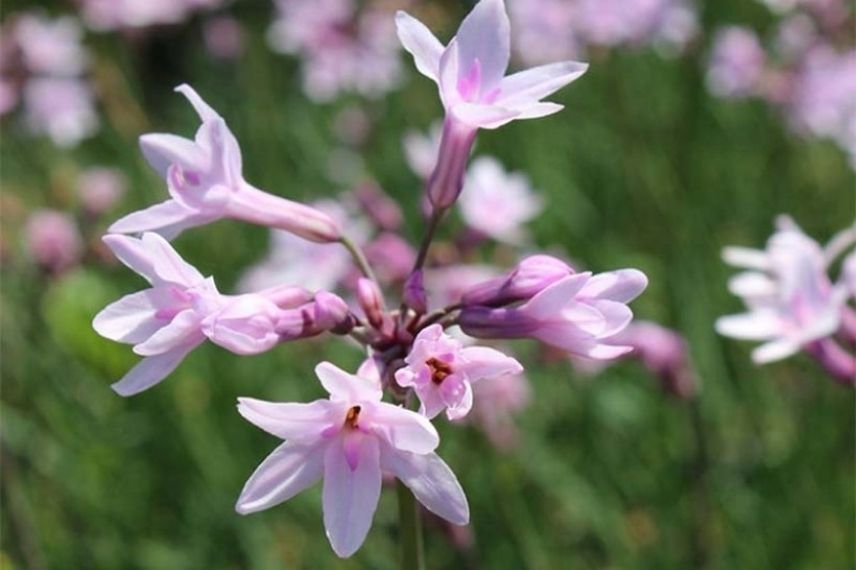
- Tulbaghia violacea ‘Ashanti’ will add softness with its star-shaped pale pink flowers. Its flexible grey-green foliage is semi-evergreen when winters are mild.
→ Discover more varieties of tulbaghia
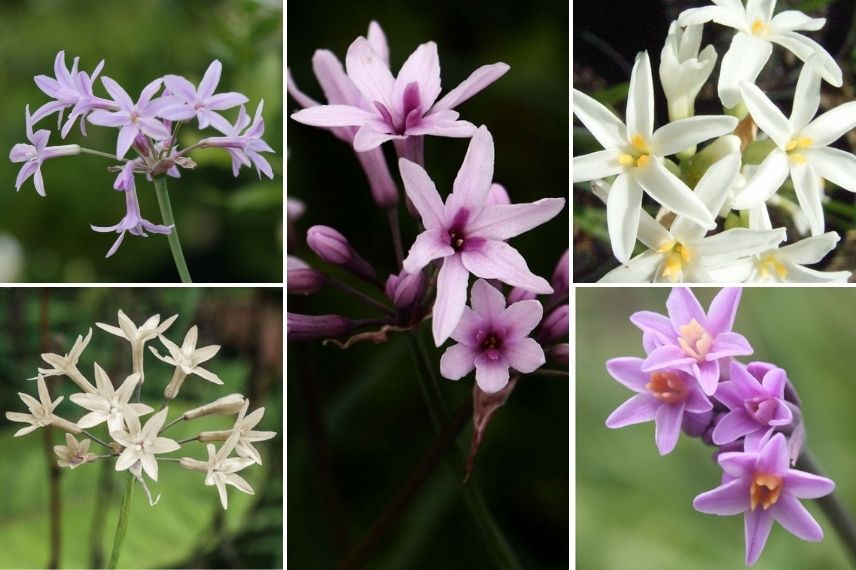
Tulbaghia violacea, Tulbaghia fragrans ‘Alba’, Tulbaghia ‘Purple Eye’, Tulbaghia violacea ‘Savannah Lightning’ and Tulbaghia Himba
When and how to plant a tulbaghia in a pot?
When should I plant my tulbaghias in pots?
Planting tulbaghia tubers takes place in spring, around April-May depending on your climate. Wait until the risk of frost has passed before placing your pot outdoors. It is also possible to plant the tubers in late summer or even early autumn in regions with a mild climate.
How to plant my tulbaghia tubers in pots?
- Pour a layer of clay balls at the bottom of your pot, about 3 to 4 cm thick.
- On top of that, add a mixture of potting soil, garden soil, and planting sand.
- Place your tulbaghia tubers and then cover them. They should be planted approximately 3 cm deep. Generally, 3 to 5 tubers are planted per pot depending on the size of the container.
- Lightly compact the potting soil with your hands.
- Water generously with rainwater.
- Place your pot on the terrace or balcony in a sunny spot.
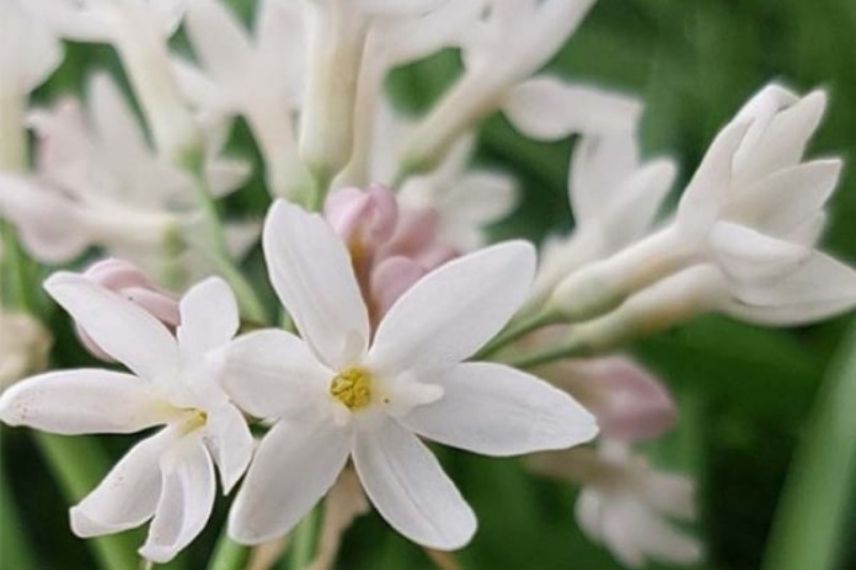
The Tulbaghia violacea ‘Pearl’ looks stunning in a pot on a balcony or terrace
How to care for potted Tulbaghia?
Exposure
Tulbaghias thrive in warmth and brightness. Therefore, place your pot in full sun.
Watering and fertilising
Potted tulbaghias will need to be watered more frequently than those in the ground. Indeed, the substrate dries out much faster in a pot, especially when placed in full sun. It is essential to keep the substrate slightly moist, particularly in spring, to avoid compromising the upcoming flowering.
To check if your bulbs need water, insert your finger into the compost to a depth of 2 to 3 cm. If your finger is damp, there is no need to water. However, if your finger is dry, you should water without delay.
To aid flowering, add some slow-release fertiliser to your pot, such as bone meal and dried blood. Also, add fertiliser each spring during repotting or by top-dressing.
Repotting
Tulbaghias will need a new substrate and to be repotted every 3 years. This allows the bulbs to replenish their reserves for good flowering.
Wintering
In general, plants are always more sensitive to cold and frost when in pots. Tulbaghia can withstand temperatures down to -8 °C in the ground, but not in pots. You will need to bring your pot indoors to a frost-free shelter, such as an unheated room, a cold conservatory, a greenhouse, or a cellar. The room temperature should not be too high, as the bulbs require a cool atmosphere during winter to flower again. The pot can be taken back out onto the terrace once the risk of frost has passed.
For further reading
- Discover all our varieties of tulbaghias
- Browse our sheet to learn everything about tulbaghia: how to plant, grow, and care for?
- Subscribe!
- Contents
![[tulbaghia pot="container" jardinière="planter"]](https://en.promessedefleurs.eu/blogwp/wp-content/uploads/2022/05/Cultiver-le-tulbaghia-en-pot.jpg "Growing society garlic in a pot")
Comments