





























Growing yarrows in pots: our tips
Months of flowers on your balcony or terrace
Contents
Yarrow is on the rise! Indispensable in naturalistic, on-trend settings, it is also a champion of drought-tolerant gardening, toward which we are all gradually leaning. This ability to withstand hot summer weather means it can be grown in pots to give a touch of rustic, country charm on your terrace or balcony.
Here are our five key tips to guarantee success with your potted yarrow!

Which Achillea varieties are suitable for growing in pots?
Some yarrow varieties, such as the Achillea filipendulina, are very tall perennials that are best reserved for the ornamental garden.
For a flowering pot display, choose yarrow varieties of medium size (between 30 and 60 cm) or dwarf types if you have a very small balcony or windowsill. Generally, for a pot display one looks for a yarrow with bright colours, but some paler ones are also charming and provide a good link between your different flowering periods. Pot planting helps to counter the unwelcome habit of this pretty perennial that often spreads well beyond our wishes, and as it grows quickly, you quickly achieve a flattering display!
Among the prettiest yarrows with small-to-medium growth:
- Achillea millefolium ‘New Vintage Violet‘ with a striking colour between magenta and purple (35 cm tall).
- Achillea taygetea (often called Egyptian yarrow), with a very beautiful lemon-yellow and green-grey silvery foliage, ideal on city balconies for its compact size (50 cm tall).
- Achillea millefolium ‘Cerise Queen’, taller (60 cm), forms pretty clumps and bears a vivid pink that is very attractive, showing a pale cream heart, perched above the dark green foliage, very pretty alongside dwarf roses in lighter pinks.
- Achillea ‘Bouton d’Argent’ (Achillea ptarmica), with small double flowers of creamy white (60 cm tall), attracts bees and butterflies. This lovely yarrow with white flowering differs from species with flat-topped corymbs. Here the flowers appear as pom-poms, all white, with single or double blooms depending on the cultivars, all of medium size, to form a tuft 50–60 cm tall.
- ‘Salmon Beauty’ and its salmon-pink corymbs also conjure the enchantment of wild meadows… on the terrace! It will form a tuft 60 cm across.
All these yarrows are suitable for a terrace or balcony.
The shortest yarrows
Among the smallest for a windowsill, opt for the whiteness of the Achillea ptarmica ‘La Perle’, with its pom-poms that resemble white carnations, or the yellow yarrow ‘Little Moonshine‘, with a very bright yellow on grey-green foliage (25 cm tall).
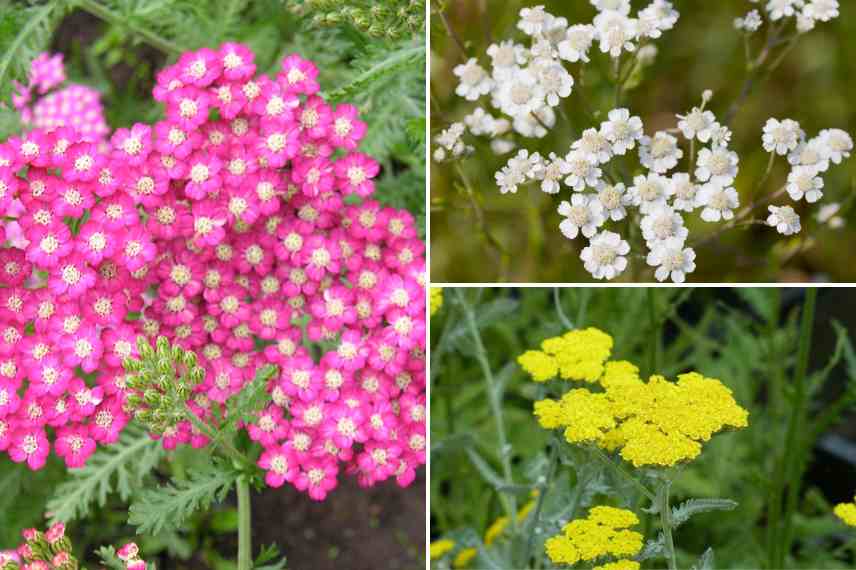
Achillea millefolium ‘Cerise Queen’, Achillea ptarmica and Achillea ‘Little Moonshine’
Choosing the right pot for yarrow
For this wild-looking plant that tends to spread, choose a pot large enough: its root system really needs space. A diameter of at least 30 cm and a minimum depth of 40 cm should be provided.
Terracotta pots, or better, a tall, deep planter, will be the perfect containers to accommodate it. If possible, avoid plastic, as it retains too much moisture. Terracotta pots have the advantage of facilitating the aeration of the root system.
The pot, regardless of material, should have drainage holes in the bottom or be equipped with drainage holes to drain away any excess water.
Do not place a saucer under the pot!
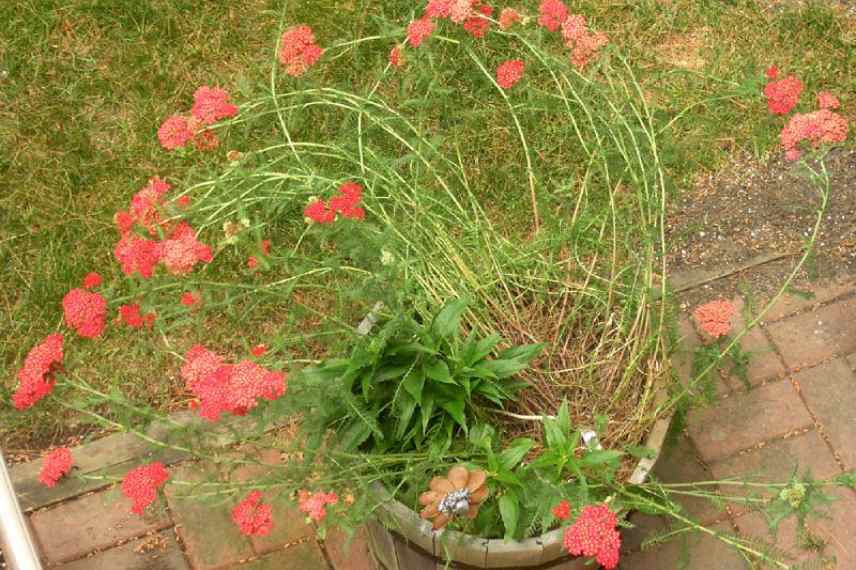
© Gail Frederick
Where to place a potted yarrow?
Sun exposure is important for this heat-loving perennial. Camel plant, potted yarrow can therefore easily be grown on a balcony or terrace south- or west-facing. It needs at least six hours of sun per day. In full sun, it is hardy, even in a pot, but in the south of the country you might prefer a west- or even an east-facing exposure, as it will prefer partial shade there.
In a heatwave, move the pot to partial shade to prevent the substrate from drying out too quickly, as potted plants are more sensitive to heat waves.
Yarrow is perfect for a countryside escape. You can surround it with container plantings just as bucolic that thrive in the sun, such as linaria grown in pots, cosmos grown in pots, carnations grown in pots, pennisetum in pots, or a Lantana in pots in their warm tones, a dwarf Buenos Aires verbena: all these perennials accompany it for months on end!
Read also
How to choose an achillea?Planting yarrow in a pot: when, how and what substrate?
Plant your young plant in spring, between March and May.
- Prepare your planting substrate, which should not be too rich, as that would cause the plant to grow tall with a risk of collapse: mix equal parts a quality potting compost, coarse sand or perlite, and, if necessary, garden soil to amend it.
- Take a pot 30 to 50 cm in diameter or about 2 to 3 times the size of the root ball.
- Bottom-water the root ball in a basin of water for 10 minutes to thoroughly hydrate it.
- Clay balls, terracotta shards or small pebbles at the bottom of the pot to ensure drainage, essential for yarrow.
- Fill the pot two-thirds full with the substrate mix.
- Install the plant, having removed its pot, in the centre of the pot, and cover with the remaining potting compost.
- Firm the soil gently around the yarrow’s collar.
- Water thoroughly.
- Add a layer of mulch or some clay balls.
→ Also read our full guide: Yarrow: plant, grow and maintain.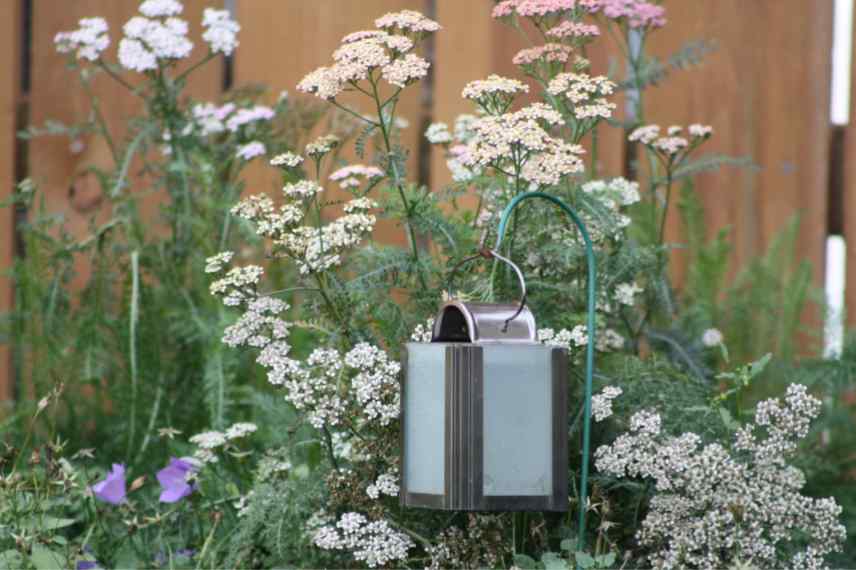
Care for a potted yarrow
Here is a low-maintenance perennial for balconies and terraces that will require little care:
Watering
Not to say you can forget it altogether, it’s a truly forgiving perennial, even in a pot. In the ground, yarrow easily tolerates drought. But in a pot, you still need to water it.
Cultivated in a pot, don’t wait for your yarrow to show thirst — it signals this by wilting of its leaves — and water it when the potting mix begins to dry out by inserting your finger (the watering frequency will vary depending on whether it is placed on the south- or west-facing side). If you’re going on holiday, yarrow can withstand two to three weeks without watering, but place it in partial shade during this period, either sheltered by a potted shrub or behind a taller perennial.
Pruning
More than in the garden, you won’t forget to prune faded flowers to keep a neat and tidy display for your container planting, especially for white-flowered varieties, which brown off. Cutting the flowers once flowering has finished allows, even in pots, to see the plant produce a second flush of flowers a few weeks later, usually in September.
Repotting
Repot your yarrow every two to three years, in spring, especially for hybrids, when the plant comes out of its dormancy, to refresh the substrate and give more space to the roots that have grown well.
→ See also: how to divide yarrow?
Diseases and pests
Yarrow is generally resistant to diseases and little prone to pests, with no particular foes known. It also overwinters without issue, as it remains hardy and will never suffer in pots, faithfully returning each year. If, however, you grow it in the mountains or in a region that experiences repeated and prolonged winter frosts, protect it with a protective mulch or with hessian.
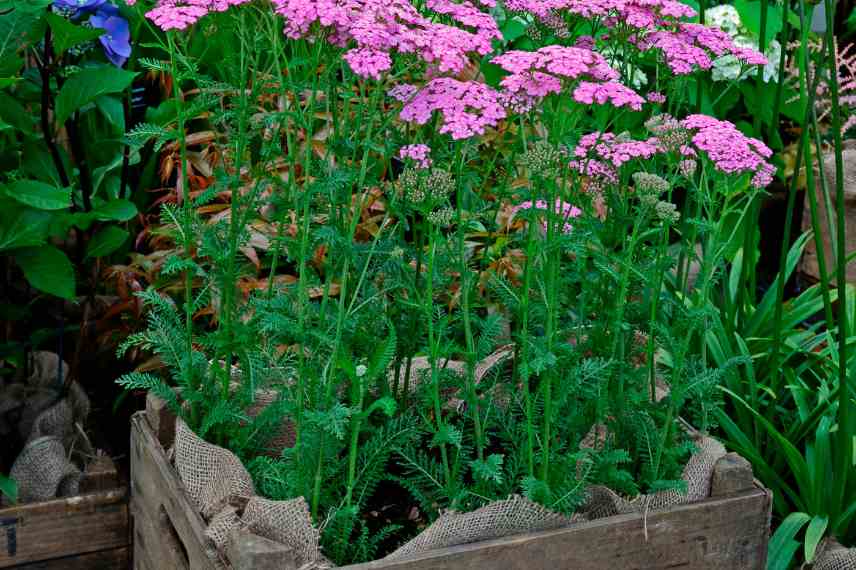 Yarrow ‘Pretty Belinda’
- Subscribe!
- Contents
Comments