





























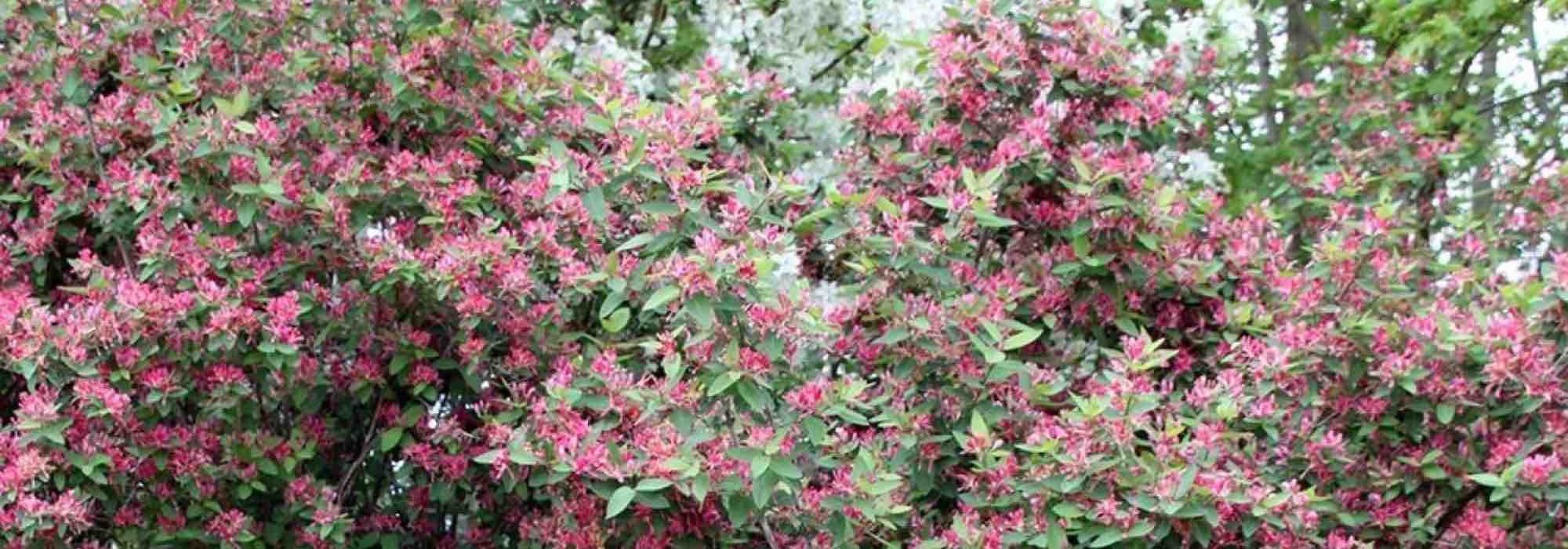
Bush honeysuckle: how to choose?
Buying guide and criteria for finding the perfect variety
Contents
Shrubby honeysuckles are often less well known than their climbing cousins. Yet they also have interesting qualities. Some have evergreen foliage, which remains ornamental all year round in the garden. Others delight with a lovely flowering that can be very fragrant, or even edible fruits.
Generally tolerant and easy to grow, shrubby honeysuckles are plants to adopt without hesitation. To choose the variety best suited to your needs and growing conditions, follow our buying guide.
For more on growing shrubby honeysuckles, explore our comprehensive dossier: Shrubby honeysuckles, Lonicera: planting, pruning and care.

Choosing a shrub honeysuckle for its flowering
Shrub honeysuckles with evergreen foliage (Lonicera nitida and Lonicera pileata) often have a very discreet spring flowering, regarded as almost insignificant, in creamy to greenish tones. But other deciduous-leaved shrub honeysuckles are interesting for their flowers, sometimes even very fragrant.
White-flowered shrub honeysuckles
This popular Lonicera fragrantissima. This winter honeysuckle has, firstly, the peculiarity of flowering during the cold season, from December to March, at a time when the garden is particularly quiet. It then covers itself with a multitude of small flowers in creamy white, borne on shoots still devoid of leaves. Above all, this flowering is prized for its intense fragrance, revealing notes of lemon and jasmine. It pleases pollinating insects, for whom food is scarcer during this period.
The same goes for the Lonicera purpusii ‘Winter Beauty’, another white-flowering winter honeysuckle with a sometimes pink-tinged base. The flowers are fragrant, but less intense than those of Lonicera fragrantissima.
Let us also mention the white, fragrant flowering of Maack’s honeysuckle (Lonicera maackii), which occurs, for its part, in late spring. The flowers will gradually take on pale yellow-cream hues and be followed by ornamental fruit.
Pink-flowered shrub honeysuckles
Still relatively unknown, the Lonicera tatarica ‘Tartarian Honeysuckle’ gives us, however, a very pretty spring flowering. The small flowers display a delicate pink tinged with white and are subtly fragrant. The flowering gives way to decorative fruiting in the form of yellow-orange berries. They are toxic to humans, but very popular with birds. For its part, the variety ’Hack’s Red’ ‘Hack’s Red’ opts for a deep pink flowering leaning toward crimson, which is followed by scarlet fruit.
A further species that deserves more attention: the lilac honeysuckle (Lonicera syringantha). It flowers in spring, cloaked in adorable pink-lilac flowers. They are quite fragrant. The flowering can even be repeat-flowering in summer.
Other flower colours
The creeping honeysuckle Lonicera crassifolia is among evergreen varieties that still feature ornamental flowering. In summer, it is indeed covered with an abundance of pale yellow-cream flowers tinged with pink, visible for almost a month.
In similar colours, the hedge honeysuckle (Lonicera xylosteum) reveals pale yellow flowers at the end of spring, slightly fragrant, giving way to bright red berries.
The small Lonicera periclymenum ‘Chic et Choc’ opts for a multicoloured summer bloom: initially white-pink, the flowers then take on yellow-orange and carmine pink shades. They exhale a delicate fragrance.
The Ledebour honeysuckle (Lonicera involucrata var. ledebourii) produces remarkable flowers in spring. They are yellow-orange, surrounded by a conspicuous collar of red bracts.
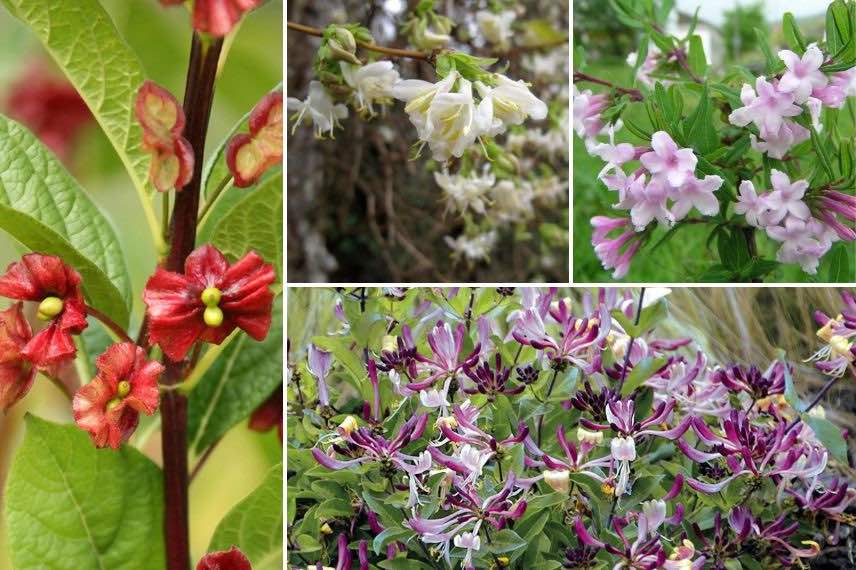
Clockwise from the top left: Lonicera involucrata var. ledebourii, Lonicera purpusii ‘Winter Beauty’, Lonicera syringantha, Lonicera periclymenum ‘Chic et Choc’
Read also
Choosing a HoneysuckleChoosing a shrubby honeysuckle for its foliage
Evergreen shrub honeysuckles
They have the advantage of foliage that remains decorative all year round. These include, for example, Lonicera nitida, which can display different foliage colours. ‘Garden Clouds Purple Storm’ is a boxleaf honeysuckle producing young shoots that are purple at first, turning to dark green. ‘Lemon Beauty’ treats us to very bright foliage, variegated with green and lemon-yellow, while ‘Silver Beauty’ opts for green foliage margined with white, giving it a silvery appearance. ‘Baggesen’s Gold’ also produces golden foliage that will brighten the garden, but will be a little greener in shaded situations.
On the other hand, On the Lonicera crassifolia ‘Little Honey’ forms a carpet of evergreen leaves, consisting of small, leathery and glossy leaves. Their colouring evolves: initially dark green through the summer, it reddens, or even turns purple in cold weather.
Let us also mention the Mossgreen cupule honeysuckle (Lonicera pileata), with its dense, lustrous foliage, dark olive-green, beautiful all year round.
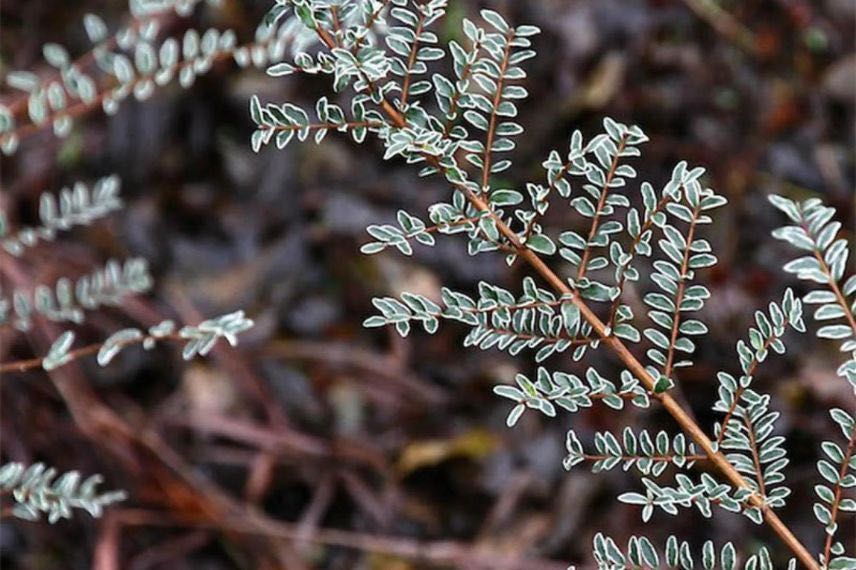
Lonicera nitida ‘Silver Beauty’
Deciduous shrub honeysuckles
These honeysuckles shed their leaves in autumn, except in milder winters for some, such as Lonicera fragrantissima. The lilac honeysuckle has the particularity of offering foliage consisting of small opposite leaves, paired or grouped in threes, and displaying a pretty bluish-green. ‘Chic et Choc’ is also interesting for its lanceolate bluish-green foliage carried on contrasting purplish petioles.
Hedge honeysuckle, for its part, opts for downy green-grey foliage from spring to autumn.
Maack’s honeysuckle has evolving foliage, which turns yellow late in the season before dropping.
Choosing a shrub honeysuckle for its edible fruits
Some honeysuckles have their flowering give way to brightly coloured, long-lasting fruits. But this decorative fruiting is often toxic, pleasing only the birds’ palates.
The Lonicera caerulea ssp. kamtschatica or May berry has the peculiarity of producing edible fruits. These are elongated berries, about 10 mm long, that stay on the shrub for a long time. They have a tart-sweet flavour and a yellow, juicy flesh. These fruits can be eaten fresh or processed (into jam, pastries, spirits…) and are prized for their high nutritional value.
The variety ‘Diana’ stands out for the cylindrical shape of its fruits, like mini amphorae. ‘Myberry’ produces fruits that have true blueberry notes, while ‘Duet’ treats us to fruits with a honey aroma.
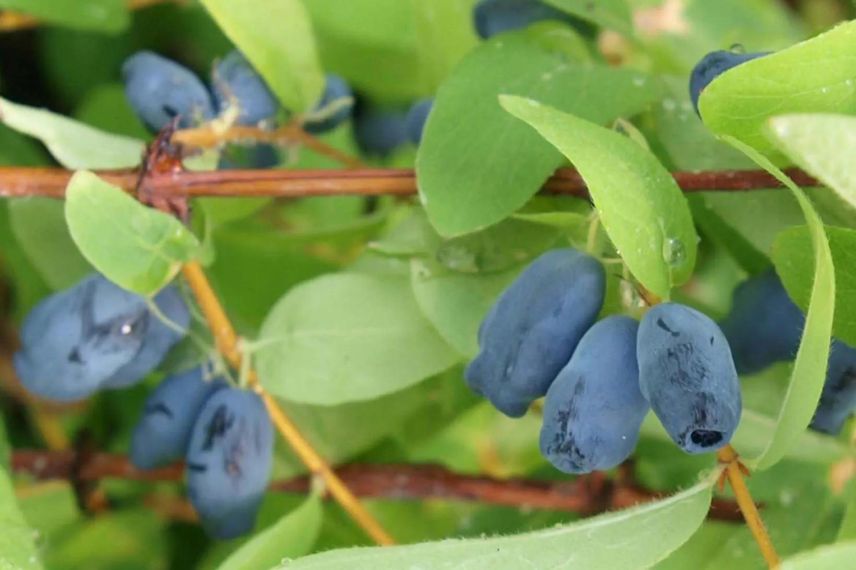
Lonicera kamtschatica Sweet Myberry
Choosing a shrubby honeysuckle according to its shape and use
Small varieties
They will be ideal for small gardens, confined spaces and container growing. This is the case with the dwarf variety ‘Chic et Choc’, with a height of 1 metre and a spread of 70 cm, ideal for flowering pots or borders.
They are also interesting honeysuckles for forming low hedges, thanks to their high tolerance to pruning. They can thus easily replace boxwood and lend themselves well to topiary, akin to ‘Garden Clouds Green Breeze’ (1 metre in all directions), ‘Garden Clouds Copper Glow’ (90 cm high by 60 cm spread) or ‘Tidy Tips’ (1.20 metres in all directions).
The Lonicera nitida ‘Maigrün’ also remains fairly modest, with its compact and spreading habit reaching 1 metre in height by 1.20 metres in spread.
Groundcover varieties
They are perfect for creating a groundcover, allowing to cover even the most inhospitable areas of the garden: rockery, banks, etc. They are wider than tall and have a creeping, spreading, prostrate silhouette. This is the case for the cupule honeysuckle (70 cm in height by 1.50 metres in spread) and its varieties such as ’Mossgreen’.
Evergreen varieties stay well-covered all year round and compete with adventive weeds (“bad” weeds). Let us mention the creeping honeysuckle, which spreads its small coriaceous leaves over a 55 cm spread (10 cm in height), as well as the Lonicera nitida ‘Hohenheimer Findling’ (1 metre in height by 1.50 metres in spread).
Varieties with an erect habit
These are larger varieties that will look splendid in a hedge, at the back of a border or even as standalone plants.
This is the case for Lonicera fragrantissima, with its elegant semi-weeping habit. Count on about 2.5 metres in all directions.
Let us also cite the type species of Lonicera nitida, with a dense, bushy habit and rapid growth, which reaches 2 metres in all directions. Ideal for creating hedges or topiary.
The Lonicera tatarica ‘Rosea’ has an upright and dense habit, which will reach 3 metres in height by 2 metres in spread.
Even more imposing, Maack honeysuckle has an almost tabular silhouette, composed of several small trunks topped by a crown in the shape of an umbrella. Its habit is quite broad, reaching 3 metres tall by 4 metres in spread.
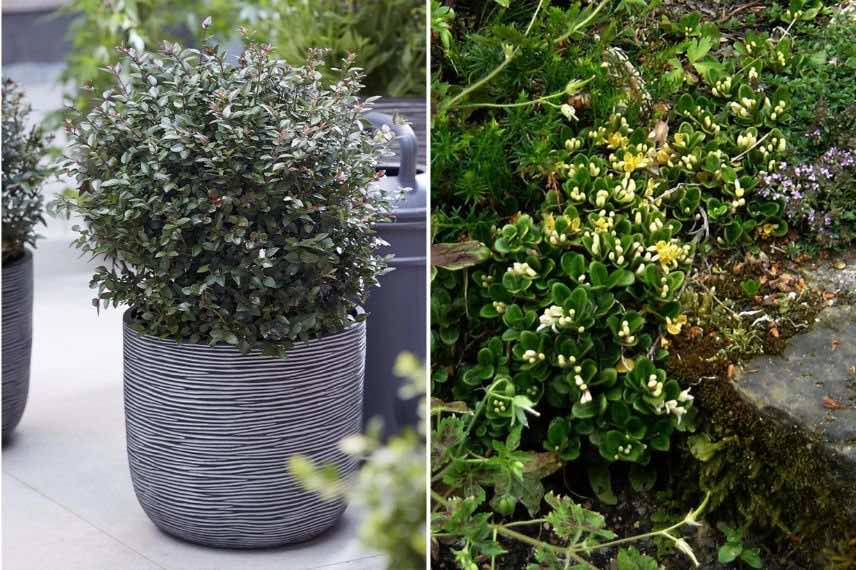
Lonicera nitida Garden Clouds ‘Purple Storm’ compact and Lonicera crassifolia, creeping
Choosing a shrub honeysuckle according to growing conditions
Shrubby honeysuckles are not difficult to grow.
Evergreen varieties grow in full sun or partial shade, in well-drained soil. They even thrive in challenging, poor, calcareous, and occasionally dry soils.
Some species will even tolerate a shadier exposure, such as L. pileata.
Deciduous varieties will require more warmth in summer to flower properly.
Shrubby honeysuckles are fairly hardy, generally down to -20°C, or beyond. However, if you live in a region with very harsh winters, avoid the less hardy species, such as creeping honeysuckle (down to -15°C).
- Subscribe!
- Contents
Comments