





























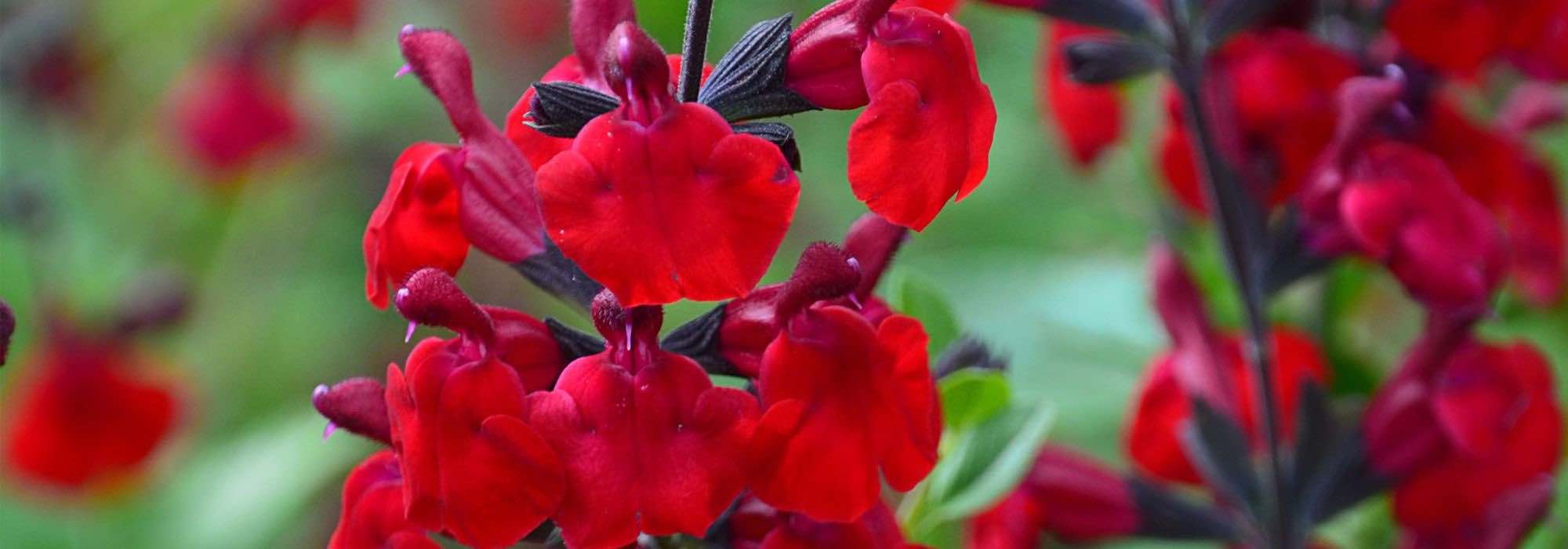
How to grow a bush sage in a pot?
Our tips for successful planting and easy maintenance
Contents
Shrubby sages are not lacking in advantages: they provide us with a long flowering period in various colours, have aromatic foliage, and form small, highly ornamental bushes. To top it all off, they are easy to care for, drought-resistant and require little maintenance.
These perennial sages are only sensitive to heavy soils (clay and wet) and harsh winters. In regions experiencing severe frosts or in gardens with unsuitable soil, you can however grow them in pots without any issues. This way, you can enjoy the benefits of these plants anywhere, even on the terrace or balcony.
So, discover our tips for planting and maintaining bushy sages in pots.

Which varieties of shrubby sages should you choose?
Shrubby salvias can reach heights from 40 cm to nearly 2 metres. For pot cultivation, choose modest-sized varieties, reaching up to about 1.5 metres.
For smaller containers, try:
- Salvia greggii ‘Alba’ (50 cm in all directions), a small bush with ivory white flowers;
- Salvia jamensis ‘Raspberry Royal’ (60 cm in all directions), with raspberry pink flowers;
- ‘Belle de Loire’ (60 cm in all directions), stunning with its bicoloured yellow and orange-salmon flowers;
- ‘Lemon Light’ (50 cm in all directions), featuring delicate pale lemon yellow flowers;
- Salvia cacaliifolia (60 cm in all directions), a collection variety with gentian blue flowers.
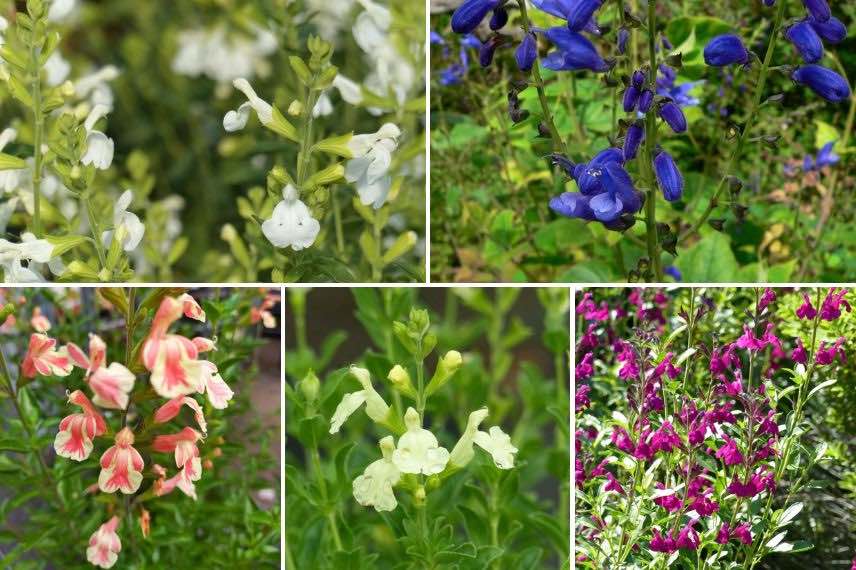
Salvia greggii Alba, Salvia cacaliifolia, Salvia jamensis ‘Raspberry Royal’, Salvia jamensis ‘Belle de Loire’, Salvia ‘Lemon Light’
For larger containers, opt for:
- Salvia microphylla ‘Hot Lips’ (90 cm tall and 80 cm wide), whose flowers change colour depending on the ambient temperature, providing a constantly renewed spectacle;
- ‘Cerro Potosi’ (90 cm in all directions), which rewards us with bright magenta flowers;
- Salvia greggii ‘Arctic Blaze® Purple’ (70 cm tall and 80 cm wide), hardy down to -15°C and flowering in purple-violet;
- Salvia microphylla ‘Delice Aquamarine’ (70 cm tall and 80 cm wide), with delicate mauve-blue flowers;
- Salvia jamensis ‘Flammenn’ (80 cm tall and 60 cm wide), a sage with intense bright red flowering.
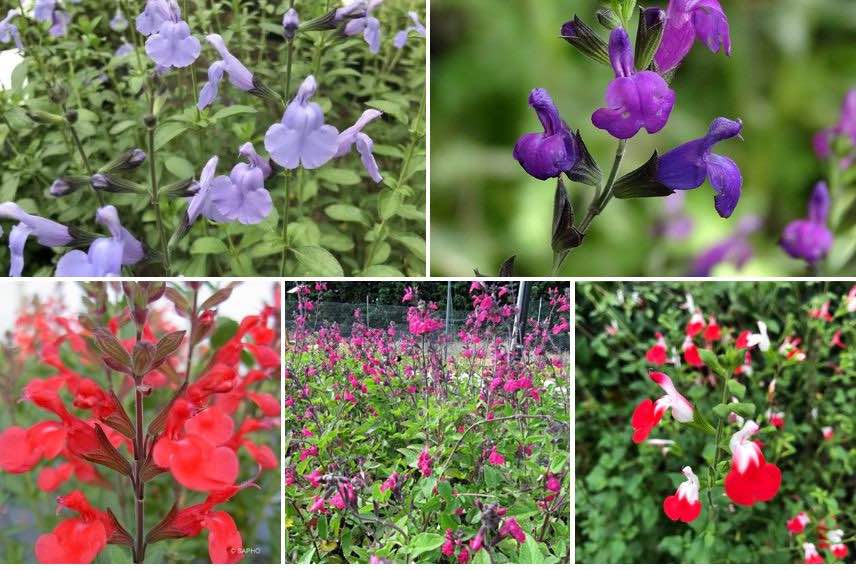
Salvia microphylla ‘Delice Aquamarine’, Salvia greggii ‘Arctic Blaze® Purple’, Salvia microphylla ‘Hot Lips’, Salvia microphylla ‘Cerro Potosi’, Salvia jamensis ‘Flammenn’
Read also
Shrubby sages: planting and care tipsWhen to plant shrub salvias in pots?
Spring is the best time to plant your potted sage. Proceed when there is no risk of frost, typically between March and May, depending on the region.
In warm climates with little or no winter frost, it is also possible to plant in autumn.
Planting shrubby sage in pots
Container
The size of the container will depend on the chosen variety. On average, choose a container with a minimum diameter of 40 to 50 cm, or equivalent to twice the volume of the root ball. Bush sages prefer fairly deep soils (at least 40 cm).
Opt for a container with drainage holes, so that water can drain away without stagnating around the plant’s roots.
A pot, planter, or trough can be suitable. Prefer terracotta containers, as the porous material allows the substrate to breathe better.
Substrate
Bush sages dislike heavy, clayey, and damp soils. Conversely, they prefer light or ordinary soils that are well-drained to avoid excess water retention. They can even tolerate poor, stony, and calcareous substrates.
For planting your bush sage in a pot, mix:
- 2/3 of high-quality horticultural compost or garden soil, if it is not too heavy;
- 1/3 of coarse sand or gravel for drainage;
- 1 handful of mature compost or well-decomposed manure (if unavailable, incorporate another organic fertiliser such as ground horn or dried blood).
Planting
- Soak the root ball of your bush sage in a bucket or basin of water for about ten minutes to rehydrate it.
- Install a drainage layer 5 cm thick at the bottom of the container, made of clay balls, gravel, or broken terracotta.
- Place the root ball in the centre of the container and fill with substrate.
- Firm down with your fingers and add more substrate if necessary without burying the collar (the part between the stem and the root system).
- Water generously.
- Apply a mulch at the base of the plant (optional).
Exposure
Bush sage particularly enjoys the mild climates of the Atlantic coast or the Mediterranean. Provide it with a warm and sunny position, especially in northern France. Elsewhere, light shade will be tolerated. Note that sunlight enhances the aromatic fragrance of the foliage.
Also, prefer a location protected from prevailing winds.
Bush sages make perfect outdoor potted plants, suitable for the garden, terrace, or balcony.
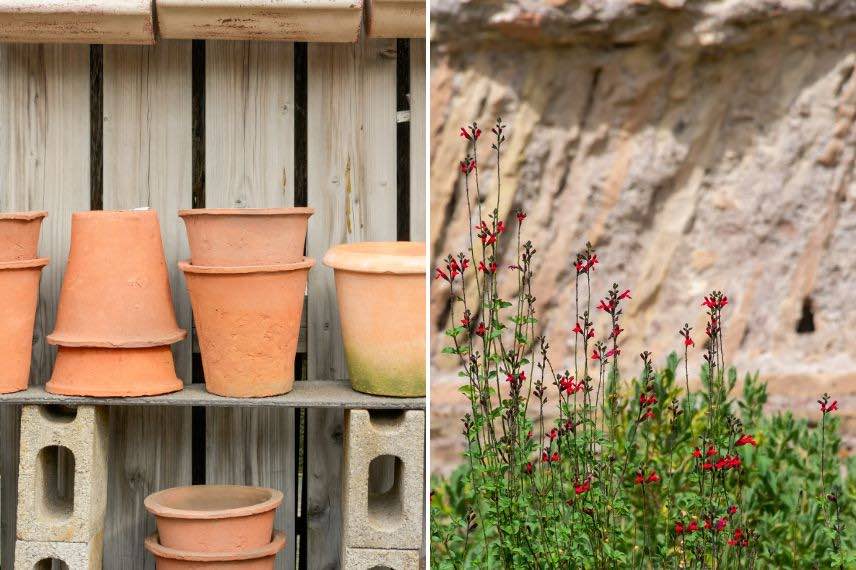
Bush sages appreciate a well-sunny exposure; terracotta pots suit them well
Read also
7 good reasons to plant a shrub sageCaring for Shrubby Sage in Pots
Shrubby sages are low-maintenance plants that require little care. Watering without excess, fertilising during the flowering period, and annual pruning will help keep the plants healthy.
Watering
Sage is a naturally drought-resistant plant that requires little watering. However, in pots, the substrate dries out more quickly: watering will need to be more regular.
During the growth and flowering period in spring and summer, water as soon as the substrate becomes dry. Increase watering during dry spells, but always without excess, allowing the substrate to dry out each time. Prefer generous watering less frequently rather than several small regular waterings.
If you have placed a saucer under your container, remember to empty it after about twenty minutes.
Mulching at the time of planting will help limit natural evaporation.
Fertilisation
In pots, the substrate depletes its nutrients more quickly. To support flowering, you can apply fertiliser for containers and pots or specific fertilisers to stimulate flowering in spring and summer. Liquid fertilisers dissolve in the watering water for a quick but short-lived effect. Solid fertilisers in granules or sticks are placed in the substrate. They diffuse slowly but over a longer duration.
You can also add a handful of compost in spring, lightly scratching the surface to incorporate it into the substrate.
Pruning
Shrubby sage requires annual maintenance pruning at the end of winter, before the resumption of growth. This will help maintain a beautiful shape and make the clump more vigorous.
To do this, use a pruning shear or shear that has been disinfected and cut the stems back by half. After pruning, you can add compost or fertiliser to encourage the resumption of growth.
To stimulate flowering, you can also remove faded flowers as they appear.
For more information, see our article “When and how to prune a shrubby sage?”
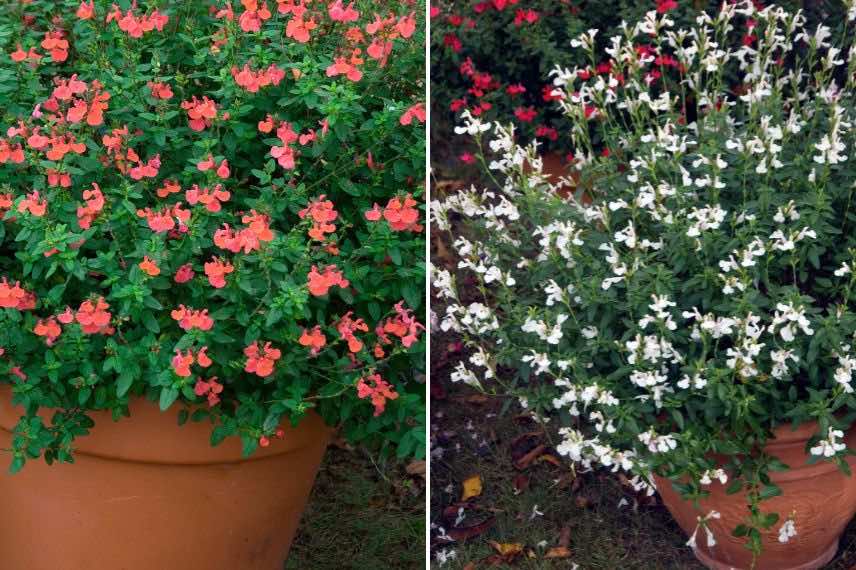
The bushy habit of shrubby sages is well-suited to pot cultivation. Moreover, they are easy to prune.
Pests and diseases
Sages can be susceptible to certain fungal diseases, such as powdery mildew (white powdery spots) or botrytis (brown and grey spots).
To prevent risks:
- when pruning, use disinfected cutting tools,
- water without excess and avoid wetting the foliage.
To learn more about these diseases, check out our articles “Powdery mildew or white disease” and “Botrytis or grey mould”.
In spring, watch for gastropods, which can feed on young tender leaves.
In overly dry and confined conditions, scale insects and red spider mites may appear.
Wintering
Not all shrubby sages have the same hardiness. The more sensitive ones will suffer at -3°C, while the more tolerant can withstand down to -12 to -15°C.
However, note that plants are always less resistant to cold when grown in pots.
In a mild climate with only occasional light frosts, it is possible to leave your shrubby sage in its pot outside. You can apply a thick mulch at the base of the plant, insulate the container from the ground, or even wrap it. Protect your plant from rain exposure to avoid risking root rot. It is also possible to protect the aerial parts with a fleece in case of forecasted frosts.
In regions with harsh winters, bring your shrubby sages indoors to a frost-free location.
Reduce watering to a minimum during this period (wait until the substrate is completely dry) and stop fertiliser applications.
Repotting
Repotting occurs every 2 years in spring, when the shrubby sage feels cramped in its container (roots protruding). Simply choose a larger container.
In years without repotting, you can perform a surfacing. This involves removing the top few centimetres of surface substrate and replacing it with fresh potting soil.
To rejuvenate an ageing plant (> 5 years), you can perform a division in spring.
- Subscribe!
- Contents
Comments