





























How to grow Pennisetum in pots?
Elegance and lightness, ease of cultivation
Contents
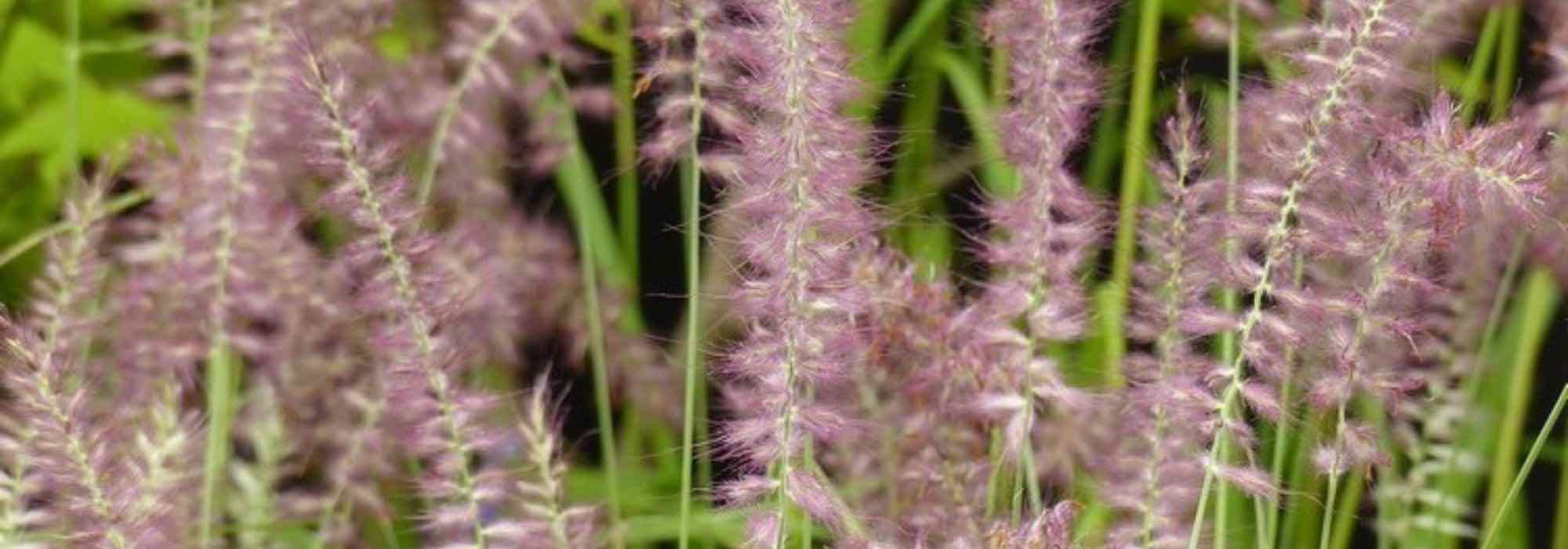
Pennisetum, also known as fountain grass, is an ornamental grass highly prized for its long, elegant leaves and feathery spikes that add a touch of lightness to the garden. Easy to grow and maintain, Pennisetum is also perfectly suited to growing in pots, which makes it an ideal choice for decorating balconies, terraces or small gardens. In pots, this plant allows you to create original and dynamic plant displays, while benefiting from its graceful habit and its characteristic inflorescences. In this article, we guide you step by step to successfully plant, water, fertilise and care for your Pennisetum in pots so that it thrives.

Which varieties?
All varieties of Pennisetum can be grown in pots, but some have a larger growth habit in height and width, ranging from about 50 to 60 cm in all directions up to almost 2 m. So check carefully the expected mature size of your Pennisetum according to the effect you wish to achieve, the space you have and the pot size.
Also note that if Pennisetums are very hardy, there are a few species that do not tolerate frost well. These will need to be overwintered in the cold season or grown as annuals.
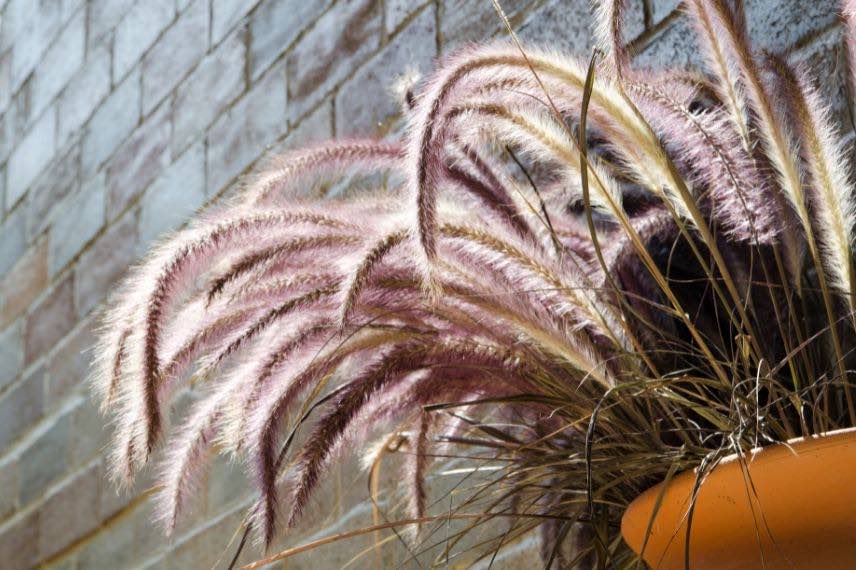
Here, a Pennisetum rubrum, a non-hardy species
What type of pot? What size?
The choice of pot influences not only the growth of the plant, but also its long-term health.
Material
The material of the pot is an important factor, as it affects water retention, root respiration and the pot’s stability. Choose a perforated pot.
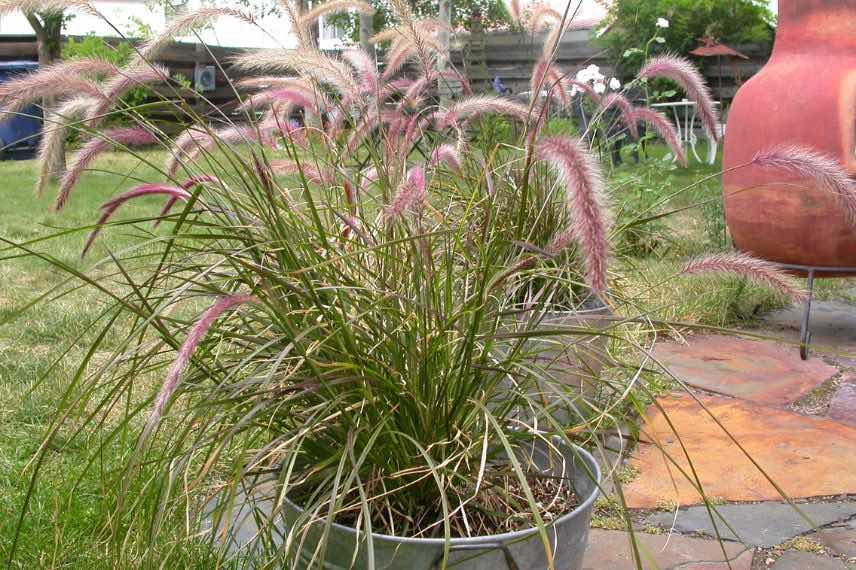
Terracotta pots are recommended for grasses such as Chinese fountain grass, because they allow good root respiration. This porous material helps regulate substrate moisture, letting excess water evaporate more readily. Terracotta pots are heavier, which can be an advantage for stabilising plants such as Chinese fountain grass that can become quite large. However, they require more frequent watering, especially in summer.
Plastic or resin pots are also a viable option; they are lighter and often more affordable. They retain moisture better, which can be beneficial if you cannot water regularly. However, they do not allow roots to breathe as well as terracotta pots. Make sure to choose a quality plastic pot, UV-resistant to prevent it from degrading too quickly in the sun.
Pot size
Chinese fountain grass, with its bushy habit and spreading roots, needs ample space to develop fully. It is recommended to choose a pot at least 30–40 cm in diameter and depth. This size allows enough space for the roots to spread, thereby ensuring good stability for the plant. A pot that is too small risks restricting growth of Chinese fountain grass and making it more vulnerable to water and nutrient stress.
Which substrate?
Pennisetum appreciates a light, organic-rich, well-drained substrate. A high-quality universal potting compost provides a perfect base. It offers a balance between water retention and aeration, which is crucial to prevent the substrate from becoming too compact or waterlogged. To improve drainage, mix the universal potting compost with river sand. A mix containing around 20% sand will lightens the substrate and ensure rapid drainage of excess water.
If you would rather not prepare your own mix, you can opt for a potting compost for Mediterranean plants, often enriched with draining elements such as pouzzolane. These composts are formulated to meet the specific needs of plants that like light, well-drained soils.
Provide a drainage layer at the bottom of the pot. The expanded clay pellets or gravel are the most commonly used materials for this layer. A thickness of 3 to 5 cm of this material will ensure that excess water can drain away quickly, preventing roots from sitting in stagnant water.
If you don’t have expanded clay pellets or gravel to hand, broken pottery pieces can also do the trick. They help to keep drainage holes clear, preventing the substrate from clogging them.
Also provide an organic mulch to keep the substrate cool and protect the roots in summer. Mulching also helps to maintain a more stable substrate temperature.
Read also
Pennisetum: 7 ideas to pairing themHow to grow Pennisetum in a pot?
Planting of Pennisetum takes place between March and June or in September and October. Avoid periods of high heat or frost.
- Remove the root ball from its nursery pot and, if necessary, tease out the roots.
- Dip it in a basin of water while you prepare your pot.
- Pour a drainage layer of a few centimetres at the bottom of the pot, in the form of clay balls, gravel or pozzolana.
- In a separate container, mix the different components of the potting mix.
- Pour your potting mix into about one third of the pot.
- Position the Pennisetum root ball.
- Top up with the potting mix, gently and evenly tamping down.
- Fill to within a few centimetres of the rim of the pot, and firm down again.
- Water thoroughly.
- When the water has been absorbed, add a little more potting mix if necessary, if any gaps have appeared.
- Mulch to a depth of a few centimetres.
What light exposure should Chinese fountain grass in a pot have?
The Chinese fountain grass prefers sunny exposures. As a rule, give it sun, but don’t hesitate to move the pot into shade or partial shade during hot periods to prevent the growing medium from drying out quickly.
If the tuft is large and the pot is light, watch out for gusts of wind. Likewise, move the pot to a sheltered spot if stronger winds are forecast.
But elsewhere, the Chinese fountain grass is wind- and salt spray resistant.
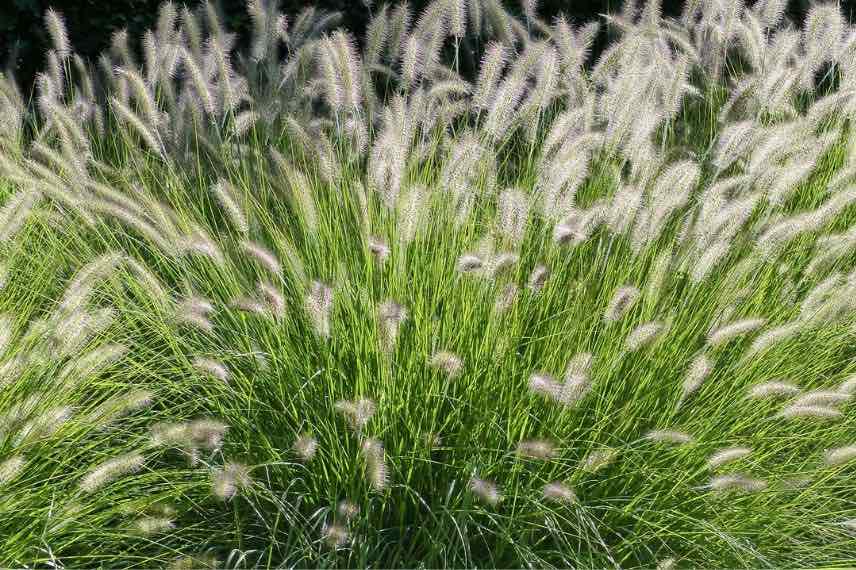
The Chinese fountain grass Pennisetum alopecuroides ‘Hamlin’ enjoys sunny exposure
Watering and fertilisers
A well-watered and nourished plant will develop dense foliage and beautiful inflorescences, characteristics of this ornamental grass.
Watering frequency
Pennisetum has moderate water needs; it is drought-tolerant, but this should not excuse you from watering it, especially in pots. Water regularly to obtain a healthy plant. Watering should be adjusted according to the seasons and weather conditions.
During hot months, Pennisetum in a pot requires regular watering, often two to three times a week, depending on temperatures and sun exposure. Check the moisture of the substrate regularly. Water as soon as the surface of the substrate feels dry to the touch on the top few centimetres, but ensure the water does not stagnate at the bottom of the pot.
During transitional seasons, watering can be reduced to about once a week, to be adjusted according to weather conditions.
In winter, Pennisetum enters vegetative rest and its water needs fall significantly. Water only when the substrate is almost dry, about one to two times a month, depending on conditions. If the pot is outdoors, ensure that water does not freeze in the substrate, as this could damage the roots.
Fertiliser
Pennisetum in a pot benefits from an application of compost or vermicompost or of organic fertiliser in spring, after pruning.
Care
A Pennisetum in a pot is an easy plant to look after, but it still requires some care to stay healthy and keep its decorative appearance.
Pruning
Pruning of Pennisetum should be carried out at end of winter or in early spring, before new growth begins.
Cut the dry stems to about 10 cm from the soil. Avoid cutting into the green foliage or new shoots, as this could weaken the plant, so don’t prune too late in the season.
Repotting
Repotting is ideally carried out in spring, when the plant comes out of its dormancy.
Choose a pot slightly larger than the previous one and prepare a new substrate similar to the one originally used.
Division
If your Pennisetum becomes too large for its pot or begins to lose vigour, you may consider dividing it. Division is carried out in spring, by splitting the clump into several sections with a sharp knife. Each section can be replanted in a new pot.
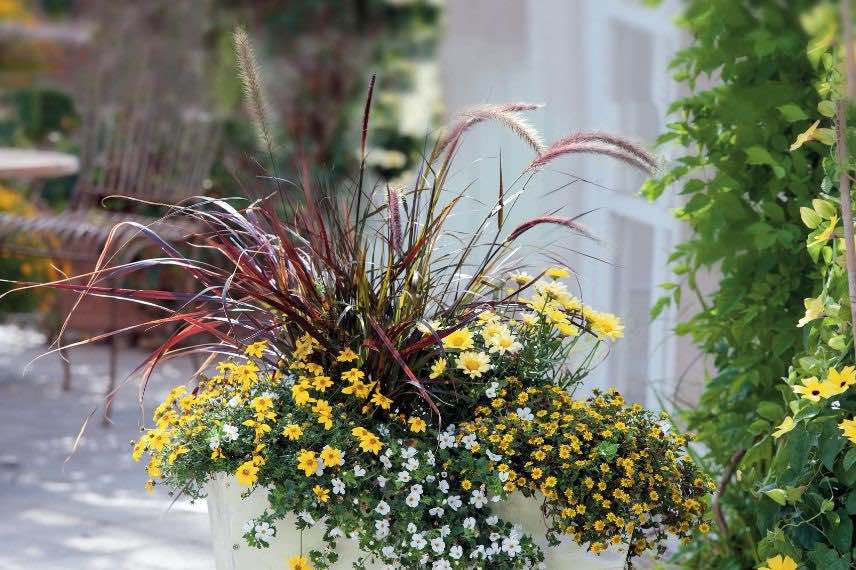
Pennisetum blends easily with other potted plants
- Subscribe!
- Contents
Comments