


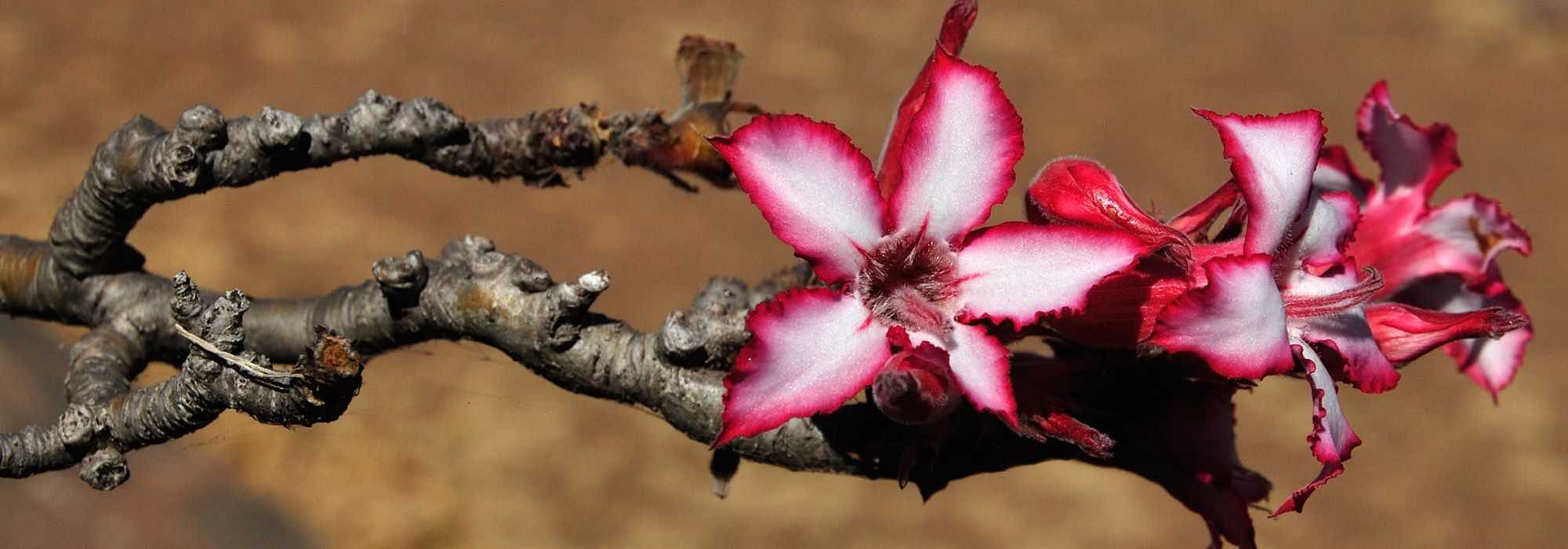
How to grow Adenium or Desert Rose?
Our tips for a successful planting and care of this beautiful succulent plant
Contents
Adenium obesum, also known by its charming name ‘desert rose’, is a succulent with a distinctive aesthetic. It hails from several semi-arid regions of Africa, notably Senegal. This succulent comprises a swollen, fleshy trunk (caudex) in a bottle shape, giving it the appearance of a small baobab. This silhouette has earned it its nicknames of ‘false baobab’ or ‘jackal baobab’. The evergreen foliage is borne on short, erect branches. From mid-spring onwards, Adenium can bloom with pretty pink, red or white flowers, with a contrasting centre.
In our regions, this slow-growing succulent is grown in pots, often as an indoor plant. Due to its origins, it does not tolerate cold at all. While it can reach two metres in height in its natural habitat, it will be much more compact under our latitudes. Outdoor cultivation could be attempted only in our rare regions where frost never occurs and in overseas territories: it would then require a site fully sheltered from wind and the elements.
Here are all our tips for planting and caring for an Adenium in a pot.
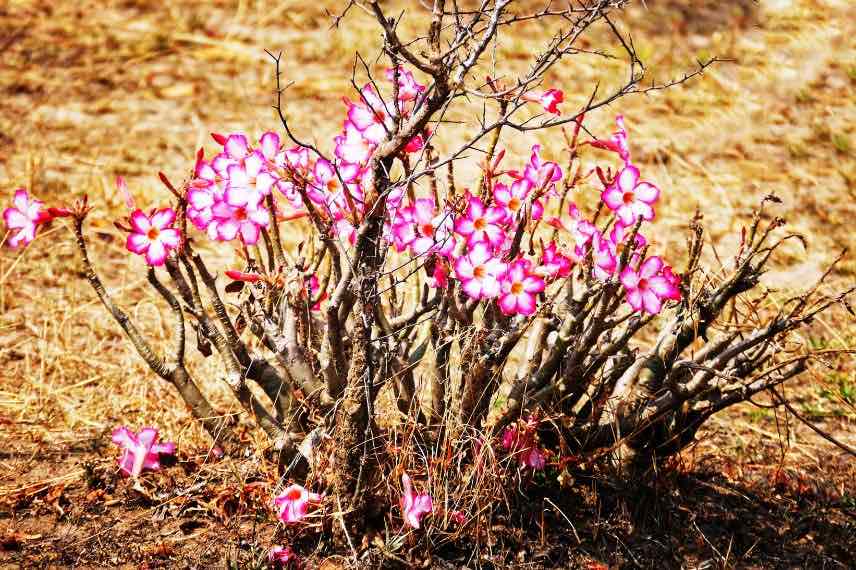
Adenium in its natural habitat

When to plant Adenium?
Potted plants can theoretically be planted year-round (excluding periods of frost or drought). Spring remains the most favourable time. Therefore, ideally plant them between March and May.
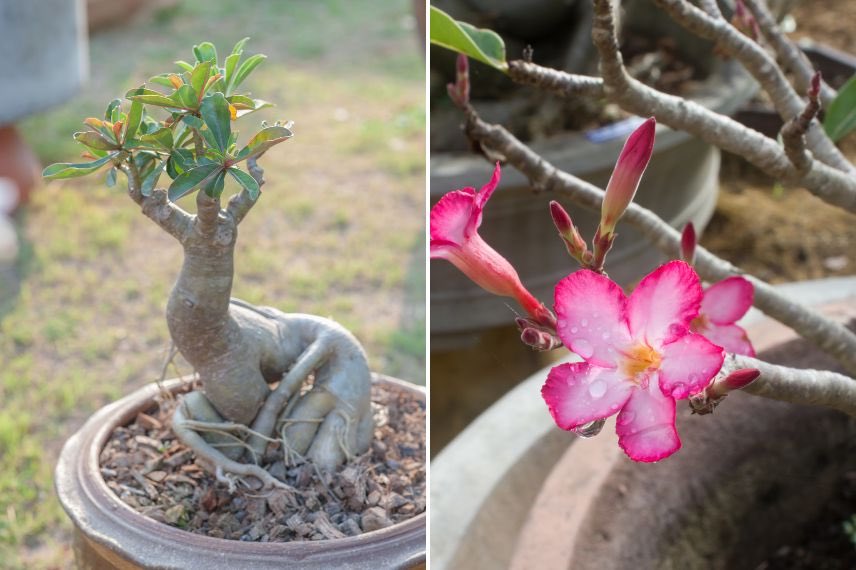
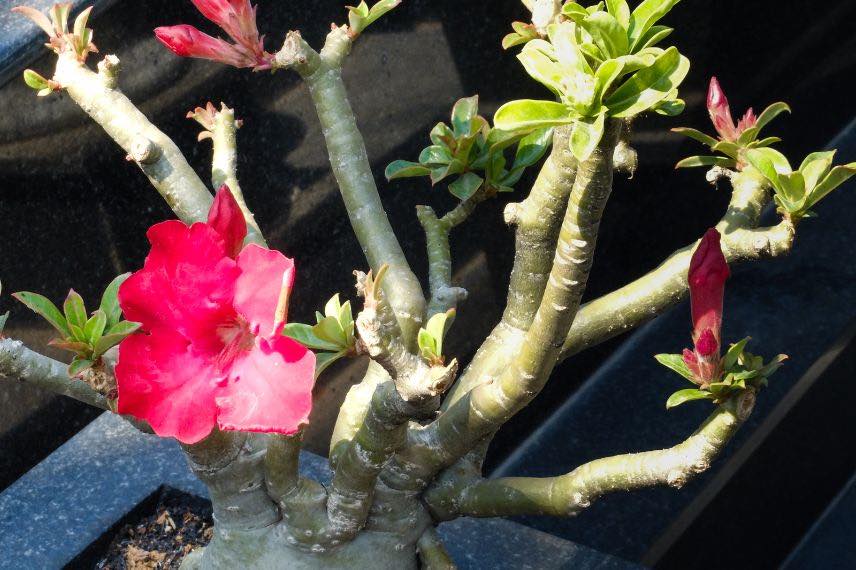
The Adenium in a pot, which will eventually flower
Planting Adenium in a pot
The container
When choosing your pot, you must select a model with a perforated bottom to allow water to drain away.
We always recommend opting for terracotta containers rather than plastic ones, as they let the growing medium breathe more readily due to their natural porosity.
The size of the container depends on the size of the root ball: allow about 20 cm in diameter for a young Adenium.
The growing medium
As with most succulents, the desert rose requires a soil that drains perfectly, in which water flows away easily without stagnating. It will appreciate light soils, even sandy and stony.
Choose a special cactus and succulent potting mix, or make your own blend with:
- half of horticultural potting mix, of half of potting mix for containers and pots, or garden soil even calcareous, but not clayey;
- half of coarse sand or gravel;
- a handful of clay balls or pouzzolane to improve drainage (optional).
The planting
- Install a drainage layer of about 3 to 5 cm at the bottom of the container: clay balls, gravels or broken terracotta.
- Top up with the growing medium until the container is half full.
- Unpot your Adenium and place the root ball in the centre of the container.
- Top up again with the growing medium until it covers the roots.
- Gently firm with your fingers
- Water at the base of your Adenium.
- Add a layer of mineral mulch to the surface (optional).
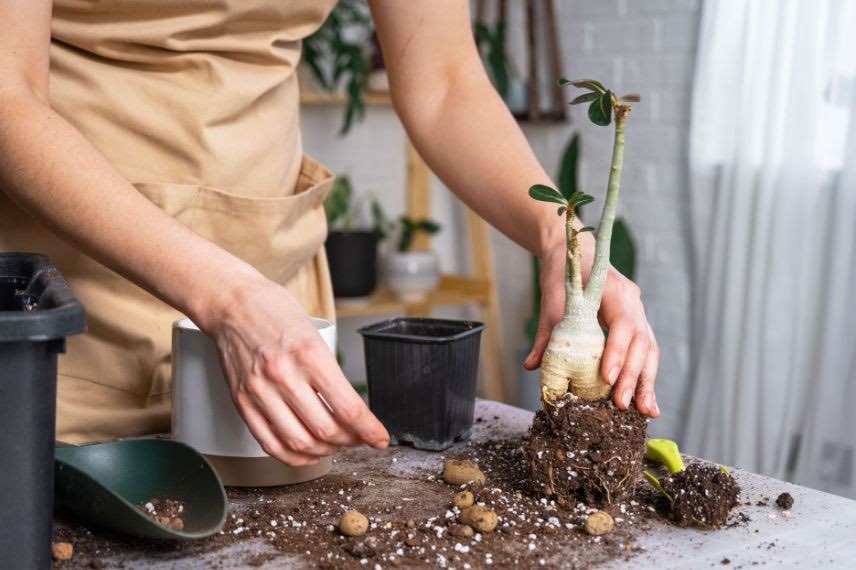
Repotting the Adenium into a well-draining growing medium
The exposure
The Adenium needs several hours of sun each day to thrive. Therefore, provide a well-lit exposure, ideally in full sun or a south- or south-west-facing position. However, remember to place it slightly back from a window to avoid any risk of scorching. The Adenium makes an excellent indoor plant.
During the warmer months, you can gradually move your Adenium outdoors in its pot. Wait until the ambient temperature reaches around 15°C and proceed gradually: first in partial shade, then a few hours in the sun, before leaving it outside for the whole day. The desert rose will thus thrive in the garden, on a terrace or balcony in a wind-sheltered exposure, ideally against a wall that reflects heat and light.
Adenium care
Watering
Like all succulents, the desert rose is not a thirsty plant. It is capable of storing juice in its trunk to endure long periods of drought.
Watering should therefore be carried out sparingly, never leaving the substrate moist for too long. Always let the soil dry between two waterings to a depth of several centimetres at the surface. With these desert plants, less water is best!
Always favour a generous watering less frequently, rather than several small regular waterings. A watering every 15 days will generally be sufficient during the growing period (spring and summer). In autumn and winter, reduce watering to the strict minimum (about once a month, depending on ambient temperature). Some gardeners even recommend not watering at all in winter.
If you have chosen to place a saucer under your container or use a cache-pot, drain them within about twenty minutes after watering.
Avoid watering the foliage.
Fertilising
Succulents are used to growing in poor soils, even barren ones. The Adenium is therefore not a very greedy plant. You can however support its flowering by adding liquid fertiliser to the water used for watering during the growing period.
You can also stimulate the plant’s development by using a special liquid fertiliser for cacti and succulents and/or, optionally, a fertiliser for Mediterranean plants.
Pruning
No pruning is necessary for the Adenium’s maintenance. Simply remove faded flowers as they appear.
If any leaves are damaged or desiccated, cut them off using a disinfected pruning shear. Remember to wear gloves: the latex produced by the plant is irritating.
If you wish, Adenium lends itself well to bonsai cultivation.
Repotting and offsets
Adenium is a slow-growing plant. It can be repotted every two years in spring, depending on its development. Just choose a pot that is slightly larger than the previous one, the plant preferring to be a little snug rather than having too much space.
Pests and diseases
The desert rose is a fairly robust plant, which mainly fears excess moisture and cold.
But if grown indoors or in a confined space in a dry atmosphere, it may suffer from scale insects. In this case, wipe the leaves with a solution of water mixed with black soap (one tablespoon diluted in 1 litre of warm water). In case of aphid attack, spray the same mixture on the affected parts. Do this in the early or late part of the day, away from direct sun.
To learn more, discover our articles “Desert Rose, Adenium: diseases and parasites”, “Scale insects: identification and treatment” and “Aphids: identification and treatment”.
Overwintering
Adenium is a frost-tender plant, which appreciates temperatures consistently above 10°C, or even 12°C. If temperatures fall, the foliage may start to shed. The plant should therefore be kept in winter in a space at least slightly heated. Choose a bright spot: a greenhouse, conservatory or well-lit room.
→ Also find our complete article: “Adenium or Desert Rose: Care Through the Seasons“.
Do not leave Adenium outdoors all year round; it needs temperatures above 10°C or 12°C
- Subscribe!
- Contents
Comments