





























How to grow Alocasia or Colocasia indoors?
And enjoy its beautiful decorative leaves!
Contents
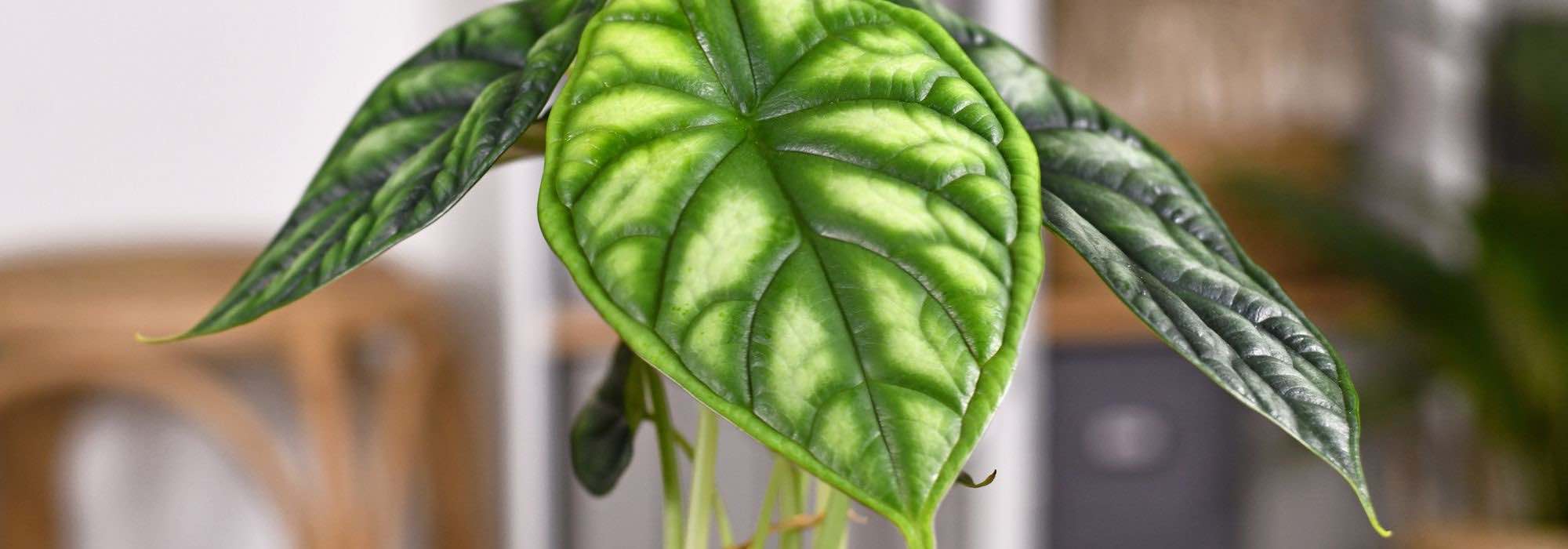
Alocasia forms a genus of 79 species, in the Araceae family, native to subtropical Asia. It is often assimilated or confused with the Colocasia, a very closely related genus, with some distinctions in the shape of the leaves and stems. They are also sometimes called elephant ear or taro. Two of the most popular species are the Alocasia zebrina with its striped stems and the Alocasia macrorrhizos with giant leaves. In our range, these exotic plants are grown as houseplants, in a conservatory or greenhouse, or outdoors in moist soil in the milder regions. Many varieties are sold as houseplants, more or less rare, more or less demanding to grow, with very ornamental foliage.
Here we focus on the indoor culture of Alocasias. Let us examine in detail the aspects of potting, growing medium, repotting, and maintenance.

What type of pot? What size?
Alocasia is a bulb that grows fairly quickly. As an indoor plant, install it in a pot that fits well, but not too tight, so that it can stay there for one to two full years before repotting.
Given its water needs, avoid planting it in terracotta, as the substrate will dry more quickly in that porous material. Choose any other material you prefer.
But be aware that in a plastic pot, the substrate may be dry to the touch on the surface and very wet at the bottom, whereas in a terracotta pot, if substrate is dry on the top few centimetres, it is dry at the bottom of the pot as well. For those not familiar with indoor cultivation, this can be more prone to errors.
Which substrate?
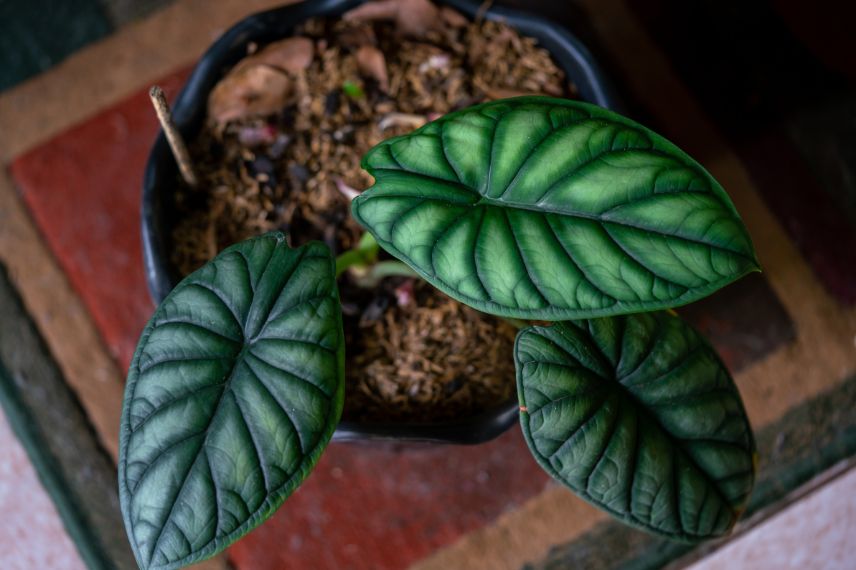
Alocasia prefers a rich substrate with good water retention, but well-draining. Choose a high-quality potting mix for houseplants. Water retention is expressed as a percentage on the bag or on the website. Add 10 to 15% perlite to improve drainage. In dry indoor conditions and/or in a terracotta pot, you can also add 15 to 20% sphagnum moss to retain moisture for longer.
Have clay balls for drainage at the bottom of the pot, around the roots.
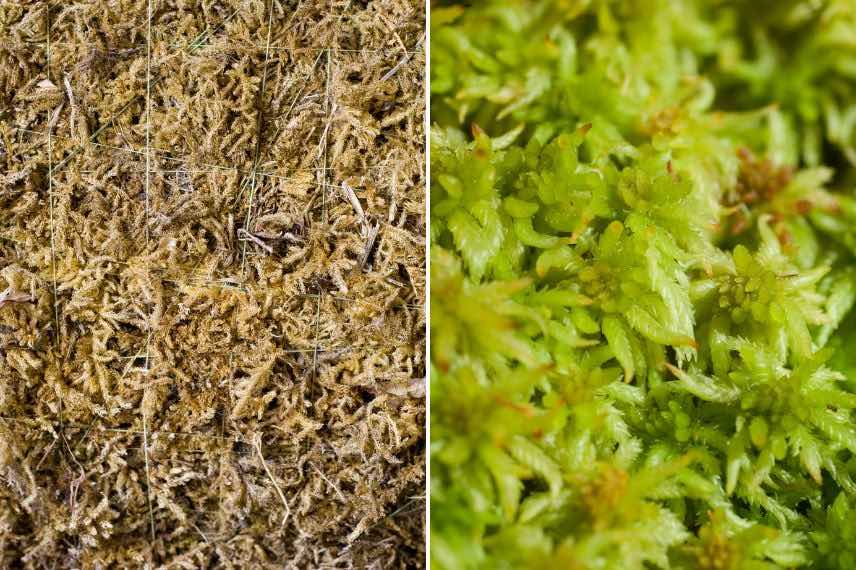
Sphagnum moss has a high water-retention capacity, useful for tropical plants with high watering needs. On the right, living sphagnum moss, once rehydrated
When and how to plant it?
The best time to pot your Alocasia is in spring, when the plant enters its period of active growth. However, indoor plants can be potted almost all year round.
- Pour a layer of expanded clay pebbles a few centimetres deep at the bottom of the pot.
- If you are using sphagnum moss, before incorporating it into the mix, soak it in water for 30 minutes and then wring it out.
- Fill one third to half of the pot with potting compost or the chosen mix.
- Place your plant in the pot.
- Pour in the remaining substrate and gradually firm it around the plant.
- Leave a 2 cm gap below the rim of the pot.
- Water thoroughly the first time, over a sink.
- Repeat the process to thoroughly moisten the substrate.
- Place a saucer under the pot or set it in a cachepot and choose a location that showcases your plant.
Then, Repotting of the Alocasia is necessary about every two years, but check the root-ball annually. To determine whether it needs repotting: check the condition of the roots, that they are not protruding from the pot or forming a tangle at the bottom of the pot. If so, repot! While you’re at it, examine the plant carefully for any parasitic pests. For more information, also read our article: When and how to repot an Alocasia?.
Read also
Colocasia: planting, growing and careWhere to place your Alocasia?
Place your plant near a window so it receives as much light as possible, but not direct sun. A south- or south-west-facing exposure is ideal for warmth and the amount of light, but in that case, filter the rays with a sheer curtain or blind.
You can take the plant outside during the warm season provided you place it in partial shade. Bring it back indoors at the end of summer. Avoid cold spells!
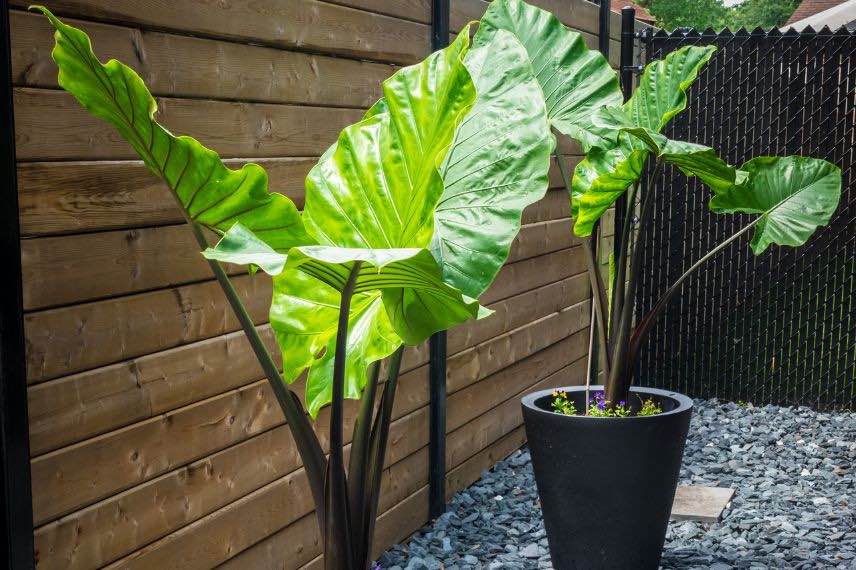
Alocasia macrorrhiza with black stems
Watering and fertilisers
Alocasia prefers moist soil in its natural habitat. Allow the potting mix to dry out between waterings in the top centimetres of the pot, plan for regular, frequent watering and always keep it slightly moist and cool in the pot. Don’t neglect watering your Alocasia; follow it conscientiously, but do not overwater either, which is why a well-drained substrate is used. The substrate should be fresh to slightly damp to the touch, but there should be no standing water.
In a dry indoor environment it may be necessary to mist the plant regularly with soft water and/or to add a humidifier. Ideally, the plant appreciates humidity of around 70%.
If it’s hot, increase watering. In winter, reduce watering frequency, as the plant also cannot tolerate excess watering.
Fertilise every 4 to 6 weeks with a balanced liquid fertiliser, diluted to half the recommended dose.
You can also use a slow-release fertiliser in early spring. Or use amendments such as vermicompost as a replacement or in addition.
Care
When a new leaf appears at the centre of the pot, an outer leaf wilts; remove the second.
Alocasias prefer temperate to warm interiors, at around 22°C, or between 15°C and 25°C.
Keep away from heaters and draughts.
Dust the leaves of your Alocasia with a damp cloth dampened with soft water.
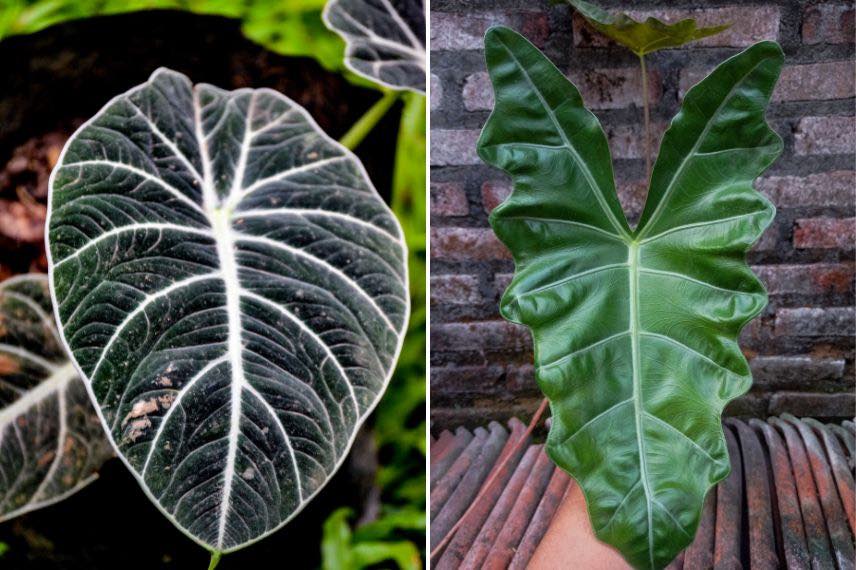
Some Alocasias have large leaves that need dusting
Diseases and pests
Alocasia is not susceptible to diseases, but may be somewhat prone to parasitic pests, notably scale insects. Treat with a natural solution such as black soap. If the atmosphere is dry, it may be susceptible to red spider mites. Mist the plant well.
- Subscribe!
- Contents
Comments