





























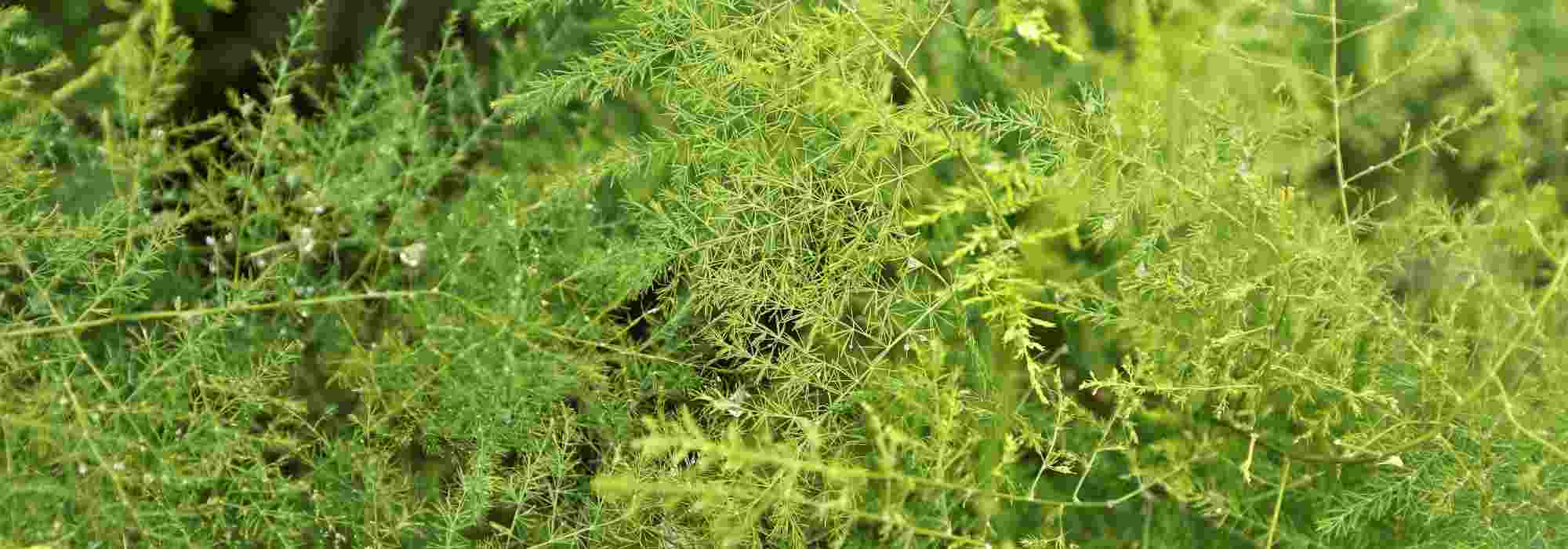
How to grow indoor Asparagus?
As an indoor plant or outdoors
Contents
Generally grown as houseplants, asparagus stands out for its foliage that is very fine, light and feathery, which bears some resemblance to that of ferns. However, asparagus has nothing in common with ferns, as it belongs to the Asparagaceae family, related to the Liliaceae. By contrast, its feathery foliage also resembles that of asparagus. And there, we are on the mark: the Latin name of the ‘asparagus is Asparagus officinalis.
But back to our asparagus, or rather to our asparagus, because this herbaceous perennial plant with a tuberous root and delicate foliage offers several species. Some are mainly grown as houseplants, while others can be used in borders or beds in regions with mild climates. But all enjoy spending the summer outdoors in the garden, or on a balcony or terrace.
Discover how to plant, grow and care for asparagus in a pot, or even in the garden.

The different species of asparagus.
The Asparagus belongs to the family Asparagaceae, which comprises herbaceous plants with rhizomatous roots or tubers. The foliage, with a wispy and very fine appearance, is quite unusual. Indeed, the leaves have taken the form of scales. As a result, it is the stems, divided into thread-like cladodes, that carry out photosynthesis. These stems are very branched, and sometimes bearing thorns. Nevertheless, this ‘foliage’ stands out for its airy, ethereal quality, in a green that is fairly intense. As for the growth habit of the asparagus, it is undeniably bushy, dense, erect or trailing, depending on the species.
Asparagus is a plural term. Apart from garden asparagus (Asparagus officinalis) which we will reserve for the kitchen garden, the most common asparagus is certainly the florist’s asparagus. This is Asparagus plumosus syn. setaceus, sometimes called bouquet asparagus. This plant is endowed with slender, highly branched stems, and leaves reduced to scaly bracts. The tip of the branching is very slender, almost needle-like, giving an overall plume-like appearance (hence the name plumosa). Native to South Africa, this species, with an upright then tabular habit, hardly exceeds 50 cm in height.
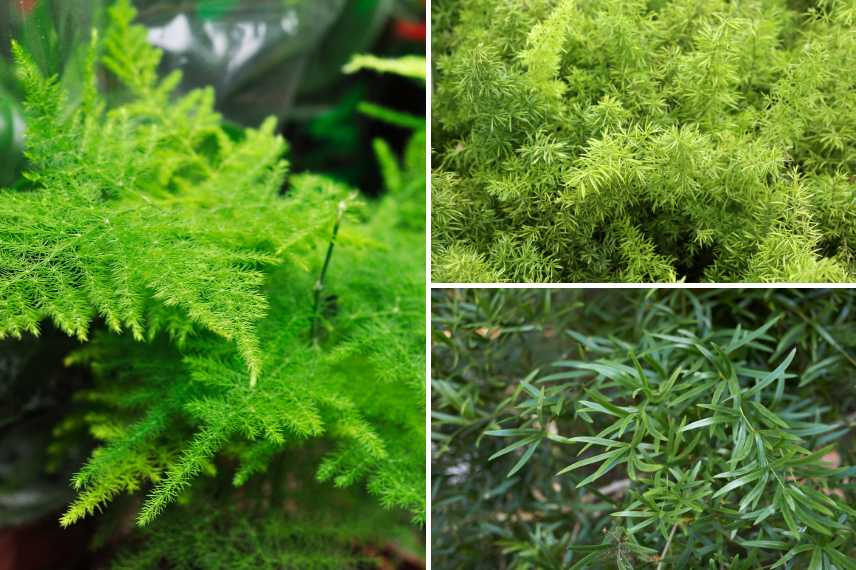
Three species of Asparagus: plumosus, densiflorus and falcatus
Another widespread asparagus, Asparagus densiflorus syn. sprengeri, or Sprenger’s asparagus. This plant is characterised by its trailing ramifications, from the axils of which arise new ramifications, i.e. the leaves, very fine, linear, bright green. The variety Asparagus densiflorus ‘Meyeri’ (or ‘Myersii’), otherwise known as “fox-tail asparagus”, offers panicles that are really tufted and form cones. It is grown outdoors, in regions with a mild climate. Its hardiness is around -4°C.
We could also mention Asparagus falcatus, commonly called “false asparagus” because of the curved aspect of its long leaves. This species has straight stems and reaches up to 1 m in height. Or Asparagus umbellatus, a Canary Islands native species bearing sharp spines and rigid cladodes.
Asparagus can bloom very discreetly in summer. The tiny white flowers give rise to small berries that turn from green to red. These berries are poisonous.
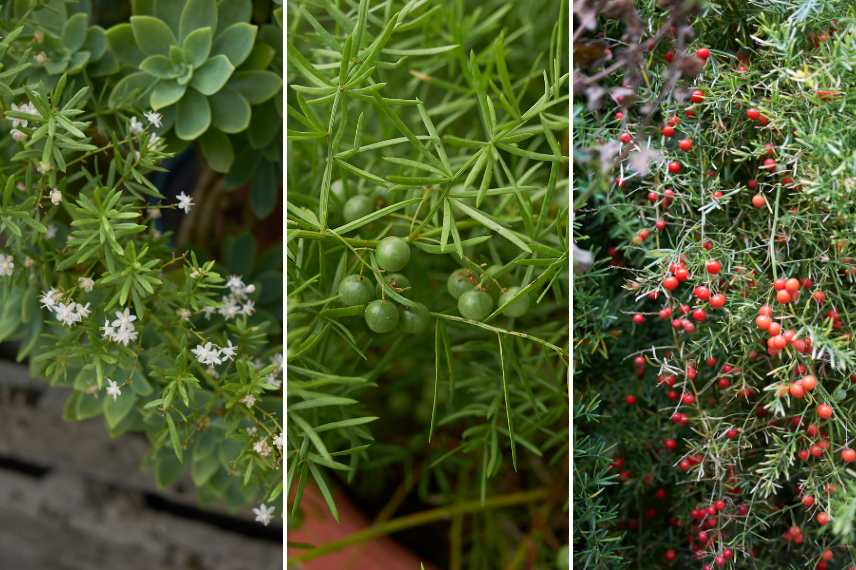
Flowers and berries of Asparagus densiflorus
Planting asparagus
Asparagus is a hardy plant that can be grown indoors, in pots, or even outdoors. But you will need to take into account its relatively low frost tolerance (down to -7°C for the asparagus densiflorius, around -4°C for other varieties). Due to frost sensitivity, asparagus can also adorn pots of annual flowering plants on balconies and terraces. Their feathery foliage will look striking there.
Asparagus are easy to grow and undemanding, and can get by on a free-draining garden loam or a sandy, permeable potting mix. Their growth will be more favourable in a humus-bearing substrate, consisting of leaf mould and sand. But potting compost for houseplants, lightened with perlite or vermiculite to lighten it, should be more than enough for them. The mix should be well-draining and loose.
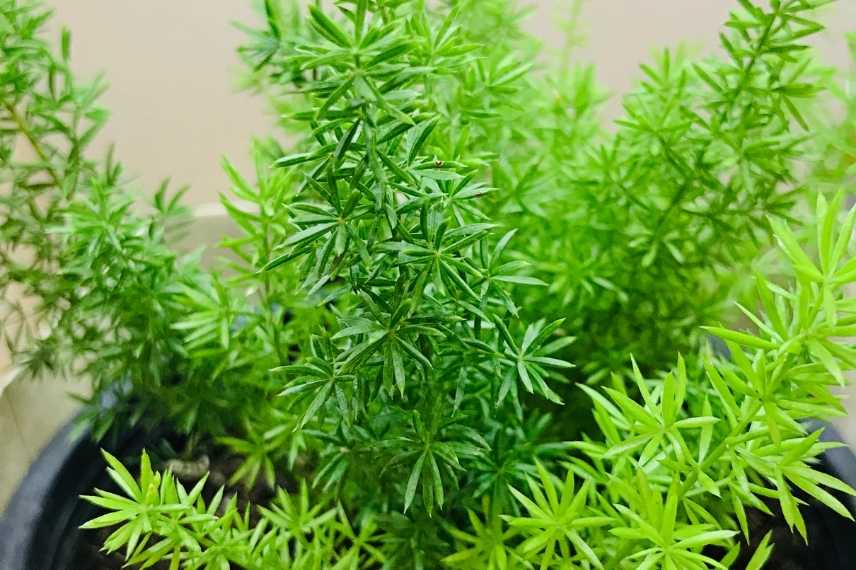
Asparagus in pots appreciates a humus-bearing and light substrate
In addition, choose a small terracotta pot, as asparagus likes to have the roots cramped. However, as asparagus grows quickly, repotting will be regular, every two years. Asparagus require a perfectly drained substrate, so it is essential to place a good layer of clay balls at the bottom of the pot.
Planting in the ground: give your asparagus a perfectly drained, humus-bearing and fairly cool soil, preferably slightly acidic.
Where to install it?
Asparagus likes light, but not direct sun. That’s why indoors, it should be placed in a room with bright, diffuse light, away from direct sun rays. Thus, in winter, asparagus will appreciate the brightness of a conservatory. Moreover, excessive heat isn’t really suitable for it. If you don’t have a conservatory, place your asparagus in a bright room, at temperatures below 20 °C. Ideally, 15 °C would suit it. And it can tolerate temperatures down to 5 °C. So, a non-heated conservatory or winter garden in winter is the ideal spot for asparagus. In any case, asparagus will struggle to tolerate atmospheres that are too dry and temperatures above 25 °C.
In summer, asparagus will appreciate being placed outdoors, in a garden, on a balcony or a terrace, in shade or partial shade, simply illuminated by the morning sun. It should also be sheltered from draughts.
In the ground, asparagus should always be planted in partial shade.
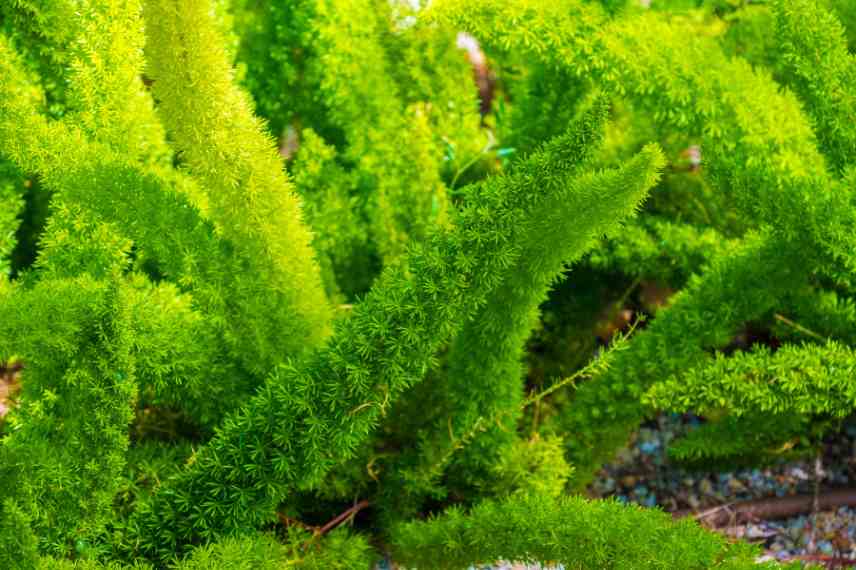
The distinctive foliage of Asparagus densiflorus ‘Meyeri’
How to care for asparagus?
Relatively hardy, low-maintenance, the asparagus requires minimal care, provided its potting mix and light requirements are met. A few care steps are essential.
Watering
Asparagus plants appreciate generous watering, two to three times a week in summer during hot spells. In winter, watering every ten days is more than enough. Concretely, the root ball should never truly dry out, meaning it should remain slightly moist between waterings. However, do not let water stagnate in the saucer or the cachepot.
If the room housing your asparagus has dry air, it is recommended to mist the foliage with non-calcareous water, ideally rainwater. Likewise, you can place your pot on a bed of waterlogged clay pebbles.
That said, a temporary water shortage is not fatal. The foliage may yellow and drop, but, with the resumption of watering, it will regain its beauty.
In the ground, asparagus should also be watered regularly to keep the soil moist.
Fertilisation
In a pot, the substrate becomes depleted fairly quickly. That is why an application of liquid fertiliser for green plants can be made once a month, during the growing season, i.e. from April to October.
Protection against the cold
In winter, like all green plants, asparagus goes into dormancy. Therefore it is recommended to place it in a bright and cool room, ideally with a temperature between 5 and 15 °C. A conservatory or a winter garden are suitable solutions for asparagus.
In the ground, asparagus should be protected from the cold by a thick mulch, for example dead leaves. It will thus withstand a few light frosts.
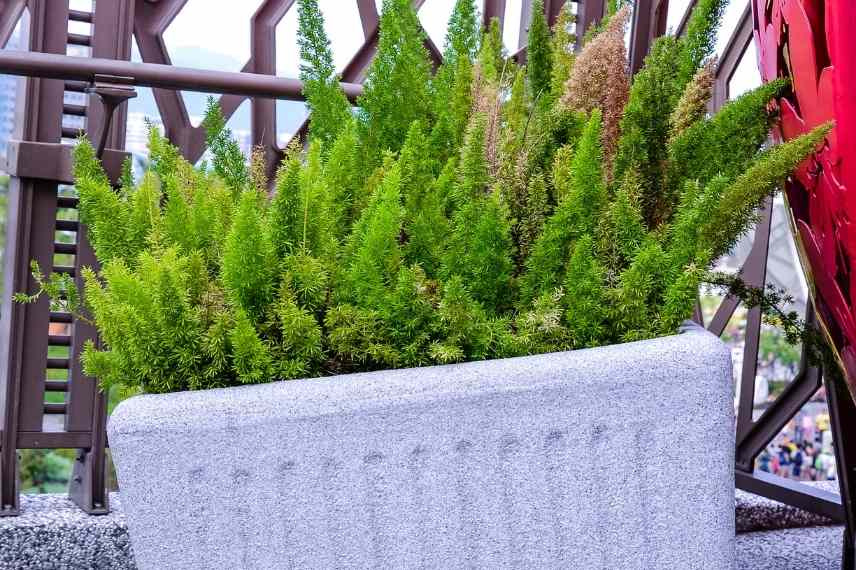
Asparagus enjoys spending the summer outdoors in partial shade
Pruning
Asparagus plants tend to lose a few leaves and prickles. This leaves long bare stems that are not very attractive. To prevent this leaf drop, pruning back the oldest stems helps stimulate the rise of new shoots. This pruning also has the merit of keeping a compact habit.
Repotting
Asparagus benefits from relatively rapid growth. Often, its tuberous roots which store moisture become visible. This is the time to repot. But this repotting must always be accompanied by root reduction, as the roots are very vigorous and can become invasive.
This division of the crown and repotting take place in spring. Simply lift the root ball from the pot and cut the roots with a pruning shear into two or three pieces that will be replanted in new pots.
Overall, repotting takes place every two years.
→ Also read: Indoor asparagus: how to care for it season by season?
The main problems with growing asparagus
Asparagus is relatively hardy and can occasionally suffer from parasitic infestations or diseases. If the atmosphere is too dry, aphids and mealybugs can invade foliage. Foliage misting is enough to prevent these infestations. However, if the mealybugs and aphids are already established, you must act quickly. Here’s everything you need to know: How to get rid of aphids on houseplants? and Mealybug: identification and treatment.
For red spider mite attacks, a good foliage misting with rainwater is very effective. For more information: Red spider mite: identification and treatment.
Otherwise, if the foliage turns yellow and drops, it may be a lack of water or a lack of light. However, too much water can cause rootstocks to rot.
- Subscribe!
- Contents
Comments