





























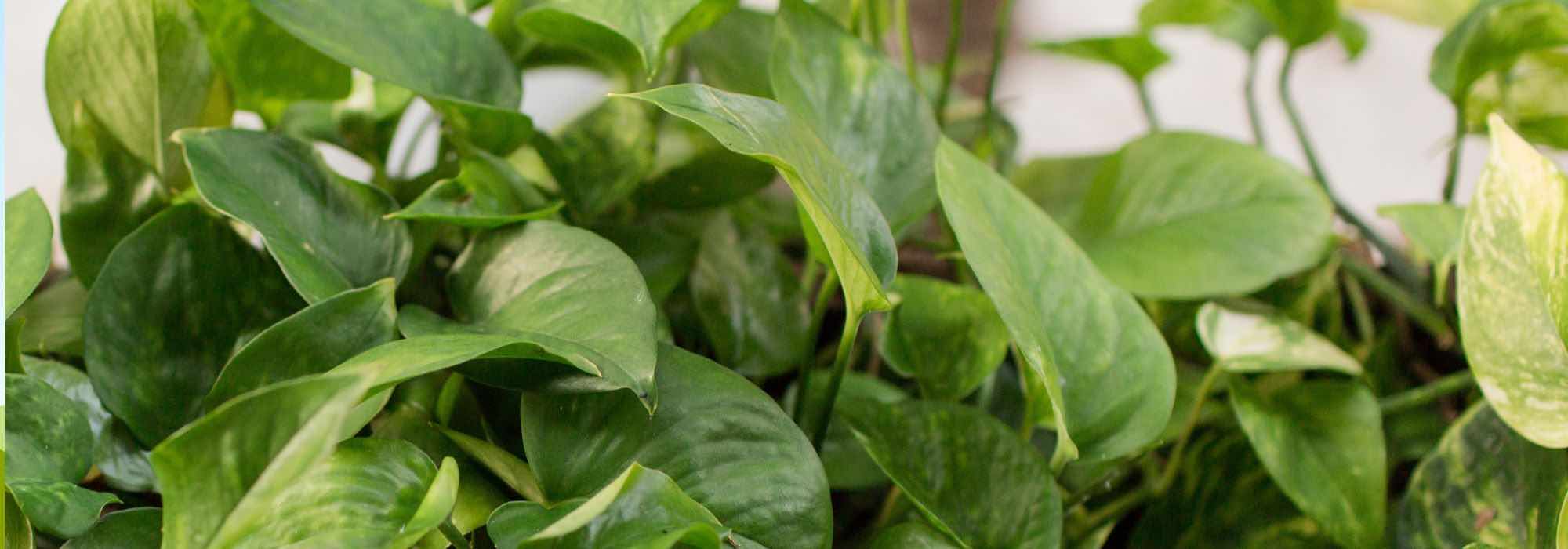
How to grow pothos?
Our growing tips for this popular indoor plant
Contents
Pothos, by its Latin name Epipremnum aureum, is also known as Scindapsus. It is a popular indoor plant valued for its vigorous growth and easy care. This trailing green plant is ideal for bringing a touch of greenery to any indoor space where it cascades gracefully from a hanging pot. In this article, let’s examine the essential steps to grow and care for your Pothos.
For clarity, we keep the Pothos name, as it is the most well-known, but the correct name is Epipremnum aureum. There are various varieties, often with variegated foliage, whose cultivation conditions are similar. Only a few are more finicky, but they are generally rare and expensive.

What type of pot? What size?
Choose the pot you like, because Pothos is very forgiving. Terracotta, being porous, allows rapid evaporation of moisture, useful for some plants. But Pothos can certainly be potted in any pot material. Make sure the pot has drainage holes to prevent water from accumulating at the roots. Add a saucer or a cachepot.
For a young Pothos, a pot measuring 12 to 15 cm in diameter is appropriate. Choose a pot that is slightly larger when repotting to allow root growth by a few centimetres in diameter or about 20% wider. Keep it snug, as indoor plants like to grow a little snug.
As the plant forms long stems that spill over the pot, plan to place it high on a shelf or hang the pot in a macramé, for example. You can also train the plant to climb a support.
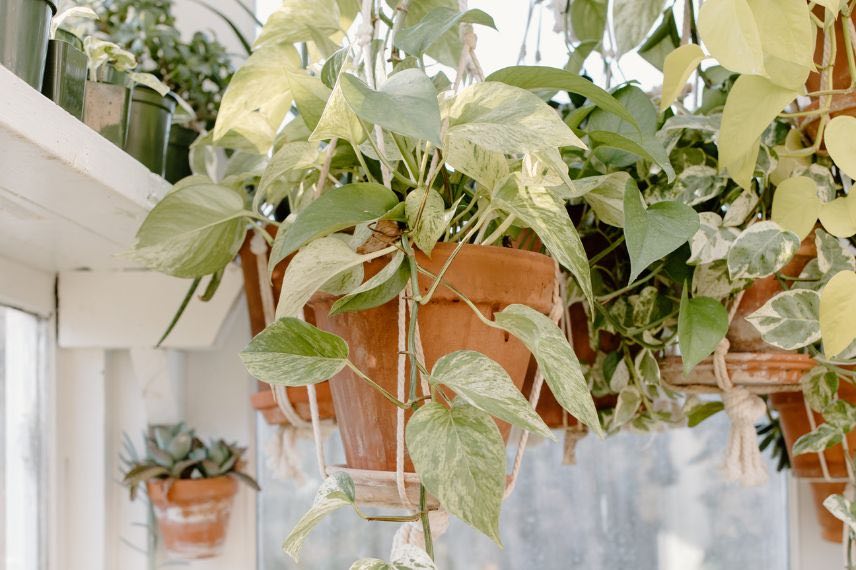
Beautiful hanging pots featuring various variegated Pothos
Which substrate?
Grow Pothos in a single high-quality potting mix, with good water retention and drainage, turf-based. Optionally, add 20% of perlite or vermiculite to your potting mix, always useful to aerate further and compensate for potential moisture excess.
Stock up on clay balls for drainage at the bottom of the pot.
When and how to repot?
When you buy the plant, the potting mix is not always of good quality and the plant has sometimes spent too long in its pot. Check the condition of the roots. If they protrude from the pot or form a rootball at the bottom of the pot, repot. Do the same if the potting mix is sticky, or too compacted.
Take the opportunity to inspect the plant carefully for pests.
Then, repotting the Pothos is usually necessary every year, or when the plant becomes pot-bound in its current pot. Spring is the ideal time to repot, when the plant enters its active growth phase. However, houseplants can be repotted pretty much all year round.
How to proceed?
- Fill the bottom of the pot with a drainage layer a few centimetres deep, consisting of clay balls.
- Fill about one third of the pot with your mixed potting mix.
- Position the plant.
- Pour in the remaining substrate and firm it down gradually.
- Stop about 2 cm below the rim of the pot, aligning with the base of the main stem.
- Water it thoroughly the first time, over a sink.
- Place a saucer under the pot or put it in a decorative cachepot.
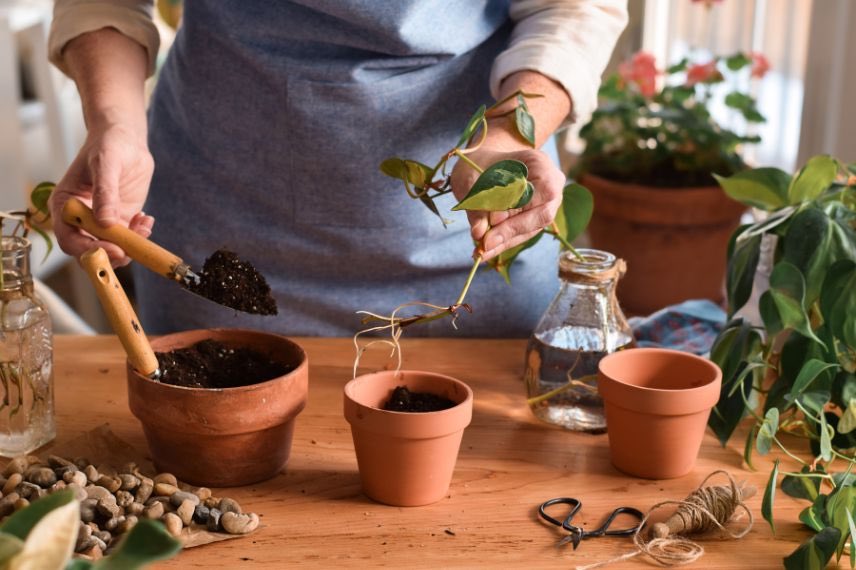
Pothos is easy to repot, simply add a little perlite to a quality potting mix
Watering and fertilisers
Water your pothos when the top of the potting mix is dry to the touch, taking care not to wet the leaves. During the growing season (spring to autumn), water regularly, allowing the potting mix to dry out slightly between waterings. Reduce the watering frequency in winter.
Feed every 6 weeks with a balanced fertiliser for indoor plants, diluting the recommended dose by half.
Where should you place your Pothos?
Place your Pothos in a well-lit spot with indirect light. Avoid direct sunlight, as it can burn the leaves and affect growth quality. The Pothos will also grow in lower light conditions, but its growth is less vigorous there.

A Pothos beautifully showcased in this round pot
Care
Turn your Pothos regularly to prevent growth from leaning towards the light on one side. Dust the leaves gently with a damp cloth to remove dust.
Pothos grows fairly quickly in good conditions.
You’ll need to trim the stems of your Pothos when they become too long, to keep the plant aesthetically balanced.
Take cuttings from your cut stems, either to produce more plants or to reintegrate them into the main pot alongside the mother plant.
If light is insufficient, nodes between the stems can be too long, that is, the spacing between the leaves on a single stem is too wide, which isn’t very attractive. Don’t hesitate to cut the stems and move your plant to a better-lit spot.
Propagation
Pothos propagation can be achieved by stem cuttings in water. Select one or more healthy stems, cut just below a node, and place the cutting in a transparent glass jar. Fill with water, ensure the node is submerged, and leave for several weeks in bright light, but not direct sunlight, until roots develop. Change the water regularly. Once roots have formed, transplant the cutting into a pot with the appropriate potting mix.
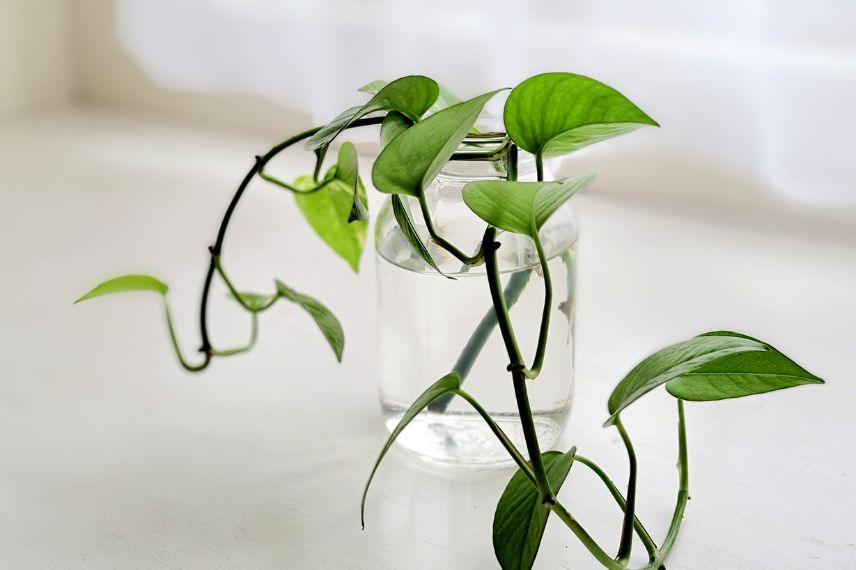
Pothos water cuttings are decorative
Diseases and parasites
Pothos is generally disease-resistant. Parasitic pests such as mealybugs and red spider mites can be a nuisance. Regularly inspect your plant for signs of infestation and take appropriate action if necessary by using natural solutions.
By carefully following these detailed steps, you will create an optimal environment for growth and prosperity of your Pothos as a lush, trailing houseplant. Enjoy its elegant stems that adorn your shelves, hanging baskets or windowsills, adding a touch of freshness to your indoor space.
- Subscribe!
- Contents

Comments