





























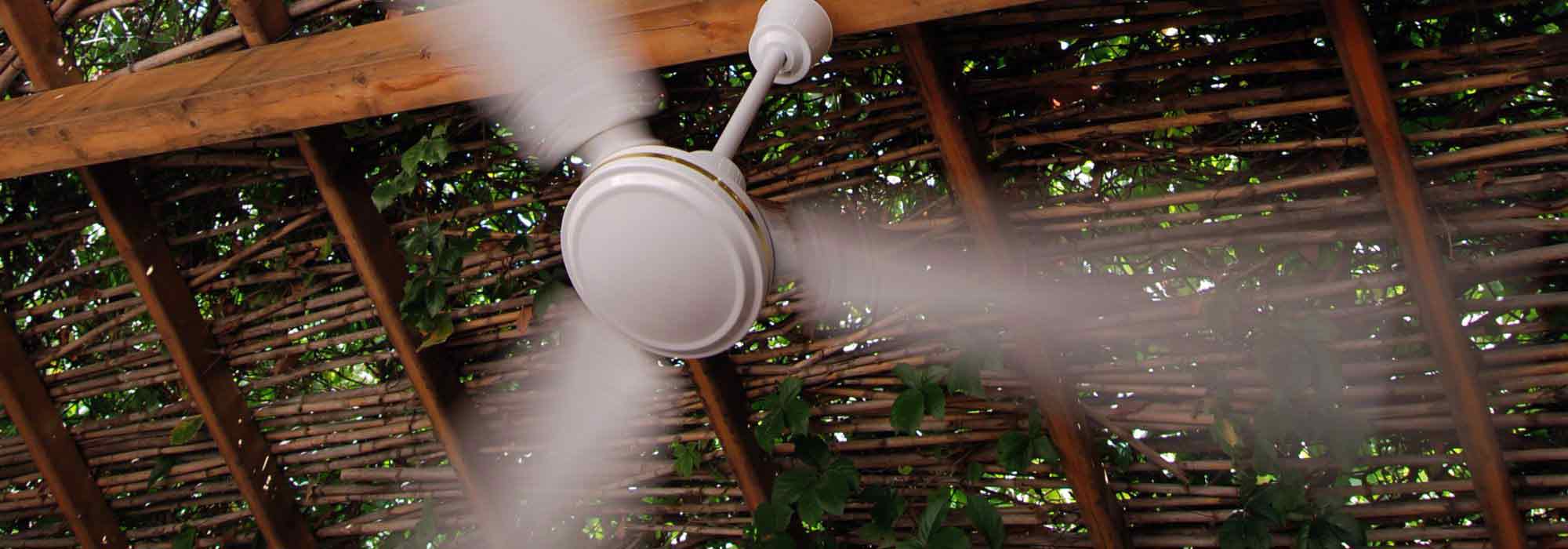
How to refresh your balcony and terrace in summer?
To better withstand heatwaves!
Contents
When the sun beams down and the heat settles in for the long haul, even summer lovers seek a bit of coolness. In the city, having a simple balcony or a small terrace doesn’t mean giving up on enjoying your outdoor space, even in the height of summer. In the face of heatwaves, it is entirely possible to transform these limited spaces into genuine cool bubbles.
Clever arrangements, well-chosen plants, suitable shading, or the refreshing presence of water: a few simple solutions are enough to effectively cool a balcony or terrace. Discover how to “climatise” your little summer green space naturally.

Well consider the orientation
In general, terraces are exposed to the sun. Bringing a real quality of life with the arrival of fine weather, when we are happy to enjoy every ray of sunshine, this orientation can quickly become a problem when the ambient temperature soars above 30 °C. When purchasing or constructing, consider optimising the orientation of your outdoor living space: in the height of summer, a naturally shaded terrace—not fully south-facing—is particularly appreciated for lounging and enjoying meals with family or friends. The downside of a south-facing terrace is that it becomes very hot in summer, as do the rooms that open onto it, where blinds and shutters will be closed all summer long.
East-facing orientation is perfect for early risers who enjoy the first rays of morning sun while having breakfast. After reaching its zenith at midday, the sun then disappears behind the house, leaving a beneficial shade ideal for the afternoon. Many plants also appreciate this exposure. West-facing orientation, on the other hand, is ideal for those who like to spend time outdoors as the sun begins to decline and its rays become less intense, in the late afternoon and evening. Few choose a north-facing orientation, and this is generally a choice dictated by the layout of the house and/or the land. A north-facing terrace is always in the shade: while it is true that it is pleasant to live in during summer, it is too cool in spring and autumn.
The ideal configuration may be an L-shape, with one part facing south for spring and either east or west for summer.
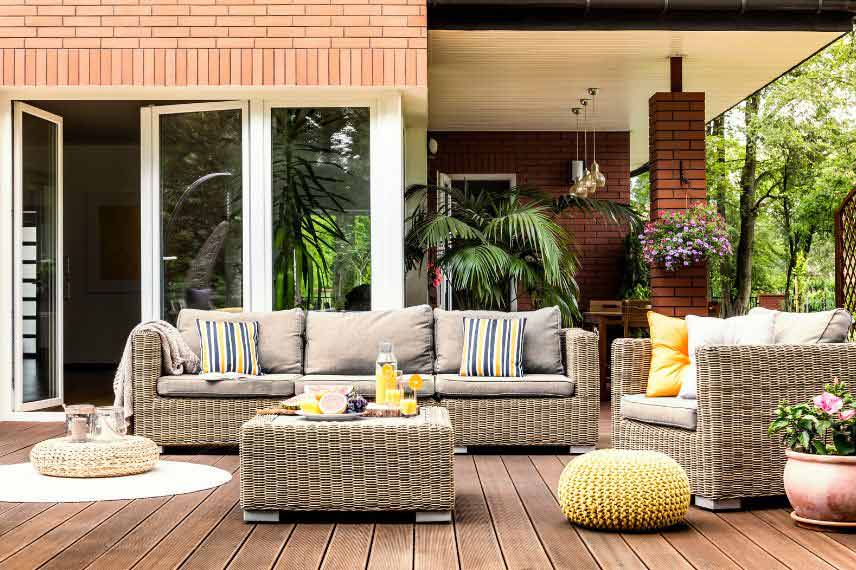 When wisely oriented, a terrace or balcony can avoid receiving too much sun during the day in summer.
Read also
Greening to cool the ambient airShade
Parasols, shade sails, gazebos, pergolas… there is a plethora of equipment designed to block out the sun. Of course, the choice and placement will depend on the size of your space and its orientation. Spacious or narrow balconies, corner terraces or large areas along a façade… you will not have the same space available and will need to consider this crucial factor when choosing and placing your shading structure.
Parasols
Gazebos and Pergolas
Gazebos create small shelters with multiple sides, removable or not, and are more suited to gardens and terraces, while pergolas are generally leaning against a wall. The latter are therefore more suitable for balconies, with their dimensions adapted to the location. If you choose one of these elements, it will be installed for years and will allow you to create a pleasant living area, sheltered from the sun.
- Some gazebos or pergolas can be adorned with plants. Opt for deciduous plants (which lose their leaves in winter) if you want to enjoy both coolness in summer and sunlight in winter.
- Reed screens create a pleasant shade, filtering the sun’s rays more or less softly. There are PVC screens, which are not very eco-friendly, but prefer natural screens. If the top part is flat, you can also cover your gazebo or pergola with natural materials such as Provence cane or bamboo stalks, or even branches. These should be straight, not too thick to avoid excess weight, and long enough. You can nail or screw them in more easily if your structure is made of wood, or secure them with thick wire. It may be a bit of work, but the satisfaction of doing it yourself and the savings at the end are worth it!
- Textile canopies, generally removable, allow you to adjust the exposure of your terrace or balcony to the sun depending on the weather, removing them once the nice season is over. As with parasols, be mindful of wind resistance and the strength of the attachments, as the canopies can be easily torn away by strong winds.
- If you want to transform your terrace into a comfortable living space, a bioclimatic pergola will be a good option.
Shade Sails and Awnings
Perfect for saving space, opt for a retractable awning or shade sails. The latter are very easy and quick to install and perfect for small budgets. Awnings are fixed to the wall and can be deployed as desired depending on the sunlight.
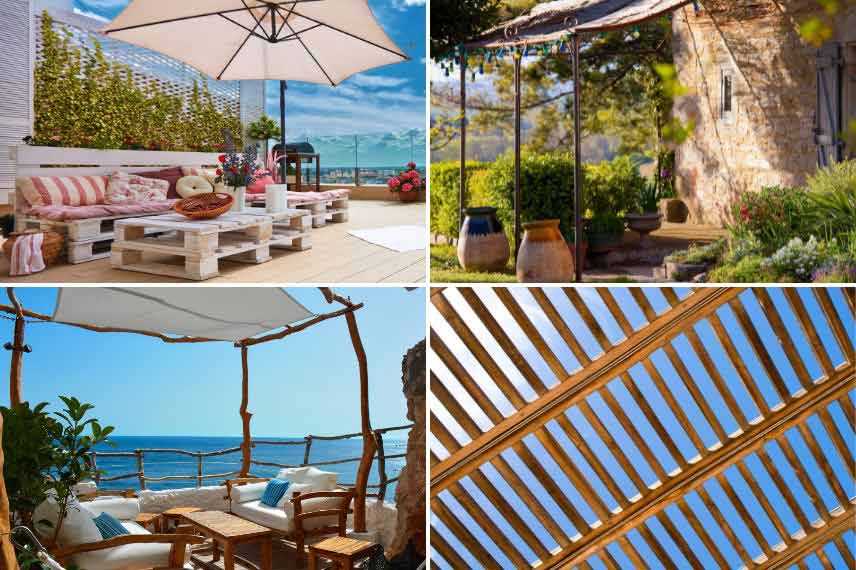 Parasols, pergolas, and shade sails help bring freshness during the hottest hours.
Vegetalise
It is well established that plants can effectively cool the air. There are both direct effects through shading and the reflection of UV rays by the foliage of plants, as well as indirect effects through the release of some of the water absorbed from the soil by the plants, thanks to evapotranspiration. Walls and roofs are also insulated by the air contained within the mass of plants, acting as an insulator. Trees, climbing plants, and potted plants will effectively cool your balcony and terrace while creating a green cocoon that enhances your well-being!
Trees
For small spaces, choose species with moderate growth. Near a terrace, plant an Albizia, a Pride of India (Koelreuteria paniculata) or an Chitalpa tashkentensis that will lightly shade the terrace. It produces beautiful clusters of pink, fragrant, and melliferous flowers in summer. A true plant parasol when grafted on a tall stem, the Catalpa ball (C. bignonioides ‘Nana’) is distinguished by its compact habit and large, exotic-looking leaves. The Weeping Sophora is a charming small tree that is perfectly suited for small spaces near a terrace.
Shrubs and Bamboos
On the terrace or balcony, you can place vertically growing plants in pots. They will create a persistent screen that blocks views and wind, while also protecting you from the sun’s heat. Layer your plantings to create a lush and fresh volume all around your outdoor living space!
- We immediately think of the must-have bamboos: Phyllostachys or the Fargesia murielae ‘Dino’ which, with its rapid and vigorous growth, is one of the tallest species. Alternatively, the Bambusa glaucescens ‘Multiplex’, which is not very hardy, forms a very dense and compact clump at the base, widening towards the top.
- With their palm-like silhouette and narrow leaves often beautifully coloured, like the Cordyline australis ‘Red Star’ or Cordyline indivisa, Cordylines are evergreen plants that are interesting for vertical gardening and are highly appreciated in southern gardens.
- Generous and fast-growing foliage like that of banana plants, Colocasias, or large-growing grasses like some Miscanthus also help create beautiful, cool, shaded atmospheres.
- Our selection of shrubs for pots will also help you find suitable subjects for your space and tastes, keeping in mind that the growth of potted plants is more limited than in the ground. Evergreen shrubs are interesting for greening your green cocoon all year round.
Climbing Plants
By installing climbing plants that will dress the structure of a gazebo or pergola, you will achieve a charming result, very effective for obtaining pleasant coolness in summer. But also let them climb your walls for an enhanced “natural air conditioning” effect, both outside and inside!
- Deciduous plants will allow you to enjoy the sun’s rays in winter, while evergreens, like Star Jasmine or Banks Rose, will provide perfect shade on a large south-facing gazebo.
- Also consider fragrant plants like wisteria, honeysuckles, Jasmines, or some Clematis that will delight you with their scents during the flowering period.
- Productive plants like kiwis, vines, or climbing squashes can provide you with both shade and beautiful fruits and vegetables.
- Finally, mineral surfaces are much warmer in summer than vegetated surfaces: why not maximise your greening and eat with your feet on the grass instead?
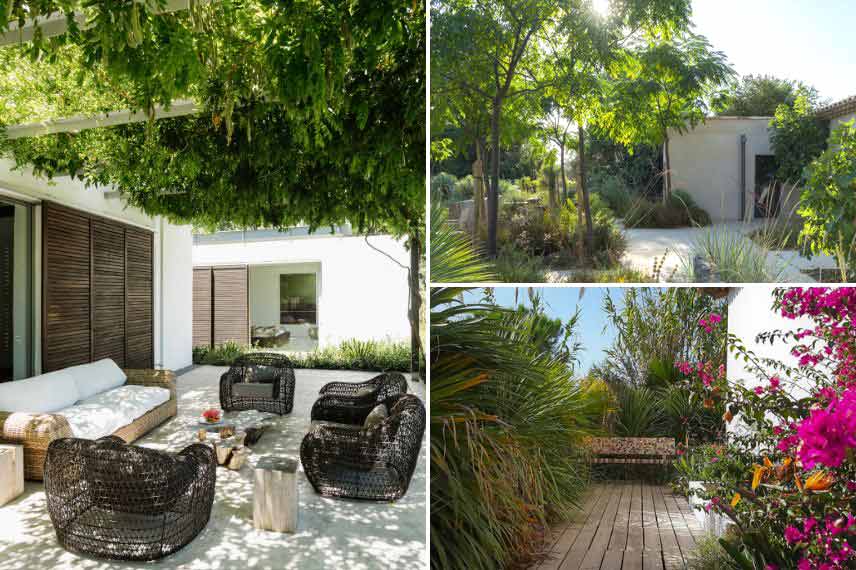 It’s the vegetation that will bring the most freshness to your outdoor living spaces[/caption>
→ Are heatwaves prompting you to green your balcony or terrace? Discover 7 fast-growing climbing plants!
Ventilate
An easy solution to enjoy more fresh air in summer is to use one or more fans. To avoid excessive electricity consumption, opt for a solar model: the blades that create the draught are powered by a low-consumption electric motor capable of running solely on the current produced by a photovoltaic panel: efficient and eco-friendly!
Avoid colours and materials that retain heat.
It is well known: light colours reflect more solar radiation than dark shades. They therefore store less energy and heat. The City of Los Angeles even launched a large initiative in the summer of 2017 to repaint its streets white, aiming to lower ground temperatures by 6 to 7 °C. On the terrace and balcony, opting for light colours can significantly cool the atmosphere!
On the ground, choose light tiles or wood and refresh your wall sections with light paints, while remembering to check with your local council about regulations. However, if your little outdoor space is very sunny, avoid white, which can easily dazzle and get dirty, and opt for shades like sand and beige. If you do not wish to undertake major renovations and the ground is covered with a dark surface, consider light outdoor rugs to attenuate heat radiation.
Finally, whether for your furniture or decoration, choose natural materials (wood, natural fibres, terracotta for pots) and set aside plastic furniture that heats up quickly under the sun.
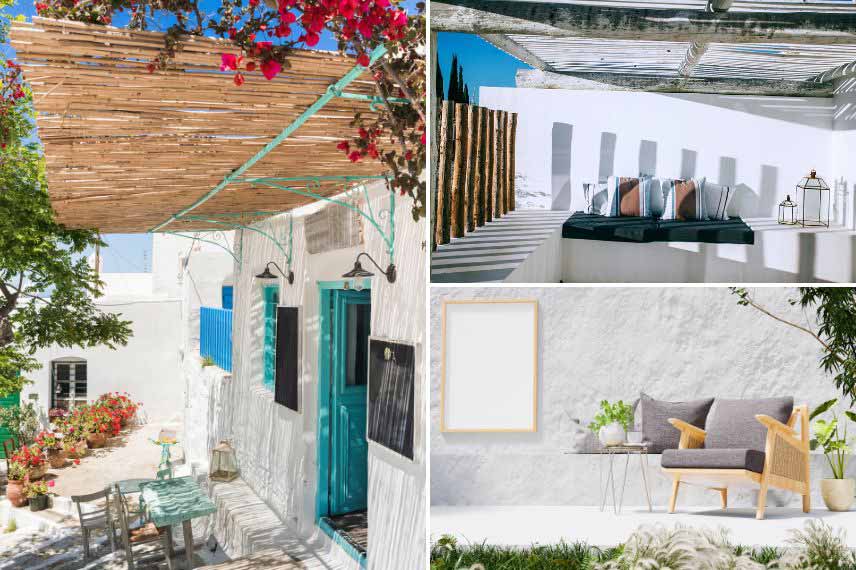 Take inspiration from Mediterranean countries that adopt light colours to absorb as little heat as possible
The presence of water
The presence of water is precious for refreshing the atmosphere! In a small space like a balcony, insert a stylish wall fountain or one with a more romantic look. Creating amini aquatic garden in a container or waterproof pot will enliven your small space and create a sort of verdant, fresh, and flowering oasis. Zen and refreshing, aquatic plants will also create a vibrant little universe of colours and sensations around you. Find our tips and inspirations to easily create a small water garden for your terrace or balcony.
If the heat is truly unbearable, many retailers now sell terrace misters that can be attached to a hose, and even kits that include several misting nozzles, which can be fixed to a pergola, for example. The mister creates a cloud of water droplets that cools the atmosphere. However, be mindful of water consumption, which is an infinitely precious resource!
The garden shower generally accompanies a pool or spa, but even without aquatic equipment, it is also welcome for cooling off on hot days. There are many models of solar showers available, equipped with a reservoir. For added comfort, some come with a mixer tap to adjust the water temperature. Consider drainage, which can be problematic on a balcony perched high up!
Finally, if your budget and ecological beliefs allow, the inflatable spa, easy to set up on a terrace (provided there is enough space) will be ultra-light and easy to store at the end of the warm days. Its installation is very simple; it inflates quickly thanks to an integrated system, and then you just need to fill it (generally between 800 and 1100 litres of water). Caution: before installing this type of equipment on a large balcony or rooftop terrace, ensure that the building’s structure can support its weight!
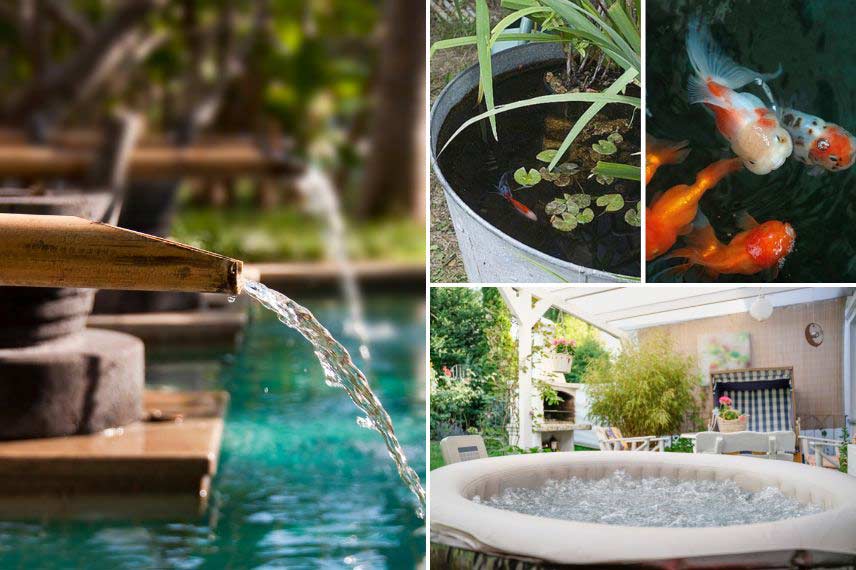
The presence of water: almost essential for refreshing your balcony or terrace in the heatwave
For further reading...
→ To guide you in your choice of shade plants, find our article: Shading a terrace: which plants to choose?
→ To assist you in selecting shade trees, check out our selection of 8 umbrella-shaped trees, as well as the article offering 10 trees to shade a small garden.
→ If climbing plants appeal to you, we recommend 8 climbing plants for a south-facing garden and 5 climbing plants that won’t damage your walls.

- Subscribe!
- Contents
Comments