





























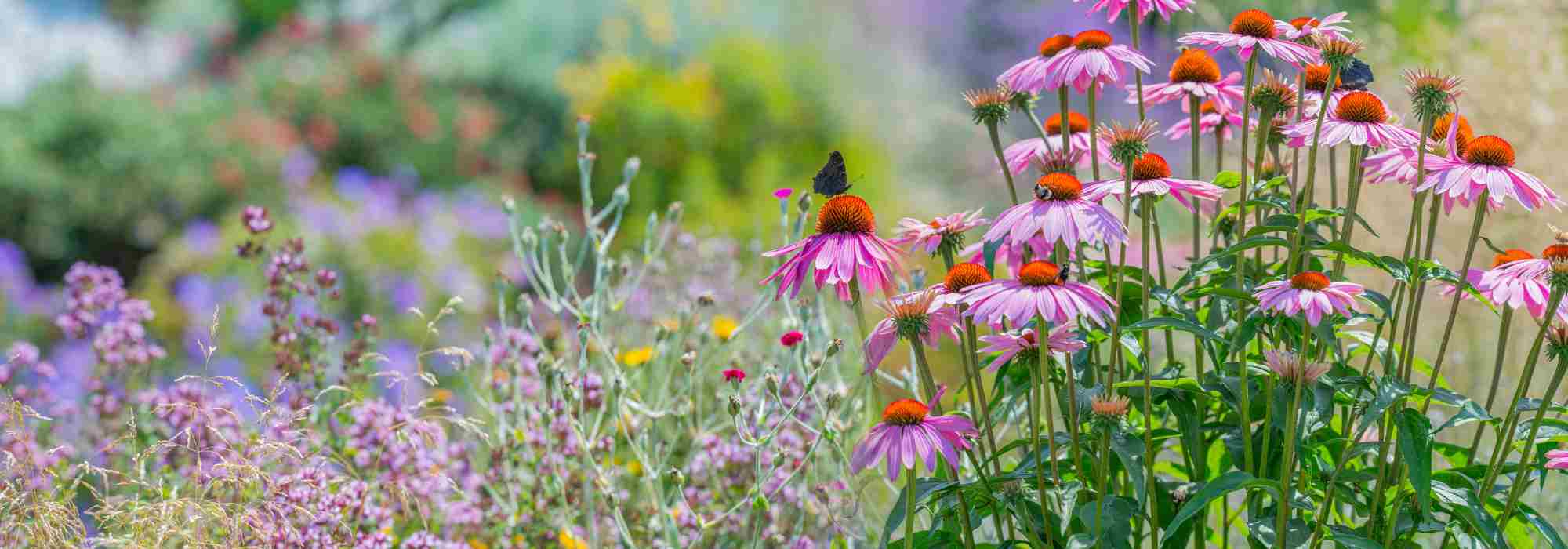
How to rewild your garden?
Learn to garden differently, with nature
Contents
The current trend in garden design is towards rewilding, and if we sometimes hear the term rewilding used, on a larger scale in cities and open spaces, we speak of renaturation, which signifies a return to nature. Why? Simply because we want to recreate more natural conditions by providing ecological solutions for our gardens. This is reflected in our planting methods and choices, as well as in the preservation of areas conducive to greater biodiversity.
In urban areas, this rewilding has become a priority in many mineralised sites with artificial soils, and the stakes are high given the current climate change. Our gardens, no matter how small, can also contribute to this evolution. We can easily rehabilitate a wilder flora at home, plant more trees, restore ecosystems, and allow a generous nature to flourish, all while fighting climate change on our small scale… These are all ways to transform our gardens into new Edens that are more environmentally conscious.
Let’s explore how to create this rewilded garden, wildly alive, colourful, useful, and practical!
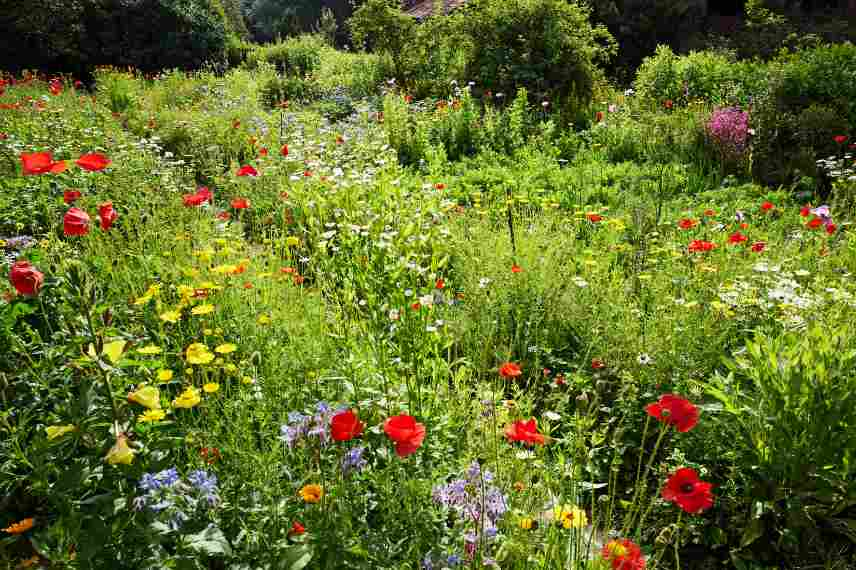
The garden in a wild mode, a great idea for more biodiversity

Planting wild and native species
It can be seen everywhere in urban landscaping, and increasingly among private individuals: wild species are on the rise! The meticulous and sophisticated garden is becoming rarer, except when it comes to specific gardens like Japanese or exotic gardens, for example. And it’s certainly not just a trend. We are now more inclined to incorporate plants with a wild appearance and endemic species alongside perennials or bushes considered highly ornamental. They provide a lush effect and a natural feel, and they have multiple benefits, requiring little maintenance while being perfectly adapted to the environment.
Here are some beautiful wildflowers, commonly known, that come from our undergrowth, ditches, or slopes in the countryside, but which integrate perfectly when mixed with other perennials or grasses in a bouquet garden, an English garden, or a cottage garden: fennel, mallows, foxgloves, Verbascum, loosestrifes, Salvia pratensis, willowherbs, …
Identify the typical species, by its sole Latin name, which does not include a horticultural variety name. For example, one would choose Verbascum thapsus (the true great mullein) rather than a cultivar like Verbascum ‘White Domino’, which is a result of hybridization.
Indigenous plants are, by definition, endemic to a given region or country. They grow spontaneously there, such as common gorse (Ulex europaeus) which is very common in western France, for example, or the Azarole in Provence. They prove to be particularly robust, less sensitive to diseases, and require little maintenance as they are perfectly adapted to the soil and climate, humidity, and rainfall of the region.
Fruit species are also included, and should be reintroduced when found in local specialized nurseries, by choosing old local varieties such as the ‘Patte de loup’ apple in Anjou or the ‘Muscat de Provence’ apricot.
Among the trees and bushes to favour in many regions: Acer campestre, hazel, Ribes, Cornus mas, willows, hawthorn, Prunus spinosa, hornbeam, spindle, woodbine (Lonicera periclymenum), elder, dog rose, etc.
N.B.: The ARB (The French Regional Biodiversity Agencies) offer lists or interactive maps with local species by department, so don’t hesitate to consult the one for your region!
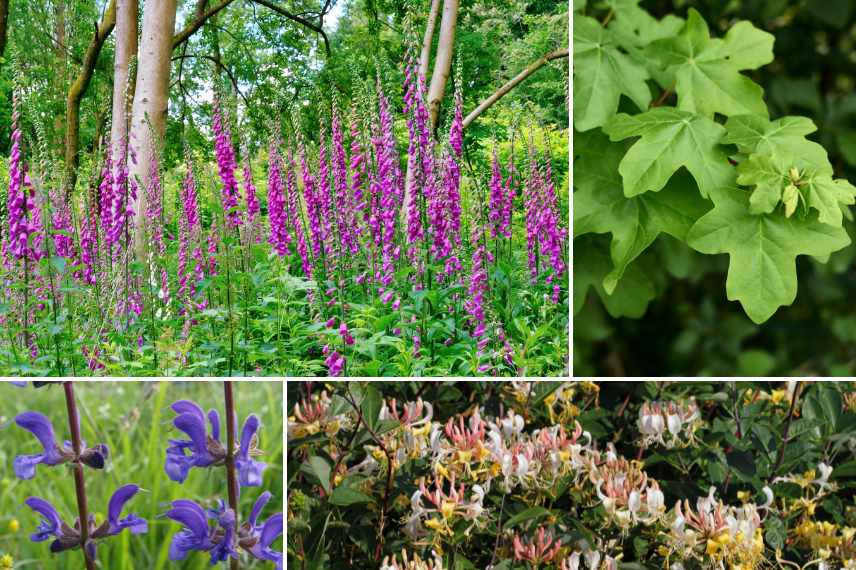
Foxgloves, field maple, meadow sage, and woodbine
→ Read also: Indigenous plants: let’s take stock, Let’s plant indigenous species to attract pollinating insects, Natural garden: 5 remarkable wild plants and our opinion on the book Indigenous plants for a nature garden.
Let nature take its course
In certain areas of the garden, it is also good to let nature take its course. Of course, it is easier to do this in larger spaces, where one can choose a dedicated area, as a part of the garden closer to the house will likely be kept more tidy. When one has a small garden, there is often a tendency to want it to be perfectly manicured for the more perfectionist among us.
But it is possible in all cases to invite wandering plants into the garden, which can be controlled to varying degrees depending on the area, to keep uncut sections around trees, and to encourage a meadow-like spirit. This wild garden reminds us of the garden in movement dear to Gilles Clément, which he has been discussing for several decades now: a garden in constant evolution, limiting the gardener’s intervention, who constantly redraws the lines.
Nature indeed does things very well and expresses itself freely in several ways with:
- Wandering plants and natural sowing, these are plants that self-seed through the wind or birds that disperse the seeds! Absolutely essential when one wishes to rewild their garden. They always offer beautiful flowering displays and are often melliferous.
- Naturalisation: this ability of certain plants, many bulbous species and many trees, to reproduce naturally (crocus, certain tulips, snowdrops, cyclamen, etc.).
- Rhizomatous plants: We also rely on plants that quickly form beautiful colonies by spreading through their running root system, to be installed in larger spaces (be cautious of invasive plants, however!).
→ Read also: Plants that self-seed, 6 bulbs easy to naturalise in the garden, and Invasive plant or invasive species, let’s not mix things up!
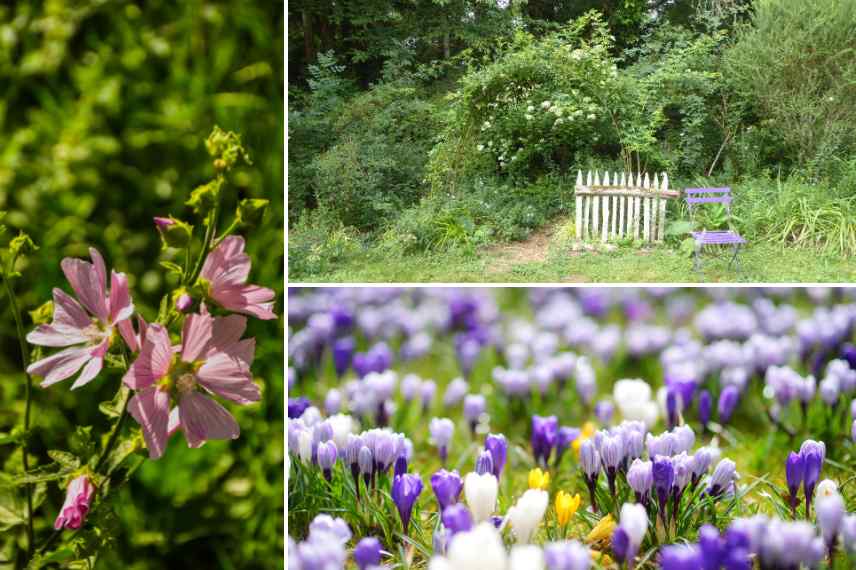
Lavateras and crocuses will easily reproduce. Liliane’s garden in Limousin, top right, blurs the outlines with nature running wild (© Gwenaëlle David)
Late mowing and reforestation
Nature abhors a vacuum, as is well known… And we too should strive for a nature that reclaims space: to spare us maintenance work, but also to once again imitate nature, which settles where the good wind takes it, where it will thrive happily.
To this end, late mowing or managed mowing allows for the welcoming of a whole microfauna and pedofauna and the return of numerous butterflies and insects. This involves mowing open spaces once a year. The wild herbs preserved in this way ensure soil work that contributes to life and helps combat various pests. The aesthetic aspect is also interesting, with the mower shaping the free spaces like a pencil (often between 1 and 3 m wide, or squares of varying sizes depending on the garden’s dimensions). This is referred to as differentiated management, stemming from practices observed in municipalities for the appropriate treatment of spaces. Open areas are then mowed once or twice a year.
Planting trees is another means at our disposal to ensure vegetation cover and effective reforestation. It helps better regulate the increasingly frequent summer heatwaves, the overall warming of the climate, and restore living conditions in the soil. Planting trees, even in a simple grove, also reduces the impact of wind and induced drought, and of course integrates the garden into the surrounding landscape. We can take inspiration from the forest by allowing certain areas to reforest naturally, or by assisting further by sowing native species manually or planting bare roots. With these methods, humans no longer dominate; a mutually beneficial relationship is established, in a win-win mode!
→ Read also: Mowing a flower meadow or a grassy area, Creating a micro forest, and How to create a forest garden?
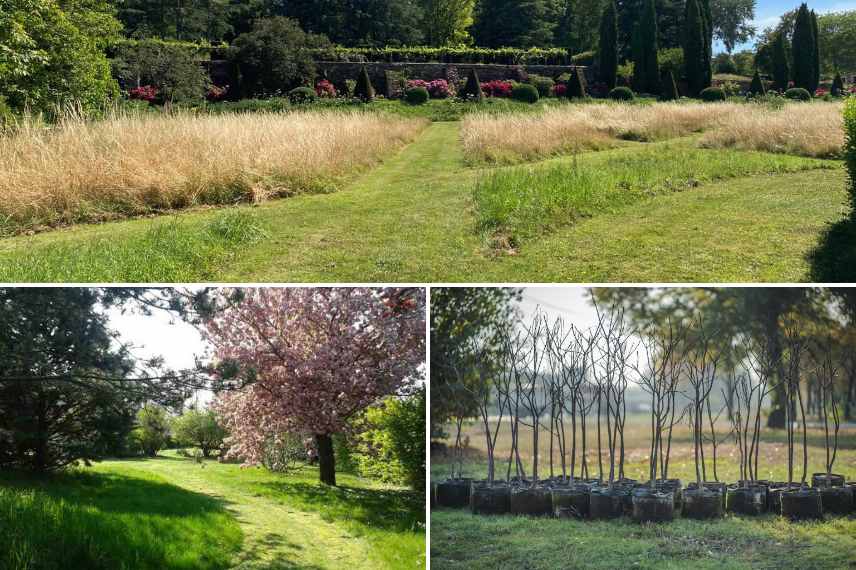
Two examples of differentiated management: at the Manoir de la Groye in Anjou and in a private garden (© Gwenaëlle David Authier). The planting of trees and bushes is also essential.
Read also
How to create a dead hedge?Promote biodiversity
Landscaping your garden for rewilding also involves the more evident preservation of a life-saving biodiversity. In addition to the wild and native plants whose importance we highlighted at the beginning of this article, one should design the space with biodiversity in mind as much as possible. The idea is to restore a life cycle and mimic what nature does very well on its own when humans are not there to control it:
- Through the creation of flower meadows or mesophilous – they require some initial work – or the planting of messicoles (poppies, cornflowers, daisies, etc.)
- By the conservation or restoration of habitats and refuges for small wildlife (birds, as well as bats, weasels, reptiles, etc.): shelter provided by piles of wood, branches, crevices in walls or trunks, rockeries, old stumps left in place…
- By providing nesting boxes, feeders, hedgehog homes, etc. in the garden
- Through the establishment of multi-species hedges, composed of several species to limit the risk of disease. They are useful as screens, boundaries, or separators within the garden!
- By carrying out pruning or trimming at the right time (read Olivier’s advice on this in Do not prune hedges between 15 March and the end of July)
- By diversifying as many plants as possible and combining them to encourage positive interactions, particularly with the small wildlife in the garden.
- Finally, when there is space and the desire to do so, the creation of a wetland such as a pond, marsh, or even the development of a stream can attract and reintroduce specific wildlife.
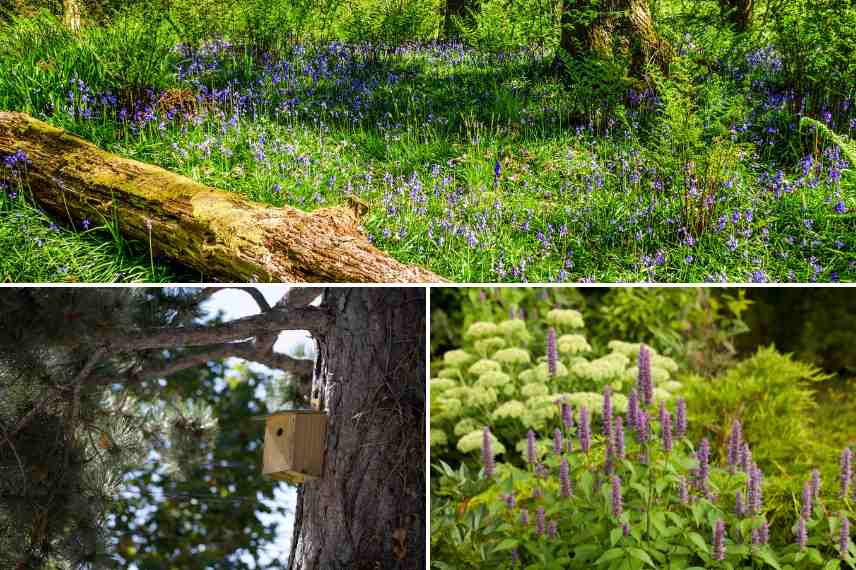 Fallen trunk left in a flower fallow, nesting boxes, associations of varied plants: promoting biodiversity takes many paths…
→ Also see our article Creating a natural pond in your garden.
Books for inspiration
The rewilded and naturalistic garden has been the subject of numerous publications in recent years. Here is a non-exhaustive list of books addressing the topic of wild gardens, their flora, and how to better integrate them into our landscaping -these are in French, but some of them are translated into or originally in English.
- The Wild Garden: Engaging with the Dynamics of Life, Louisa Jones. Ed. Actes Sud. 2022.
- The Garden in Motion, Gilles Clément. Ed. Sens et Tonka. 2017 (6th edition).
- Let It Be: The Art of Gardening with Self-Seeding Plants, Jonas Reif Becker Jürgen, Christian Kress. Ed. Ulmer. 2015.
- A Brief Treatise on Punk Gardening: Learning to Unlearn, Eric Lenoir. Ed. Terre vivante. 2018.
- I Saw a Wild Flower: The Herbarium of Malicorne, Hubert Reeves. Ed. Seuil. 2017 and the companion site of Hubert Reeves’ herbarium.
- Wild Flowers in My Garden: Choosing, Growing, and Combining Them, Brigitte Lapouge-Déjean. Ed. Terre vivante. 2017.
- The Forest Garden, Martin Crawford. Ed. Ulmer. 2017.
Don’t forget the flora, those handy little books that help with plant identification and introduce everyone to the emblematic plants of our regions. It’s always very useful to have one in your library (Flora of Brittany, flora of northern France and Belgium…)
- Subscribe!
- Contents
Comments