





























May berries: how to choose the right variety for your garden?
Our criteria for selecting the best variety of edible honeysuckle or blue honeysuckle
Contents
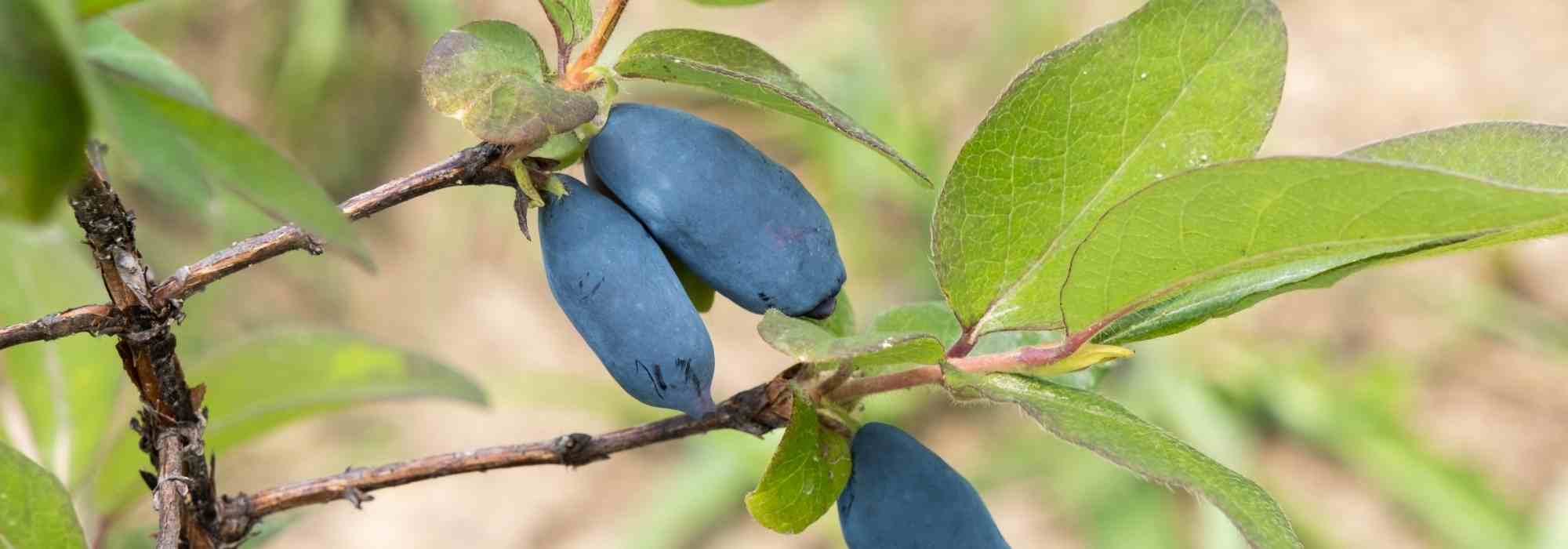
Do you know May berries, also known as honeyberries or haskaps? No? Yet, these small berries, similar in shape and flavour to blueberries, are well worth paying attention to as they are rich in vitamin C and antioxidants. These virtues, in fact, place May berries in the category of superfruits, excellent for health. If we add to the nutritional quality of the fruits the ease of cultivation, all the conditions are in place to bring the honeyberry, blue honeysuckle or edible honeysuckle (Lonicera caerulea var. kamtchatica) into your garden, even onto your balcony or terrace. This honeysuckle with a bushy habit (and not climbing!) and deciduous foliage, which rarely exceeds 1.5 m in height, proves very frost-hardy (it originates from Siberia) and easy to grow. It simply needs humus-bearing soil and cool soil, rich in organic matter, non-calcareous, and a sunny or partially shaded exposure in the southernmost regions.
To choose the best edible honeysuckle and savour delicious May berries, discover our selection based on cultivation and yield criteria.
For further reading: Blue honeysuckle, May berry: planting, growing, care.

For potted May berries
If you don’t have a garden, there’s no reason to deprive yourself of the slightly tart flavour of May berries. Moreover, blue or edible honeysuckle, otherwise called honeyberry, benefits from a fairly rapid fruiting of around two years. And what a pleasure to nibble, from May onwards, these small berries, oblong or cylindrical, a deep blue, widely pruinose, with red flesh and a delicate honey aroma! Berries that hide beneath the foliage, escaping for a time the garden birds’ appetite. As for the flowering, discreet though it is, it is highly nectariferous and melliferous and attracts a profusion of nectar-foraging insects and pollinators.
So, if you only have a balcony, a terrace, a courtyard or a patio, honeysuckle cultivation remains possible since it adapts perfectly to pot culture. However, you will still need the best cultural conditions, very regular watering, as May berries absolutely cannot tolerate drought, and a mulch of dead leaves. This shrubby honeysuckle will therefore be planted in a tall pot with a diameter of at least 30 cm, with drainage holes and lined with a layer of clay balls. Indeed, even though it does not have a taproot, the honeyberry roots downward. As for the substrate, it should consist of a rich mix of compost, potting soil and leaf mould.
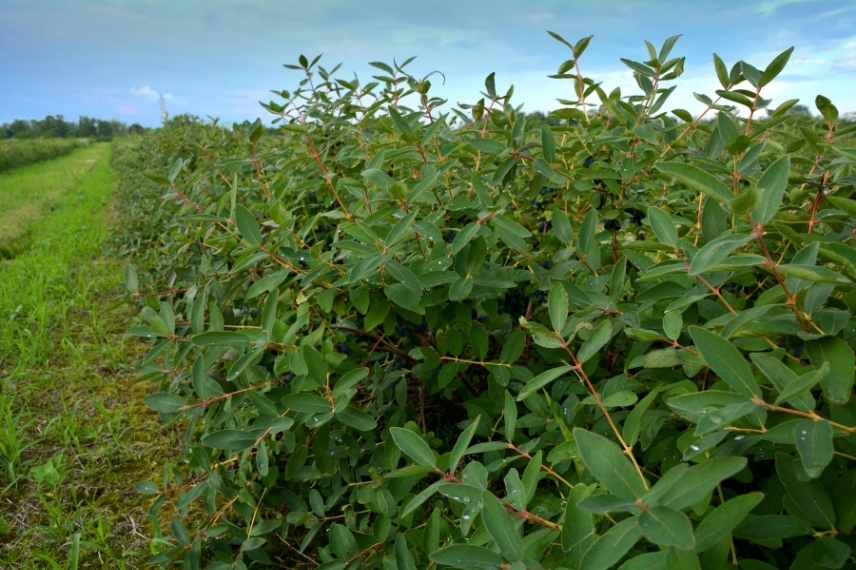
The standard variety Lonicera caerulea var. kamtchatika grows very well in pots
For pot culture in a restricted space, you will need to choose a variety with a more compact habit. Note, however, that the honeyberry tends to have relatively slow growth. Among edible honeysuckles suitable for pots, you can list:
- Lonicera caerulea var. kamtchatica : it is the type species, about 1.20 m tall and 1 m wide, producing cream-coloured flowers with little fragrance and May berries from around May!
- ‘Duet’ : a medium-growing variety that shows the same dimensions as the type species. Its flowers are yellow, slightly scented, and its fruits are 2 cm long.
- ‘Kalinka‘ : a variety very well suited to pot culture due to its height limited to 1.20 m and a spread of 60 cm. Extremely hardy, it offers tubular cream-coloured flowers that are fragrant and tasty fruits.
- ‘Sweet Myberry’ : a highly fruitful and very productive variety with generous, cream-white scented flowering. It reaches a height of 1.30 m and a spread of 80 cm.
However, it is preferable to plant two plants to maximise your fruiting chances.
Read also
I've missed it for you…: may berriesFor successful pollination of blue honeysuckle
Why plant two plants to maximise your chances of fruiting? Quite simply, the honeyberry is a self-sterile fruiting bush. Although they are hermaphroditic, the flowers of one variety must therefore be pollinated by those of another variety to bear fruit. Thus, you should choose varieties that flower at the same time. Note that edible honeysuckles are classified into early, normal, mid-late or late varieties. Thus, as an example, the type species Lonicera caerulea var. kamtchatica can be paired with a variety such as ‘Kiev’ because they flower at the same time, between March and April. It is also a variety renowned for its productivity that can also be paired with the varieties ‘Duet’ and ‘Morena’.
The hybrid variety ‘Honey Bee’, developed in Canada, is recognised as an excellent pollinator. It is a particularly robust variety that is very productive. Classified as a late variety, it yields heavier fruits by weight than other varieties. With noticeably faster growth, it reaches 1.80 m in height and 1.50 m in width.
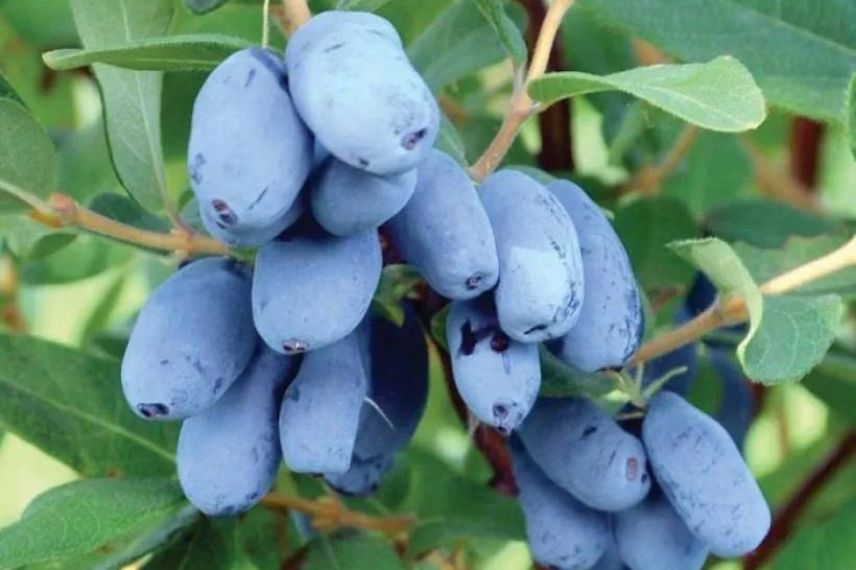
The Honey Bee variety is an excellent pollinator
Other varieties are considered self-fertile, but cross-pollination by bees and bumblebees with other varieties will always be better. The honeyberry variety ‘Martin’, classified as early, which produces large, elongated fruits, offers flowers highly attractive to insects. As for the variety ‘Altaj’, a cultivar selected in Slovakia, it is also considered self-fertile.
Based on the productivity of May berries
When choosing to plant edible honeysuckle, it is mainly for its fruit, the flowers being beautiful but discreet. We expect the honeyberry to bear fruit in quantity and quality, and as quickly as possible! That’s why we’ve selected for you a few varieties among the most productive. Starting with the Canadian variety ‘Honey Bee’. It is a bush with an erect habit, very attractive both aesthetically and in terms of productivity. It benefits from rapid growth and early fruiting. Its harvest of large, heavy blue berries is particularly abundant, but late. In fact, the fruits reach maturity only between mid-June and July. The fruits are often hidden among the foliage.
The recent German variety ‘Eisbär’ is also renowned for its productivity. It offers a multitude of wrinkled and frosted berries, in May or June. They can reach up to 4 cm in length. The ‘Kiev’ variety is also a very productive and prolific variety. Its fruits, not very large but tasty and aromatic, are harvested between May and June.
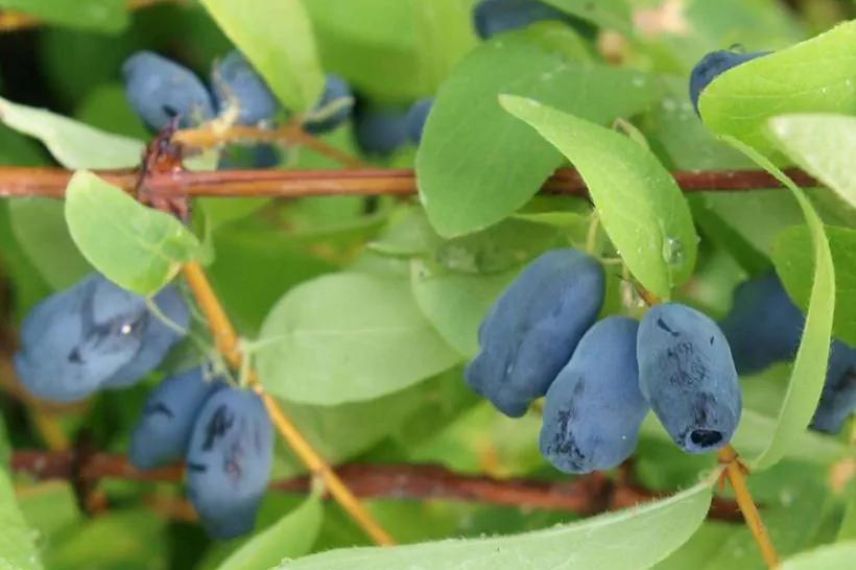
The May berry variety ‘Sweet Myberry’ is very fruitful
Finally, we cannot end this section without mentioning the edible honeysuckle variety ‘Sweet Myberry’, very fruitful. It is, moreover, one of the varieties with the best yields of blue berries, large in size, and excellent flavour.
As for the ‘Blue Velvet’ variety, it can be selected for the size of its fruits and its growth rate.
According to the harvest period
Logically, May berries are harvested in May, and, depending on the weather, in June. However, you can considerably extend the harvest by planting late-ripening varieties which will bear fruit from mid-June to July. This is the case with the Canadian variety ‘Boreal Beauty’ which yields elongated berries, medium to large, weighing between 2 and 3.5 g. These berries are also very firm, cling well to the shrub, which makes harvesting easier. As for the shrub, it forms a handsome, bushy tuft with upright, straight branches. It shows good vigour and can resist powdery mildew.
The Fialka variety is also classified among late-season types, as it bears fruit from mid-June to late June. Its berries are blue-gray, rather elongated and of medium size.
- Subscribe!
- Contents

Comments