





























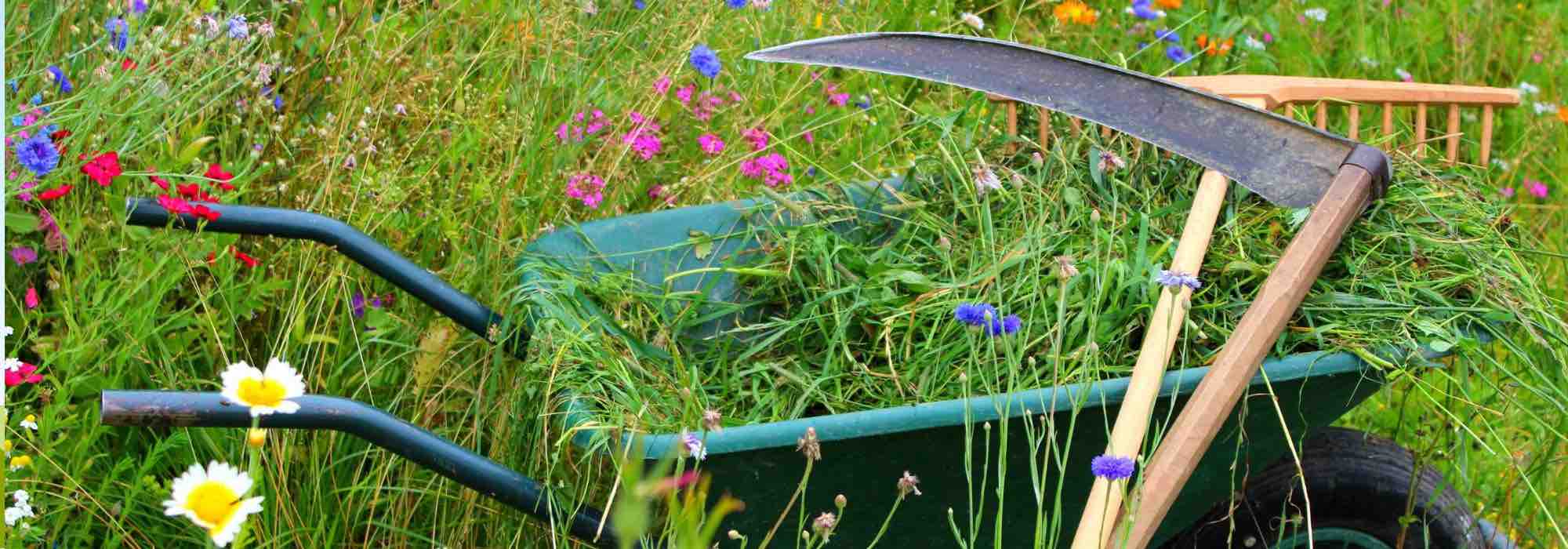
Mowing a flower meadow or a grassy area
Our tips for maintaining your garden in a more natural way that is beneficial to biodiversity
Contents
Mowing has been gaining popularity in recent years. It is emerging as a more natural and biodiversity-friendly alternative to close mowing, which is typically applied to lawns. It is possible to mow various areas in the garden: grassy plots, meadows or flowering fallows, orchards, etc.
So how can you successfully maintain your land safely with mowing tools? Follow our tips.

The advantages of mowing compared to cutting
If mowing becomes popular again as a method of garden maintenance, it is because it has numerous advantages.
- It does not use electric or fossil energy (petrol), which represents a significant saving and is more environmentally friendly.
- It promotes biodiversity by providing more shelter and food for local wildlife. This helps attract and retain beneficial insects in the garden, such as valuable pollinators or pest predators. It is less traumatic for wildlife than mowing, which often falls victim to rotary blades. This maintenance technique also highlights the diversity and preservation of native plant species, which are sometimes endangered. Less human intervention is a simple way to rewild the garden!
- Mowing allows for the maintenance of areas that are sometimes difficult to access with a mower, strimmer, or electric brush cutter.
- It saves time, as it requires fewer regular passes compared to maintenance with machines. Generally, it is done only once or twice a year, compared to sometimes weekly mowing!
- Keeping plants longer ensures a cooling effect. Their foliage retains moisture and coolness in both soil and air, which is particularly beneficial in summer. This also helps reduce watering.
- The soil remains protected from pressures exerted by climate and humans: weather, UV rays, trampling, etc.
- Mowing generates no noise or odour pollution if done with manual tools.
- Aesthetics is also an argument, even if it is entirely subjective. For some, a closely trimmed lawn signifies a clean and pleasant garden; for others, it may appear dull and lifeless, unlike a wilder garden. Mowing also allows for a degree of creativity: it is possible to play with heights, shapes, etc.
- Finally, mowing the garden is a great way to get physical exercise, completely natural and free!
On the downside, hand mowing is indeed a physical task that requires a minimum level of fitness, and often some warm-up beforehand! It is also necessary to have a tool and maintain it regularly (but this is also the case for electric tools). Finally, mowing will require more patience.
Late mowing
In areas that do not require daily maintenance, you can opt for late mowing in the garden. Local authorities are increasingly adopting this maintenance technique, which involves cutting later in the season. This helps preserve biodiversity. The goal is to allow plants to complete a full life cycle, enabling them to set seed before being cut. Late mowing typically occurs at the end of summer or the beginning of autumn. Animals and insects can thus enjoy food and shelter for longer.
Differentiated mowing
Another way to maintain the garden more naturally is to practice differentiated or reasoned mowing. This simply involves distinguishing different areas in the garden:
- those that require regular maintenance, around the house, along paths crossing the garden, in the children’s play area, etc. (regular mowing area);
- those that only need annual maintenance, such as meadows or flowering fallows;
- those that can be left fallow, in their natural state (no-mow area).
The height and frequency of cutting are thus specifically adapted for each area, unlike a blanket maintenance approach. Once again, this alternation is beneficial for biodiversity, as it multiplies habitats. It also requires less energy and time.
For more information, we invite you to read our article “Differentiated Mowing: A Small Step for the Gardener, a Giant Leap for Biodiversity.”
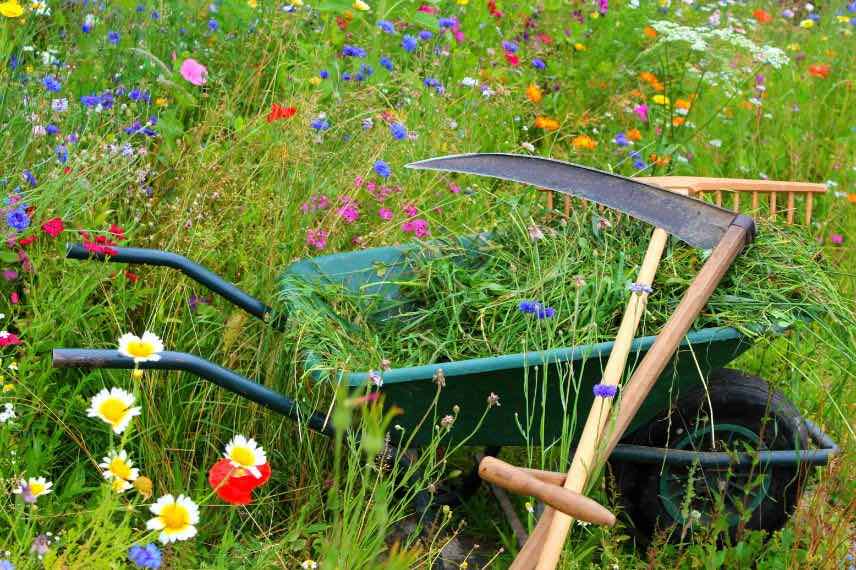
How to practice mowing safely?
When to mow?
The timing of intervention depends on the area in question. For a flowering meadow, wait until the end of summer or the beginning of autumn, once the life cycle of the plants is complete. This allows them to disperse their seeds, enabling them to return spontaneously year after year. A once-a-year mow is therefore sufficient here.
For an orchard, you may choose to mow in spring, so that pollinating insects can prioritise your trees and bushes. Then, intervene a second time during the fruit harvest.
Wild areas, such as hedge borders or the back of the garden, can manage with a mow every 2 to 3 years.
Take advantage of a dry, sunny day to intervene, ideally in the early morning or late afternoon, when wildlife will have reduced its activities.
The different mowing tools
For hand mowing, you can choose between a manual sickle or a scythe.
- The herb sickle or the brush hook consists of a semi-circular blade attached to a wooden handle. They are held in one hand and are mainly suited for small areas.
- The scythe (formerly known as a faulx) features a curved, tapered blade fixed to a long handle. It is used for larger plots and requires two hands to operate.
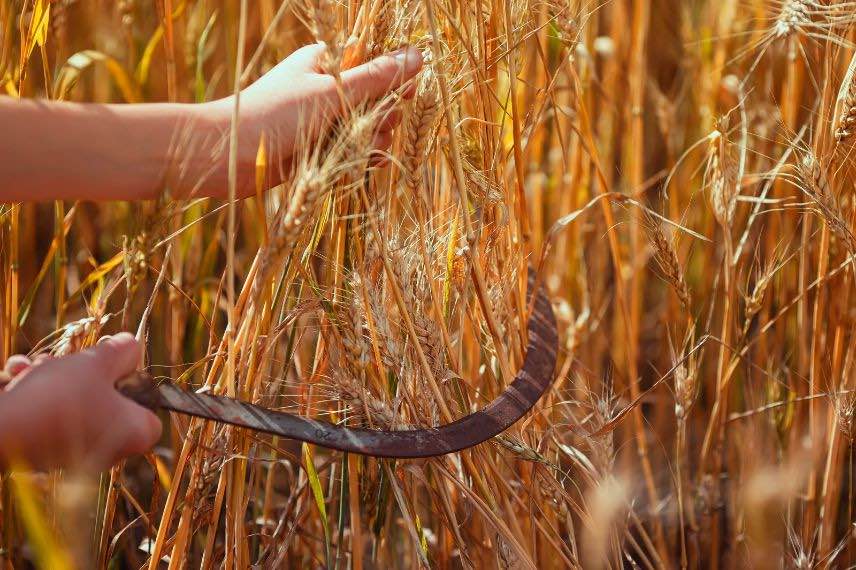
The sickle, smaller than the scythe, is easier to use
Choose ergonomic, lightweight tools made from durable materials (wood, steel…). They should also be suited to your height and build. Some are even adjustable in height. For a scythe, the handle should ideally reach just below the hip, at the level of the femur. Prefer tools with two handles, which are easier to manoeuvre and balance.
Ensure that the blades are well sharpened: a poorly cutting tool will be more dangerous and require more energy than necessary. If needed, use a sharpening stone, which is sometimes sold with the tool.
If the area to be mowed is very large, some gardeners prefer to use a brush cutter or a mower set to the highest possible height (around 8 to 10 cm). Note that you will lose some advantages of manual mowing in this case, but will gain in energy and time.
How to Successfully Mow?
Mowing is ideally done against the curve of the tall grasses (generally dictated by prevailing winds).
Before starting, equip yourself with gloves and appropriate gardening clothing (sturdy shoes or boots, covering trousers, long-sleeved t-shirt). Glasses will also be useful to avoid projections.
Using a scythe is simple, but requires a bit of adjustment.
- Stand upright, facing the area to be mowed. Let the blade rest on the ground to your right (or to your left if you are left-handed), with the point facing forward.
- Hold the handle with both hands (the right hand above the left), then make a lateral swinging motion from right to left, using your shoulders. Keep your arms straight. The taller the area to be mowed, the wider the movements can be. The blade should always remain horizontal.
- Replace the scythe on the ground by stepping forward. Proceed in strips across the entire area to be mowed. If the grasses are particularly tall and vigorous, it may be necessary to mow in both directions. For sloped terrain, start from the bottom, mowing strips parallel to the slope. Then, return to your previous position to move to the next length. In case of obstacles (trees, structures, etc.), proceed in a circle around the area to avoid.
- When moving, carry your tool on your shoulder with the blade facing back for safety.
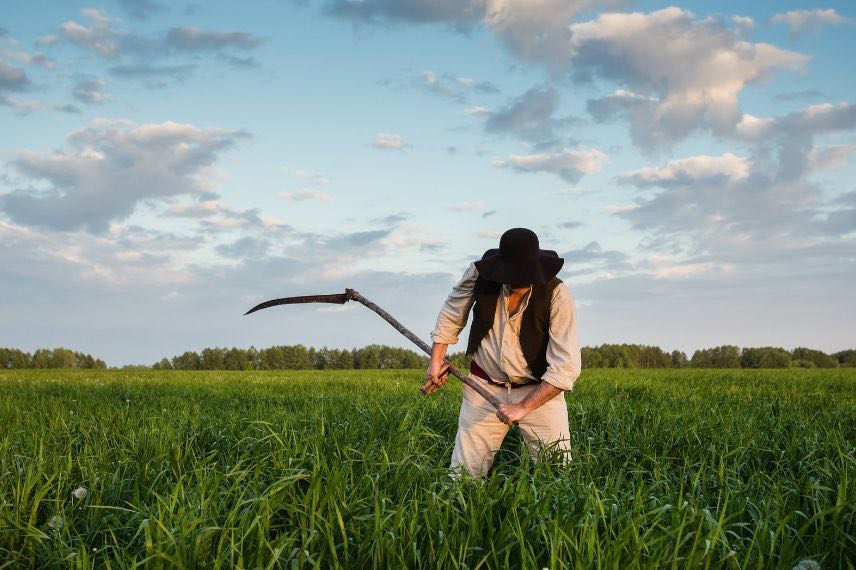
Mowing requires appropriate movements
Using the sickle is easier.
- Grab a handful of grass to cut with your left hand (or with your right hand for left-handers).
- Cut at the base with the other hand, making a lateral motion from right to left.
After use, always clean the blade of your tool with a cloth soaked in alcohol. This helps limit the spread of diseases between plants and keeps the blades in good condition for longer. Then store your tool in a dry, protected place, ideally with the blade facing up.
Managing green waste
The simplest solution is to leave the green waste in place. This will help protect the soil and gradually nourish it during decomposition.
If you prefer a cleaner appearance, it is perfectly possible to compost the waste. You can also dry it for a few days (this allows wildlife to leave and any remaining seeds to fall), before reusing it as mulch in other areas of the garden. If you wish, use a shredder.
Mistakes to avoid when mowing your garden
Some common mistakes can make mowing the garden more difficult.
- Intervening on grass that is too short. Mowing requires that the grass has reached a minimum height of at least 20 cm.
- Mowing grass that is too green, which will be too soft and the blade will struggle to cut cleanly.
- Mowing wet grass.
- Neglecting equipment maintenance. It is indeed important to check the condition of your tools and equipment beforehand. If necessary, remember that you can also rent or borrow equipment instead of buying it.
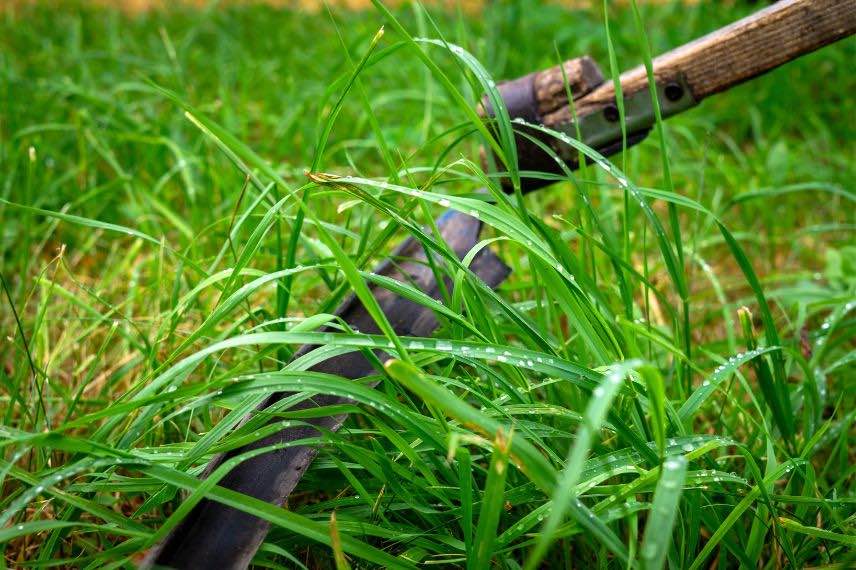
Avoid mowing wet grass
- Subscribe!
- Contents
Comments