


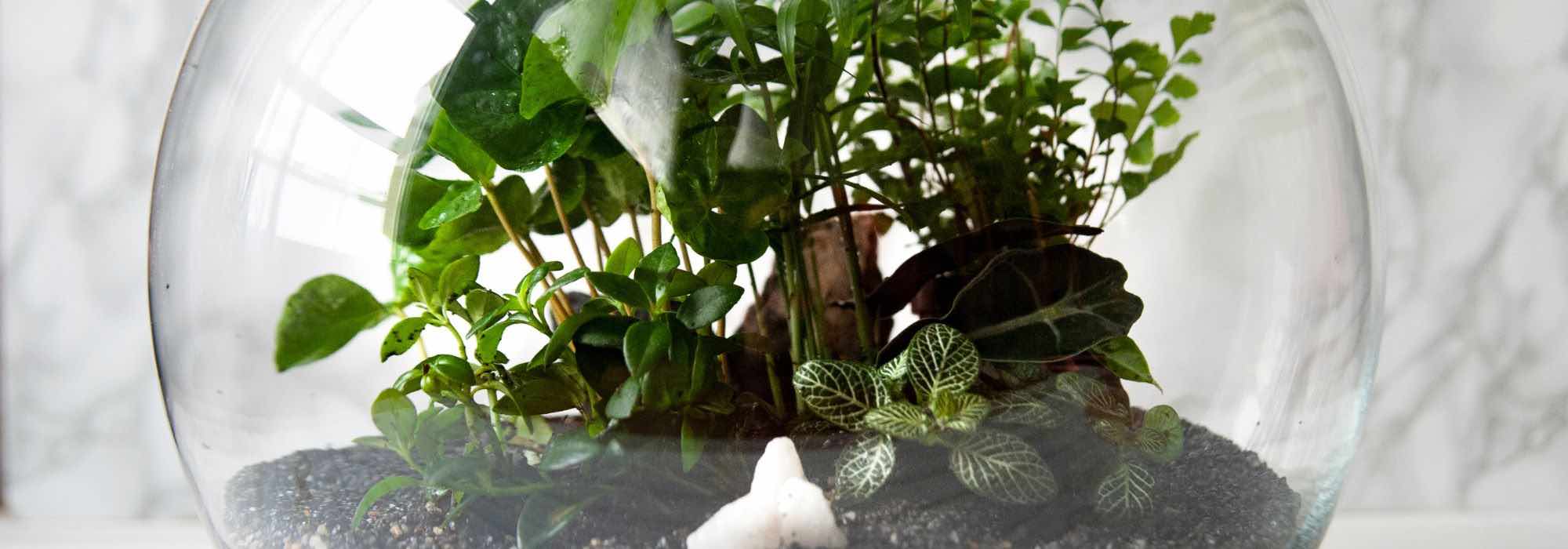
Must-have plants for a successful terrarium
Our guide to selecting your plants
Contents
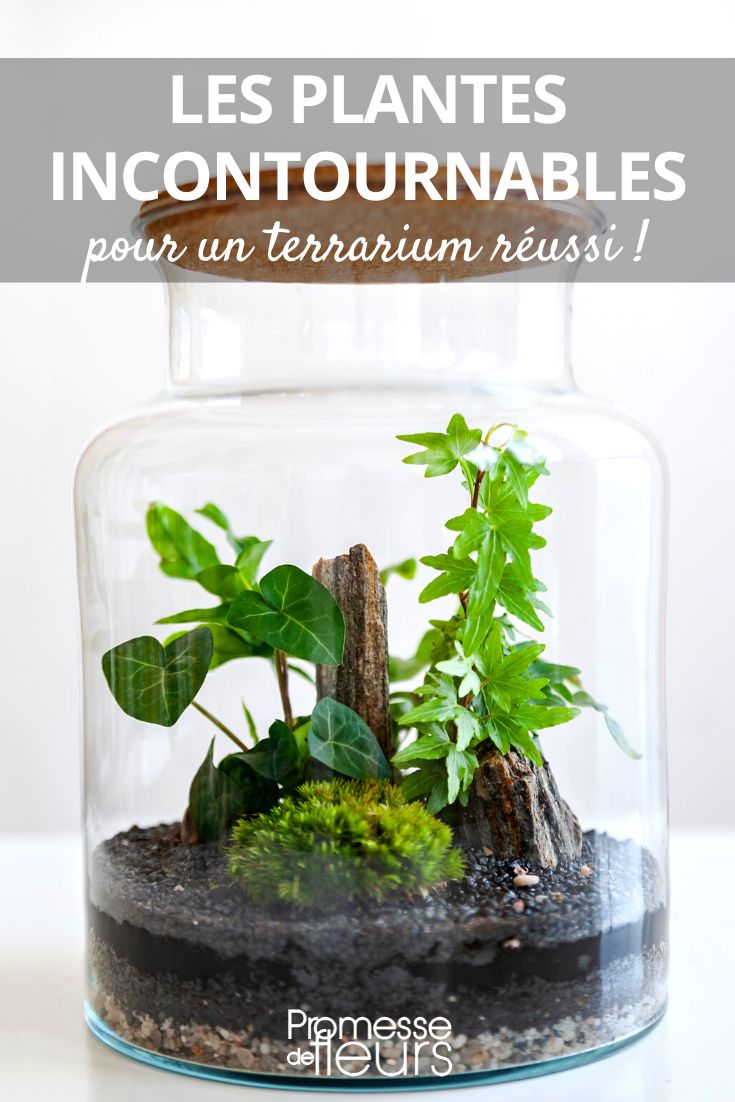
Terrariums have been popular for a few years, and it’s true that the miniature landscapes they showcase are appealing. These tiny ecosystems, often self-sufficient, are rewarding and enjoyable to create yourself, provided you don’t dive in blindly. One of the keys to creating a successful terrarium lies in the choice of plants. Consider the specific needs of each plant in terms of light, moisture and compatibility when creating your terrarium.
In this article, we guide you through a selection of terrarium plants and some care tips.

Factors to consider when choosing plants
First of all, design your terrarium as you would a small border in the garden or a balcony planter. The houseplants chosen to compose it must have the same needs and the same growing conditions. Do some research on the light and humidity needs of each plant to ensure harmonious coexistence.
Light needs
Light needs vary from one green plant to another. Succulents and cacti generally require bright light, while mosses and ferns thrive in lower light.
Humidity
Humidity is a crucial factor in the success of your terrarium. Plants sharing similar humidity needs should be grouped together. For example, succulents and cacti require a dry environment, while mosses and ferns prefer humid conditions. Ensure a balance to prevent some plants from suffering from excess humidity or drought.
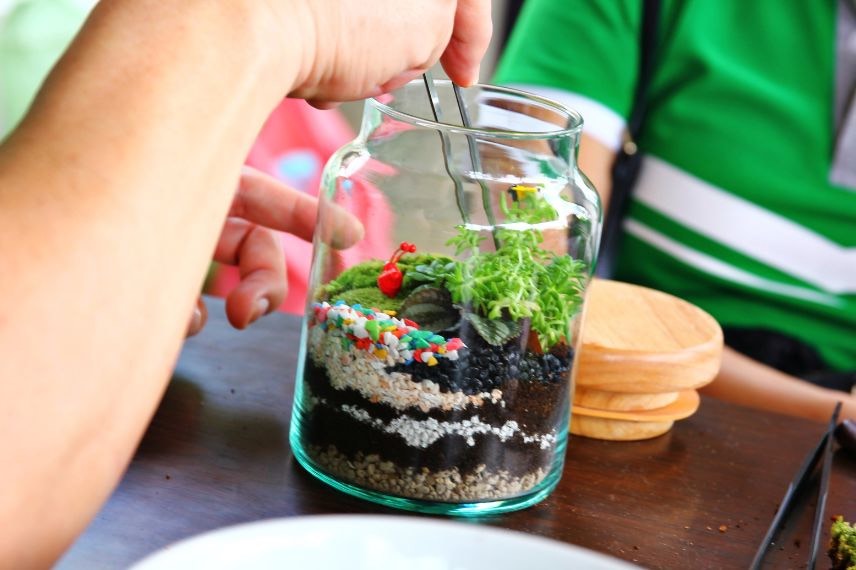
Choose small young plants or home-grown cuttings
Read also
How to make an open terrarium?Plants for terrariums
Described below are the plant groups suitable for closed terrariums and for open terrariums, translated into British English with the specified glossary and styling considerations.
Plants for closed terrariums (forest floor plants)
Generally, in a closed terrarium, you install tropical indoor mini-plants with high humidity needs and/or forest floor plants.
– Mosses
Mosses make an attractive choice, but can be tricky to maintain. Even in a closed terrarium they tend to dry out unless misted specifically. Their small size and ability to adapt to low light theoretically make them ideal. Their pillow-like appearance can suggest a small hill in a miniature landscape. Mosses such as Java moss (Taxiphyllum barbieri) or creeping selaginella (Selaginella kraussiana) add a lush texture to your terrarium. They thrive in humid environments.
– Ferns
Ferns bring verticality, grace and lightness to a terrarium. They appreciate the humid conditions of closed environments. Boston ferns (Nephrolepis) are common choices. Also consider Asparagus, which are not true ferns but resemble them.
– Chlorophytum
Also known as spider plant, Chlorophytum is hardy and easy to care for. It has long green or variegated leaves that form an attractive trailing tuft. It tolerates a range of lighting and moisture conditions.
– Fittonia
Fittonias are very interesting in a closed terrarium because they struggle elsewhere due to their high humidity needs. They are known for their leaves with coloured nervures, which add a splash of colour and a pretty texture.
– Tradescantia
Tradescantias are creeping plants with green, purple, cream-white, pink or silver leaves. They also enjoy this atmosphere, but spread quickly, sometimes too quickly for such a small space. Reserve them for large terrariums or terrariums with an opening large enough to allow regular removal of new growth.
– Ivy
Ivy adds verticality and greenery, ideal in a fairly tall terrarium. It can also create a leafy cover inside the terrarium.
– Dwarf fig or Ficus pumila
Dwarf fig is a creeping plant with small green or variegated leaves. It is perfect for creating plant cover in the terrarium.
– Among the plants mentioned, some tolerate an open terrarium without issue, provided watering is more frequent. It is mainly Fittonias, Tradescantias and mosses that need a close, high-humidity environment. Note, while other plants can be grown in an open terrarium, do not mix them with the succulent plants described in the following paragraph.
Succulents and cacti for open terrarium
Here, no question of planting in a closed terrarium; these dry-soil plants would not survive there.
Succulents are valued for their resilience and graphic quality. Species such as Echeveria, Crassula, Sedum and Haworthia suit terrariums. For an interesting contrast, miniature cacti can be an excellent choice for your terrarium. Small cacti, such as the candle cactus (Cereus peruvianus) or the globe cactus (Mammillaria), add character to your composition.
These plants require bright light, a very well-drained mineral substrate and very moderate watering. Avoid overwatering, as succulents are highly sensitive to excess moisture.
– Echeveria
Echeverias are fleshy, attractive succulents with coloured leaf rosettes. They add colour and structure to the terrarium.
– Haworthia
Haworthias are rosette-shaped succulents, similar to Echeverias, but better suited to low light conditions. Their thick, striped leaves offer interesting visual appeal.
– Candle cactus or Cereus peruvianus
Candle cacti are small-columnar cacti. Their unique shapes provide a striking contrast in the terrarium.
Read Alexandra’s article on indoor cacti and succulent plants here.
Terrarium plant care specifics
Watering
Watering is one of the most delicate aspects of terrarium maintenance. In general, it is better to water sparingly than to overwater. Use a spray bottle to lightly humidify the terrarium, but avoid soaking it, especially since there is no drainage. To give you an idea, a closed terrarium can sometimes go six months between waterings. As long as there are droplets or mist on the walls, there is no need to water. For an open terrarium, water with a fine trickle of water, as you would water indoor succulent plants, or a little less, because the plants are small and the environment is enclosed.
Lighting
Lighting plays a crucial role in the growth of terrarium plants. Place your closed terrarium in a spot where it can benefit from indirect natural light. If natural light is insufficient, consider using artificial lighting suited to the specific needs of your plants. Totally avoid direct sun exposure, as it can cause overheating inside the terrarium. A bright north-facing exposure is ideal.
A succulent terrarium, for its part, can be placed in a bright south-facing position, in very bright exposure, or even with a little direct sun, if the terrarium is not too close to the window.
Fertilisation
Terrarium plants have limited nutritional needs. However, a light fertilisation every six months with a diluted liquid fertiliser can help maintain your plants’ health. Be careful not to over-fertilise, as this can cause problems.
As with watering, avoid fussing over your terrarium too much.
Dusting, aeration
Pay particular attention to these two aspects. Regularly dust the walls of the terrarium to let light pass. If the terrarium is closed, open it from time to time for a few hours, especially if you have been a little heavy-handed with watering.
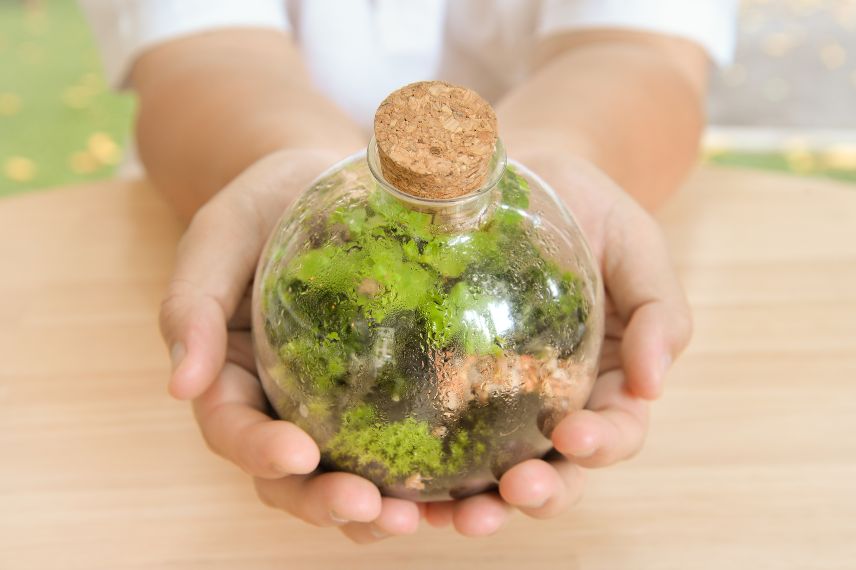
Closed terrariums are self-sufficient, but they generate condensation or droplets
Read also
How to take cuttings from indoor plants?Prevention of common problems
Moulds
To prevent mould growth, ensure your terrarium is well-ventilated. Excess humidity and poor air circulation can encourage mould growth. If you notice signs of mould, remove affected plants and reduce watering.
Parasites
Parasites such as mites can be a problem in terrariums. Regularly inspect your plants for any signs of infestation. In case of a problem, isolate the infected plant and treat it with a natural solution such as black soap or neem oil.
The choice of plants is crucial to the success of your terrarium, taking light requirements, humidity and plant compatibility into account. Also follow the care tips to ensure the health of your miniature ecosystem. Feel free to explore different types of plants to create your own indoor oasis of greenery.
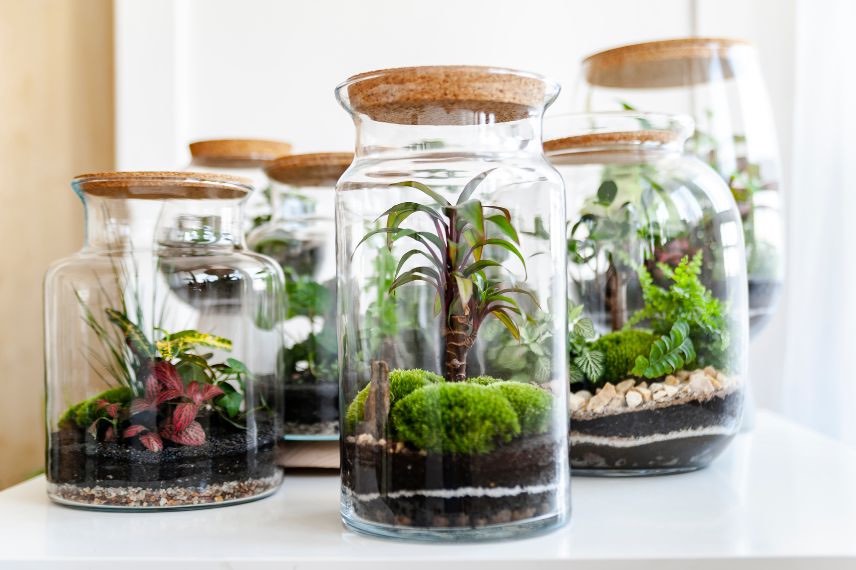
Terrariums are a wonderful way to create lasting miniature landscapes for yourself
- Subscribe!
- Contents
Comments