




























Nursery Measurements: How to Make Sense of Them?
Understanding the jargon and abbreviations
Contents
C3, P9, 6/8, 10 + or R2-D2… Sometimes, as a gardener, it can be difficult to navigate the abbreviations used by nurseries and plant producers. And what about the specific jargon: sapling, scion, bulrush, open ground… Whether it’s for the pruning of the bush, the volume of the container, or the shape of the fruit tree: do we really know what we are buying or ordering from nurseries or garden centres? How can we decipher the annotations on the labels?
→ We clarify the sizes of trees and bushes, the volumes of containers, and the calibres of bulbs.
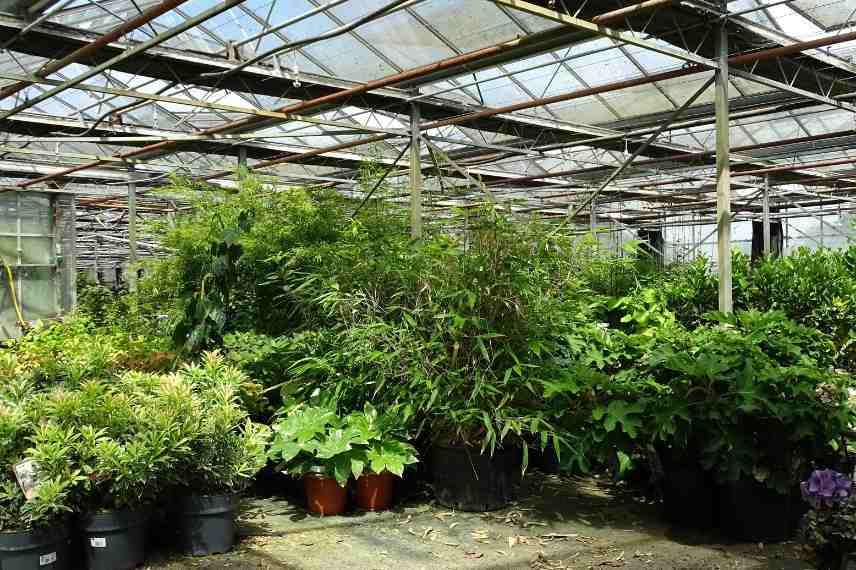 Bushes in our greenhouses in Houplines

The jargon concerning trees, bushes, and fruit plants
Firstly, it is important to define certain terms from the nursery lexicon to understand what we are talking about.
- Scion: this is a young fruit plant aged 1 year, less than 130 cm tall, untrained and featuring some branching. Young willow and poplar shoots intended for planting and aged one year are also referred to as “scion”;
- Sapling: a young tree aged 2-3 years, straight and vigorous, which will develop into a fine forest tree (A forest is a wood or area composed of large trees);
- Palmette: a fruit tree of at least 5 years (mainly pear and apple trees) shaped in a “U” or double “U”;
- Cup (or Quenouille): a fruit tree aged 2 years, with the first branches starting 40-60 cm from the ground (very short trunk) and with the main branches growing around the trunk, leaving the centre of the branching well aerated;
- Spindle: very similar to the cup, but the trunk is slightly shorter: about 30 cm;
- Low-stem: a tree of 2-3 years of cultivation (similar to the cup and spindle) with a trunk height of about 50 to 70 cm;
- Half-stem: a tree of 3 years of cultivation with a trunk height of about 120 to 150 cm;
- High-stem or “stem” or “full-crown”: a tree of 3 years of cultivation with a trunk height of about 175 to 200 cm.
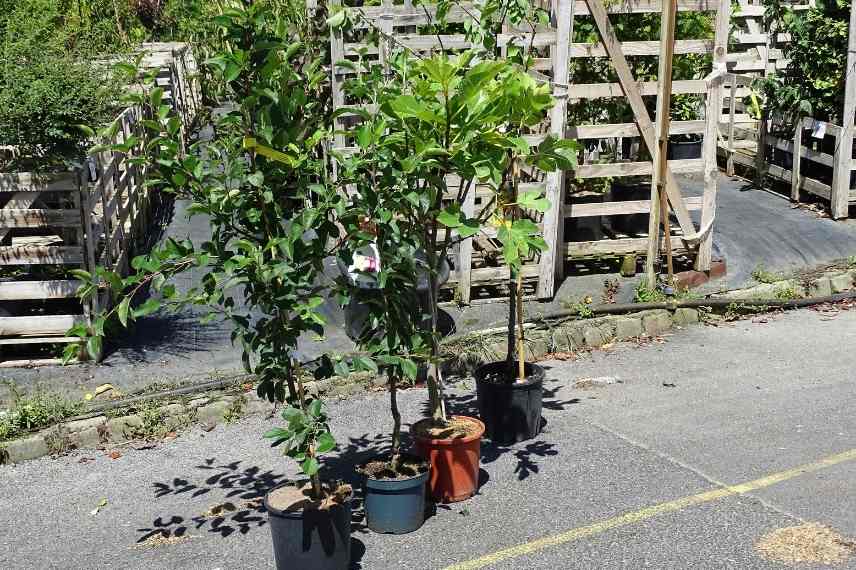
Fruit trees: saplings
Measurements of trees and bushes for sale
Measurement rules are very codified in nurseries. You can’t just do anything, any way. The idea is to ensure clarity. But to achieve clarity, you first need to understand what you’re talking about. The measurements provided by the nurseryman in catalogues or on labels represent what nurserymen call “the strength of the tree”. This strength is indicated differently depending on the plant being sold.
Bushes, roses, conifers, and climbing plants
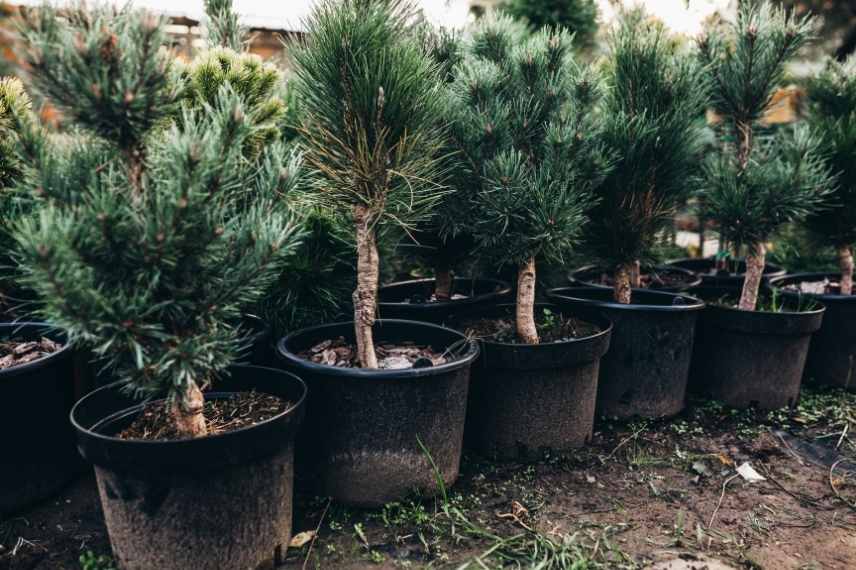
Here, it’s simple! The strength of bushes, conifers, and climbing plants corresponds to the height of their vegetation at the time of sale. This strength is expressed in centimetres and follows a size range. For example: a bush with a strength of 100/125 will be at least one metre tall at purchase.
Note that in the specific case of creeping bushes, the strength refers to the width of the bush being sold. For example: a groundcover bush with a strength noted at 60/80 will be at least 60 cm wide at purchase.
Ornamental trees and fruit trees
It gets a bit more complicated! The strength of a tree, whether fruit-bearing or not, refers to the circumference of the trunk at 1 m above the ground. This strength is expressed in centimetres within a size range. For example: a label that displays a strength of 10/12 means that the circumference of the tree’s trunk is between 10 and 12 cm at 1 m above the ground.
A strength of less than 6 cm is a sapling (see above), while 6/8, 8/10, and 10/12 are “young stems”. Beyond a strength of 20/25, we are in the category of “large specimens”.
The size of containers: pots, pots...
A large number of plants are now available for sale in containers: perennials, grasses, bamboos, bushes, trees, palms, fruit trees and soft fruit, herbs, and even flowering or vegetable annuals.
Containers also have their abbreviations. In this case, we differentiate between pots or containers with a volume of 1 litre or more (diameter greater than 12 cm) and small pots or plugs of less than 1 litre (diameter less than 12 cm).
Containers are noted as follows: C (for container) followed by a number, indicating the volume in litres that the pot can hold. For example: C3 for a 3-litre pot. You may also commonly see C3L (the L stands for “litre”), CONT. 3L, CT3, or CO3.
Plugs are referenced as follows: P (for pot) followed by a number, indicating the length in centimetres of one side of the square pot. For example: P9 for a plug with a side length of 9 cm.
Nota bene: if in a catalogue or on an online site, you do not find this type of abbreviation, but a simple “RN”, it means that the plant (often trees and bushes) is offered as “bare roots“, that is to say, without a container. You may also occasionally find the acronym MO for “in clod” and MG for “in mesh clod“.
Note: the size of pots is always relatively approximate. A 2L pot may sometimes only hold 1.8L, which usually does not make much difference. This is why, on our site, it is not uncommon to find approximations for plants presented in containers. For example, with this Ajuga reptans, a perennial for which we offer two types of packaging: a plug of 8/9 cm and a container of 2L/3L.
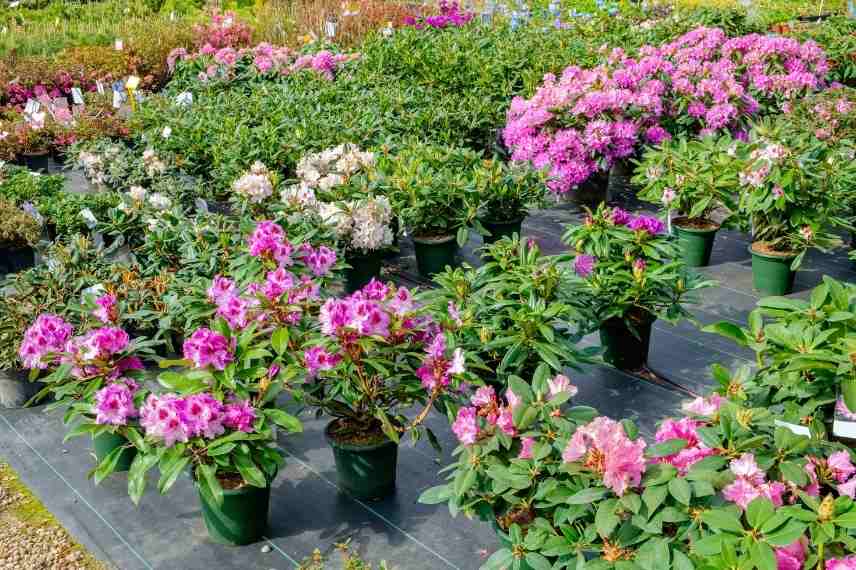 A range of Rhododendrons at a nursery
Read also
Fruit trees: pruning of a young shootThe size of bulbs
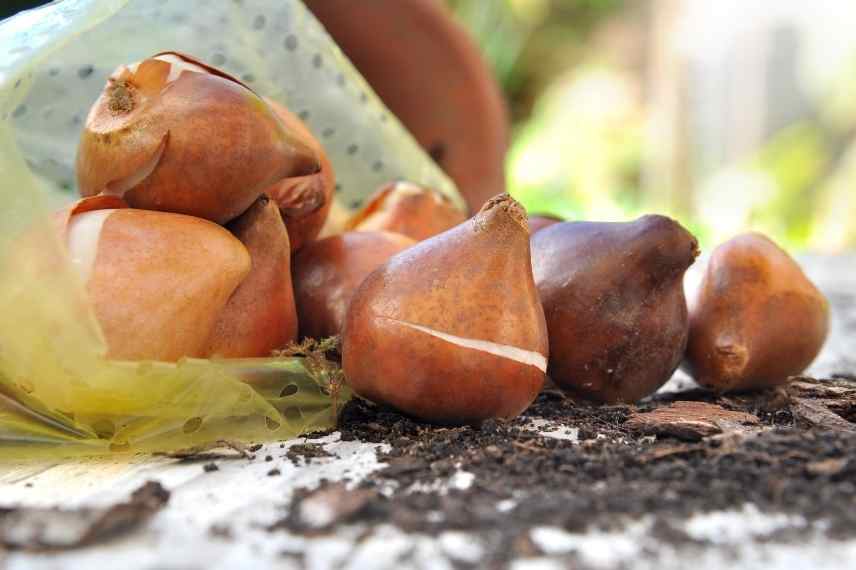
Bulbs also have their own sizing calculation. This size refers to the circumference of the bulbs, in centimetres. Moreover, the larger a bulb is, meaning the higher its size number, the more reserves the plant has accumulated, and the more likely it is to produce an abundance of large and beautiful flowers.
There are two types of sizing noted on bulb packets:
- “8/10”: means that the smallest in the packet will have a circumference of 8 cm, and the largest, 10 cm;
- “8 +”: means that the bulbs have a minimum circumference of 8 cm. This means that some in the batch may be larger.
 Tulip bulbs
- Subscribe!
- Contents
Comments