





























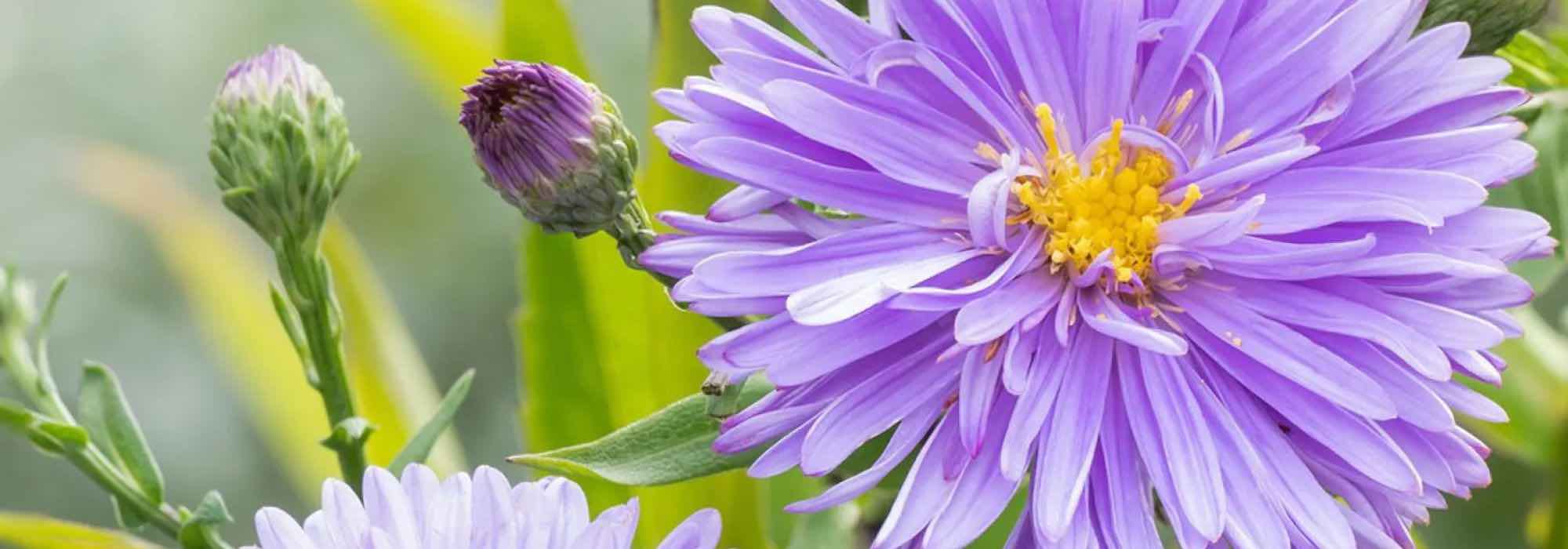
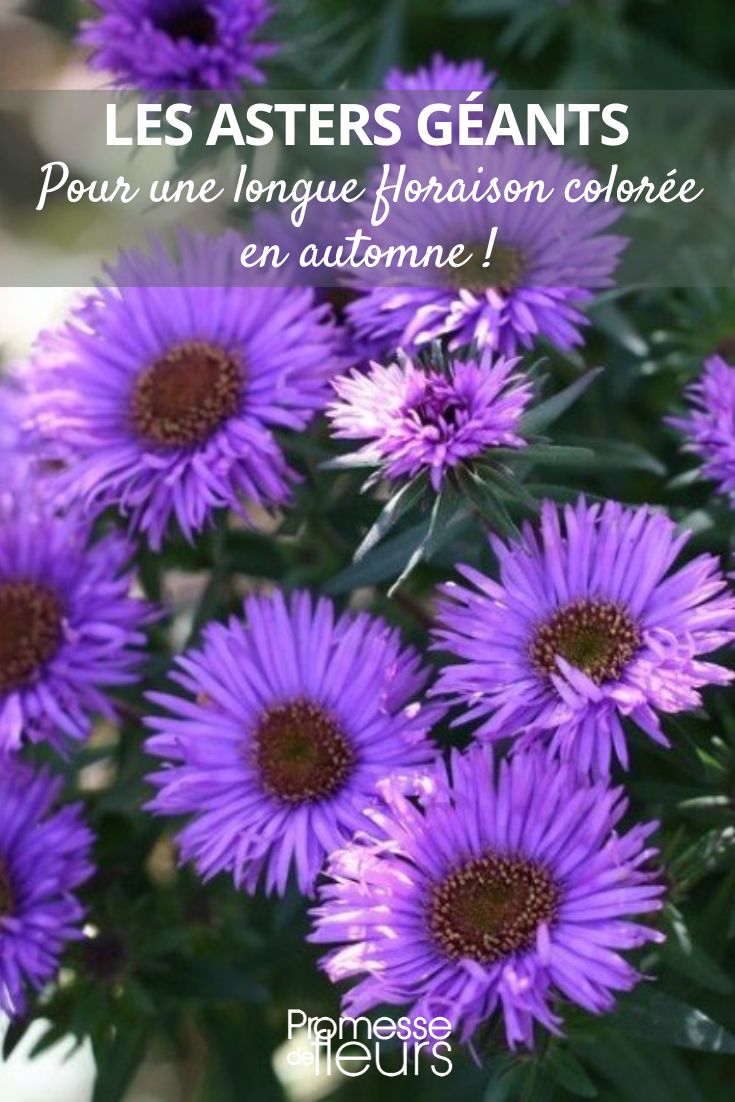
Opt for giant asters for a long flowering display in autumn
Easy-to-grow plants that will provide long-lasting volume and colour
Contents
Asters are generous perennial plants that reliably brighten the garden in autumn. They reward us with a colourful flowering, with a diverse colour palette: blue, violet, mauve, pink, purple, red… There’s something for everyone!
Among the asters, giant varieties are clearly not to be missed. Growing to more than 1 metre in height, they are generous and will be perfect for adding bulk to borders. Discover everything you need to know about these large autumn asters, so you can use them well in the garden and enjoy a long colourful flowering.
For everything you need to know about growing asters, discover our guide Asters: planting, growing and care.

Aesthetic benefits of these tall asters.
Autumn arrival marks the end of the garden’s busiest season. While it isn’t, by any means, a dull period, thanks in particular to shrubs with colourful foliage, decorative fruiting or striking bark, it is true that the flowering becomes more subdued. Fortunately, asters are there to brighten the garden!
A generous, colourful flowering
If we recommend choosing giant asters for autumn, it is primarily for their colourful flowering, which will bring energy and joy to the garden. Whether bold or more subdued, it adds a lovely countryside note, with flowers featuring golden-yellow centres that contrast beautifully and glow. In addition to their wide colour range, asters display an interesting diversity of flowering: you can opt for single flowers, but also for double flowers with several rows of petals. In Aster novi-belgii ‘Marie Ballard’, for example, the pale blue flowers resemble real pom-poms with a sophisticated look, almost with hints of dahlias when they are not fully open. In ‘Fellowship’, the pale pink double flowering has a wild, charming allure with its tousled appearance.
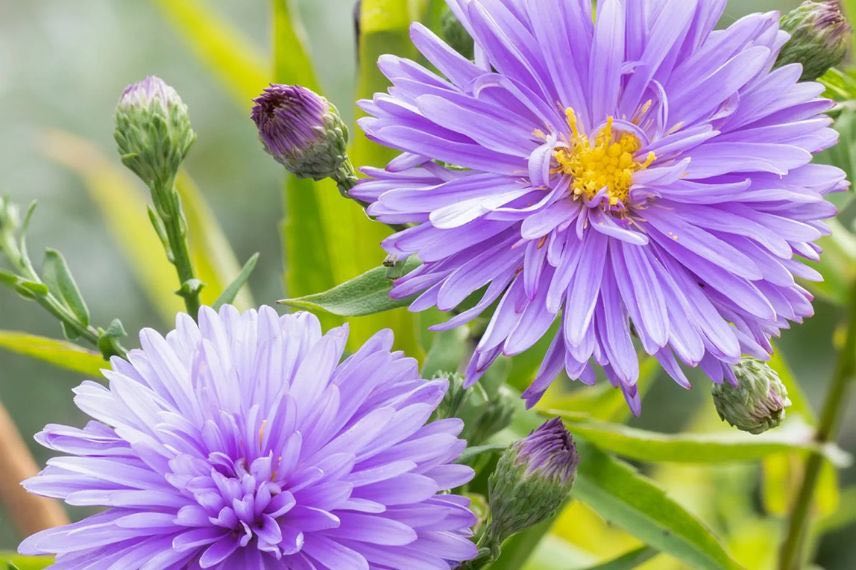
Aster novi belgii ‘Marie Ballard’ à fleurs doubles
NB: with asters, the flowers aren’t quite what we think. The heart is actually made up of yellow tubular flowers, while what we take for petals are also numerous small ligulate flowers grouped around the outside, as with daisies.
Some varieties flower from late summer in August, while others can provide the display until November. For a long-lasting effect, don’t hesitate to pair early-flowering autumn asters with later-flowering asters.
They are melliferous plants, which attract numerous butterflies and valuable pollinating insects to the garden, creating real ballets that provide a pretty display during autumn.
Finally, asters make perfect candidates for rustic-looking bouquets. The flowers are indeed able to stay beautiful for at least a week in a vase.
A silhouette that adds volume
Giant asters easily fill space. They feature an erect, bushy habit, reaching at least 1 metre in height and up to 1.5 metres on average. There is, however, a climbing species, the only one in the genus, capable of reaching 5 metres in height: Aster carolinianus. This impressive liana produces a multitude of pale pink small flowers between October and November.
In the background of borders, asters have no equal for adding volume and will pair perfectly with grasses, always in that very natural, wild spirit. You can also plant them along borders or in a large tub, to brighten terraces and balconies in autumn.
Other ornamental attributes
The flowering is not the only decorative asset of these plants. To complement this, some asters also feature decorative foliage, further enhancing their ornamental value. It can be purple, as with Aster laevis Calliope, which also has distinctive black stems, nicely setting off the blue-violet flowering. At Aster macrophyllus ‘Albus’, also known as the large-leaved aster, the cordate (heart-shaped) leaves form a handsome light-green shrub. Let us also mention the type species of Aster laevis, with its dark green leaves with bluish reflections, contrasting with a wine-red central line.
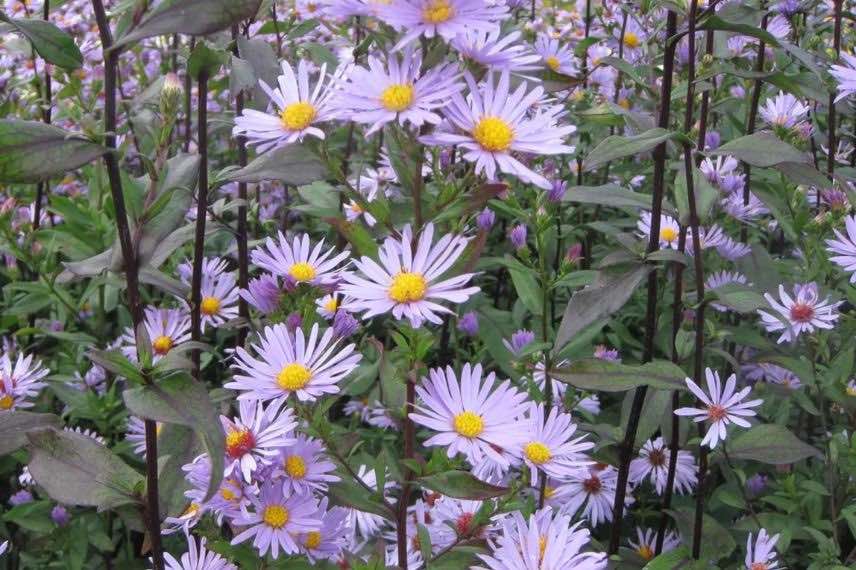
Aster laevis ‘Calliope’ à tiges noires
After flowering, asters produce decorative fruits, composed of an achene attached to a egret of bristles. Airy and poetic, they detach and drift with the wind, like dandelion flowers.
A cultivation accessible to all gardeners, even beginners
In terms of cultivation, giant asters are easy-to-grow autumn perennials: hardy and requiring little maintenance. They can be grown in most of our regions. Give them light, well-drained soil in a sunny position where water does not stagnate. Some species can even tolerate occasional drought, as with Aster pringlei ‘Monte Cassino’, which blesses us with a swarm of white flowers that flutter in the August-to-November wind. This is also the case for Aster pringlei x ericoides ‘Pink Star’. Most asters will, however, favour a moist (never completely dry) soil.
Asters can spread quickly thanks to their rhizomes and divide easily, making it effortless to propagate them in the garden.
In summary, giant asters are plants that combine many virtues: easy to grow, generous, colourful and versatile; they are ideal candidates for enlivening the autumn garden.
Read also
Choosing, planting and caring for astersVarieties to plant for a colourful autumn.
The large autumn asters in blue and mauve tones
These are the colours we typically think of when we mention asters.
Among autumn giants, choose from, for example:
- the Aster novae-angliae ‘Purple Dome’, with its flowers a vivid purple-violet between September and October;
- ‘Violetta’, with its extremely intense violet flowering from the end of summer to October;
- ‘Barrs Blue’, a safe bet producing blue-violet daisies with a golden-yellow eye up to November;
- the Aster tataricus ‘Jindai’, which bears a blue-tinged pink and whose sturdy stems mean it doesn’t require staking;
- the Aster novi-belgii ‘Reitlingstal’, with its semi-double flowers in lavender, visible in early autumn;
- ‘Sarah Ballard’, with its star-shaped blue-mauve flowers with very slender petals.
The large pink autumn asters
Another colour well represented among autumn giants: pink. It ranges from the softest to the most vivid shade, to suit all tastes.
- The Aster novae-angliae ‘Andenken an Alma Pötschke’ produces, for example, flowers in a pink so vivid that it leans toward red. They provide the display between September and October.
- ‘Barr’s Pink’ opts for a very fresh pink. Its large, daisy-like flowers appear until November.
- The Aster hybrid ‘Pink Star’ turns into a real cloud of small pink stars with mauve reflections.
- The flowers of the Aster novi-belgii ‘Karmin Kuppel’ seem to change colour with the hours and brightness, displaying pink-mauve to carmine hues.
- ‘Rosenponpon’ lives up to its name, with its well-double flowers in a bright pink.
- Let’s also mention the Aster novae-angliae ‘Septemberrubin’, whose flowers display an astonishing ruby red, in perfect harmony with the season’s flamboyant colours.
The large white autumn asters
Delicate and easy to pair with, they highlight all other colours and will elevate autumn hues in other plants.
The Aster novae-angliae ‘Herbstschnee’ offers, for example, a long pure white flowering until November. For its part, the white flowers of the Aster novi-belgii ‘Weisses Wunder’ will take over from the summer flowering from August.
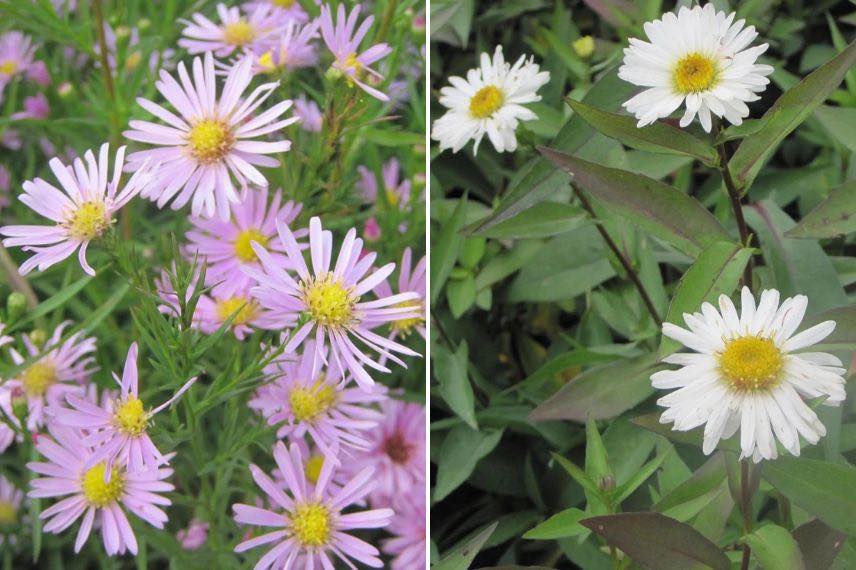
Aster hybrid‘Pink-Star’ and Aster novi belgii ‘Weisses Wunde’
How can I grow beautiful giant asters?
To get the best from your large autumn asters, a few maintenance steps are worth applying:
- Avoid heavy soils: asters do not tolerate standing moisture. Add drainage elements if needed at planting time (gravel, clay balls, etc.).
- If your soil is poor, incorporate well-rotted compost before planting.
- Water the soil during dry spells, taking care not to splash the foliage. Apply a mulch at the base of the asters to help retain moisture.
- Choose a sunny site, but sheltered from strong winds, which could topple the clumps. Some heavy or very tall varieties will need staking. For more information: How to stake an Aster? Techniques and tips.
- Avoid moving your asters once established: they dislike change.
- Maintain planting distances (about 70 to 90 cm, depending on the mature spread of the variety), to promote natural aeration and limit the development of fungal diseases. In very damp climates, opt for varieties resistant to powdery mildew (Asters novae angliae). Carry out regular pruning to aerate the plant, using only cutting tools that have been disinfected beforehand. As a precaution, you can treat the plants with horsetail manure.
- In mid-summer, regularly pinch back the shoots to encourage a more compact habit and prevent the plant from growing too tall. This helps avoid the need for stakes.
- For container growing or poor soil, don’t hesitate to apply a potash-rich fertiliser to support flowering in summer.
- To support flowering, remove spent flowers as they appear.
- Divide clumps every 3 to 4 years to keep your asters floriferous.
- Subscribe!
- Contents
Comments