





























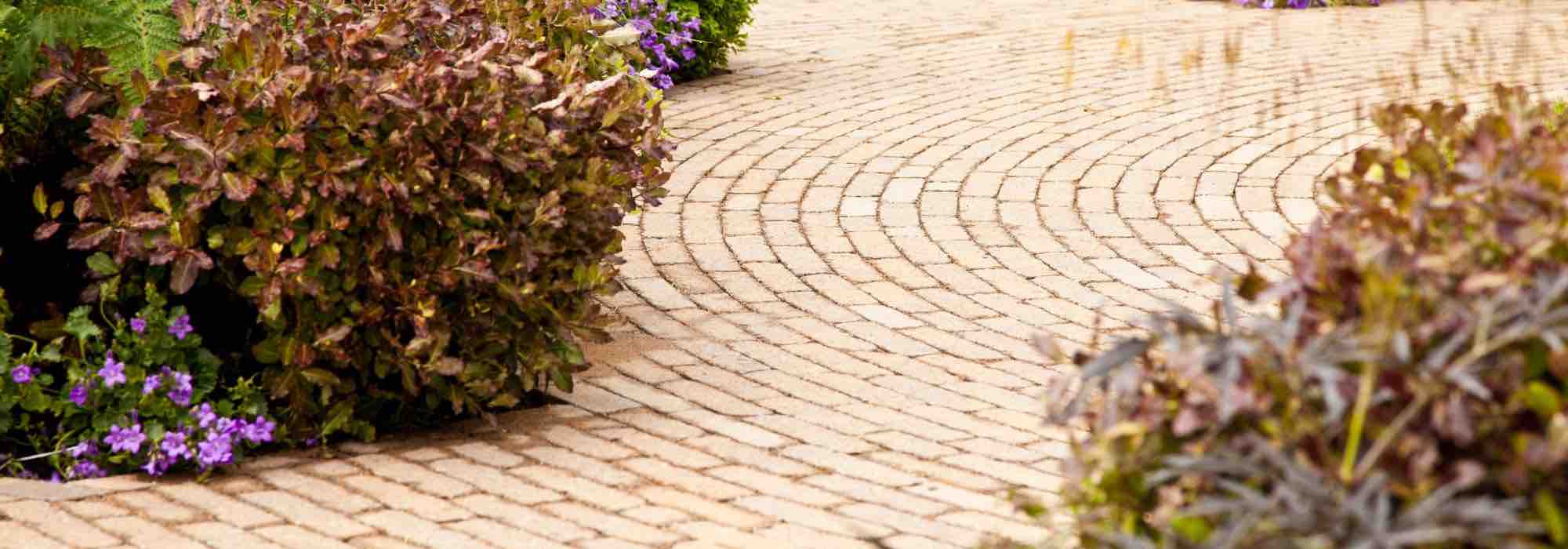
Our maintenance tips to keep pavers beautiful and clean all year round
Cleaning, products to use and protection
Contents
On your terrace, on your driveway, or even to mark out garden paths, you may have outdoor paving at home. While they are often robust and durable materials, their maintenance should not be neglected.
To keep your paving looking its best all year round, it is indeed useful to apply a few single maintenance steps, notably to clean it from time to time, while limiting the factors that could affect its quality. Discover all our tips for maintaining your outdoor paving!

Why must outdoor paving be maintained?
Paving maintenance has several functions:
- Aesthetics: subject to weather, dirt and pollution, paving will inevitably lose its appeal over the seasons. By maintaining it regularly, you can ensure it stays looking its best and clean year-round.
- Safety: regular cleaning and good maintenance of paving reduces the risk of slips caused by fallen leaves or the growth of moss, which can be slippery.
- Durability: well-maintained outdoor paving will have a longer lifespan and can retain its properties for longer.
There are several types of paving, varying in shapes, materials, colours and, of course, price. You’ll usually have a choice between:
- brick;
- concrete;
- natural stone (travertine);
- reconstituted stone;
- interlocking paving blocks;
- standard paving blocks;
- marble;
- slate.
Before laying your paving, to ease future maintenance, consider providing a slight fall that will allow rainwater to drain away naturally without pooling (usually about 1 cm per metre).
If you are not carrying out masonry work (notably the installation of interlocking paving blocks), ensure the ground is well levell ed and compacted before installation. You can add a geotextile fabric, which will help limit the growth of unwanted vegetation.
Finally, ensure that the cleaning products or tools we recommend are compatible with the materials of your paving and will not damage them. Each paving may have its own particularities.
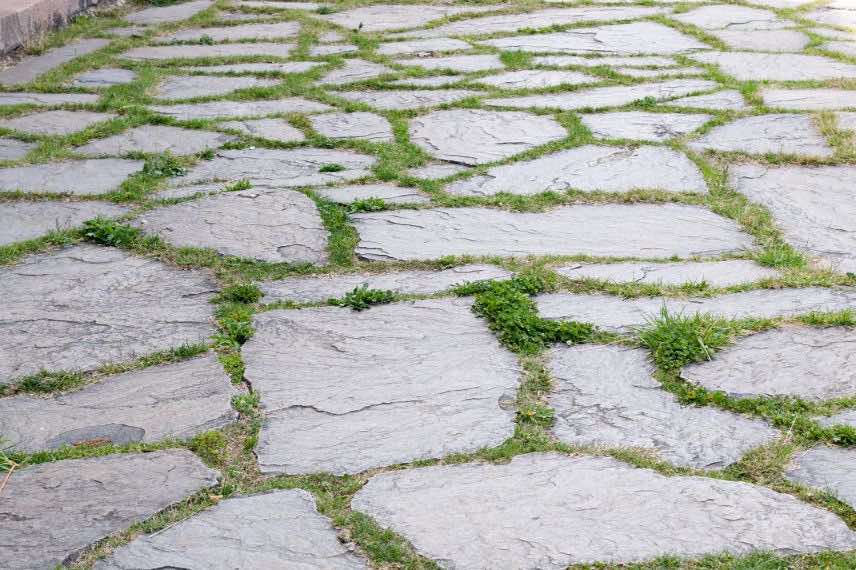
Which products to use to clean paving slabs?
We always recommend opting for the gentlest cleaners and the most natural options available, to limit their environmental impact. Here too, we remind you to check the compatibility of your paving materials with the products chosen.
For this, you can prioritise the following ingredients:
- Black soap. Natural, inexpensive and fairly economical, black soap can suffice to clean joints or stains, while degreasing surfaces. You can use it in a mixture, following the same dosage as for use as an insecticidal product, i.e., about 1 tablespoon diluted in 1 litre of lukewarm water. Be sure to rinse after use to avoid leaving a slippery film on your paving.
- White vinegar. Another staple for natural maintenance, this multifunctional product helps maintain joints, remove moss, lichens and other fungi, but also restore shine to surfaces. Simply dilute 150 ml of white vinegar in 1 litre of water. This mixture can also be used as a weed killer, sprayed directly on the aerial parts of the plants, if they are still young (older plants will be able to recover after this treatment). This product should be reserved for materials that tolerate acidity: avoid using it particularly on natural stone.
- Baking soda. Yet another versatile product that will allow you to clean your paving naturally, without using chemical products. Dissolve 3 tablespoons of baking soda in 150 ml of lukewarm water and spray onto the areas to be cleaned. It is also an effective weed killer, but it will disturb the balance of soils if used in large quantities. Therefore, use it sparingly, in restricted areas. Do not use it near plantings or borders landscaped with plants. Sodium percarbonate or washing soda crystals are also sometimes used for very stubborn stains and to whiten grout.
- Cooking water from vegetables or starchy foods. This is the most natural and economical weed control method. However, be careful if your water has previously been salted: it can contribute to soil imbalance and affect nearby vegetation. Therefore, opt for non-salted hot water and take care to avoid splashes when pouring it onto your paving.
What are the different steps to clean paving slabs?
Twice-yearly cleaning of paving should ideally take place in spring and autumn. Do this on a dry, sunny day, preferably in the early or late part of the day.
Start by removing all movable items from your paving: furniture, pots, decorations, etc. This will allow thorough cleaning without obstruction.
Regular dirt removal
If cleaning paving can seem laborious and time-consuming, it will actually be much less burdensome if done regularly. Dirt will have less opportunity to settle and penetrate the surfaces. Cleaning will therefore be easier and quicker to perform.
To do this, start by using a leaf blower or a simple stiff outdoor broom (the bristles are sturdier) to remove fallen leaves, sand, dust and other plant debris. If your paving is fairly protected (for example under a covered terrace), you can even use a vacuum cleaner compatible with this type of debris.
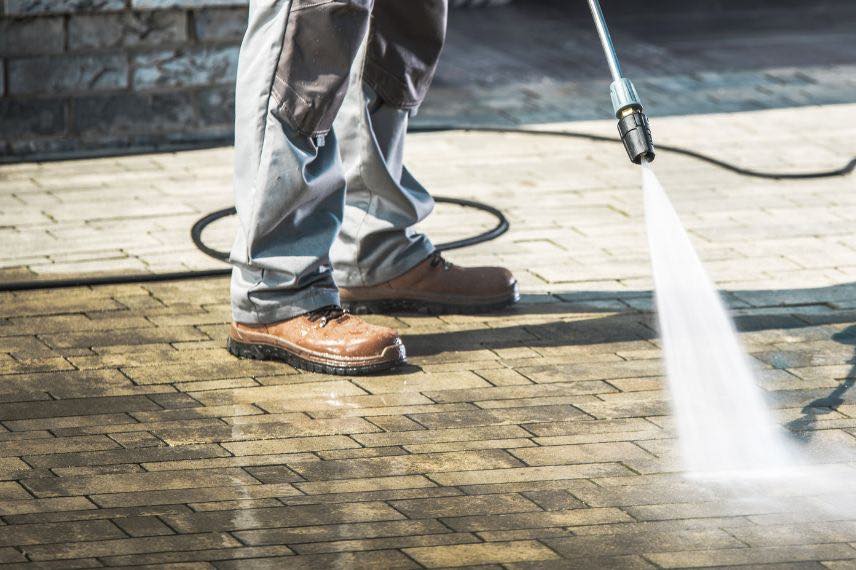
To complete this cleaning, you can rinse the slabs with a jet of water or empty a few buckets. Then leave to air dry. This step can be performed several times a year.
Check and maintain the joints
If the joints of your paving become dirty, they will be less effective and their impermeability will gradually decrease, increasing the risk of water ingress. Mosses, lichens, mushrooms and other unwanted vegetation will also more easily creep between the slabs. To prevent this, equip yourself with a joint scraper or a triangular-head scraper. If some “weeds” have already grown, use a weeding knife to remove them. This is the most natural and economical method for maintaining the joints and gaps in paving.
You can also use more advanced tools, such as a thermal weed burner or the weeding brush. Be careful if you plan to use a pressure washer: they can damage certain joint types, alter the waterproofing layer of the paving and create micro-cracks in some materials.
If you notice gaps in the joints, you will need to top up with sand or mortar.
In addition, feel free to read our dedicated tutorial: How to clean the joints in terrace paving or garden paths?
Removing the most stubborn stains
For more stubborn stains (oil, coffee, wine, hydrocarbons, rust, etc.) you can equip yourself with a brush (even a toothbrush), a sponge or even a mop if the area is large. Do this ideally as quickly as possible so that the stains do not penetrate the materials too deeply. Warm water with a few drops of soap or washing-up liquid can be enough if the stain is treated promptly. For more ingrained stains, consider leaving the cleaning product to work for at least 30 minutes to maximise its effectiveness. Baking soda and black soap often help to tackle the most common stains.
Protecting paving from the weather
To preserve the waterproofing of certain pavings, it is necessary to use specific products promoting sealing (water-repellent or oil-repellent). They create a protective layer that should last several years. At the outset, it is necessary to carry out thorough cleaning and degreasing of the paving, then wait for the soil to dry thoroughly. Always follow the manufacturer’s precautions for the products used. Saturator products are, on the other hand, intended for wooden surfaces.
Read also
A weed-free pathway: how to achieve it?What precautions to tak to protect paving slabs?
To keep paving looking good, a few extra steps are worth taking:
- Avoid planting near paving slabs any plants that can damage or stain the surfaces. This includes plants with roots that are too large or suckering, regarded as destructive or overly invasive. They can indeed damage paving, even when laid on a masonry surface. This is notably the case with running bamboos, weeping willows, the poplars, the mimosas, the wisterias or the Sorbaria sorbifolia. Think also of fruit trees that can cause staining, make paving slippery and require overly frequent cleaning, such as fig trees, the black mulberries or the Prunus domestica. In addition, you can draw inspiration from our articles “Which trees should not be planted near a terrace?” and “Which trees to plant near a terrace?”
- If necessary, to protect your paving from scratches, you can install an outdoor carpet or mats.
- Of course, avoid dropping heavy objects (terracotta pots, stones, etc.) on your paving slabs, to avoid weakening them.
- Limit as much as possible the use of chemical products or abrasive tools, which can damage coatings. Also avoid bleach, which can attack and discolour materials.
- If you plant in pots, add a saucer under the containers to limit staining.
- If you need to clear snow from paving, use tools with rubber protection to avoid damaging the materials or causing scratches.
- Subscribe!
- Contents
Comments