





























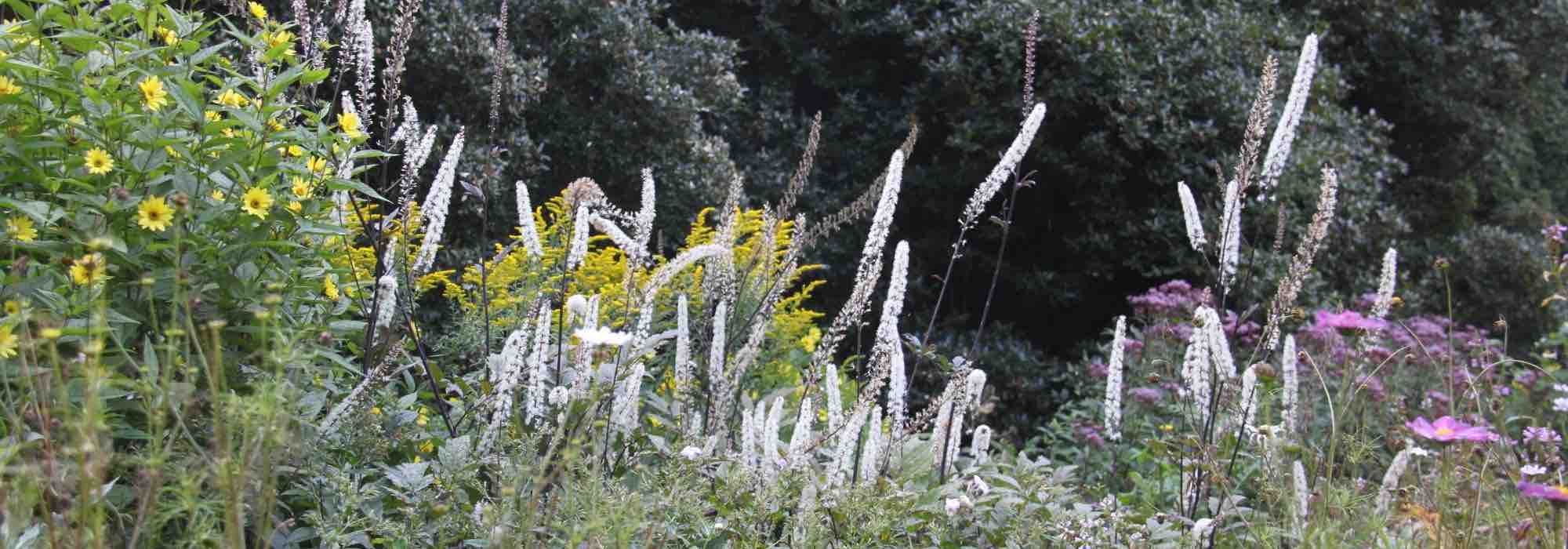
Pair Cimicifuga with other shade-loving plants.
Our ideas for lighting up a shaded area
Contents
Cimicifugas, also called Actaea by their vernacular name, or more commonly ‘silver candle’ in reference to their flower spikes, are jewels of shade gardens, renowned for their elegant flower spikes and their superb, lacy foliage. These perennials originate from temperate forests of Asia and North America. With their slender habit and their flower spikes, they catch the eye and hold interest throughout their flowering from late summer into autumn. In this article, discover how to pair Cimicifugas with other partial-shade or shade-loving plants to create harmonious and dynamic displays and thereby enrich biodiversity and the aesthetics of your shaded gardens.

In an autumn-flowering border, with perennials for partial shade.
For a shaded position with moist soil, Cimicifuga’s leaves scorch if they receive too much sun or if the soil is too dry. Plant it at least in partial shade, shielding it from the sun’s rays during the hottest hours.
In partial shade, Cimicifuga appreciates the company of perennials grown under similar cultivation conditions, using colour or foliage contrasts to enliven the space.
Cimicifugas begin to flower from July for the earliest forms, such as Cimicifuga racemosa, but most open their feathery racemes from August or September, with October for the latest, such as ‘Queen of Sheeba‘.
Create a superb autumn scene with the flowering of Japanese anemones, asters with small star-shaped flowers, and Persicaria amplexicaulis with slender, erect spikes. At the base, plant autumn cyclamen bulbs. Also add flowering shrubs such as rounded hydrangeas in muted tones or hardy fuchsias with a graceful habit. The white-to-pink flowers of silver candles pair well with white, pink, purple or blue-tinged blooms.
That said, you can still plan year-round flowering by adding, for example, elf flowers, wood hyacinths, lamiums, forget-me-nots, but also hardy geraniums.
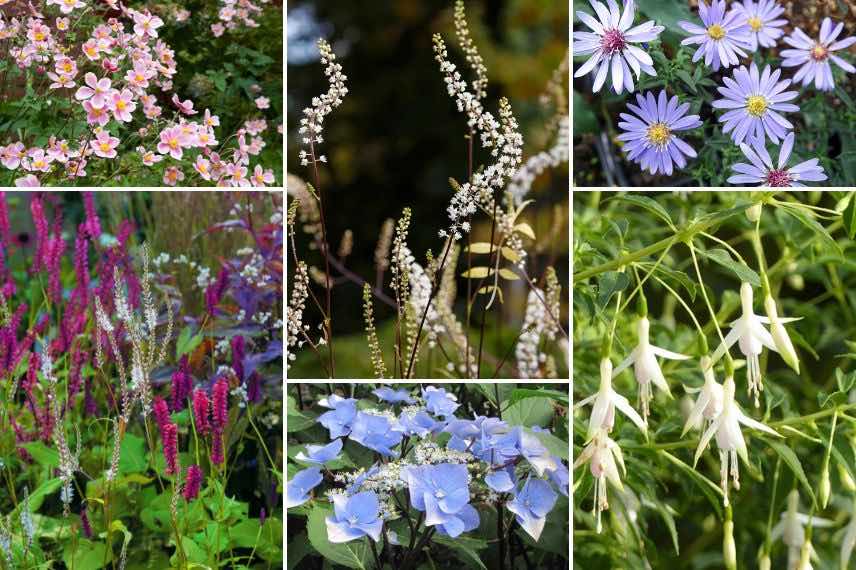
From left to right: Japanese anemones, Cimicifuga racemosa, Aster cordifolius, Fuchsia magellanica, Hydrangea ‘Zorro’, Persicaria ‘Taurus’
In a contemporary garden
In a contemporary garden, where graphic design and colour take precedence, Cimicifugas offer interesting qualities: elegant foliage and growth habit, understated flowering for an architectural plant.
The silver candles pair perfectly with shade-loving plants with graphic foliage and clean lines, typical of modern schemes. Species such as Japanese ferns, of the Athyrium type, notably the cultivars with silver foliage, the Heucheras with metallic foliage, the large blue-green hostas bring an elegant and minimalist touch, the Carex or the Holcus mollis ‘Albovariegatus’ in perfect harmony with the aesthetics of contemporary design. In the foreground, clumps of Ophiopogon noir bring their entire modernity. For a few flowers, choose Astrantias or Corydalis.
Cimicifugas, with slender flowering spikes and dark foliage for the purple varieties, create a subtle, yet sophisticated contrast. By playing with textures and hues, these plants allow you to structure shade borders while preserving a visual flow, a hallmark of modern gardens. Their appearance and verticality pair with contemporary materials such as concrete, steel or rough wood, for a garden that is both natural and decidedly design-led.
All Actaea varieties and species lend themselves to this use—why not Actaea matsumurae ‘White Pearl‘ with white flower spikes and green foliage.
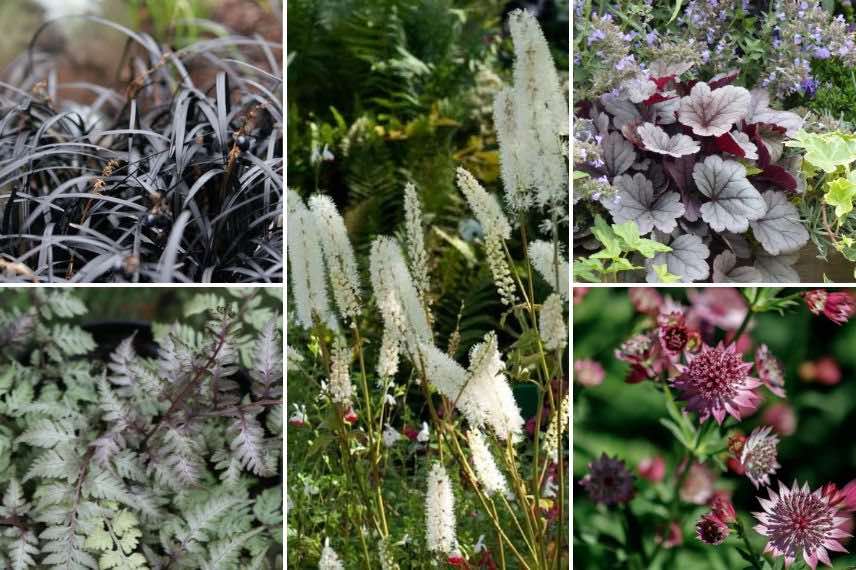
Ophiopogon nigrescens, Actaea ‘White Pearl’, Heuchera ‘Silver Gumdrop’ , Astrantia ‘Roma’, Athyrium nipponicum ‘Pictum’
Under trees and bushes
To highlight the white, airy flowering of Cimicifugas, pairing them with trees or bushes with dark foliage in the background creates a striking contrast and is ideal for providing shade to the silvery candles.
Shrubs such as Black Lace elder, the Physocarpus opulifolius ‘Diabolo’, or the twisted hazel with purple foliage, or Corylus avellana ‘Contorta’ with purple foliage, provide a rich, deep backdrop that makes the flowering stems of Cimicifugas stand out, like delicate, luminous touches in a shadowy setting. Evergreen species of conifers, viburnum, spindle (Euonymus) or holly are also good choices.
This colour contrast highlights the lightness and grace of the white inflorescences, while providing a solid structure to the garden. These trees and shrubs, through their dense habit and textured foliage, add depth and timeless elegance to the garden, while enhancing the ethereal beauty of Cimicifugas.
For example, choose the variety Actaea pachypoda ‘Misty Blue’, which offers bluish foliage, white pom-pom flowering, followed by white berries carried on red pedicels. Alternatively, choose an Actaea with green foliage and white flowers such as Cimicifuga racemosa, the handsome Cimicifuga dahurica, less well known, or the Actaea ‘Cheju-Do’, both more compact.
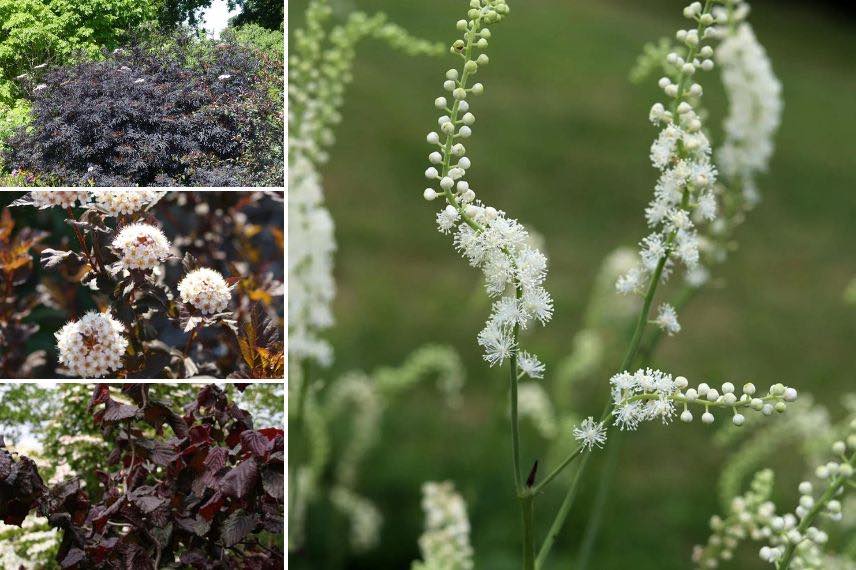
A Black Lace elder, a Physocarpus opulifolius ‘Diabolo’, or a twisted hazel with purple foliage can serve as a dark backdrop behind the inflorescences of a Cimicifuga dahurica
by the riverside
Cimicifuga thrives in cool soil, but also in damp soil, right up to the water’s edge, provided the site is not in full sun. It prefers clayey and humus-bearing soils.
In this riverbank, pond or lake-edge medium, pair it with plants typical of the same conditions, such as Ligularias, the Astilbes, the water iris, the Lysimachias, the Filipendula, and some Carex, which thrive in humus-bearing soil and enrich the biotope by their presence.
By pairing them with Cimicifugas, you can maintain ecological balance near ponds, streams, or water features. Adding such species helps ensure staggered flowering, thanks to the diversity of flowering periods, a varied foliage structure, and also to attract beneficial wildlife.
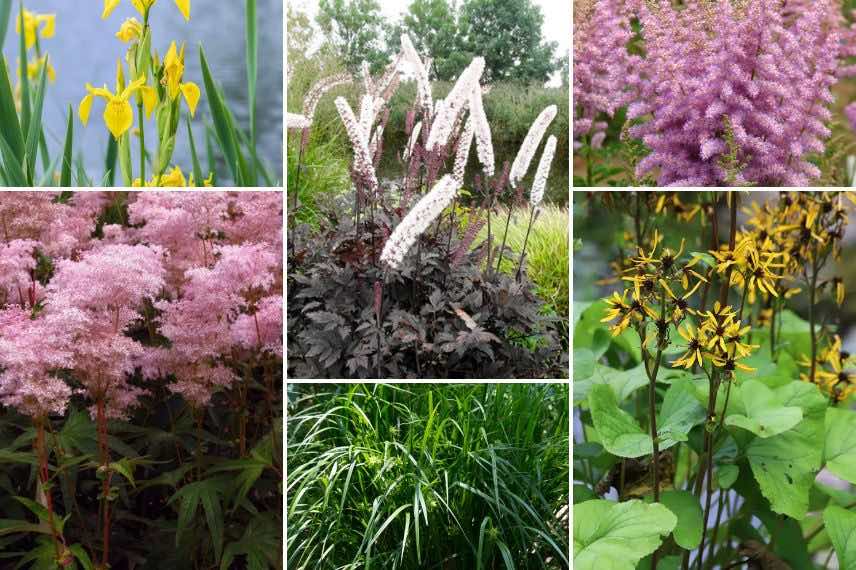
Iris pseudacorus, Cimicifuga ‘Chocoholic’, Astilbe ‘Hyazinth’, Ligularia hessei ‘Lanternchern’, Carex grayi, Filipendula palmata
Go all out for foliage contrasts.
To create a dynamic border around Cimicifugas, pairing them with shade-loving plants with colourful foliage offers a striking play of contrasts in form and colours.
These colourful leaves contrast wonderfully with the dark, textured tones of Cimicifugas, whose leaves are purple or green depending on the other choices, while highlighting their white, airy flowering.
By combining plants with a variety of forms, such as ferns, Brunnera with silvery foliage or Epimediums with cordate leaves and unusual flowers, you create a border rich in texture, where each plant plays a complementary role. Add foliage-rich plants such as Hostas, with variegated foliage to bring light, Heucheras with palmate leaves in vibrant shades of purple, bronze, lime green or golden yellow and shade-loving grasses such as Hakonechloa. Also consider the splendid Rodgersias, with palmate leaves, green or bronze.
This mix of contrasting foliage transforms shade into a vibrant and elegant space, where colours and forms intertwine harmoniously around Cimicifugas.
Choose Cimicifuga cultivars with nearly black-purple foliage, such as the well-known ‘Brunette’, or the newer ‘Chocoholic’ and ‘Carbonella’, which are more compact and floriferous.
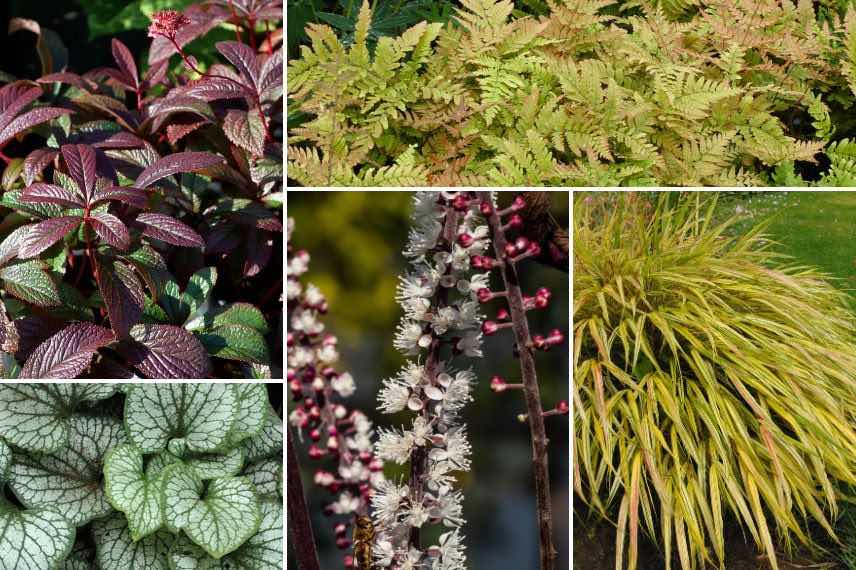
Rodgersia ‘Bronze Peacock’, Dryopteris erythrosera, Hakonechloa macra ‘Aureola’, and Brunnera ‘Jack Frost’ surround the pale pink spikes of an Actaea.
In the wild
In a wilder area of the garden, less well-tended, where plants fend for themselves or almost, Cimicifugas grow quietly, provided the growing conditions are right.
They pair perfectly with shade-loving plants with natural, lush foliage, creating an atmosphere that is both wild and harmonious. Pair them with native ferns, such as Dryopteris filix-mas, Polygonatum (Solomon’s seals), Smilacina and Aruncus dioicus, which provide varied textures and reinforce the natural feel of the space. Add Pulmonarias, foxgloves, a Geranium phaeum, and Tiarelles.
The different leaves, small or broad, with varying textures, provide contrast with the slender silhouette and the airy inflorescences of Cimicifugas. For an even wilder effect, incorporate shade-loving grasses such as Luzula sylvatica. These associations favour biodiversity and create an immersive atmosphere, where Cimicifugas blend into the landscape while adding a touch of light thanks to their white or pink flowering. These plants, in addition to their aesthetic value, naturally adapt to shaded and damp areas, and reinforce the wild and spontaneous character of your garden. The play of shapes and textures gives the wild area a natural yet structured aesthetic.
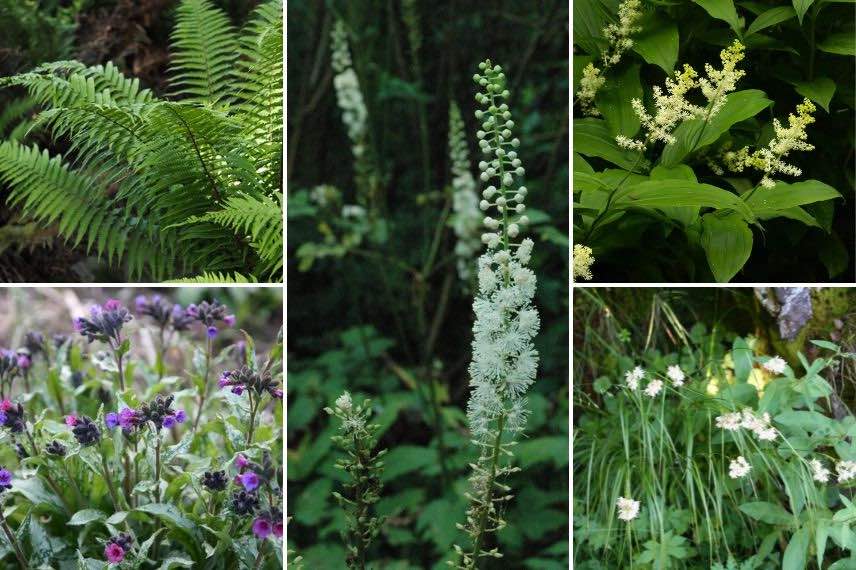
Dryopteris wallichinia, Cimicifuga racemosa, Smilacina racemosa, Luzula sylvatica, Pulmonaria
Potted
Cimicifugas make beautiful pot specimens, adding a touch of elegance to a patio or balcony. Place one or more of them at the back of pots containing smaller plants, and remember to alternate between pots containing deciduous and evergreen plants. Add a few pots of ornamental grasses.
In a cut flower arrangement
Finally, don’t forget to pick a few Actaea flower spikes. Choose fragrant varieties to create stunning mixed cut flower arrangements, with their elegant vanilla-scented spike flowers. Among the most fragrant varieties, we list Actaea simplex James Compton.
- Subscribe!
- Contents
Comments