


Pine needles in 8 Questions - Answers
All you need to know about pine needles, their uses and benefits
Contents
If you have pines in your garden, a thick carpet of needles should cover the soil beneath their branches. You may be tempted to remove them for a “cleaner” look, and use these needles as mulch since they are sold as such in garden centres, or compost them. However, there are various opinions on pine needles: soil acidification, “weeding” effects of their compounds, etc. So, what do you really know about pine needles? Are you aware of their actual disadvantages in the garden, or their overlooked benefits? We explain everything in 8 questions and answers.

What exactly are pine needles?
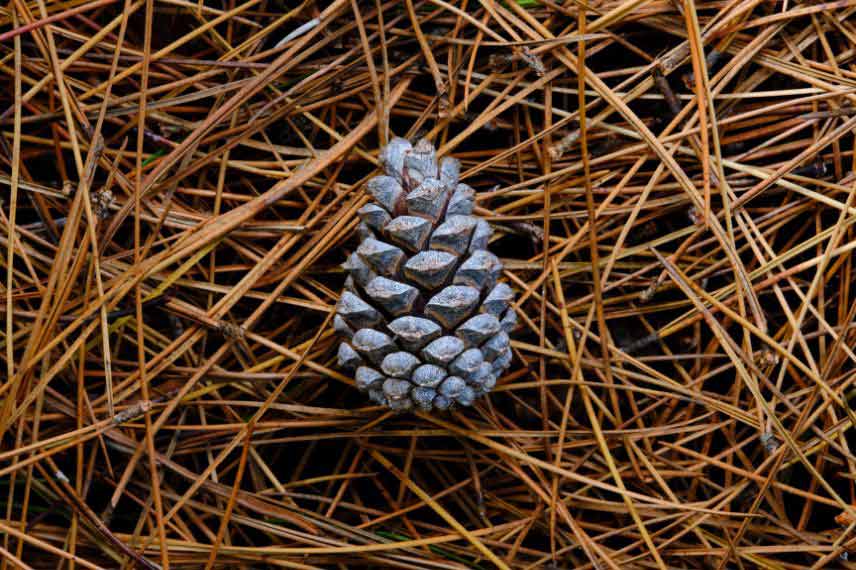
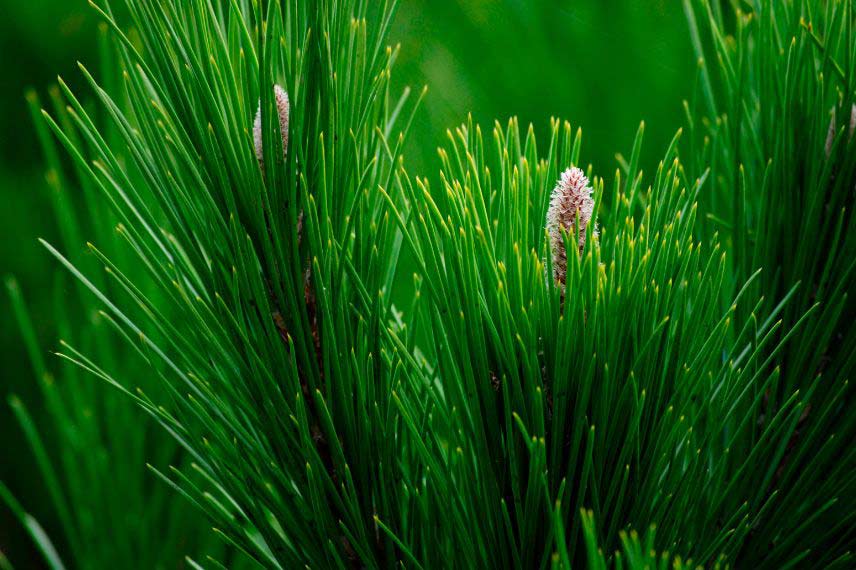
Pines are conifers and, as such, have branches adorned with needles, the equivalent of leaves on leafy trees. Generally, we refer to pine needles, but it can be considered that the needles of the vast majority of conifers have broadly equivalent properties. The generalities related to them can therefore be extended to the needles of firs, larches, as well as the needles of all pines, whether they are dwarf or large, like umbrella pines.
Why does nothing grow under pine trees?
Sometimes, one can observe a true plant desert beneath pine trees. This phenomenon has several causes that combine:
- Pines have a high density of superficial roots, meaning just below the soil surface. This root competition, drawing water and nutrients, prevents the germination and growth of other plants beneath their branches.
- The crown of the pines is dense and evergreen. Little sun and light reach the ground, thus hindering the growth of vegetation below.
- Pine needles contain phenolic and terpenic substances found in essential oils, which are detrimental to the growth of other plants when they are still green. Moreover, when they fall to the ground, they form a dense mulch that decomposes very slowly. Again, the germination of other plants is hindered.
However, by regularly collecting the needles, pruning for transparency to allow light to pass through, and planting plants that tolerate dry shade underneath, it is entirely possible to associate pines with other plants in the garden.
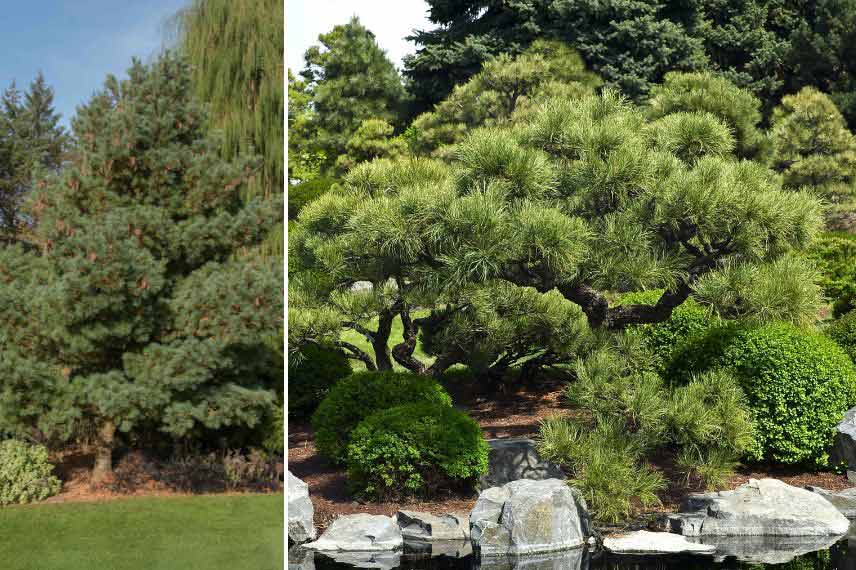
By choosing the right plants and adopting the right gardening methods, it is indeed possible to plant under pines.
Discover other Pinus - Pine
View all →
Available in 1 sizes
Available in 1 sizes
Available in 2 sizes
Available in 2 sizes
Available in 2 sizes
Available in 2 sizes
Available in 1 sizes
Available in 1 sizes
Available in 2 sizes
Available in 1 sizes
Do pine needles acidify the soil?
Studies have shown that pine needles have no effect on the average pH of the soil, even in the long term. If the soil is very alkaline, a mulch of pine needles may help to slightly lower its pH, but it turns out to be very difficult to truly modify the pH of a soil, which remains very stable.
Furthermore, while green pine needles have a slight acidifying effect, dead and brown needles, in the process of decomposition, have a pH between 6 and 6.5, which is suitable for the majority of plants.
Should pine needles be collected?
Collecting the needles that accumulate under your pines is a matter of aesthetics. You may not like this natural mulch and prefer to remove it. However, be aware that you will end up with a naked soil, more vulnerable to erosion, drying out, and less alive than if it were covered by this natural mulch. Additionally, like fallen leaves, the needles also provide shelter for a host of beneficial insects and small animals.
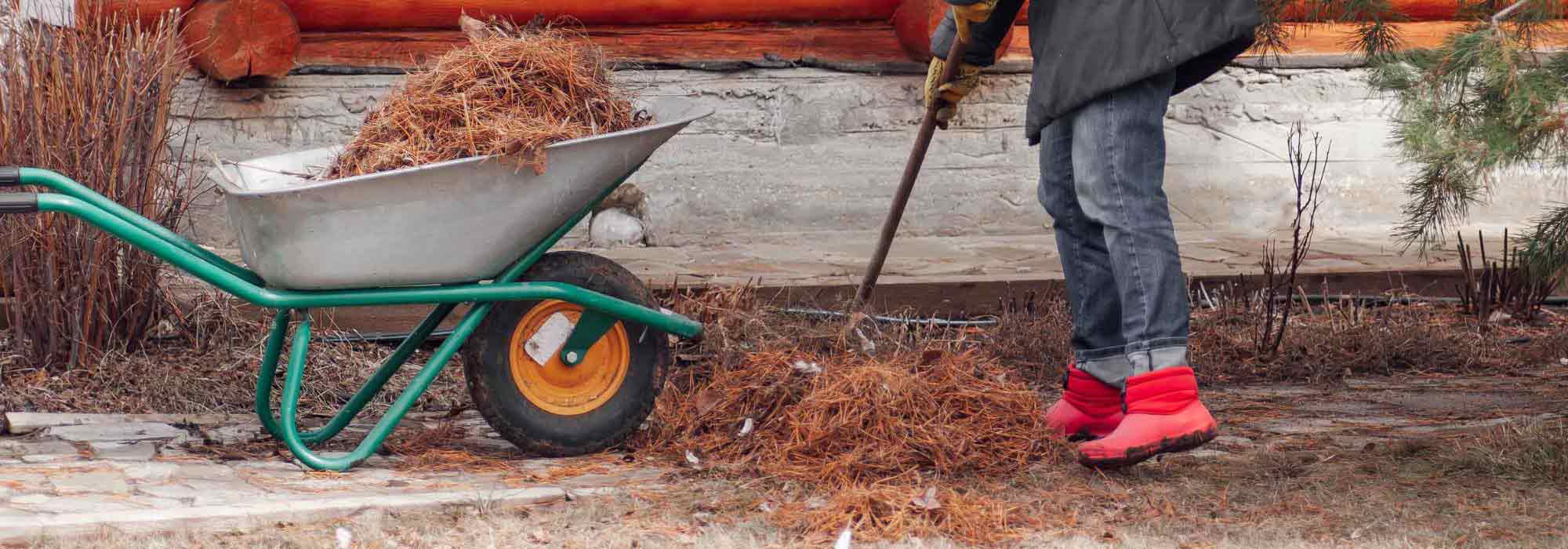
If pine needles accumulate on surfaces (patios, paths, etc.), it is normal for you to want to remove them to keep these areas clean and non-slippery. They can also block ducts and water drains. Therefore, you will need to proceed with a collection that can be a bit tedious if the quantities and surfaces are significant.
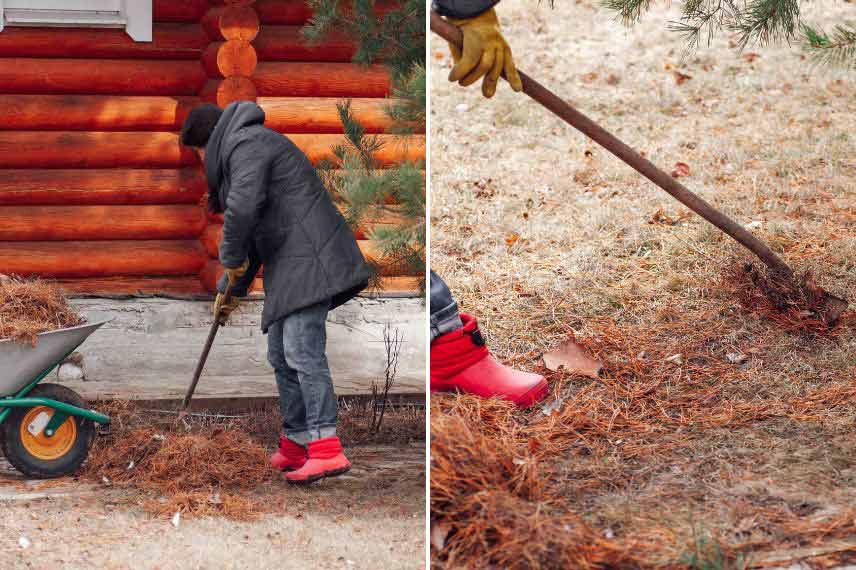
Collecting the needles under the pines can be a somewhat lengthy and tedious task, but in the end, your surfaces will remain clean and non-slippery
Terrace and paths, lawn, gravel: how to collect pine needles?
If you want to get rid of pine needles on a lawn or in your flower beds, you can traditionally collect them usinghand tools for collecting and tidying up such as lawn rakes, rakes, shovels, and wheelbarrows. Small hand rakes allow you to refine the work between plants without damaging them.
You can also use a pair of leaf grabbers: they act as an extension of your hands, capable of quickly and efficiently collecting handfuls of garden waste.
Long-handled leaf grabbers are also very practical: the handles prevent you from bending down and protect your back, while the two plastic “hands,” equipped with teeth, make it easier to gather and grasp the needles. To collect them, you can use reusable garden waste bags or a wheelbarrow.
For noisier and less eco-friendly solutions, you can also use an electric or petrol blower-vacuum or convert your self-propelled or ride-on lawn mower by raising the blade height to the maximum. In mulching mode, the shredded needles will be left on the ground to decompose gradually, while with the collection bag, you can easily and quickly gather them. Avoid doing this in wet weather to prevent clogging.
There are also commercially available leaf collectors in the form of push sweepers, which operate solely by arm strength: their rotating spiral brushes sweep the needles and direct them into a collection bin that you can easily empty afterwards.
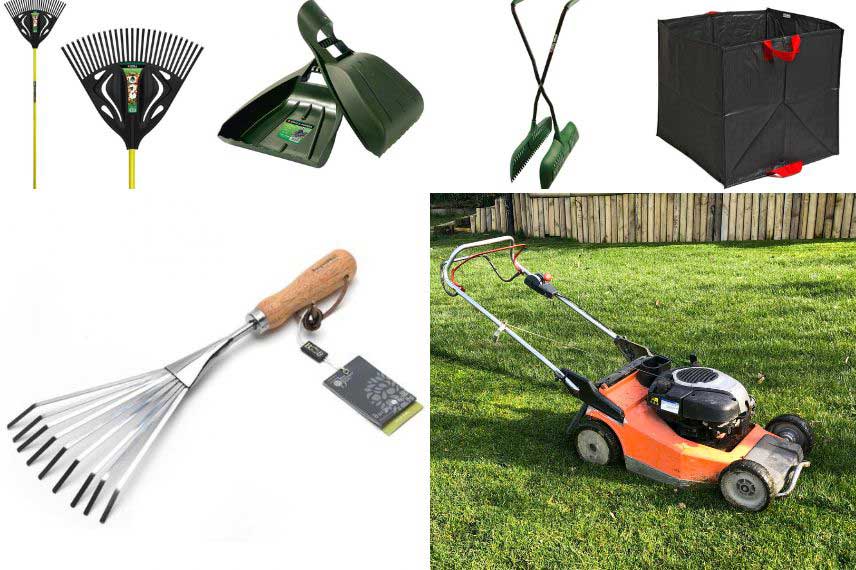
Lawn rake, leaf grabbers, long-handled leaf grabbers, garden waste bag, small hand rake, and lawn mower are part of the equipment you can use to collect pine needles
What to do with pine needles?
Once collected, pine needles must not be burned (this is prohibited by law, as with all green waste), and it would be a shame to dispose of them at the tip, as they can be used as mulch or incorporated into the compost bin.
Using pine needles as mulch, good or bad idea?
Pine needles can indeed be used as mulch; they are even sold commercially for this purpose, and at Promesse de Fleurs, we offer them to gardeners.
Composed of ligno-cellulosic material, pine needles improve the soil as they naturally decompose. They are a source of humus and will enrich the soil with organic matter and microorganisms necessary for the healthy development of plants. You can generously mix them with mown grass and shredded wood to create a thick protective mulch at the base of your plants.
When used perfectly dry, they also make an excellent mulch in the vegetable garden for growing vegetables and fruits, isolating them from the soil and reducing the risk of rotting. Their water retention capacity limits evaporation, especially in summer, helping to maintain good soil moisture and reduce the frequency of watering. Thanks to their structure, they allow rainwater to penetrate more easily.
By depriving the soil of light, pine needles prevent the germination of many weeds.
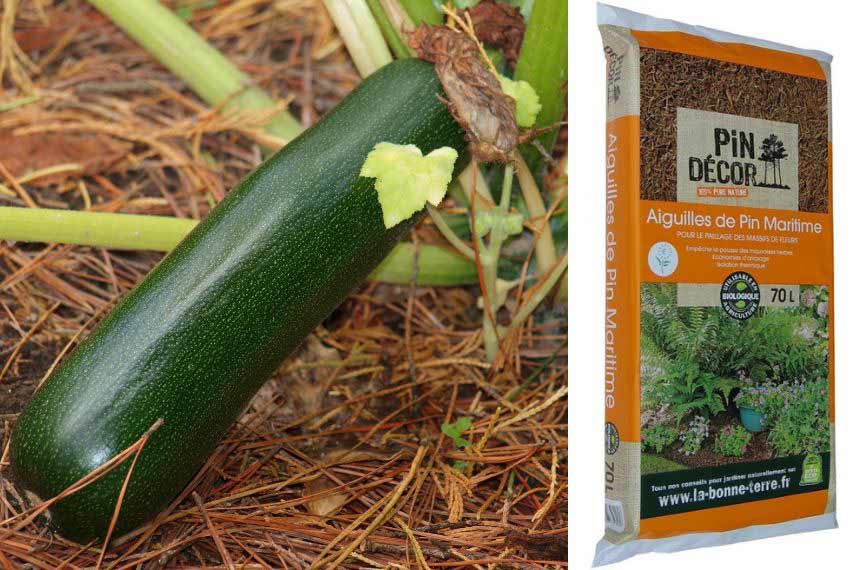
Pine needles make good mulch, both in the vegetable garden and in the garden
How to compost pine needles?
A good rich and balanced compost should contain:
- carbonaceous or cellulosic materials (tough oak or plane leaves, for example, and shredded branches),
- balanced carbon and nitrogen materials that decompose fairly quickly (ash or willow leaves),
- and nitrogen-rich green, soft, and moist materials, such as grass clippings, nettles, tender young leaves, and fruit and vegetable peelings.
As we have seen, pine needles are ligno-cellulosic: they are quite tough and slow to decompose. To add pine needles to the compost, simply mix them with other varied garden and kitchen waste. To shorten their decomposition process, you can shred them and layer them with other green waste, regularly moistening and turning the mixture.
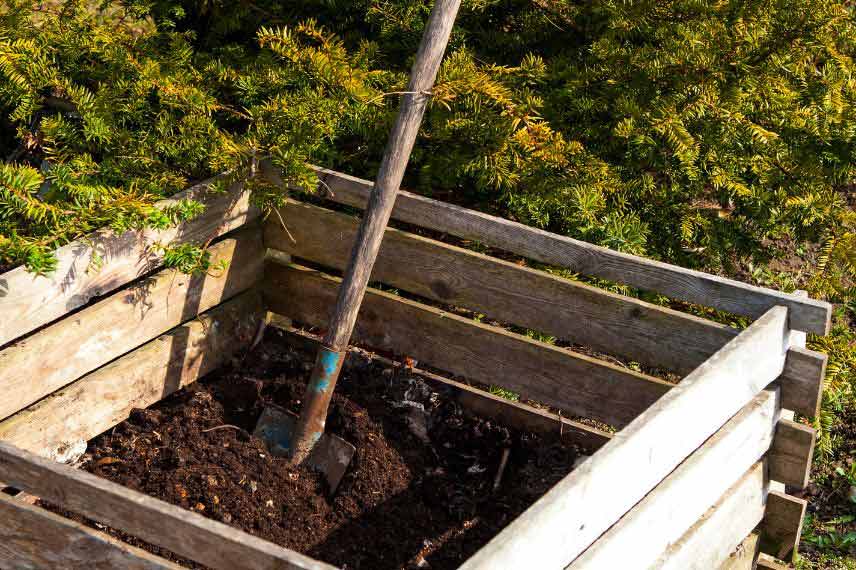
Pine needles can certainly contribute to the compost along with other green waste

- Subscribe!
- Contents
Comments