





























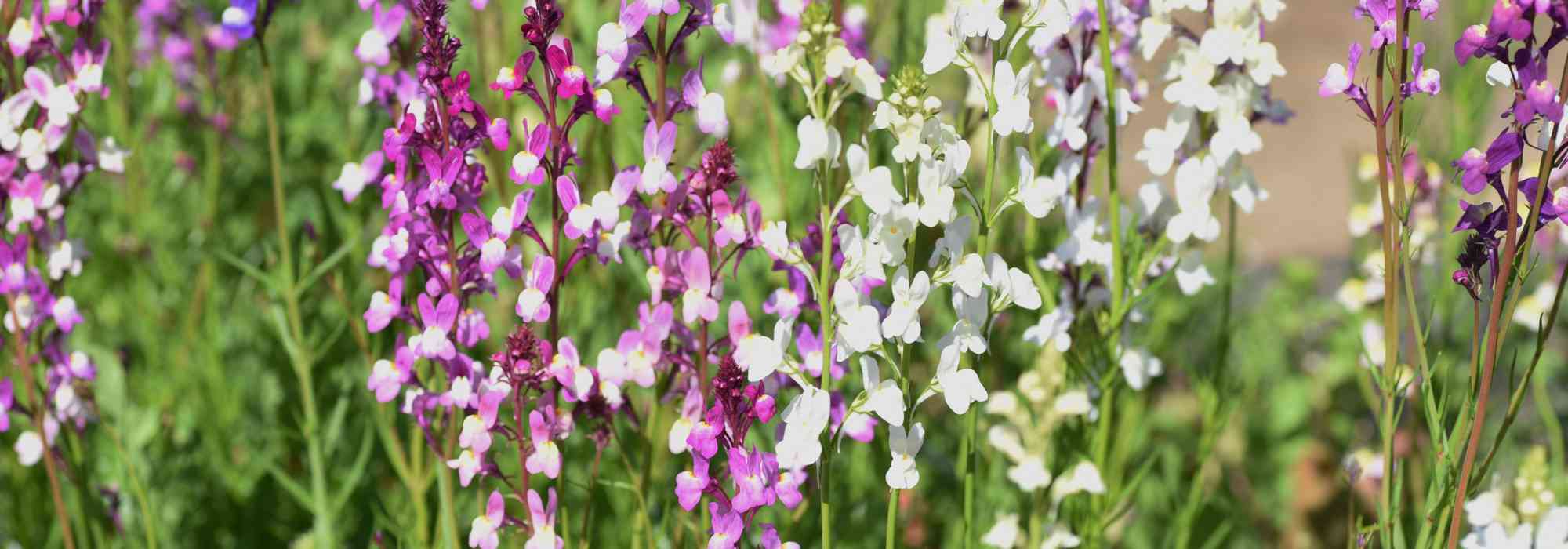
Self-seeding plants
Flowers in abundance... without doing anything!
Contents
There are plants that need to be divided or propagated to multiply, and then there are those, magical ones, that self-seed. These are often annuals or biennials, but also perennials, which, to ensure their survival and offspring, will easily scatter their seeds with the help of the wind.
So let these flowers do their thing, as they know very well how to propagate themselves in the garden without your help! In addition to their natural beauty, they are a source of savings and a time-saver for busy gardeners like us, as well as for beginner gardeners. This self-sufficient garden is also tremendously useful in laissez-faire gardens, second home gardens, or for gardeners who embrace “slow gardening” and “cottagecore“!
Here is a non-exhaustive list of flowers that self-seed, which are very handy for enhancing a country garden, a natural garden, or a holiday garden at minimal cost!

Annuals and biennials
In light, well-drained soil, many annuals or biennials self-seed spontaneously and reproduce without our help, saving us time. The idea of a free garden where annuals—less commonly used nowadays in favour of perennials—become desirable is achievable with a few carefully chosen plants. Beware of forget-me-nots, which can be quite invasive…
- Nasturtium: Tropaeolum majus by its Latin name, this timeless annual is a delight with its orange hues and long summer flowering, not to mention its round, edible foliage. Nectariferous, it deserves a place in the vegetable garden, as well as in rustic scenes of the garden where it climbs freely on trellises. It requires full sun or partial shade, and a dry, poor soil.
- Love-in-a-mist: Nicknamed Venus’s Hair for its finely cut foliage, Love-in-a-Mist is an annual with the old-world charm of gardens from yesteryear. Its blue flowering, varying in intensity, or white, is very delicate, starting in May and continuing until September depending on the region. It has the advantage of transforming into one of the most beautiful fruiting bodies in the plant world, magical in bouquets: a swollen capsule containing tiny seeds. A low-maintenance flower, it will gradually produce many small Love-in-a-Mist plants if you plant it in very well-drained soil and in full sun. Do not move it; it does not like that too much.
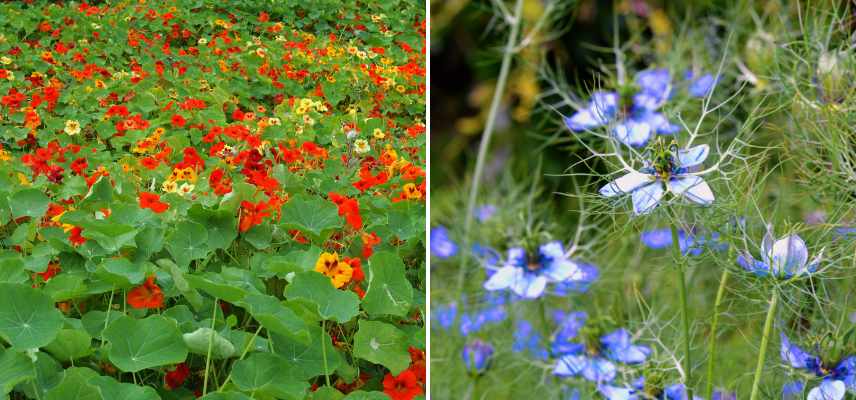 Nasturtiums and Love-in-a-Mist
- California poppy: also known as Eschscholzia californica, here is a lovely orange flower (in the typical form), queen of dry or gravel gardens, self-seeding abundantly (sometimes too much!) wherever it decides. We appreciate its natural look and warm colours in the height of summer. The California Poppy needs plenty of sun to bloom well (the flowers close in the evening into an elegant tubular shape) and very light soil. Its bluish foliage is also part of its appeal.
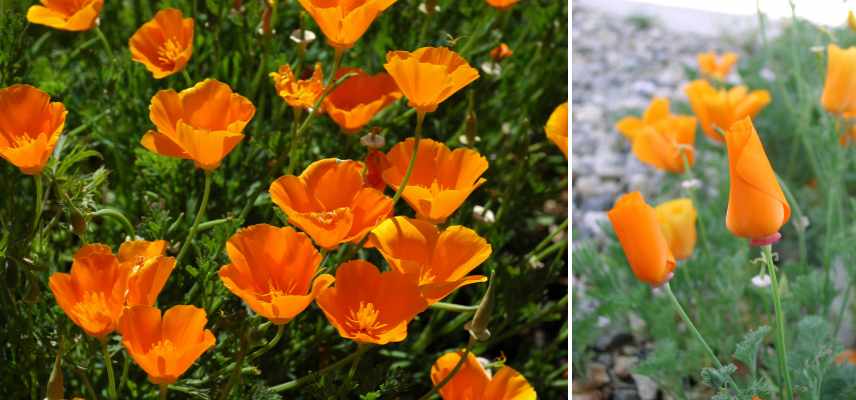 Eschscholzia californica
- And also: cosmos and Calendula (or marigold), foxgloves, honesty (Lunaria annua), which is also found in a more interesting perennial form, cornflowers… and in the vegetable garden, vegetables and herbs that self-seed
Perennials
What a wonderful creation nature is! Short-lived perennials rush to seed to ensure their offspring. When they grow in optimal conditions, some ephemeral perennials self-seed freely. This category includes many full-sun perennials thriving in well-drained soil.
Here are some of the most attractive ones:
- The purple toadflax: in sufficiently light and well-drained soil, the purple toadflax is a beautiful, slender perennial, about 70 cm tall, offering a delicate flowering of tiny flowers gathered in long clusters, violet in the species type, and pale pink to white in the varieties. In June, it adds incredible charm to the garden, in mixed borders or rockeries. It requires full sun or partial shade and must have well-drained soil. While common toadflax or Dalmatian toadflax are considered invasive, the purple toadflax, although it self-seeds abundantly in gravel gardens, remains manageable by cutting some flowers before they set seed.
- Lychnis: another well-known wanderer of bucolic atmospheres, the lychnis (Lychnis coronaria) enchants with its greyish, velvety foliage and stems, and its flowers, often pink, magenta, or white. Almost invasive if not kept in check, the Lychnis coronaria forms beautiful masses in sunny borders. As it has a short lifespan, it proliferates by self-seeding, especially in poor or stony soils.
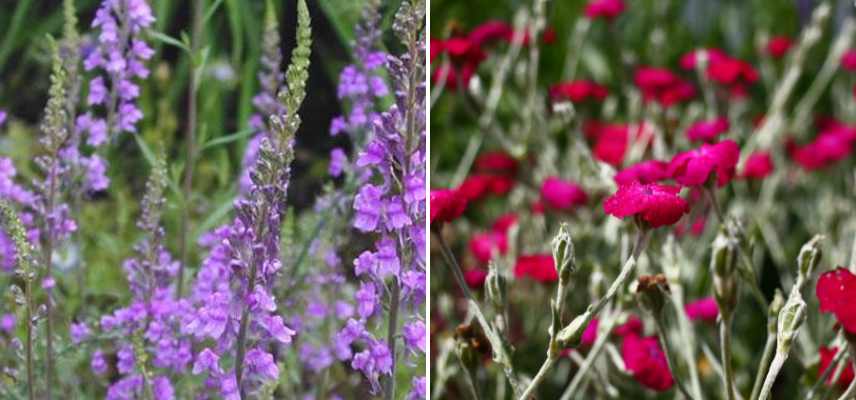 Linaria purpurea and Lychnis coronaria
- Mirabilis: the Night Blooming Jasmine opens its flowers in the evening and closes them in the morning. It is a beautiful herbaceous tuberous perennial, with flowers in solid or variegated colours, in shades of yellow, pink, and orange. Growing up to 1 m tall when happy, Mirabilis shines in natural, no-fuss gardens. It thrives in full sun, in deep, well-drained soil. Its seeds, resembling peppercorns, will spread to create new plants in mild climates, where they will bloom the following summer.
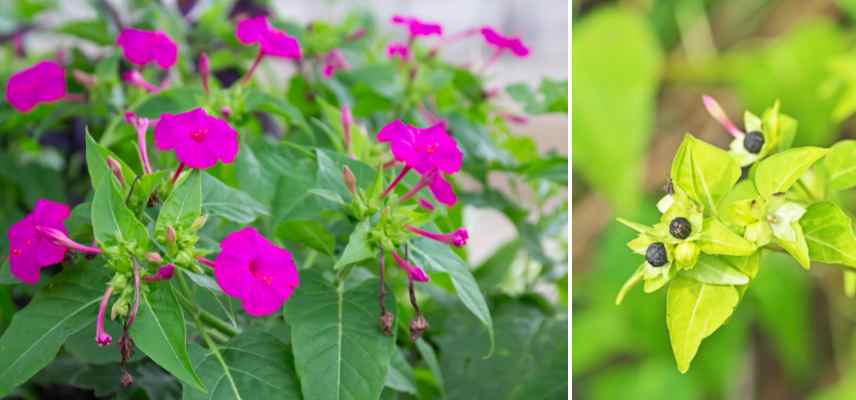 Mirabilis jalapa
- Columbine: light and very elegant, the columbine or Aquilegia adapts to various exposures in the garden. Like the lychnis, it is a short-lived perennial that self-seeds happily when it finds a suitable environment, in well-drained, humus-rich soil. Its atypical flowering, either drooping or upright, single or double, comes in a wide range of solid or bicoloured hues, making it a gem, while its finely cut, bluish foliage adds a lot of lightness. This late spring perennial bears its flower spikes, depending on the variety, between 40 cm and 80 cm tall.
- Brunneras: charming shade plants, admired for their blue flowering resembling forget-me-nots, but especially for their heart-shaped, slightly velvety foliage, some cultivars being variegated with white. Brunneras also self-seed magically in borders. This is a boon for filling shaded areas in the garden. Their crinkled, heavily veined leaves make beautiful groundcovers. Take advantage of their spontaneous sowing to replant in other areas of the garden. The Caucasian forget-me-not is also perfectly hardy, disappearing in winter.
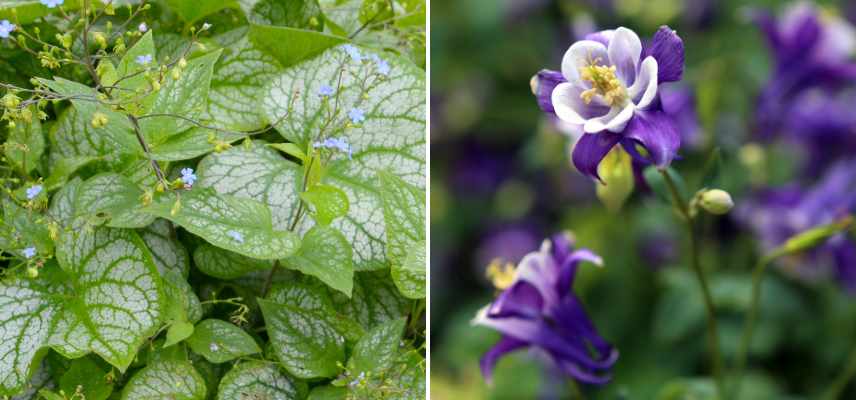 Brunnera macrophylla and Aquilegia vulgaris
- Centranthus ruber or valerian: with their long spring flowering, valerian plants are prized by gardeners for renewing their flowers in red, pink, or white panicles until frost, requiring little maintenance. They thrive in poor, very well-drained soil, preferably chalky or limestone. They grow between 45 and 90 cm tall, depending on the cultivars.
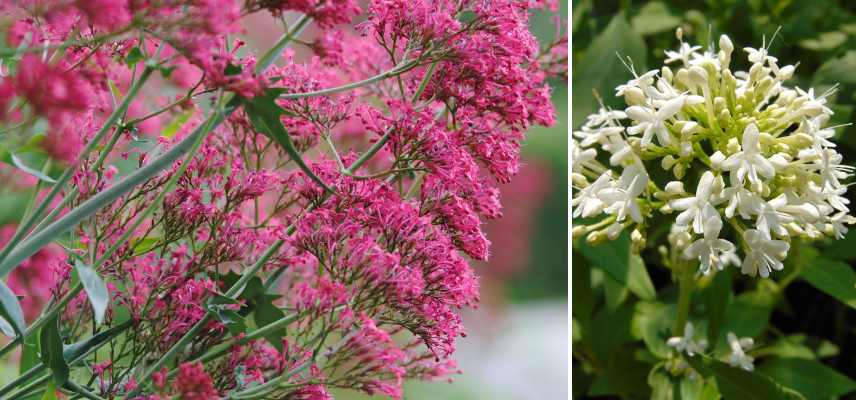 Centranthus ruber: pink and white flowering
- Hollyhocks: another short-lived flower, but one that produces prolific self-seeding. Hollyhocks are the charming asset of country or cottage gardens, perfect by the sea as well, where they can be found in the wild. Their stature, reaching up to 2.5 m, creates striking, structural displays. They readily self-seed in gravel and where least expected. Provide them with sun, but shelter them from the wind.
- Mullein: like the Alcea, the white mullein or Verbascum behaves as a biennial perennial, with its rosette of leaves in the first year and its sulphur-yellow flowers the following year. It adds structure to a garden, often appearing as a delightful surprise, and it’s beneficial to let it self-seed, as it produces many seeds. It also thrives in poor soil and full sun.
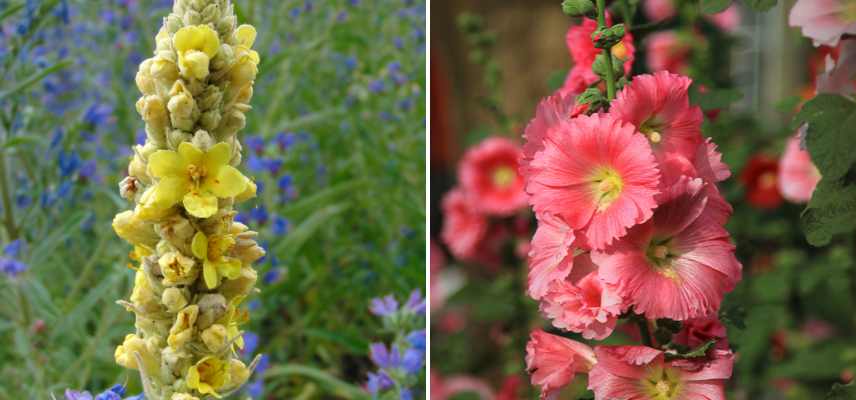 Verbascum and Alcea rosa
- And many others, including: the Sisyrinchium californicum (California Blue-eyed Grass), the large Sedum, the sea kale (Crambe), the Welsh poppy (Meconopsis cambrica), the lavatera, the catananches, and Solidago (including less invasive varieties like Solidago altissima, for example…)
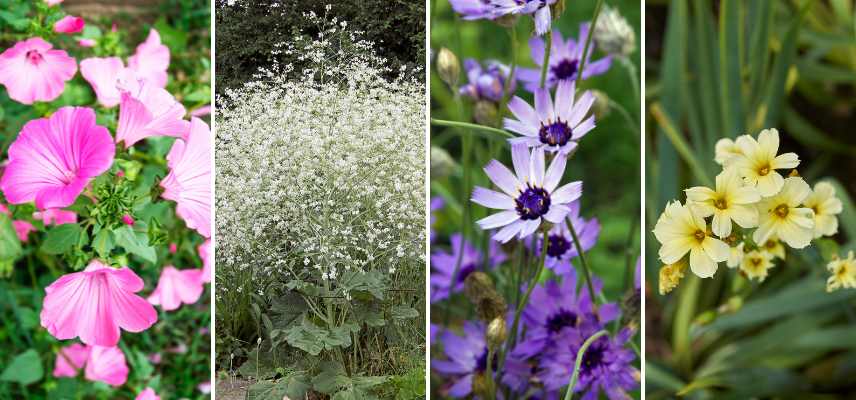 Lavatera, sea kale, cupidone or catananche, and Sisyrinchium striatum
To remember
These plants that produce numerous spontaneous seeds are rewarding in the ornamental garden, but some can become really very invasive, even truly aggressive. This is particularly true for wild impatiens such as Impatiens balfourii and Impatiens glandulifera, which are indeed beautiful in their wild appearance. Also, the more common borage. By carefully removing all new plants that arise from sowing, you can enjoy some lovely wild-spirited plants in certain corners of the garden… but you have been warned!
Also remember that the typical species naturalise through spontaneous seeding much more quickly and easily than horticultural cultivars.
Be aware that new seedlings will always be stronger and better developed when allowed to grow in the place nature has chosen for them. However, they can obviously be transplanted at an early stage and relocated to a spot that suits us better in the arrangement of the beds.
Finally, it may seem obvious, but you must of course allow all these plants to go to seed so they can reseed themselves, meaning do not cut the flowers at the end of flowering…
We recommend an excellent book published by Ulmer in 2015, which covers this topic from all angles, with 90 plants described: Laissez-faire! The art of gardening with self-seeding plants. By Jonas Rief, Christian Kress, and Jürgen Becker.
- Subscribe!
- Contents
Comments