





























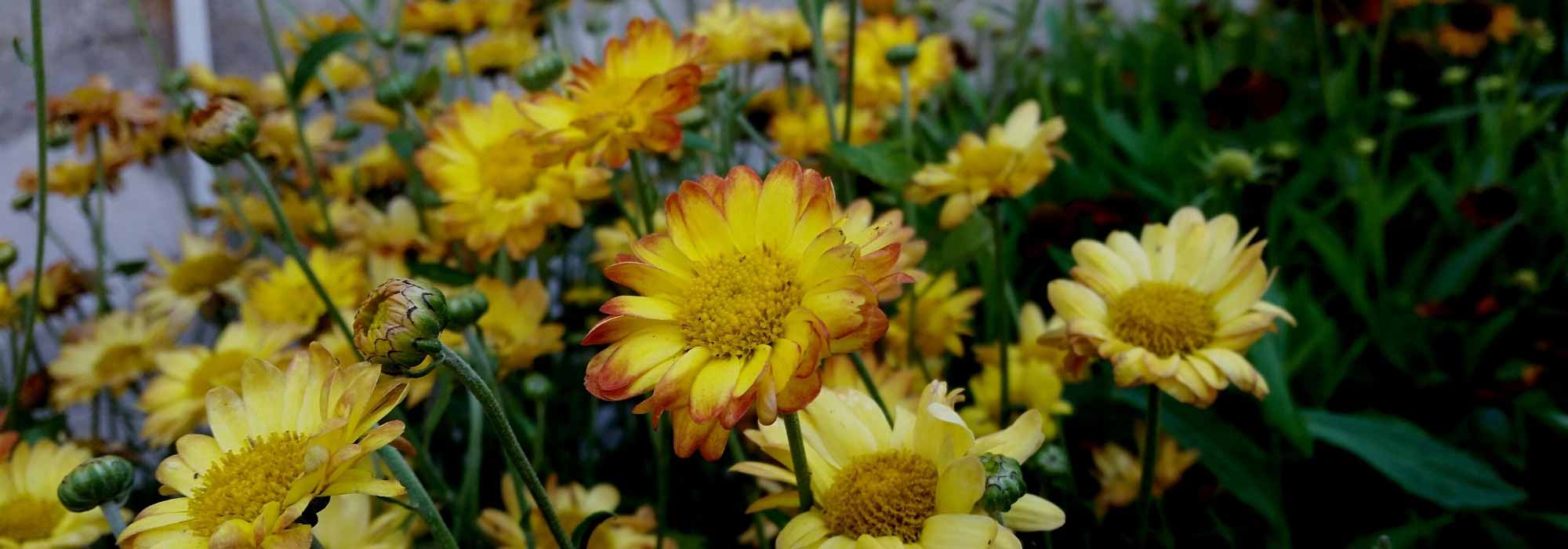
Rediscover chrysanthemums, the iconic autumn flowers
They more than deserve their place in the garden!
Contents
Chrysanthemums are delightful perennials, all too often relegated to their image as cemetery plants, yet they richly deserve their place in the garden. They generally form rounded, dense, compact clumps that are covered in flowers in autumn, from August–September through October or November depending on the varieties. These flowers come in a palette of vivid, warm colours: yellow, orange, red, pink, fuchsia, white… Ideal hues for brightening an autumn border. They often have very double flowers, in generous, opulent pompons, but can also form single flowers, with the petals arranged in one or a few ranks, revealing a yellow centre. We invite you to rediscover chrysanthemums and give them a place in your garden!
And for everything you need to know about growing them, see our complete fact sheet: “Chrysanthemum: planting, care”.

History and symbolism
Chrysanthemums or Chrysanthemum have an ancient history, carrying with them a deeply rooted symbolism. Native to Asia, these magnificent flowers have won the hearts of gardeners around the world.
The earliest records of cultivated chrysanthemums date back to ancient China, more than 2,500 years ago, where they were used for their medicinal properties long before being appreciated for the beauty of their flowering. The chrysanthemum is still today an essential plant in Chinese pharmacopoeia, and in China it is also a symbol of longevity.
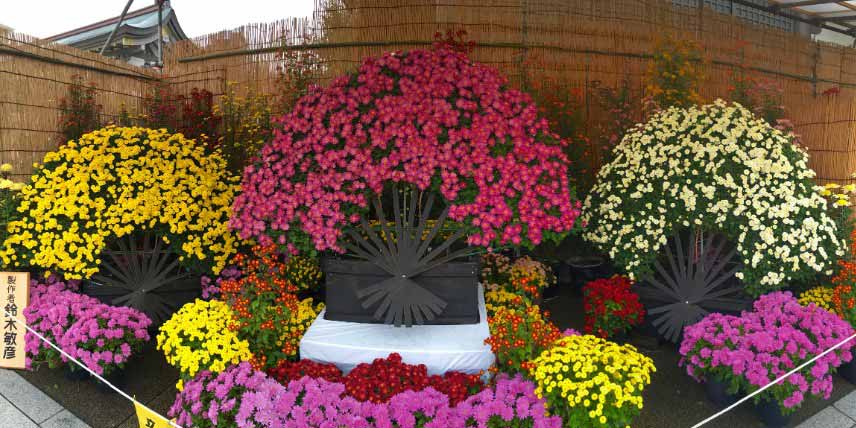
Chrysanthemums displayed during the “Kiku Matsuri” Festival in Tokyo
The chrysanthemum is a sacred flower in Japan. It was imported there from China in the 8th century, and there too it was initially used for its medicinal properties. From the 13th century, Emperor Go-Toba made the chrysanthemum the emblem of the imperial family. It was initially reserved for the Japanese aristocracy, but under the Edo era (1600 to 1868) it became popular and accessible to everyone. The chrysanthemum is called Kiku in Japanese and is still a national emblem today. It even adorns Japanese passports as well as some coins! The Kiku Matsuri is a chrysanthemum festival held in Tokyo in November to celebrate this flower and honour its role in Japanese culture. There is even a popular belief that a chrysanthemum petal at the bottom of a glass of wine is a sign of a happy and healthy life. The chrysanthemum is also consumed in Japan as a tea and appreciated for its benefits. More broadly across Asian countries, the chrysanthemum is a symbol of happiness and longevity.
The chrysanthemum was imported into France in the 18th century and quickly became very popular. It then had a positive connotation. Etymologically, its name means “golden flower”. However, at the end of the First World War, more precisely in autumn 1918, France had to pay tribute to countless victims. As they bloom at that time, chrysanthemums were chosen for the occasion. This symbolism of mourning remained associated with these flowers, used to decorate graves on All Saints’ Day and thus commemorate the dead in early November. This earned them the nickname “Daisy of the Dead”. They symbolise immortality.
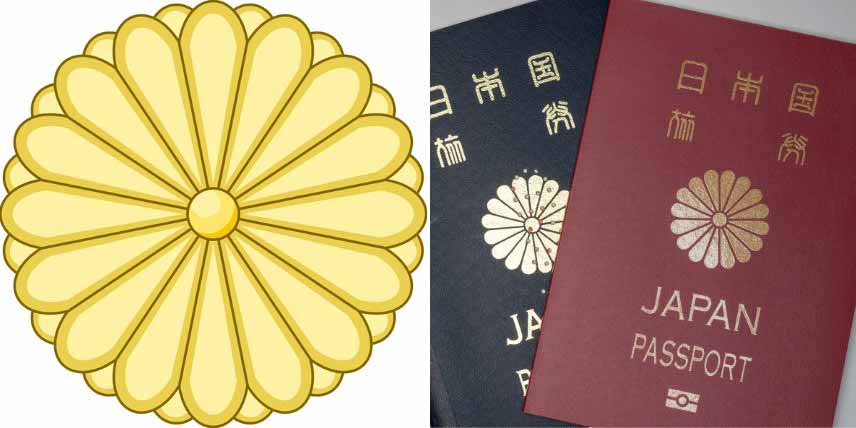
In Japan the chrysanthemum is the emblem of the imperial family, and it even appears on passports!
In the language of flowers, the chrysanthemum has a positive meaning: giving chrysanthemums demonstrates sincere love. It symbolises happiness, loyalty and longevity. Moreover, outside France and Belgium, it generally retains a positive connotation: in the Netherlands, the chrysanthemum is given for a 13th wedding anniversary, while in Australia it is given to mothers for Mother’s Day.
Today the most commonly cultivated in gardens is the florist’s chrysanthemum, also called the autumn chrysanthemum. It is the result of a cross-breeding between the Japanese chrysanthemum (Chrysanthemum indicum) and Chrysanthemum morifolium. It then gave rise to countless horticultural varieties, available in a wide range of shapes and colours. Hybrid autumn daisies (Chrysanthemum x rubellum) are also frequently cultivated.
Read also
5 pairing ideas with ChrysanthemumsAn incredible diversity
A very wide range of colours :
Chrysanthemums are available in a wide variety of colours, with bright, warm tones ranging from passionate red to brilliant white, through sunny yellow and delicate pink.
- Orange flowers : discover the varieties ‘Mary Stocker’, ‘Cottage Apricot’, ‘Dernier Soleil’.
- Yellow flowers : we recommend the varieties ‘Citronella’, ‘Goldmarianne’, ‘Nantyderry Sunshine’, ‘Schwefelglanz’. For a softer shade, cream to pale yellow, choose the chrysanthemum ‘Poésie’
- Pink flowers : discover the superb variety ‘Orchid Helen’, with very double blooms, but also ‘Clara Curtis’ and ‘Roseum’, with simple daisy-like flowers.
- Red flowers : ‘Cedie Mason’, ‘Rehauge’, ‘Brennpunkt’, ‘Oury’
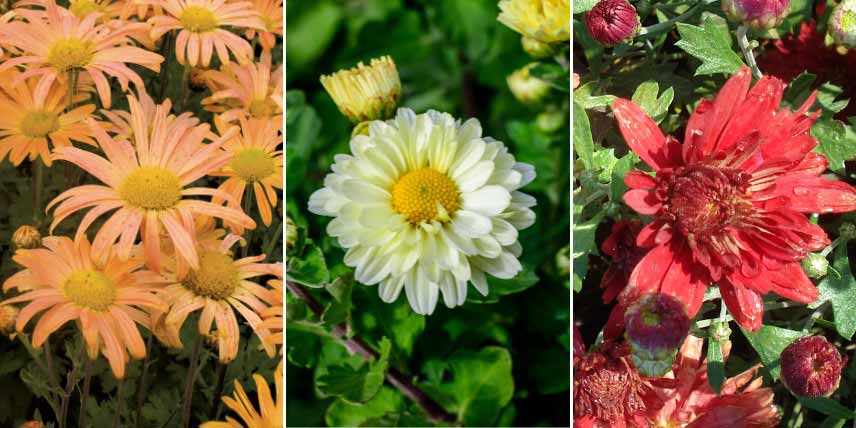
Chrysanthemums come in a wide palette of colours, often in warm, luminous tones. Here, the varieties ‘Mary Stocker’, ‘Poésie’ and ‘Duchess of Edinburgh’
Various flower shapes :
Botanical species produce single flowers, made up of a single row of petals surrounding a yellow centre, whereas horticultural varieties generally produce fully double flowers, formed of very many petals. They are sometimes pompon-shaped, which is why they are often nicknamed pomponettes.
The shapes of chrysanthemums are just as varied as their colours. From single, delicate-petalled flowers to double, pompon-like varieties, and those with curled petals, each type evokes a particular aesthetic. Chrysanthemum indicum charms with its tousled petals, while Chrysanthemum morifolium is notable for its elegant simplicity.
- Single-flowered chrysanthemums : their flowers are daisy-shaped, with a very natural look, formed of a single row of petals surrounding a yellow centre. This is the case for example with the varieties ‘Roseum’, ‘Hebe’, ‘Oury’, ‘Schwefelglanz’…
- Double-flowered chrysanthemums : they offer pompon-like blooms, with a generous, opulent style. Discover the varieties ‘Citronella’, ‘Orchid Helen’, ‘Brennpunkt’…
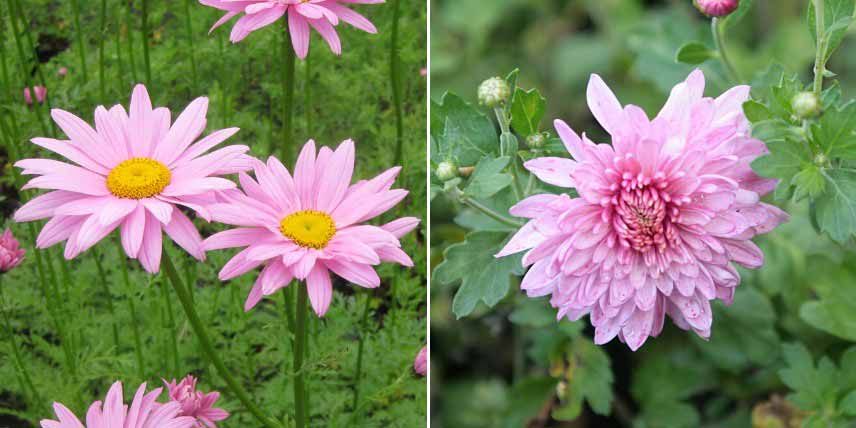
A single-flowered chrysanthemum, ‘Clara Curtis’, and a double-flowered variety, ‘Orchid Helen’
Dwarf, medium or large chrysanthemums
The diversity of chrysanthemums is also expressed in their dimensions. Some dwarf varieties will easily find their place at the front of a border, as edging, or for a potted display, while medium varieties are very versatile. The largest chrysanthemums are perfect for adding volume to a flower bed, but it is best to avoid planting them in pots.
- Dwarf chrysanthemums (30 cm to 50 cm tall) : ‘Schwefelglanz’, ‘Roseum’, ‘Rotes Julchen’…
- Medium chrysanthemums (around 60 to 80 cm) : ‘Cottage Apricot’, ‘Rehauge’…
- The largest chrysanthemums (about 1 m tall) : these include the varieties ‘Nebelrose’, ‘Duchess of Edinburgh’, ‘Poesie’, ‘Herbstrubin’…
How to plant and care for chrysanthemums?
Where to plant chrysanthemums?
Chrysanthemums enjoy the sun, and they can adapt to almost any type of soil, although they prefer rich, light soils, neutral to slightly acidic. Above all, they need the soil to be well draining, as they dislike heavy, wet ground in winter which can cause their roots to rot. Of course, they also do very well when grown in pots.
When and how to plant them?
You can plant chrysanthemums in spring (March to May) or in autumn (September to November). Avoid periods of frost or extreme heat.
We recommend leaving 30 to 50 cm between the young plants.
- Start by digging a planting hole about twice the size of the root ball
- Place at the bottom a little soil mixed with well-rotted compost
- Remove the chrysanthemum from its pot and place it in the centre of the planting hole
- Fill in with a mixture of soil and compost, then firm down lightly
- All that’s left is to water.
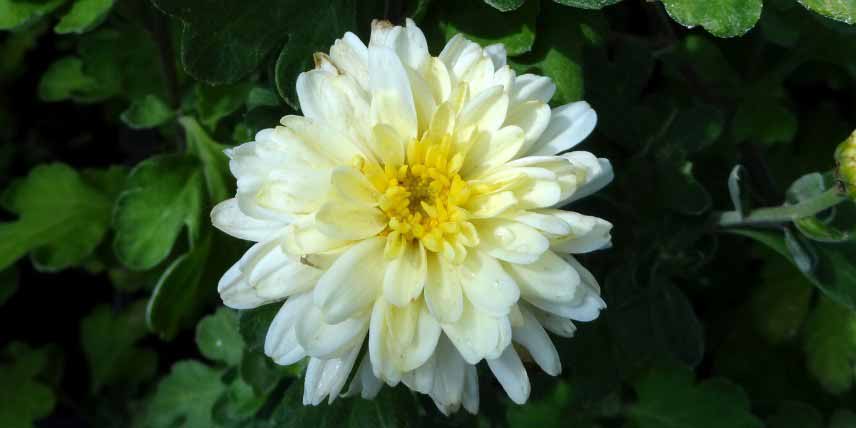
The superb double flowers, cream-white to pale yellow, of the chrysanthemum ‘Poésie’
How to care for chrysanthemums?
Easy to grow, chrysanthemums require little maintenance. They will, however, appreciate regular watering: you can water them once or twice a week when the soil is dry. Direct the jet at the base of the plant, onto the soil, avoiding wetting the foliage. Wait until the soil has dried before watering again, as excess moisture could cause the roots to rot.
Chrysanthemums like rich, fertile soils, which encourage their development and abundant flowering. Add a little well-rotted compost to their base in spring or autumn. During the growing season, you can apply a potassium-rich liquid fertiliser, to be diluted in the watering water.
The taller varieties may require staking, especially if they are exposed to the wind.
In regions with a mild climate, chrysanthemums can remain in place over winter: simply protect them with a thick layer of mulch (dead leaves, straw…). You can also use a winter fleece. In colder regions, bring chrysanthemums under cover to a frost-free place. You can take them out again in spring, from May onwards.
We recommend dividing chrysanthemum clumps every two to three years. Besides giving you new young plants, this will regenerate the clumps, which otherwise could become exhausted and flower less.
At the restart of growth (March–April), cut back the dead stems to their base using a pruning shear. Likewise, to help your chrysanthemums develop fully and take on a compact, bushy habit, we recommend pinching them in spring, around mid-May, by cutting off the top part of the young shoots. During the flowering period, regularly remove faded flowers to encourage the plant to produce new blooms.
- Subscribe!
- Contents
Comments