





























The best crocus varieties with white flowers for your garden
Discover 5 spring- or autumn-blooming white Crocuses to brighten the garden
Contents
Crocus are wonderful early-flowering bulbs with cup-shaped flowers, heralding the arrival of spring. They are also, in autumn, other bulbs with saffron-coloured flowers. The species are different, but both belong to the same genus. They share yellow stamens at the heart of the flower, the flower which is often mauve, but also yellow, orange or white. They prefer light, well-drained soils, in which they naturalise easily. Discover in this article our favourite white-flowered Crocus varieties, to brighten up gardens, terraces and balconies.

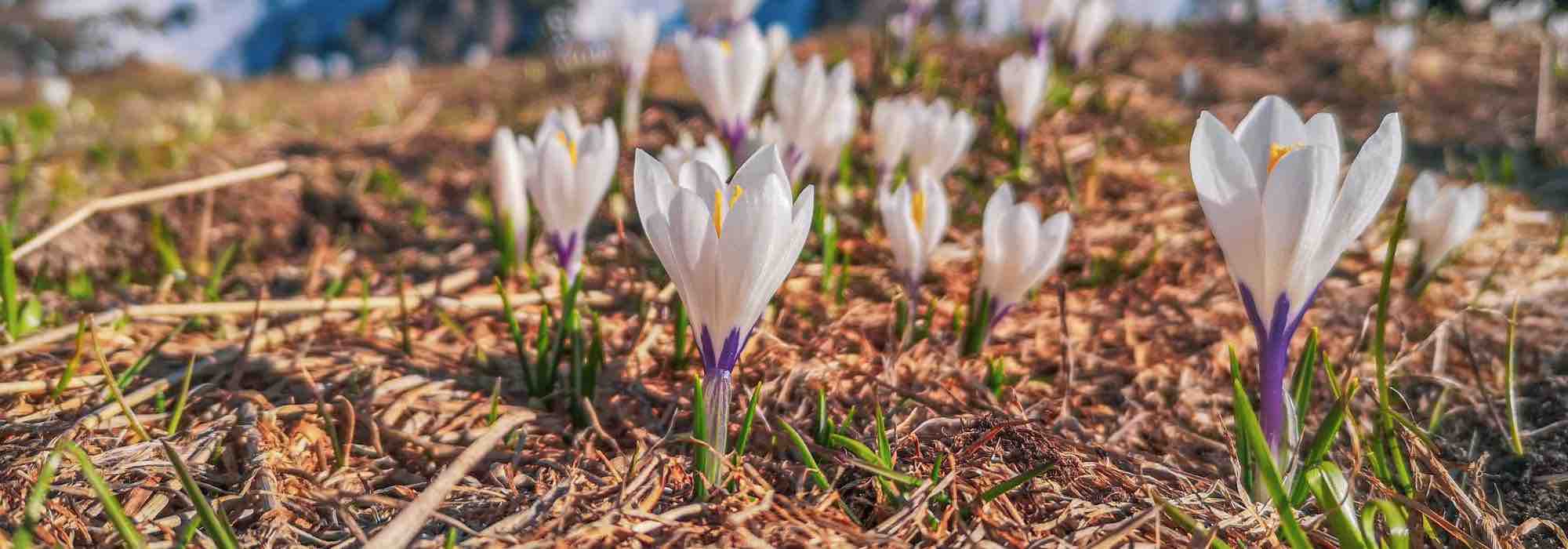
Crocus tommasinianus 'Albus'
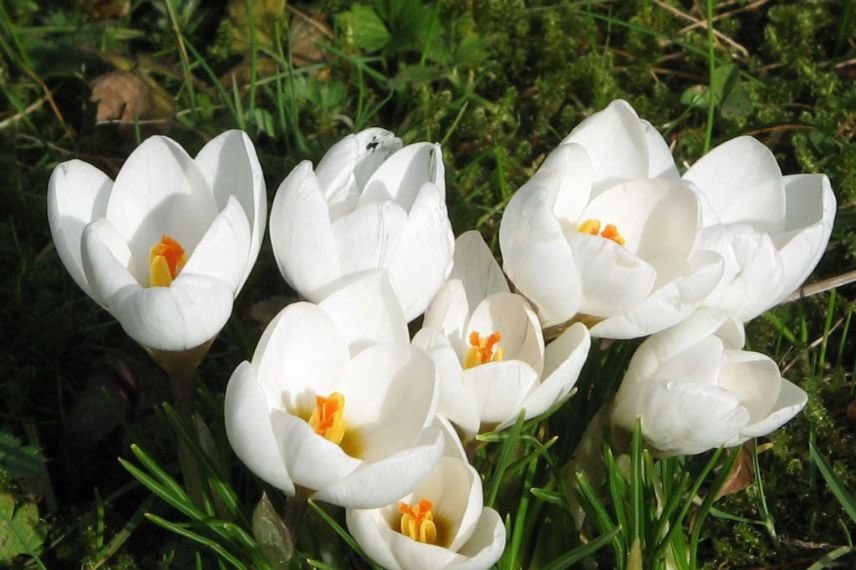
The Crocus tommasinianus ‘Albus’ is the white form of a botanical crocus, renowned for its early flowering in late winter. Not particularly difficult to grow, it flowers in sun as well as in partial shade. This pure white crocus, with a silvery sheen on the reverse, is rarer than the type species with purple flowers, brightening the garden in February and March, signalling that spring has returned. With a crown of golden-yellow stamens that are clearly visible, the petals are arranged in a star shape from a very slender tube at the base and form a cup-shaped flower about 3 cm long.
The Crocus tommasinianus is an undemanding species, one of the easiest to naturalise in the garden. It is native to Eastern Europe and reaches 10–15 cm in height. Wonderful in a rock garden, surrounded by sunlit stones, it is never as beautiful as when planted en masse, made up of one or more varieties and colours, marking the late winter with blooms unfurling day by day. You can also take advantage of its easy cultivation by planting it in a pot, for the terrace or balcony, either alone or with Muscari and Chionodoxa.
Crocus versicolor 'Picturatus'
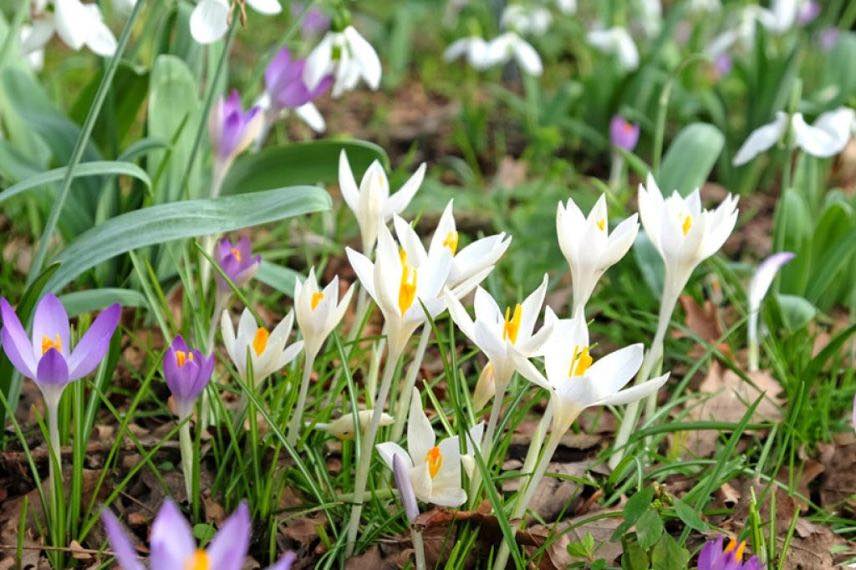
The Crocus versicolor ‘Picturatus’ is a variety derived from a botanical species endemic to Provence and Dauphiné. A species also known as variegated crocus, Crest crocus or changing crocus. It occurs there in the low mountain ranges, on sunlit slopes and low-altitude pastures, on calcareous soils. It flowers in February or March depending on the climate. Its delicate, goblet-shaped flowers are pure white inside. The outer surface of the petals is striate with mauve-violet stripes. The stamens are yellow-orange. Its fine foliage is fairly thick, a medium grey-green.
This crocus tolerates wet soils in summer better than others during its dormancy. Often, bulbs at that stage of their cycle prefer dry soil. Plant it, for example, at the edge of a woodland, at the foot of deciduous trees, with the Leucojum vernum or spring snowflake and the anemone blanda ‘Blue Splendour’ whose sky-blue hue echoes the bluish mauve touch of the Crocus.
Crocus fleischeri
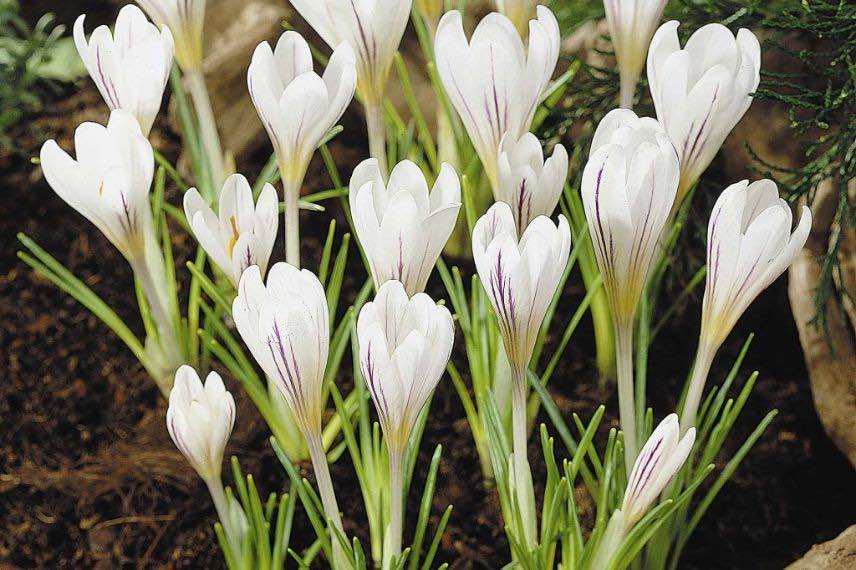
Crocus fleischeri is a rare botanical species in cultivation. It is found in the wild in Turkey and on the nearby Greek islands, on rocky hills as well as in evergreen woods such as oak or pine, on calcareous clay soils. In its preferred environment and climate, it flowers from January. It is distinguished by small stylised spring flowers with elongated petals. They open widely into six-pointed stars, with a bi-coloured heart of yellow stamens and bright red styles.
Everything about this species exudes vitality, from the elongated petals to the touch of bright red on the feathery styles. In an Alpine garden to which it is well suited, in a Mediterranean rock garden near its origins, it is planted alongside botanical tulips such as the Tulipa turkestanica, a splendid companion that flowers a little later, with small Euphorbias of the same condition such as the Euphorbia pythiusa or the Balearic Euphorbia, or indeed the Corsican Euphorbia, Euphorbia myrsinites.
Crocus chrysanthus 'Snowbunting'
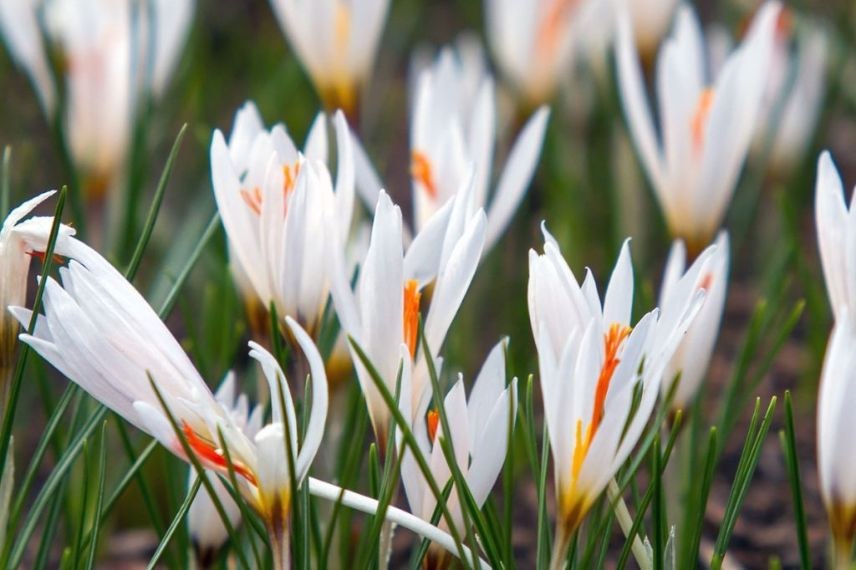
The Crocus chrysanthus ‘Snowbunting’ is a spring bulb derived from a species also known as the golden crocus, native to Turkey and the Balkan Peninsula. This prized variety, often regarded as one of the best, received in 1993 the Award of Garden Merit, awarded by the Royal Horticultural Society in England. Its cup-shaped white flowers are ivory-tinged and their throat is bright yellow, bearing stamens in a vivid orange-yellow. The reverse of the petals bears a tawny halo tinged with lilac. The flowers close at night and in bad weather, to open widely in sun and even in partial shade, as with all spring crocuses.
Flowering takes place from February to March, depending on the climate. Plant it at the foot of a late-winter perennial border with hellebores, Heucheras with handsome dark foliage and Eranthis hyemalis, stunning bulbs with yellow flowers echoing the heart of the crocus.
Crocus cartwrightianus 'Albus'
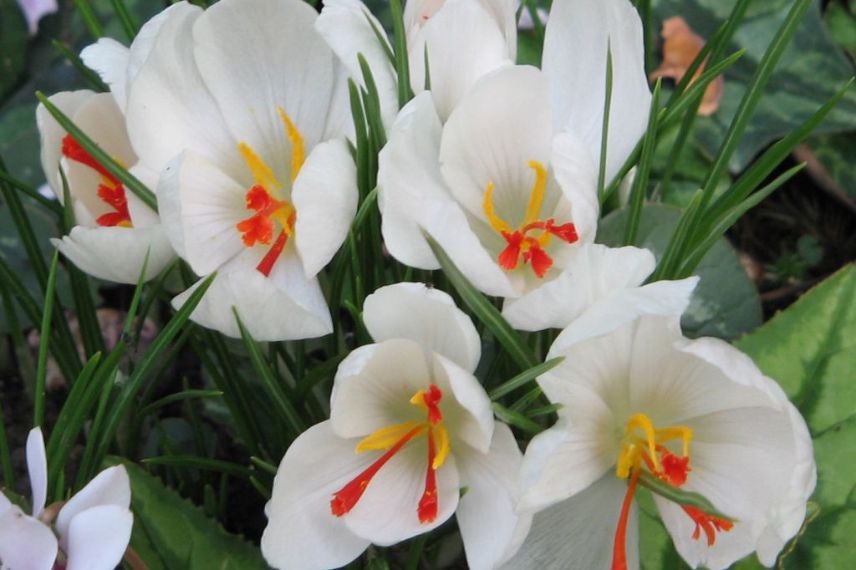
The Crocus cartwrightianus ‘Albus’ is not an early-spring Crocus, but an autumn Crocus, and, moreover, a relatively uncommon saffron Crocus. It is white in colour and derived from the species Crocus cartwrightianus, much less well known than its cousin Crocus sativus, which produces the purple saffron crocus with which we are more familiar. Its large flowers are spectacular, forming well-rounded cups about ten centimetres across. Each bulb produces 1 to 3 flowers, the three orange-red filaments being edible as they are the famed saffron.
The plant grows to about 10–15 cm tall, and its foliage typically appears after flowering, then dries back by the end of spring. Its flowers stay open even when the sun hides, unlike other crocuses. Plant it in a border or in a pot. To harvest saffron, you need to pick daily, as the flowers last no more than 48 hours. As 150 flowers are required to produce one gram of saffron, it’s best to keep expectations reasonable.
- Subscribe!
- Contents
Comments