


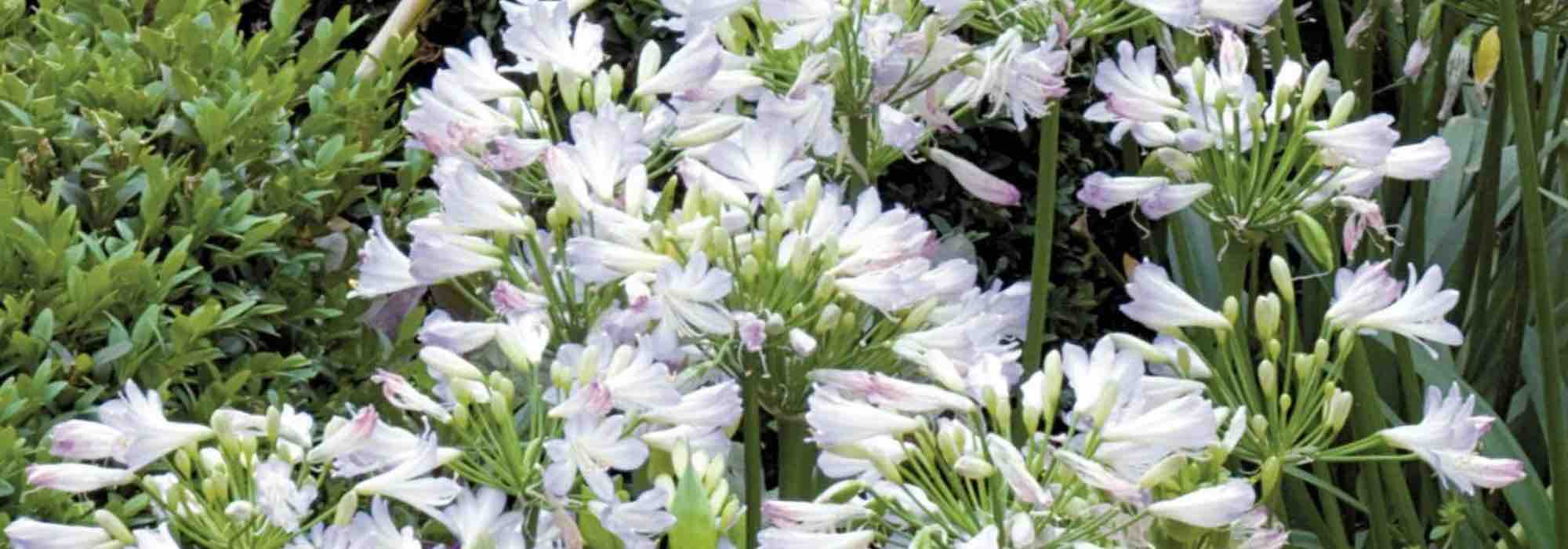
The best dwarf Agapanthus for the garden
Compact varieties that can easily be grown in pots and small spaces
Contents
Agapanthus have enjoyed considerable success in recent years, thanks to their architectural silhouette and their pretty ball-shaped flower spikes.
While the larger ones can reach up to 1.5 m, there are dwarf Agapanthus not exceeding 60 cm in height. They are thus easy to grow in small spaces or even in pots, perhaps to shelter the more tender ones under cover in regions with harsh winters. Discover here our favourite varieties of small Agapanthus.
And to succeed in growing Agapanthus, see our guide: Agapanthus: planting, growing and care.

Agapanthus 'Enigma'
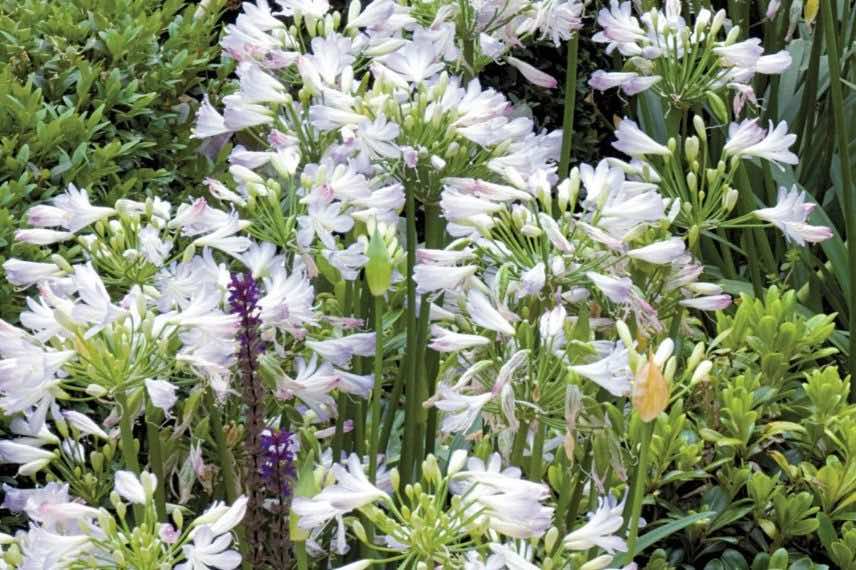
Agapanthus x praecox ‘Enigma’ is distinctive for its originality, with its two-tone flowering. During summer, from July to September, it reveals beautiful spherical umbels of 12 cm in diameter, blending white and blue. The long trumpet-shaped flowers are at first almost pure white when they open, then their bases take on blue as time passes. The white stamens are accented by black anthers, which add a great deal of elegance and originality to this flowering.
The foliage is evergreen, consisting of slender, dark green leaves. This variety of agapanthus, like many of its counterparts, is not very hardy: it will not tolerate frosts below -6°C. But its compact habit does not exceed 50 cm in height and 40 cm in width. This makes it easy to grow in a pot, which can be brought indoors to shelter from frost during winter if required. It is also a perfect choice for sunny courtyards, balconies or terraces.
With its elegant, refined white flowering, this small agapanthus will be perfect in a white garden, for example in a border, alongside dwarf roses flowering in the same tones. In a pot, it will accompany Alliums and hardy geraniums.
Plan a soil mix rich in organic matter, but well-drained, to prevent waterlogging. Keep the soil evenly moist (never allowed to dry out completely) during the flowering period. Agapanthus need sun to flower well, so give them a fairly bright exposure, but sheltered from strong winds that could damage the flowering stems.
Read also
5 Agapanthus to grow in potsAgapanthus 'Strawberry Ice'
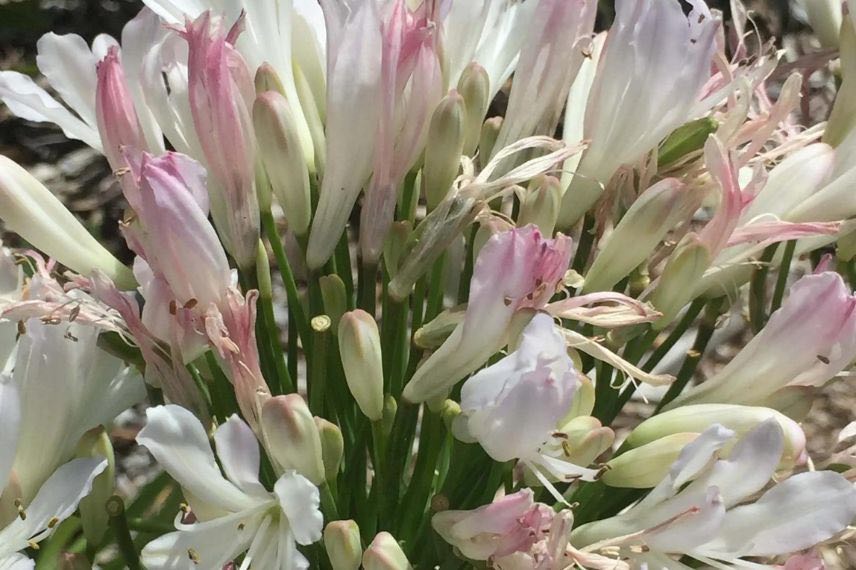
Among agapanthus, the most common flower colours are blue, white and purple. Our ‘Strawberry Ice’ stands out, with its white flowering tinged with pink. Between July and September it produces flowering stems that rise toward the sky, revealing globes formed of graceful bell-shaped florets. Initially white, they gradually take on pale pink hues and will intensify these nuances in cooler temperatures. Unlike other agapanthus, its florets also stay upright and are not borne horizontally. These flowers are perfectly highlighted by the ribbon-like foliage, bearing a dark green colour. It is evergreen, remaining decorative and interesting all year round.
The colour of this agapanthus makes it a rare variety, which you will encounter less often in gardens. A little more frost-tolerant, it will withstand frosts down to around -9°C, provided the soil is perfectly drained and the crown protected by a thick mulch.
In terms of dimensions, expect 65 cm in height at flowering with a 50 cm spread. This dwarf variety can thus be accommodated anywhere in the garden, whether in small spaces or in pots. Being more tolerant of summer drought than other species, it can be planted in a rock garden, alongside a small Phormium with decorative foliage and sages.
Provide it with a mix of fertile soil and sun, in soil that remains light. If you wish to grow ‘Strawberry Ice’ in containers, take extra care with watering and feeding.
Agapanthus 'Golden Drop'
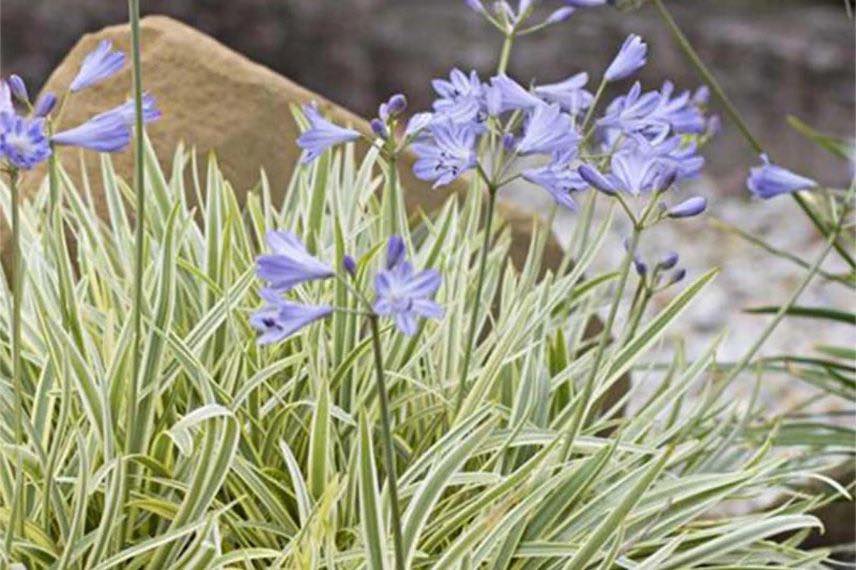
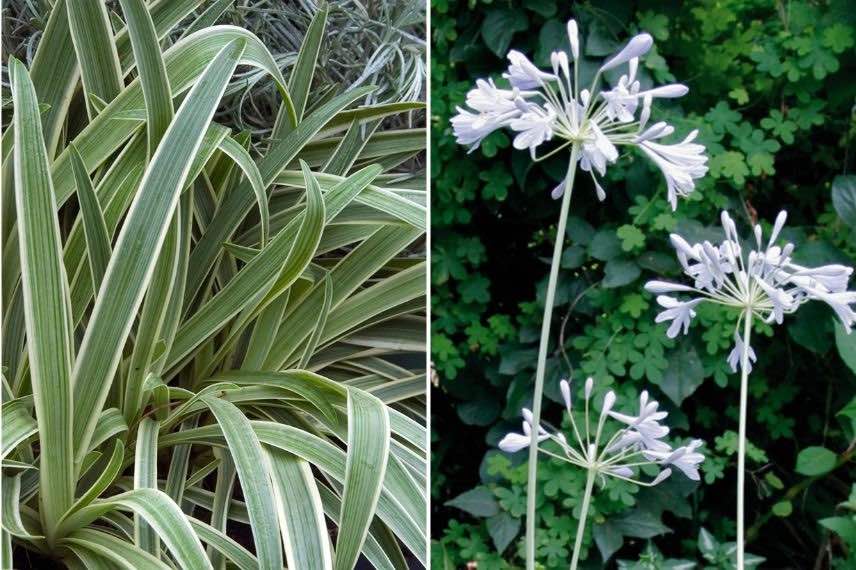
Here, it is with its foliage that agapanthus ‘Golden Drop’ has chosen to stand out. It bears its distinctive, dense foliage, with long, graphic ribbons that lend a touch of lightness. But it is not simply green as with most other varieties: it displays a lighter green, variegated with pale yellow and cream, making it a true ball of light. This deciduous foliage pairs beautifully with the summer flowering in airy umbels, with a delicate pale blue leaning toward lavender.
About 40 cm across for this compact little agapanthus (slightly more when flowering). It looks lovely in borders as well as in pots. Its aesthetic, reminiscent of certain grasses, fits just as well in naturalistic gardens as in spaces that are more contemporary. For a cottage-garden effect, pair it with Gaura and Echinacea.
Plant ‘Golden Drop’ in full sun, in rich, well-drained soil, in a wind-sheltered position. Hardiness is medium, so this agapanthus will require winter protection in our regions with the harsher climates.
Read also
How to grow an agapanthus in a pot?Agapanthus ‘Peter Pan’
The Agapanthus x africanus ‘Peter Pan’ is one of those dwarf varieties whose only fault is that it is very frost-sensitive (around -4°C). From its South African origins, these plants have indeed retained a certain frost sensitivity. But that doesn’t mean you can’t enjoy it if you live in a region with harsh winters: this small Agapanthus is perfectly suited to pot culture. Indeed, its silhouette does not exceed 60 cm in height and 40 cm in breadth.
In summer, from July to September depending on the region, ‘Peter Pan’ produces clusters of bell-shaped flowers in a delicate azure blue, subtly enhanced by a darker central stripe.
A sun-lover, it is ideal in south-facing coastal gardens, provided it is sheltered from strong winds. As with other plants, provide regular watering and fertilising to support flowering. Summer heathers and small Sedum can accompany it in pots or in a low border.
Agapanthus 'Tinkerbell'
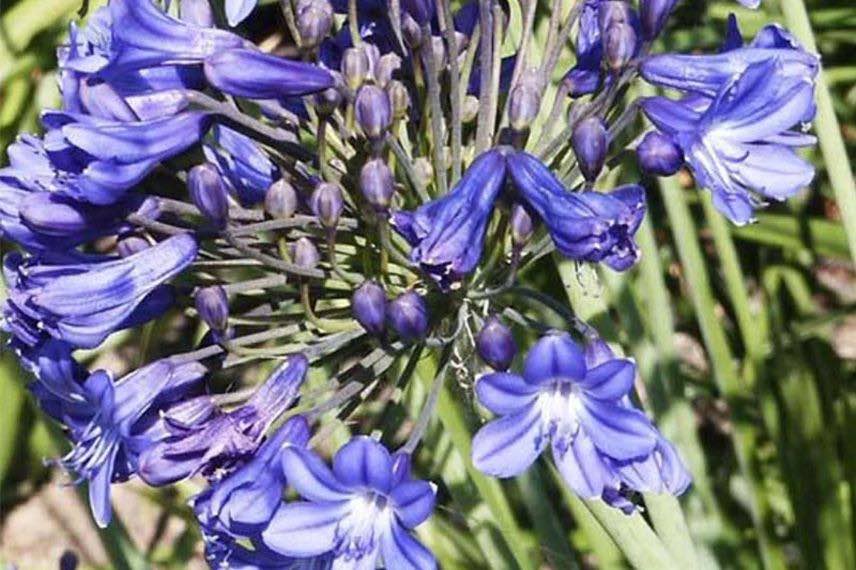
Another agapanthus with remarkable foliage: that of ‘Tinkerbell’. It forms a pretty, slender, bright tuft, thanks to its light-green variegated leaves edged with cream. The leaves are deciduous, so disappear in winter (unless the winter is mild), but the plant has the advantage of good hardiness. It will tolerate frosts down to around -10°C in sheltered conditions and on well-drained soil.
In terms of flowering, globose umbels blue in colour provide the display during the summer.
Fairly compact, its silhouette reaches 60 cm in all directions, placing it among dwarf agapanthus varieties.
For cultivation, again plan for a fairly fertile yet light soil, staying cool throughout the summer. In a monochrome garden, pair ‘Tinkerbell’ with other blue-flowering plants, such as Nepetas and Caryopteris.
- Subscribe!
- Contents
Comments