





























The easiest indoor plants to grow
Discover the most resilient species for your home
Contents
There is no universal truth regarding houseplants or outdoor plants, and it is always possible to kill a houseplant that is reputed to be easy to care for. Let’s set the record straight. There are two categories of houseplant owners: those who overwater and those who forget to water. Curiously, the intermediate category between these two extremes is a rare species. Corresponding to these two opposing classifications are the plants that suit them. Some will appreciate being forgotten, while others will not forgive it. Some will drown under the onslaught of those anxious about not doing enough, while others will mummify in place due to our repeated neglect.
However, there are also very accommodating plants that do everything to help us, that are not fussy about their exposure, and that tolerate our watering or substrate mishaps. We can then consider them easy to care for. Here is a selection of almost universal plants that you could still kill, but only with determination or a six-month trip abroad after forgetting to water them before you leave.

Chlorophytum
Chlorophytum or Chlorophytum comosum is quite a lovely plant. There’s no more accommodating species. The most commonly cultivated variety is the variegated version, Chlorophytum comosum ‘Variegatum’, which you have undoubtedly encountered since the 1970s. Chlorophytum is native to Africa and belongs to the family of Liliaceae. It forms rosettes of long, slender, arching leaves that are pointed at the tips. As it grows, it produces numerous large, fleshy roots filled with water, allowing it to withstand drought. Chlorophytum sometimes flowers, producing charming little white flowers that measure about 1 cm in diameter.
This species ideally grows in rich, light soil, which is generally what indoor plant potting mixes are, but it adapts to all types of substrates. Allow the potting mix to dry out between waterings. It tolerates periods of drought well. Like most indoor plants, it does not like direct sunlight and accepts both bright and more filtered light, further away from a window. It suffers when temperatures drop below 5° C. Gradually, it forms a clump that widens and cascades over the sides of the pot, but remains low in height.
It produces stolons on stiff stems, ending in young plants with small rosettes of leaves. They develop short roots and can be transferred directly into a pot filled with potting mix to see a new plant grow, which will produce roots quite quickly. It is therefore also equipped with the simplest method of propagation by cuttings.
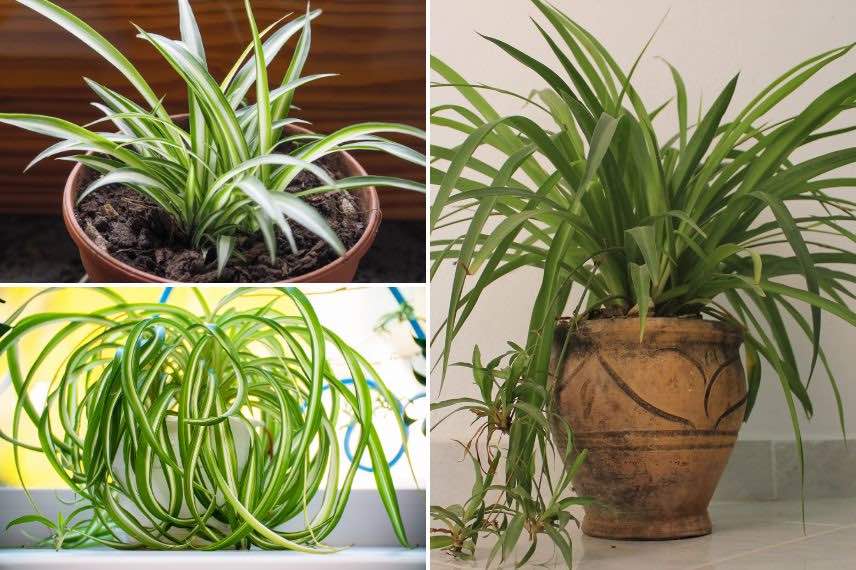
On the left, Chlorophytum variegata, young and then a bit more established, on the right the non-variegated form showing the stolons that can be easily replanted
Read also
Outdoor plants that also thrive indoorsPilea peperomioides
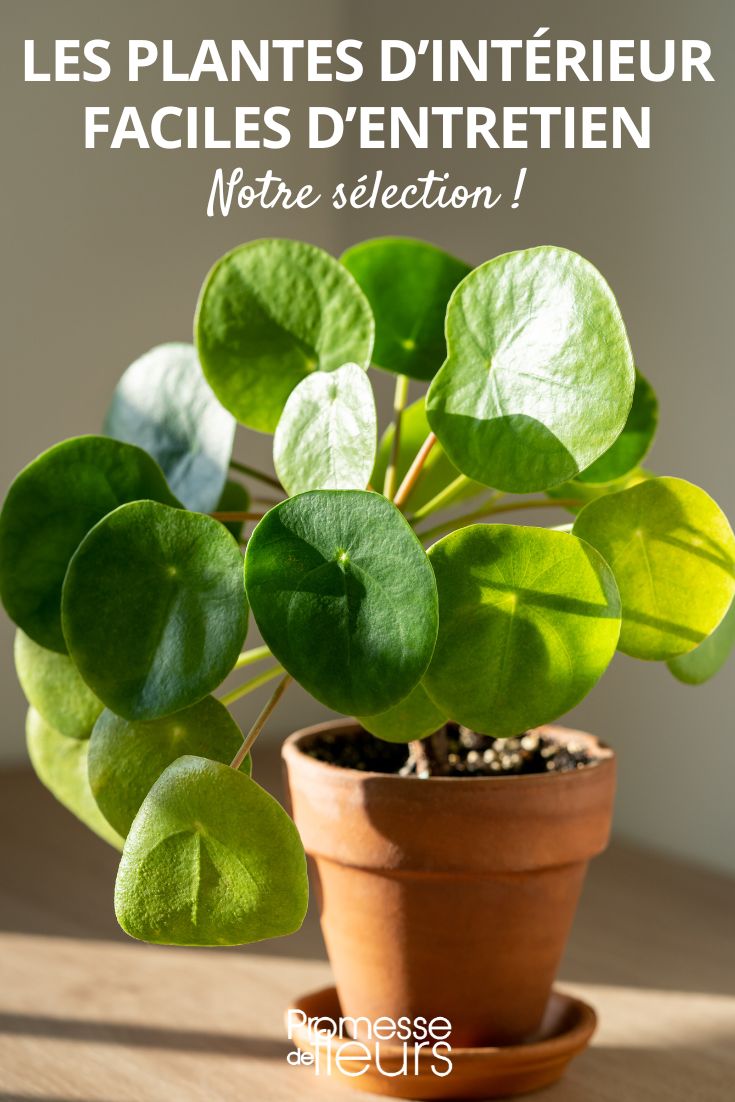
The Pilea peperomioides has recently experienced, around 2018/2020, a tremendous surge in popularity. It was not widely distributed, and its rarity gave it significant notoriety, especially as it is very photogenic and current trends around houseplants are heavily featured on Instagram. Fortunately, it later flooded the European market, and the pressure eased. It is not quite as easy as the Chlorophytum, but it is still low-maintenance and resilient. It tolerates your missteps and propagates quite easily, which is an important quality. It is native to Yunnan in China and belongs to the family of Urticaceae. It has received an Award of Garden Merit from the Royal Horticultural Society.
It enjoys a bright location, without direct sunlight, temperatures above 10° C, and moderate watering, allowing the substrate to dry out between waterings. It is a succulent plant. The Peperomia prefers a well-draining substrate: you can add 20 to 30% sand or perlite to the potting mix and plant it in a terracotta pot. It forms a central stem from which long petioles with round leaves of 10 cm emerge. Often, young stems separate from the main plant appear. You can gently take them to propagate in a glass of water. Once roots appear, replant in a pot. The Peperomia generally forms a modest-sized plant but can also reach 60 cm in height (or more) and the same width, in which case it needs a stake.
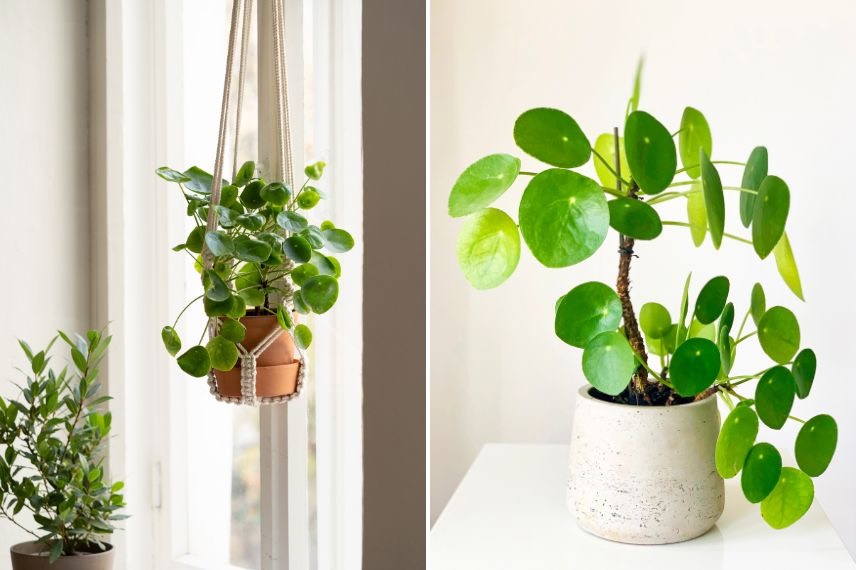
The lovely shapes that the Pilea peperomioides takes as it grows a bit (still young in these photos)
Sansevieria
Sansevieria is also a succulent plant that tolerates almost all light conditions, including full sun or a rather dim spot indoors. It simply won’t behave the same way. It is native to tropical Africa, India, or Madagascar and belongs to the Agavaceae/Dracaenaceae family. It prefers to be watered sparingly; it’s better to forget it a little, as only excessive watering will be detrimental to it. For the rest, it is not difficult. With an upright habit, it forms a clump of thick, linear leaves that can be more or less spreading, flat, concave, or cylindrical, depending on the species. The most commonly encountered as houseplants are Sansevieria trifasciata, also known as “mother-in-law’s tongue,” and Sansevieria trifasciata ‘Laurentii’ with its yellow-edged, marbled, and striated leaves. Sansevieria gradually thickens in width but maintains a narrow habit. It can reach a height of 1.5 m or more over time.
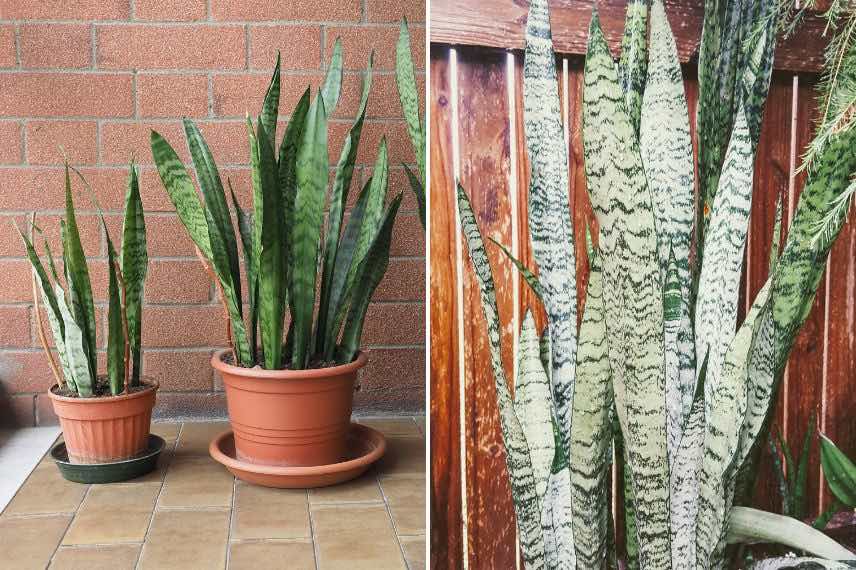
Two different variegations on these Sansevieria, which are large, easy-care houseplants
Scindapsus and Pothos
Scindapsus (Scindapsus pictus) and Pothos (Epipremnum aureum) are close enough to be grouped in this paragraph. They are climbing plants, known for being very resilient and for thriving even in the darkest places. Native to Southeast Asia and India, they belong to the family of Araceae. Their main difference lies in the colour and shape of the leaves. The leaves of Scindapsus, almost always cordate (heart-shaped), are quite thick and textured, dark green, variegated with silver-grey, while those of Pothos are thinner, glossy, yellow-green to dark green, variegated with yellow, light green, or white, and can be either cordate, elliptical, or ovate in shape. They are also broader.
Both appreciate a fairly moist substrate but tolerate periods of drought. Water them when the substrate in the pot has dried out a few centimetres down, taking care not to let water stagnate at the bottom of the pot. They thrive in good indirect light, although Pothos is tolerant of its exposure. It grows faster than Scindapsus. They lose their variegation if the light is too direct and unfiltered. They should not be exposed to temperatures below 10°C and prefer to be grown between 18 and 29°C. Scindapsus enjoys cascading from a hanging pot, while Pothos can also be used as a climber on a support.
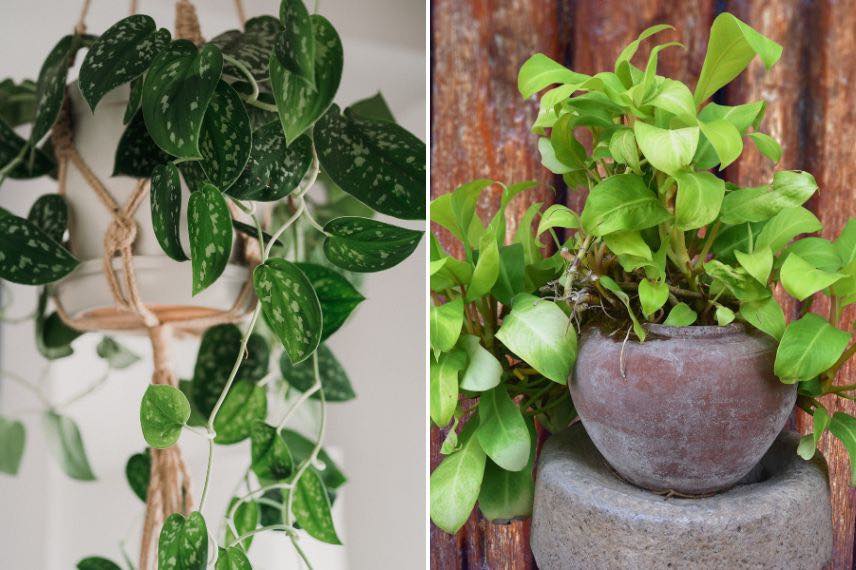
Scindapsus on the left and Pothos on the right
The rhizome begonia, and more specifically the water lily begonia
The Begonia family is vast, with significant ornamental variations and multiple modes of cultivation or propagation. Some are quite sensitive. The water lily begonia or Begonia x erythrophylla is the most charming one I know; it is absolutely not resentful. It is a vigorous, rhizomatous begonia that is tolerant. Indeed, many begonias are more successful ornamentally, displaying beautifully coloured, spotted leaves of various shapes and textures. They can be relatively easy to cultivate or true divas depending on the species and cultivars. Although it may seem to have less appeal or be less photogenic, the water lily begonia is a very reliable plant. Its leaves with long petioles that emerge directly from the rhizome are rounded and held upright, with a dark green, satin lamina, purple underneath. The presentation of the leaves is enhanced by this vertical orientation. When well positioned, lovely light effects can be seen through the leaves, highlighting the purple. Its exotic appearance, reminiscent of the water lily, is accompanied by a light, pinkish-white flowering above the foliage, in late winter.
Begonias belong to the Begoniaceae family and are native to tropical regions: Central and South America, the Caribbean, Southeast Asia, and tropical Africa. There are over 2000 species and varieties. The water lily begonia enjoys a bright location but tolerates being in more shade. It prefers a fairly well-draining and cool substrate, with regular watering, without constant moisture, but it can withstand all watering oversights. A lack of light and water may prevent it from flowering, but it has little impact on its foliage. It is cultivated above 13° C. It propagates easily by stem or leaf cuttings. Leaf cuttings in begonias are quite astonishing. Some begonias can reproduce simply from a piece of the leaf lamina! It is a fascinating family to explore.
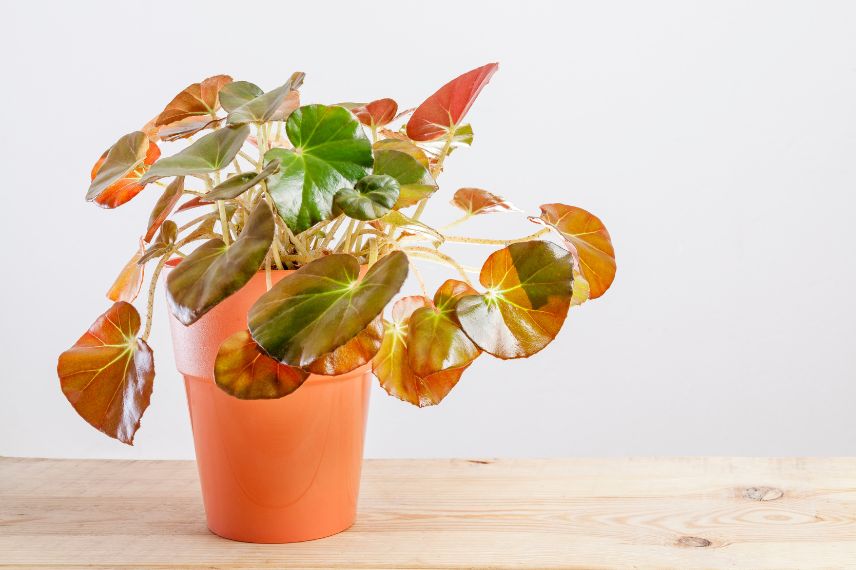
Here, the Begonia erythrophylla is young; its leaves have not yet achieved this vertical positioning, but the play of light is present
A few other companion plants
- Ivy or Hedera helix is accommodating regarding light conditions and likes to be regularly watered. Do not let it dry out too much.
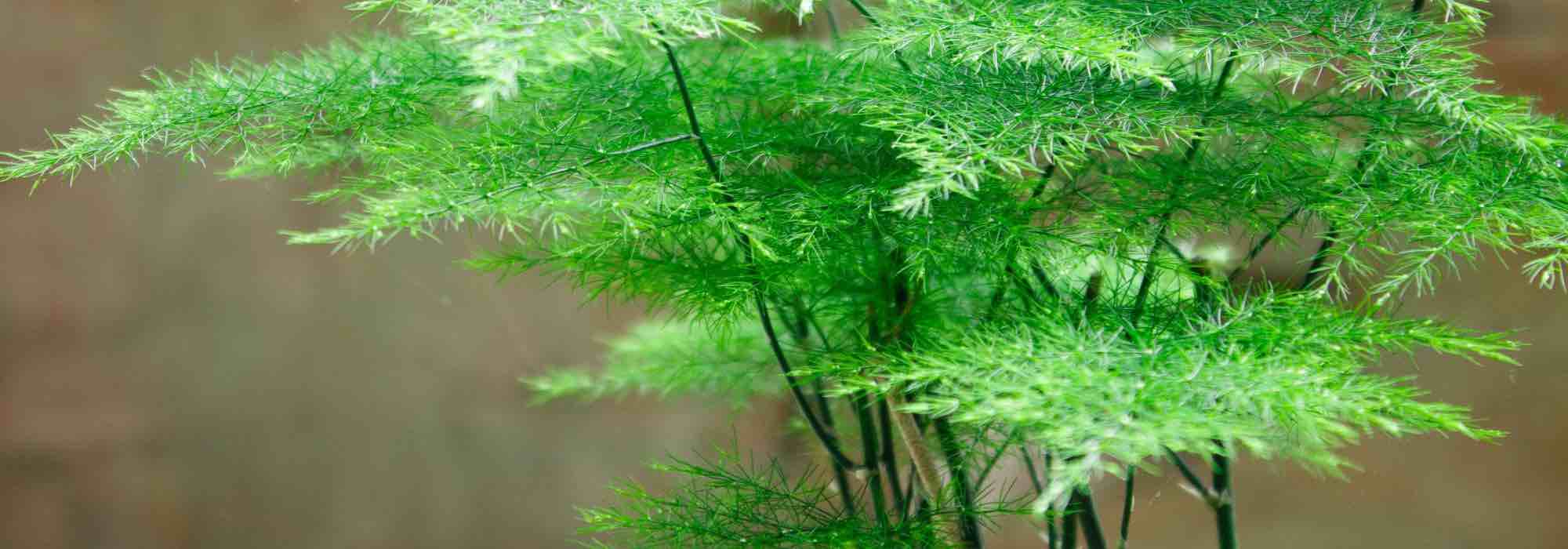
- The Asparagus (visible in the header photo of the article) are lovely feathery plants that also appreciate a fairly moist substrate and attentive watering. They are, moreover, quite resilient.
- Spathiphyllum and Schefflera are easy-to-maintain green plants.
- Dracaena and Yuccas as well. From my experience, I have a large Yucca that I’ve had for at least 20 years, which I have sometimes forgotten to water for 6 months… Unless it’s a very special specimen I inherited, it’s the most self-sufficient plant I’ve known. The Dracaena requires more attentive care but remains an accommodating plant.
Some general tips
- No indoor plant, apart from submerged medium plants like Papyrus, appreciates stagnant water at the bottom of the pot.
- If they are placed in a porous terracotta pot, the medium dries much faster than in a plastic pot. This is useful for certain plants (notably succulents) or if your interior tends to be more humid than dry. It can also be a wise choice if you tend to overwater or vice versa. You learn through trial and error.
- The medium of the plants should always dry within a few days. If after a week it is still damp, water less or repot in terracotta or add a draining material to your medium like perlite or sand. Start by watering less.
- Moreover, adjust watering to the season. The same medium in the same pot can dry in two days in summer and not dry in a week in winter.
- Indoor plants prefer to be grown snugly. Only gradually increase the pot size at each repotting.
- Bright, indirect light conditions are most frequently recommended for indoor plants. This can be either near a north-facing window or behind a window that receives sunlight, but it must be shaded or filtered with a sheer curtain, for example, to prevent direct sunlight from hitting the plant. That said, winter sun is not the same as summer sun, and southern sun is stronger than that in the northern regions. Adjust the filtration accordingly. If your interior is well-lit away from the windows, you can certainly place your plants further away. Position them further away also if it is indicated that the plant prefers lower light conditions.
- Subscribe!
- Contents
Comments