





























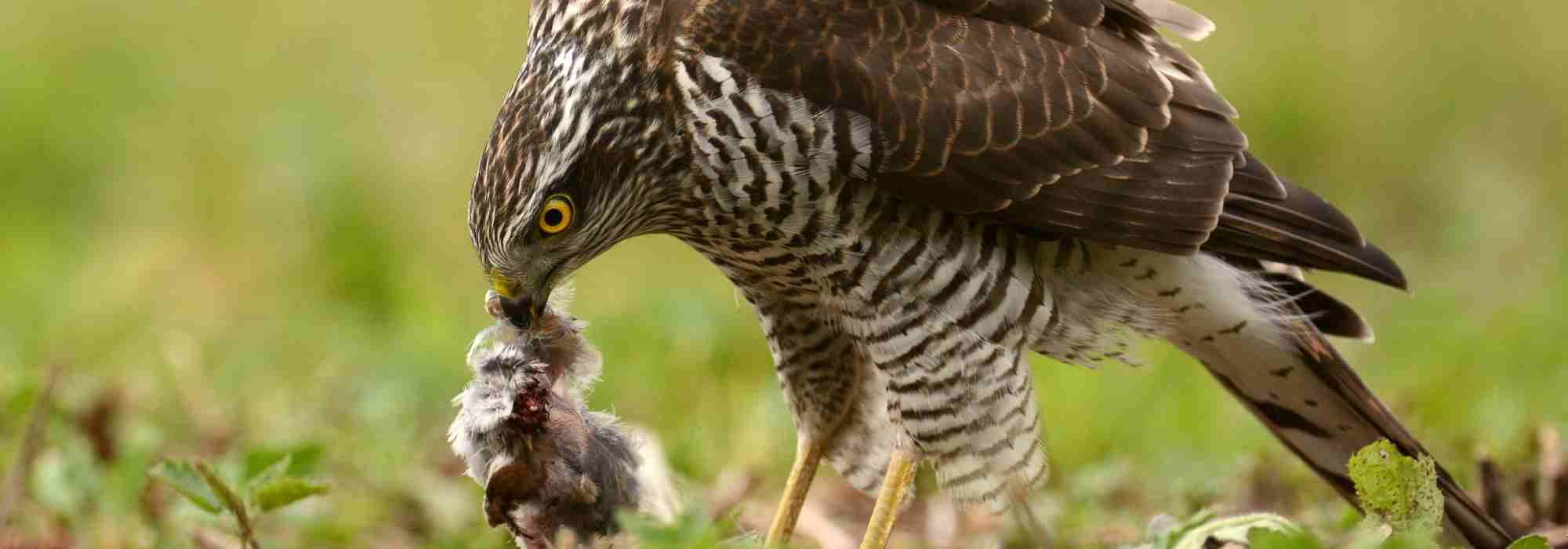
The Eurasian sparrowhawk: recognise it and understand its way of life
Let's get to know this raptor, roaming our countryside, a keen admirer of garden birds
Contents
Anyone living near a wooded or semi-wooded area, an urban park, or with a garden welcoming birds, may have the opportunity to spot an Eurasian Sparrowhawk (Accipiter nisus) gliding overhead. Relatively unobtrusive, this small raptor, now common in our territory, especially in winter, often has us looking up to the sky with its piercing cries. Unless you’ve seen it swoop onto the feeder installed in your garden… The Eurasian Sparrowhawk is a formidable predator of the passerines that make up the bulk of its diet.
Let’s get to know this raptor, one we might dislike for preying on our blue tits and sparrows, but which has its place in the sky over our beautiful territory.

How to distinguish the Eurasian sparrowhawk?
The European Sparrowhawk (Accipiter nisus) is a bird of prey in the order Accipitriformes and the family Accipitridae. Birds of this family are diurnal raptors characterised by binocular vision, a hooked beak and feet with four digits and sharp talons. A cousin of the goshawk, the European Sparrowhawk is one of the smallest raptors present on the territory. Like all members of its family, it also has broad wings, rounded at the tips and rather short, a long tail and a yellow eye. Nevertheless, it is difficult to recognise it from these characteristics alone.
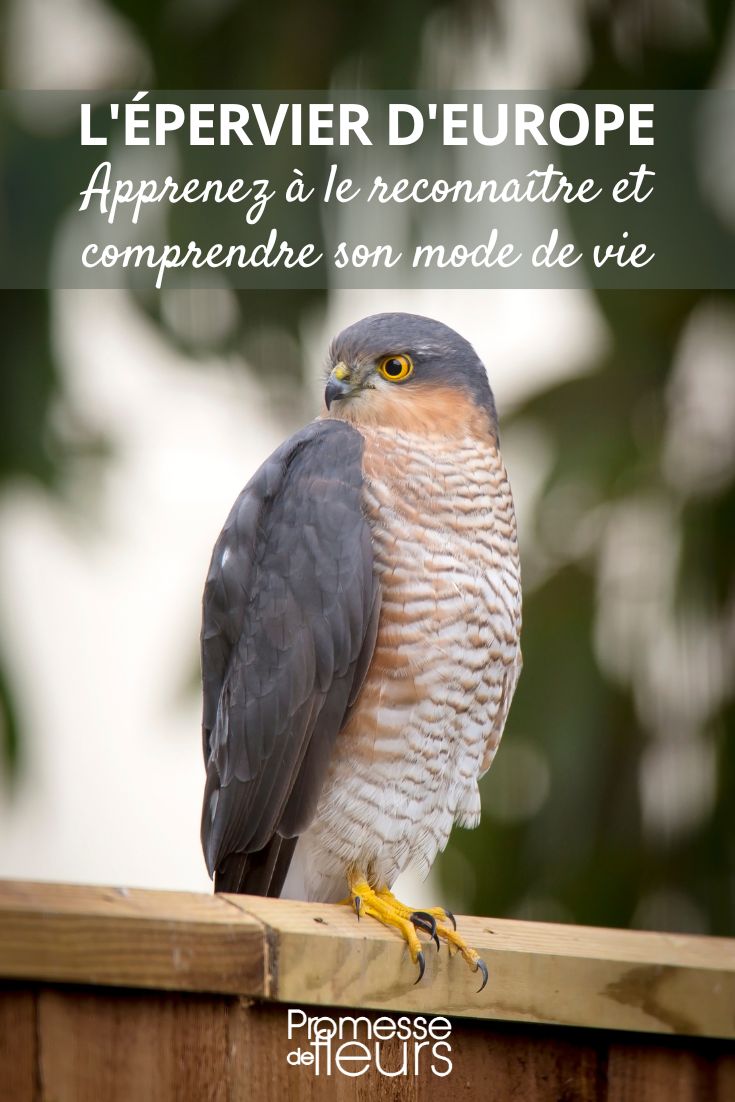
Other visual and audible signs can be readily observed to recognise a European Sparrowhawk soaring in the sky. Signs that differ between the male and the female, as this species exhibits sexual dimorphism. The male, smaller than the female, is fairly recognisable with the upperparts of his slate-blue body and the underside, white barred with russet, a colour easily discernible to the naked eye when viewed from below. As for the female, she has duller plumage, brown-grey on the upperside and grey-brown on the underside, with no reddish tint. Juveniles resemble the females closely. Both have very piercing eyes.
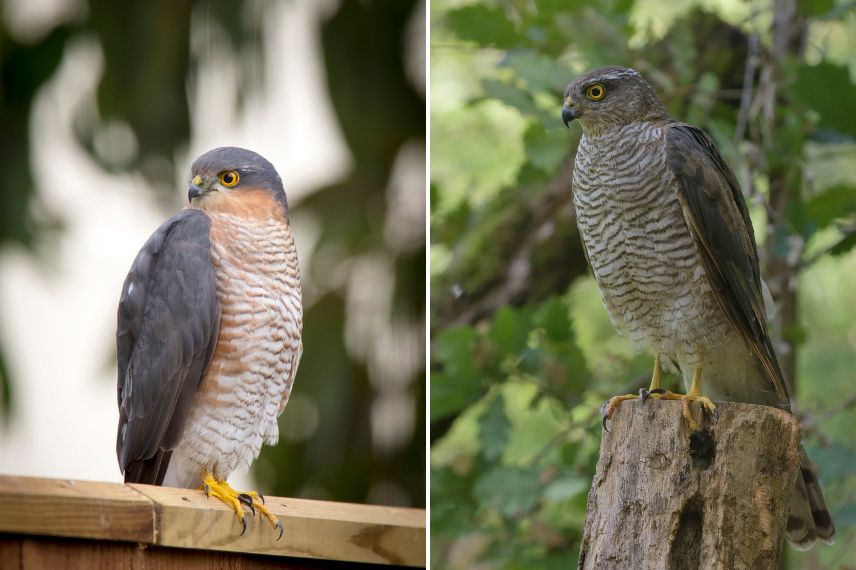
European Sparrowhawks, male and female
In terms of calls, the European Sparrowhawk is especially noisy during the breeding season. It is not uncommon to hear very characteristic “kyukyukyu” cries. Nevertheless, it is not entirely silent for the rest of the year.
Finally, to spot a European Sparrowhawk in the sky, sometimes all you need to do is watch its flight. It alternates between periods of rapid flight, punctuated by swift and striking wingbeats, and long glides with the wings folded.
The European Sparrowhawk is a sedentary breeding bird (except in very cold regions). France experiences an autumn influx of populations from northern and eastern Europe, with very visible passage peaks over the passes, from mid-October to mid-November.
Read also
DIY: Bird FeedersThe lifestyle of a secretive raptor: habitat and reproduction
It’s during the cold spells that it’s easiest to observe Eurasian sparrowhawks. Although they are relatively swift! But they frequent increasingly varied habitats.
Their habitat
The sparrowhawk has a preference for wooded and semi-wooded areas, such as deciduous or relatively open coniferous woods, clearings, coppices, but also hedgerows or banks covered with shrubs. Increasingly, Eurasian sparrowhawks have tended in recent years to settle in urban environments, in the large parks of conurbations or not far from suburban gardens. There have even been sightings of Eurasian sparrowhawks nesting in central Paris.
By contrast, they always build their nest in wooded areas of conifers or deciduous trees, fairly dense and old, most often quite close to a clearing. The pair join forces to construct an arboreal nest, made of small twigs and dead sprigs, and lined with thorns and bark from resinous trees. Simple conifer branches are usually enough to accommodate this nest, perched between 5 and 8 m high.
Their reproduction
The courtship display takes place from April to June. The male seduces the female with fast and undulating, noisy aerial flights, with abrupt dives. The pair chase each other through wooded areas.
After the nest is built by the pair, the female lays 3 to 6 eggs which she incubates for about thirty days. These eggs are laid every two days, from early May to June, as two clutches may occur in a season. Hatching is therefore staggered. Chicks stay in the nest for 25 to 30 days before fledging, still dependent on their parents who feed them for a few more days.
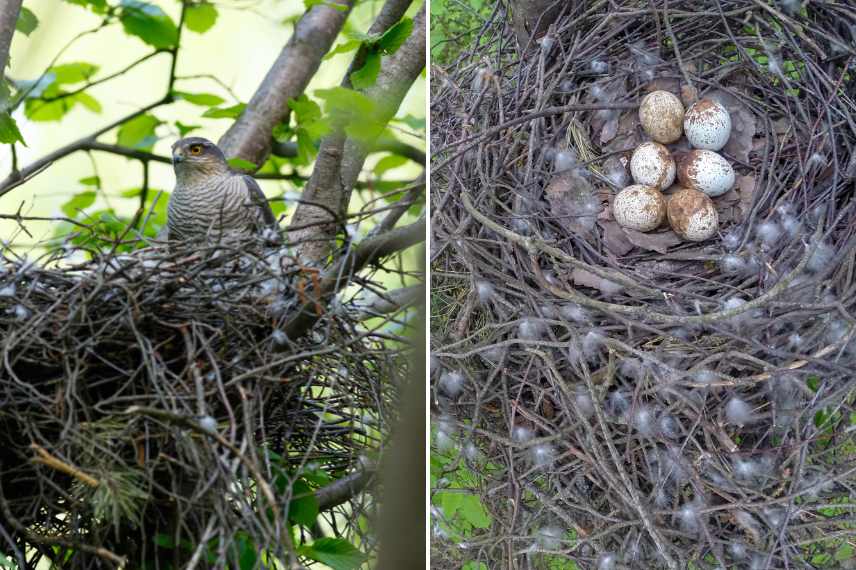
Nesting of Eurasian sparrowhawks
What does the Eurasian sparrowhawk feed on, and how does it feed?
The European Sparrowhawk is a raptor whose diet is notable for feeding on small birds, particularly passerines, at least for the male. Indeed, the female, larger, targets larger prey. The male thus favours species that are very common such as the House Sparrow, the Great Tit and the Blue Tit, the European Robin, the Tree Sparrow, the European Greenfinch, the Common Blackbird, the swallows… The female can add larger birds to her menu, such as pigeons (Common Wood Pigeon), pheasants, thrushes and starlings…
In winter, in times of lean spells, they can also feed on rodents and small mammals.
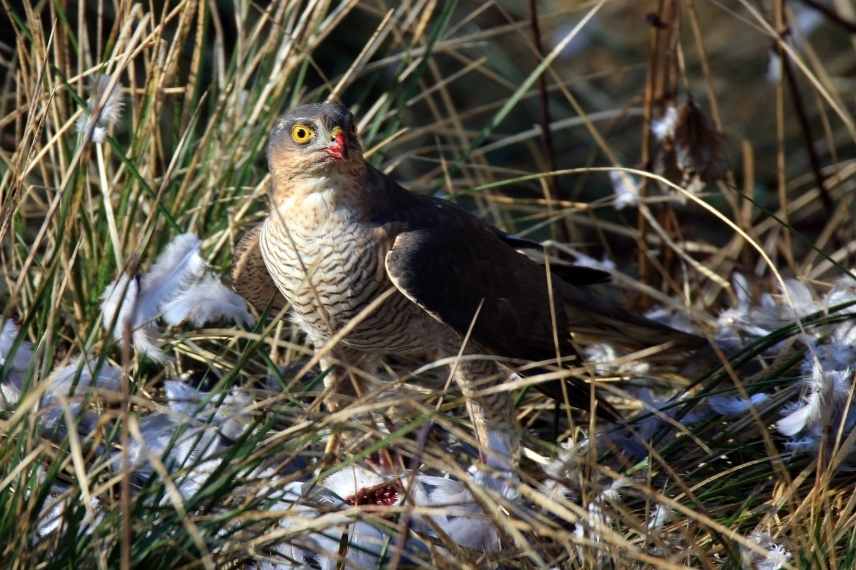
The European Sparrowhawk is an excellent hunter that feeds mainly on passerines
An excellent hunter, the European Sparrowhawk generally flies low when it is in search of food. It stays at a very low height, taking advantage of hedges or shrubs to hide and prepare its attack. An attack that is meant to be lightning-fast. It can also wait, perched on a tree, in observation. It is also a patient and obstinate hunter who can pursue its prey right through the shrubs and hedges, for several kilometres, waiting for the best moment to dive. The feeders installed in gardens to feed birds in winter are also good hunting spots for sparrowhawks.
Once its prey is seized, it smothers it with its talons, then carries it into the woods, not far from its nesting site, to pluck and devour it. It is not uncommon to discover feathers on a stump or a stone, which serves as a “table”.
Read also
Hedge for birds: which shrubs to choose?Should songbirds be protected from this predator?
If you have ever faced an attack by a European sparrowhawk, you have surely asked yourself: should I stop this raptor from using my bird feeders as a food source? Personally, my garden lies a short distance from a large wood, at an elevation of 650 m, in a semi-urban area; it is not unusual to see and hear European sparrowhawks. And often, particularly in winter, they come to feed in privet hedges, darting at a sparrow with exceptional dexterity. Or right around the feeders. And the bird-loving me does not relish this sight. All the while knowing that this predation is, in the natural order of things, normal and essential to the survival of this raptor, which is rather handsome and elegant.
Moreover, in the 1950s to 1960s, with the rise of insecticides and other pesticides, the European sparrowhawk paid a heavy toll. Today, it is no longer considered endangered, but vigilance remains warranted.
In my garden, these repeated attacks at certain times drive away blue tits and other greenfinches that frequent my feeders, or the robin that often darts around in my wake. Even though I know full well that neighbouring cats are also formidable predators of garden birds, my cat is more drawn to the warmth of the hearth than to hunting.

The European sparrowhawk easily spots bird feeders and knows where to find food
In short, it is perfectly possible to protect the birds in your garden and reduce attacks by Eurasian sparrowhawks—thanks to a few simple, easy solutions:
- Increase feeding stations so as not to create large gatherings, often sources of unwanted chirping, quickly spotted by European sparrowhawks. With several feeders located at different corners of the garden, feeding becomes noticeably more discreet, as different species spread out without squabbling.
- Choose feeders fitted with a small roof or overhang, which hinder the sparrowhawk’s attack. Moreover, this overhang helps conceal the birds.
- Place feeders near shrubs or thick hedges where songbirds can hide during an attack (even though the sparrowhawk, endowed with extraordinary patience, can lie in wait, waiting for the small birds to emerge)
- Opt for wild hedges made up of thorny shrubs such as hawthorn (Crataegus), the pyracantha, the Japanese quince (Chaenomeles), the blackthorn (Prunus spinosa), the barberry (Berberis)… These shrubs will provide cover for small birds, but European sparrowhawks will be more reluctant to enter them.
Of course, these tips aren’t foolproof, and nothing will truly stop a hungry Eurasian sparrowhawk from going after the songbirds in your garden if it’s desperate for food.
- Subscribe!
- Contents
Comments