





























Hyponomeutes: prevention and control
... without panicking either
Contents
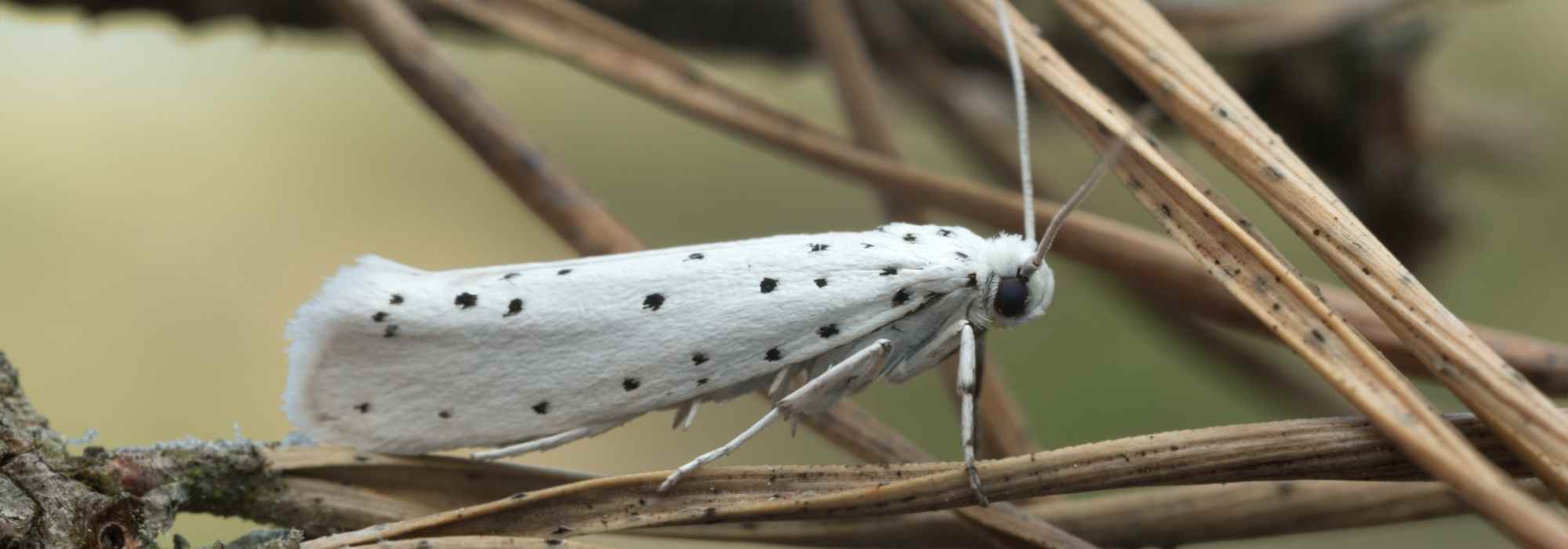
Yponomeuta moths (Yponomeuta sp.), sometimes referred to as “tineids,” are small white butterflies punctuated with black dots, whose caterpillars can completely defoliate the host plant on which they grow. Spindle trees, apple trees, pear trees, cherry trees, willows… a significant number of trees and bushes can be affected depending on the species of Yponomeuta. The attack is often very dramatic and worries gardeners: in spring, a large silk cocoon surrounds almost the entire tree or bush. It then appears as if it has emerged from a bad Halloween movie.
→ Is it really dangerous for the survival of the plant? What can be done to prevent an invasion of Yponomeuta moths? We provide all the details in our article.
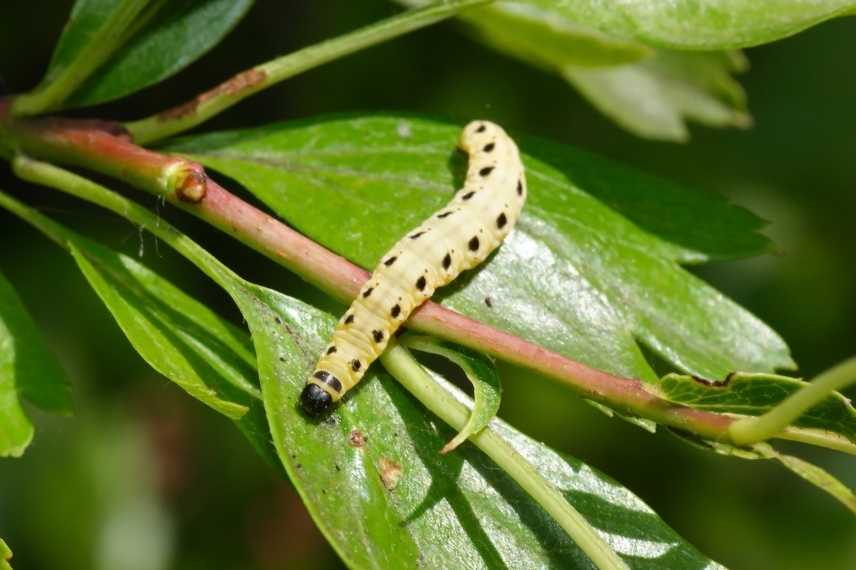
Caterpillar of Yponomeuta cagnagella

What are these insects?
Yponomeuta, commonly known as hyponomeutes, are insects from the order Lepidoptera (butterflies) and the family Yponomeutidae. The genus Yponomeuta includes nearly 1000 described species worldwide, with only about ten species in Europe.
Hyponomeutes, sometimes referred to as “tineids,” are small white butterflies speckled with black, resembling ermine fur. The placement or number of these black spots is rarely useful for species identification, as the spots can vary from one individual to another within the same species. Hyponomeutes are observed at dusk, from mid to late summer. They measure about 1 cm from head to the tip of the abdomen. When at rest, the hyponomeute folds its wings over its body, similar to a moth.
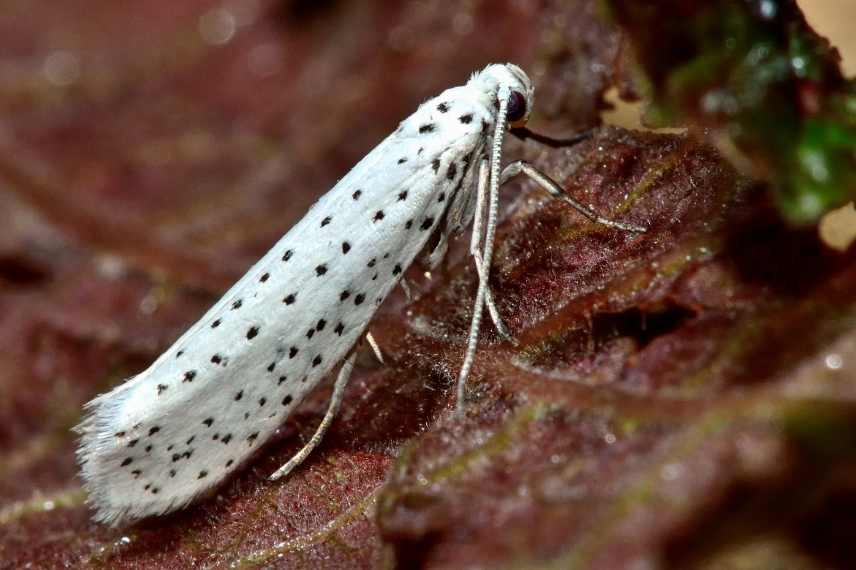 Yponomeuta evonymella
The different species of Yponomeuta look remarkably similar. In fact, only microscopic examination of their genitalia allows for accurate differentiation. The study of the caterpillars (often pale yellow larvae with black spots) and the host plant can also aid in species identification. Here is a list of species according to their host plant for these small pests:
- Spindle trees, sometimes Buckthorn or Blackthorn: Yponomeuta cagnagella – Large Spindle Tree Hyponomeute;
- European Spindle and sometimes a few Rosaceae: Yponomeuta plumbella – Small Spindle Tree Hyponomeute or Plumbed Hyponomeute;
- European Spindle: Yponomeuta irrorella;
- Bird Cherry, Cherries or Rowan: Yponomeuta evonymella – Spindle Tree Hyponomeute (the vernacular name is surprising…);
- Mahaleb Cherry: Yponomeuta mahalebella – Mahaleb Cherry Hyponomeute;
- Hawthorns, Damson, Bird Cherry, Rowan: Yponomeuta padella – Cherry Hyponomeute;
- Poplars: Yponomeuta gigas;
- Willows and Poplars: Yponomeuta rorrella – Willow Hyponomeute;
- Apple trees and Pear trees: Yponomeuta malinellus – Apple Hyponomeute;
- Hylotelephium telephium and other stonecrops: Yponomeuta sedella – Stonecrop Hyponomeute.
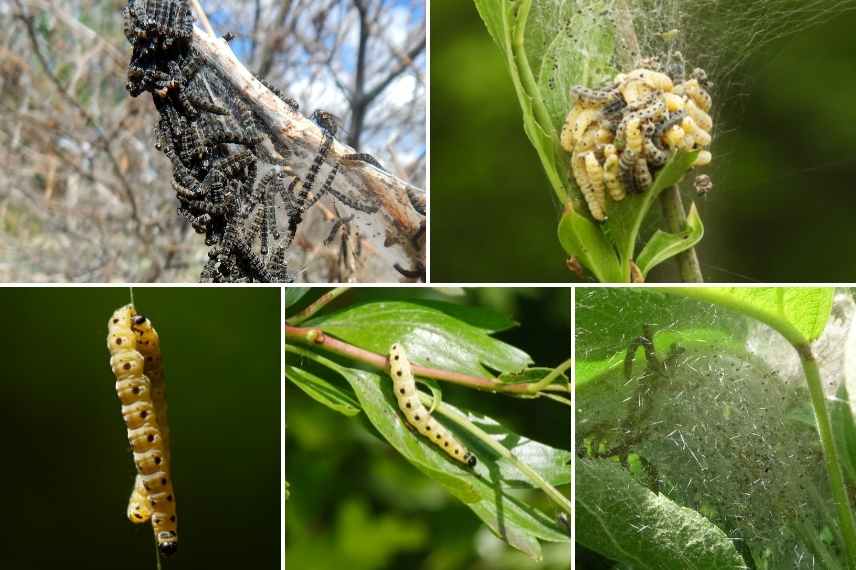 From top left to bottom right: Yponomeuta evonymellus, Yponomeuta padella, Yponomeuta rorrella, Yponomeuta cagnagella, and Yponomeuta malinellus
How do hyponomeutes live?
- During summer and until the very beginning of autumn, females lay clusters of small eggs that they attach to the leaves of the host plant;
- 4 weeks later, the caterpillar emerges from the egg (it will develop by moulting 5 times);
- The caterpillars will hibernate in colonies under a protective “shield”;
- In spring (April-May), the caterpillars leave the protection of the shield and begin to eat the leaves and buds of the plant they are on;
- While feeding, the caterpillars protect themselves by weaving a very characteristic silk veil. This veil can cover the entire plant. This network of silk threads, this web, protects the caterpillars from rain, wind, and their predators;
- When about 80 to 100% of the plant is defoliated, the caterpillars begin to form a cocoon: but they can also descend on a thread to switch to another plant to ravage;
- The pupation occurs in summer and then the adult hyponomeutes will emerge between early summer and late summer to reproduce very quickly;
- The biological cycle can restart and the insect will reproduce again: the male dies after mating, but the female lives for another two months, long enough for her to lay eggs.
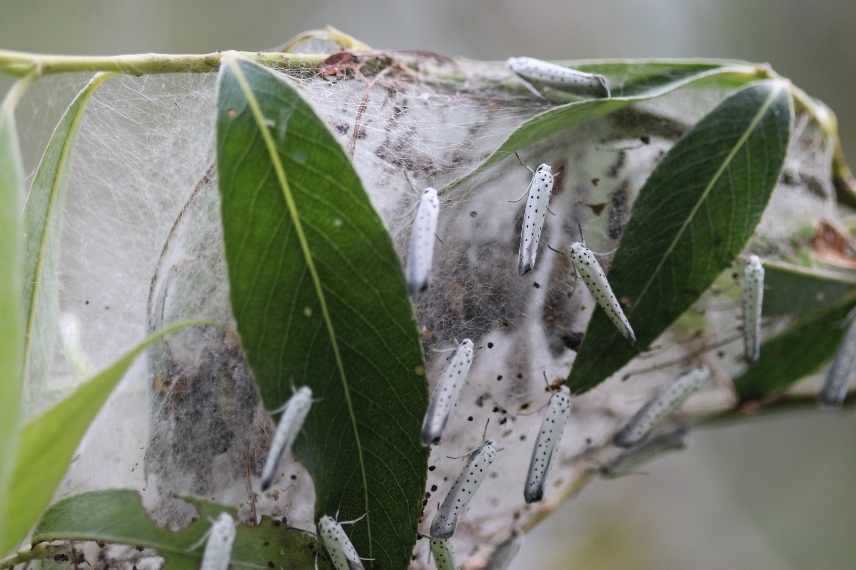
Yponomeuta evonymella
How to prevent or combat?
In prevention
- welcome as many insectivorous birds to the garden by creating a true biodiversity sanctuary (trees, hedges of native bushes, flowering plants, water features…): the Goldfinch, for example, appreciates Cherry Ermine Moths;
- applying a coating of green clay or white clay, or a lime wash, in winter on the trunk and large branches can eliminate some caterpillars during their hibernation;
- as part of biological control, the installation of specific pheromone traps for ermine moths in May is quite effective: the pheromones trap the males, preventing them from reproducing.
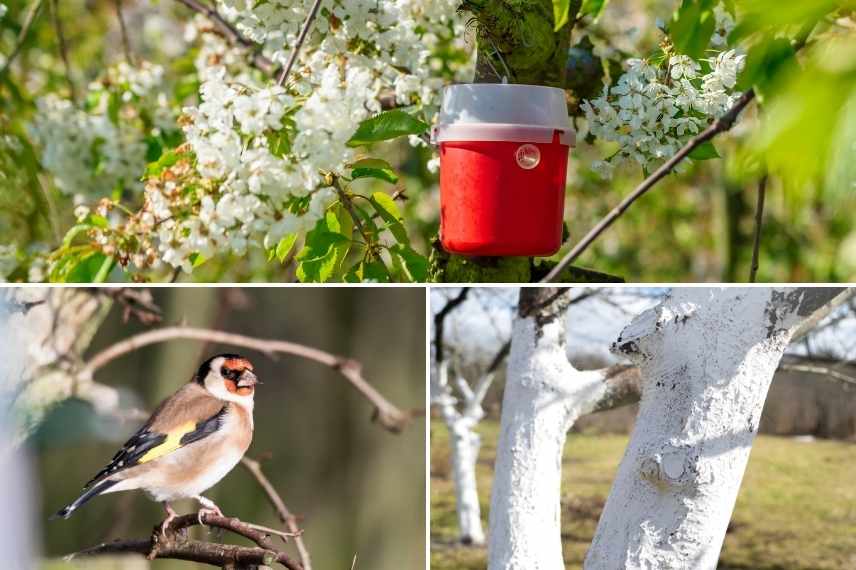 Pheromone traps, the presence of the Goldfinch, and lime applied to trees are good preventive measures.
Control when caterpillars are already present
- you can prune the branches where the silk cocoons are attached;
- spraying with Bacillus thuringiensis, a biological insecticide, before the formation of web nests can also be considered in a production orchard: if the nest is already formed, you can slightly open the web before spraying the bacilli. The Thuringian bacilli are bacteria that the caterpillars will ingest, preventing them from feeding afterwards.
Oliver’s little note: in my garden, I cultivate a small collection of willows and euonymus. The willows are surprisingly spared, unlike my euonymus. When I see an early cluster of silk on one of them, I gently collect it with the ermine moth caterpillars inside and place it in my living hedge near a large European Euonymus. Subsequently, I see no damage on that euonymus: have the caterpillars been devoured by the birds? No idea. But this way, I “save” my beautiful collection of euonymus every year.
Read also
Hedge for birds: which shrubs to choose?Is it really that problematic?
All or much of the foliage of the tree or bush may disappear during the growth of the caterpillars. However, it is rare for the plant to ultimately die. At most, the growth of the tree or bush is slowed down.
Therefore, although “the attack” is visually very impressive, it is important not to panic too much (except for very young specimens). The numerous predators of the hyponomeute caterpillars should resolve the issue quickly. Or at least, attenuate it.
Only fruit trees (mainly apple and pear trees) may see their production wiped out: in this respect, the hyponomeute is often considered a pest by fruit producers. Furthermore, defoliation by hyponomeutes in young specimens (spindle trees, willows, hawthorns) can lead to the premature death of the plant.
Please note: the hyponomeute caterpillar is completely harmless to humans and animals.
- Subscribe!
- Contents
![[yponomeuta remove_from_garden="true"]](https://en.promessedefleurs.eu/blogwp/wp-content/uploads/2022/06/Les-hyponomeutes-prevenir-et-lutter.jpg "[hyponomeutes prevention=\"Prevention and Control\"]")
Comments