





























Thrips: Identification and Natural Treatment
Identification, prevention and natural treatment
Contents
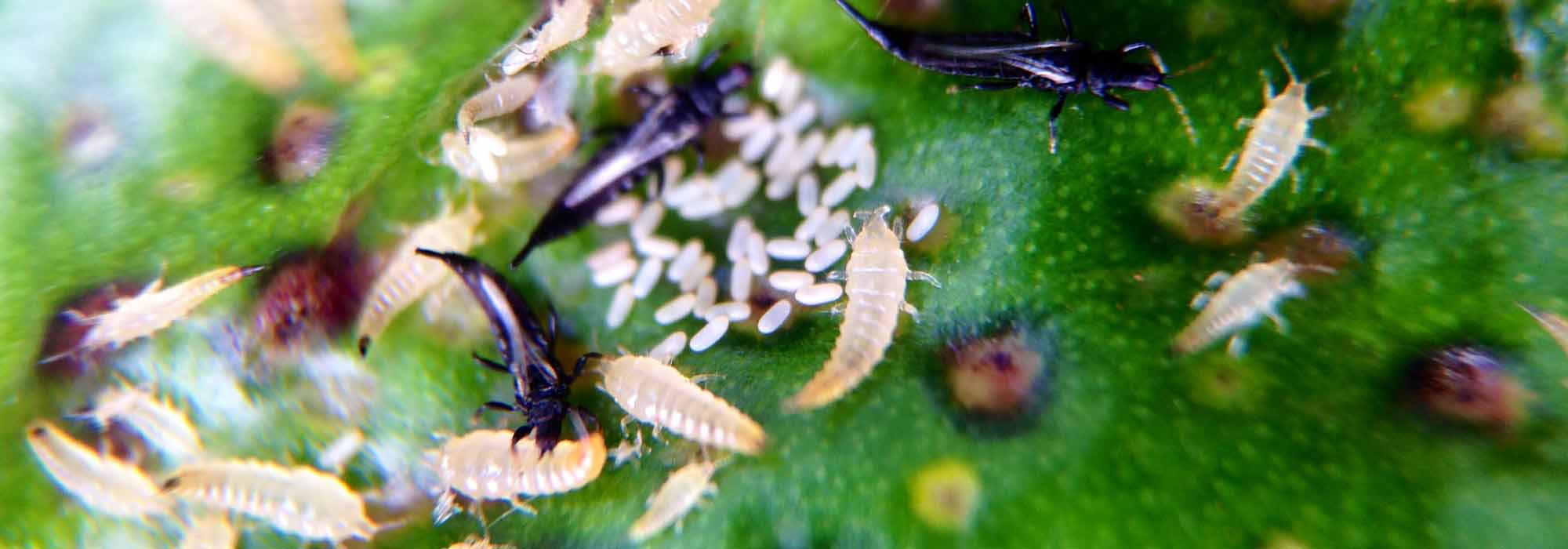
Thrips are tiny winged insects belonging to the order Thysanoptera. Well-known parasites, these piercing insects feed on the sap of the plants they infest.
Particularly prolific, thrips quickly invade enclosed growing areas, such as greenhouses and conservatories, and they can also appear on our indoor and garden plants. Although a thrip infestation rarely leads to the death of the plant, the damage caused is quite visible and can impact your harvests. Tenacious, thrips are not always easy to repel. However, there are natural ways to combat these parasitic pests.
Here’s how to identify, prevent, and naturally treat a thrip infestation in your crops.

How do thrips come about?
Like many parasitic organisms, thrips multiply in hot and dry weather. Therefore, it is during the summer months that their attacks are most to be feared.
Under good conditions, thrips can multiply at a record speed. However, as soon as the weather becomes humid and cold, thrips larvae flee the aerial parts of the infested plant to burrow into the soil where they hibernate. The following year, the attack resumes vigorously as soon as conditions allow.
How to identify thrips?
Thrips is a term derived from Greek, meaning “wood louse” or “wood louse”. Nowadays, this piercing insect is also known by the names “thunder bugs”, “heat bugs”, or “August bugs”. However, the latter name can be misleading, as it may lead to confusion between thrips and the harvest mite. In reality, the two species are unrelated. It is worth noting that there are nearly 3,000 different species belonging to the order Thysanoptera worldwide. These belong to various genera (Frankliniella, Thrips, Echinothrips…) and not all are harmful to plants.
Description of the thrips
Tiny, thrips measure between 1 and 2 mm long, making them difficult to distinguish with the naked eye.
While some species of thrips are wingless (apterous), the majority are winged in their adult stage. They can be recognised by their feathery wings and their piercing-sucking mouth cone.
Note that thrips larvae are always wingless. They can be recognised by their elongated bodies, which can be red, brown, yellow, or black. Thrips larvae are particularly characterised by their slow movement.
Symptoms on the plant
Thrips pierce plant organs to feed on the contents of their cells. Small spots, or sometimes silver-grey mottling, appear on the foliage of the plant. Eventually, the leaves dry out and fall off. Another symptom is the deformation of young shoots, flowers, and fruits, which may eventually undergo necrosis.
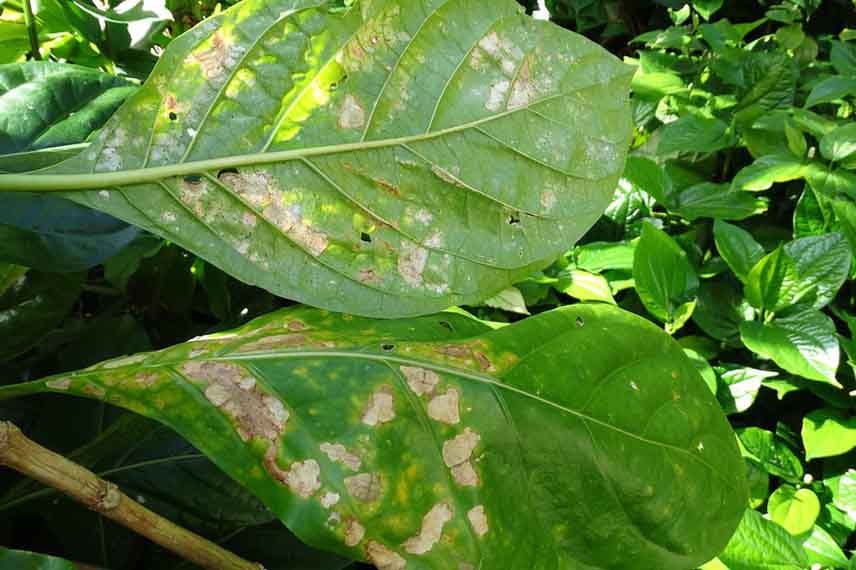
Damage caused by thrips on leaves ©Scot Nelson
To ensure that these symptoms are indeed caused by thrips, you will need to look more closely. The presence of microscopic excrement that is black on the leaves is another clear indication of their presence.
Finally, note that a thrips attack rarely kills the plant, except in cases of severe infestation. However, thrips can significantly weaken it and may even transmit viral diseases. Among these, the bronzing disease of tomato is the most common, and it can occur in many crops, contrary to what its name suggests.
Which plants are susceptible to thrips attacks?
Thrips are not picky, and they target a wide range of different plants, both indoor and garden varieties.
The following are particularly affected:
- flowering plants;
- ornamental trees and bushes;
- soft fruits and fruit trees;
- tomatoes, green beans, cucumbers, onions, aubergines, leeks, etc.
Note that each species of thrips has its own preferences. In mainland France, you may encounter:
- onion thrips,
- pea thrips;
- peach thrips;
- rose thrips;
- cereal thrips;
- olive thrips;
- gladiolus thrips;
- etc.
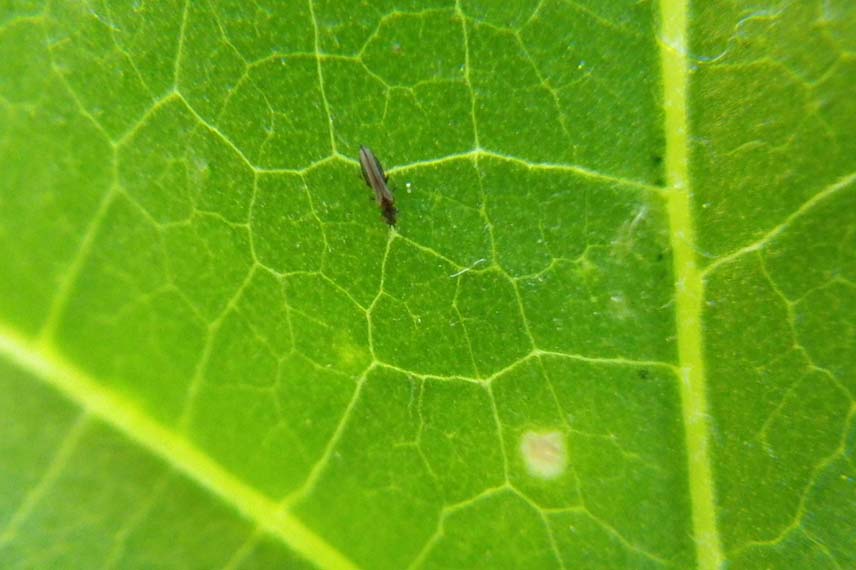
Thrips on bean leaf ©Gary Chang
Among the most feared, the Californian thrips is particularly virulent and is capable of parasitising a wide diversity of plants.
Read also
Using pyrethrum in the gardenHow to get rid of thrips?
To begin with, it is important to highlight that there is a preventive method to limit the risk of thrip attacks. Indeed, as these parasitic insects thrive in heat and dryness, you can easily keep them at bay by promoting a humid environment around your plants.
- Outdoors, when the weather is hot and dry, regularly spray the leaves of your plants.
- Indoors and in greenhouses, you can mist the leaves of your plants all year round.
Unfortunately, this technique has its limits, as many plants are very sensitive to humidity and even prone to fungal diseases, the development of which is encouraged by the constant presence of water.
Natural Treatments for Thrips
In the event of a confirmed attack, some natural treatments will help you eradicate thrips without using chemical insecticides.
- On your greenhouse plants, use integrated biological control methods. Predatory bugs from the genus Orius, the mite Amblyseius cucumeris, and the nematode Steinernema feltiae are natural predators of thrips. You can also employ blue sticky traps used in conjunction with a special thrip attractant. These are effective for trapping both male and female thrips of the main species.
- If you are facing a significant attack, you can use neem oil, a garlic decoction mixed with a solution of black soap, or pyrethrum to get rid of thrips.
Note: whatever control method you use, always repot your infected plants to provide them with healthy, thrip-larvae-free compost.
- Subscribe!
- Contents
![[insecte thrips: identification, prevention, treatment]](https://en.promessedefleurs.eu/blogwp/wp-content/uploads/2022/04/thrips-1.jpg "thrips")
Comments