





























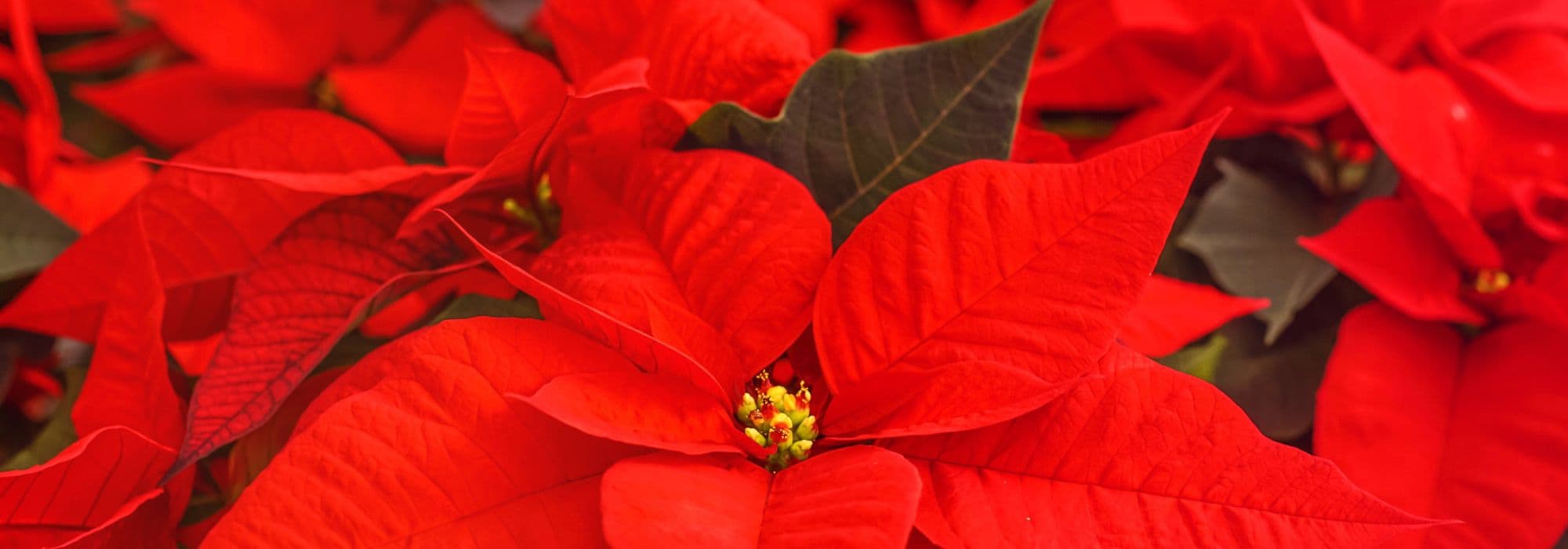
Growing Poinsettia, the quintessential Christmas plant
All our advice on caring for and keeping your Poinsettia or Christmas star
Contents
There is a sign that doesn’t lie! From the beginning of December, the red that dresses Father Christmas’s cloak appears everywhere — on the Christmas tree, in the outdoor decorations, on the table… At florists and garden centres, red is also taking centre stage with the Poinsettia (Euphorbia pulcherrima), this indoor plant, aptly named the Christmas Star, which fills the displays. It must be said that this plant knows how to show off its finest features to charm lovers of indoor plants. If its “flowering” is often red, it can also appear in pink, orange, salmon, cream…
While it’s easy to fall for this superb Christmas Star, keeping it beyond the holidays is more difficult. And it is not uncommon that, once the year‑end festivities are over, your Poinsettia, stripped of leaves, ends up pitifully abandoned at the bottom of the bin or on the compost heap.
I offer you a few tips to care for this Poinsettia that was given to you (or that you bought yourself!) and, above all, to see it bloom again and again.

A short history of Poinsettia
Before discussing this indoor plant, let’s take a brief look back at its history. For the history of the Poinsettia is a beautiful one! Native to Mexico, the Poinsettia is called “Flores de la noche buena” there (the flower of the holy night). And naturally, a legend is associated with it: a goddess, dying of heartbreak, is said to have let a drop of blood fall onto its leaves.
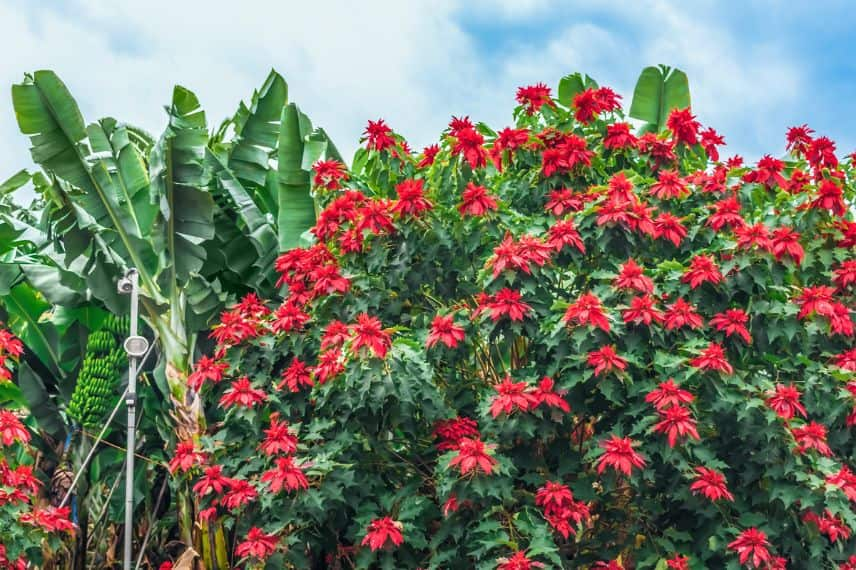
Euphorbia pulcherrima in its natural habitat
If this Poinsettia has become an essential indoor plant for the end-of-year festivities, the blame lies with the American Joël Robert Poinsett, botanist and ambassador, who brought back some seeds of this plant to give to the botanical garden in Philadelphia. The plant caused a sensation there and became popular. This was in the 1830s. Mr Poinsett died on 12 December 1858. From then on, 12 December became Poinsettia Day. A few decades later, a grower saw a fine commercial opportunity: the Poinsettia became the symbolic plant of Christmas.
Poinsettia, the iconic flowering plant of Christmas
The Poinsettia’s Latin name is Euphorbia pulcherrima. Needless to say, it is a relative of the spurges, of the family Euphorbiaceae. It is also called “scarlet spurge”, because of the red colour of its bracts. Indeed, the pretty red star that gives the Poinsettia its charm is not a flower, but bracts — that is, the leaves that arise from the base of the peduncle to surround the flower. The flower of the Poinsettia is yellow-green. A flowering colour typical of euphorbias.
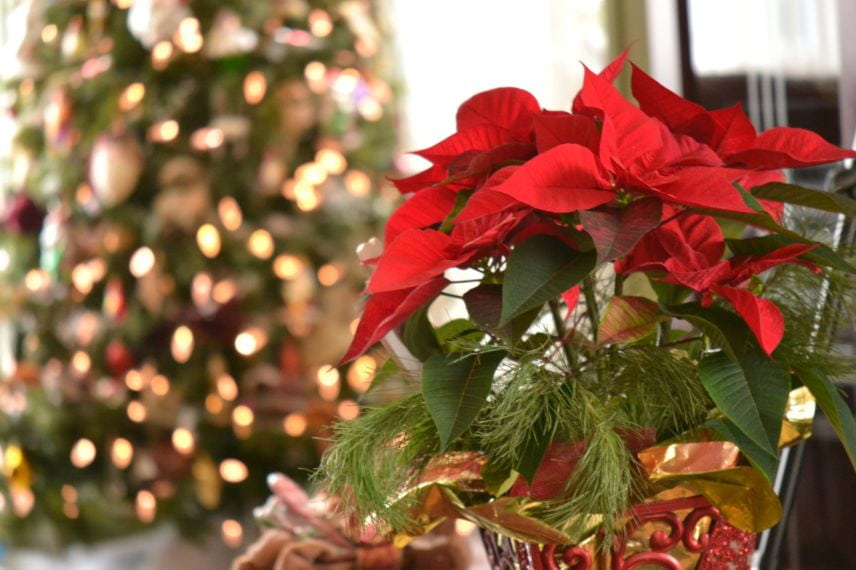
The Poinsettia, the must-have plant for Christmas
Poinsettia flowering occurs between October and March, it is a short-day plant that does not need a great deal of light to flower. 8 to 10 hours are more than sufficient. That’s why this plant is found in our homes at this time.
If I give you all this information, it is not by chance. You will see later that it matters…
How should you care for a poinsettia during the festive season?
When you buy (or are given) a Poinsettia, it is usually in full flowering. And it takes centre stage in the living room among the Christmas decorations and the garlanded Christmas tree. Yet sometimes it quickly looks glum, the leaves drop, the colours of the bracts fade. Certainly because it does not receive optimal care.
Watering the Poinsettia
The Poinsettia needs a potting mix that is constantly moist, but never waterlogged. However, if the potting mix is too dry, the leaves will drop. That is why watering should be regular, every 3 to 4 days. You should therefore water thoroughly and, 15 minutes later, remove any excess water from the saucer or cachepot.
These waterings should be done only with water at room temperature. Indeed, cold water may also cause the leaves to drop.
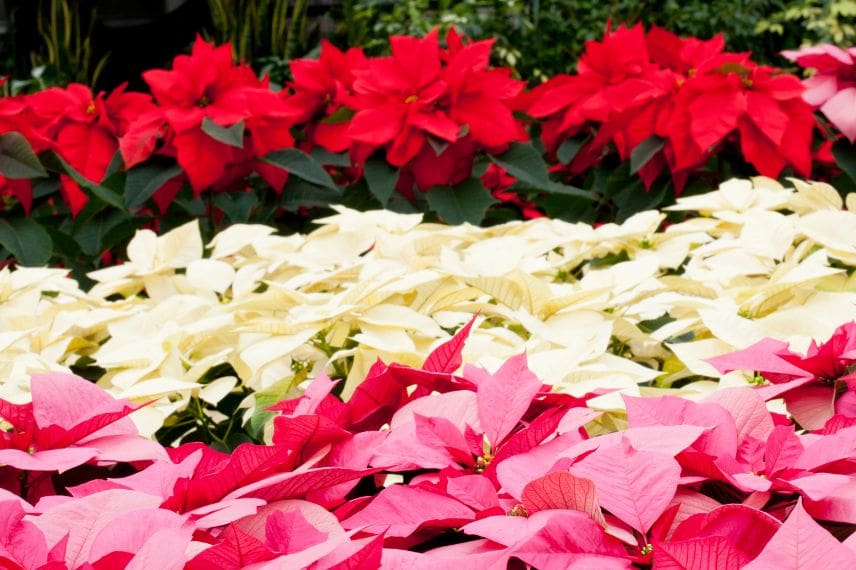
With selected varieties, the Poinsettia offers bracts in different colours
Lighting and the ideal temperature for the Poinsettia
Light levels and temperature are also key elements for the Poinsettia’s healthy growth. Ideally, owing to its subtropical origins, Euphorbia pulcherrima appreciates the mild conditions of our homes. A temperature between 19 and 21 °C suits it perfectly. At least during the day. And at night, it tolerates a little coolness. You can therefore place it in a cooler room with a temperature between 16 and 18 °C. However, draughts are harmful.
You should also provide it with enough light, but not direct sunlight (if there is any at Christmas!).
Read also
Perfect indoor plants to give as giftsAnd after Christmas?
In its natural habitat, the Poinsettia can reach 3 m in height. Rest assured, in our homes it rarely exceeds 50 cm. That said, keeping it beyond the Christmas holidays requires a little effort. If you water it and provide the right living conditions, it will still be there in January. And then?
To keep your Poinsettia until the following Christmas, and above all to see it flower again, you will need to give it some care :
- At the end of flowering, prune the plant back to 10 cm and repot it into a new pot with drainage holes, lined with a layer of clay pebbles and filled with potting compost and sand.
- From February to May, keep Poinsettia indoors under the same conditions of light and warmth.
- From May to September, place the plant outside in the shade and give it a liquid fertiliser for houseplants once a week while continuing to water it.
- In September, bring the plant back indoors, because it enters its flowering phase. As the Poinsettia is a short-day plant, it absolutely requires a daily period of total darkness. That is why it is recommended to lock your plant in a cupboard, always at around 20 °C, for example from 19:00 to 09:00. This way it will benefit from roughly 14 hours of total darkness to redden its bracts. And for the rest of the day, it spends time in the light. You can also cover it with a cardboard box, but that is a rather unattractive decoration in a living room… This day/night alternation will continue for 8 to 10 weeks.
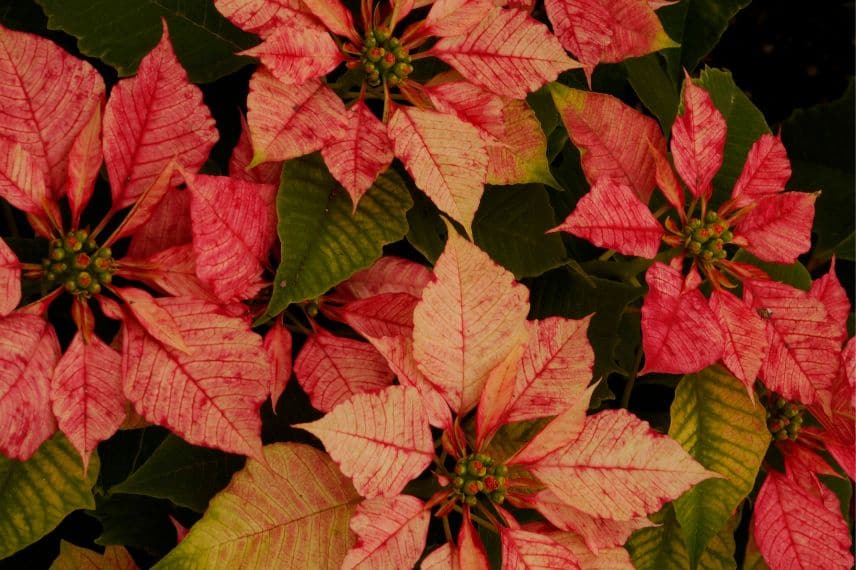
The Poinsettia during flowering
Diseases and pests of poinsettia
In terms of disease, poinsettia can suffer from root rot due to overwatering or poor drainage of the substrate. If the plant is watered correctly, there should be no problem.
The poinsettia can also be invaded by aleurodes or whiteflies. I invite you to read Olivier’s article: Aleurode or whitefly: identification and treatments
- Subscribe!
- Contents
Comments