




























Watering the vegetable garden: our tips
The golden rules for effective watering of your vegetable garden
Contents
It has not escaped anyone that the climate is changing. Year after year, periods of drought are becoming more frequent, longer, and earlier… And across France, Prefectures are imposing water restrictions. Because water is a precious resource that we must conserve. However, the plants in your vegetable garden need this water to grow and bear fruit. Without water, there are no beautiful, ripe tomatoes or crunchy, tasty salads.
Watering your vegetable garden is therefore essential, but following certain tips can help you save this vital water. Obviously, the watering of your vegetable garden depends greatly on the region where you live, the nature of the soil, and the level of sunlight exposure. It is difficult to establish absolute rules, but these general tips can help minimise the damage caused by insufficient or excessive watering.
Discover the golden rules for properly watering your vegetable garden.

What is the best time to water your vegetable garden?
Here’s the translation:
This is a thorny question that sparks some friendly debates among gardeners. Some swear by morning watering, while others advocate for evening watering. However, they all agree on one truth: you should never water during the day, especially in the height of summer when the sun is blazing. Indeed, during the hottest hours of the day, adding water can scorch the leaves.
Generally speaking, if you water early in the morning, before 8 a.m. in the height of summer, and before 10 a.m. in spring and autumn, you can’t go wrong. Why?
- In summer, watering in the morning rather than the evening limits water evaporation. Watering occurs on cooler soil, as in the evening, the ground is still warm from the day’s sun.
- In spring and autumn, nights can be cool, and evening watering can be detrimental as it maintains a certain level of humidity.
- Evening watering risks attracting slugs and snails that will feast all night on your young shoots.
Read also
Watering the garden: how to do it?How often should you water?
In the vegetable garden, overwatering is not recommended for several reasons. Firstly, an excess of water and humidity affects the taste quality of your vegetables. If you water your vegetables too much, especially tomatoes, they become tasteless as they are waterlogged. Moreover, excessive humidity opens the door to fungal diseases.
Finally, daily watering encourages your vegetables to be lazy! Indeed, with regular water supply, your vegetables will not develop their root system deeply, and their roots will remain near the surface. They become entirely dependent on this life-giving water you provide every day. Consequently, in times of drought or heatwaves, they will not be adequately equipped to withstand the lack of water. Naturally, they will suffer from water scarcity. This is particularly true for vegetable plants such as tomatoes, parsnips, squashes, and courgettes, as well as melons…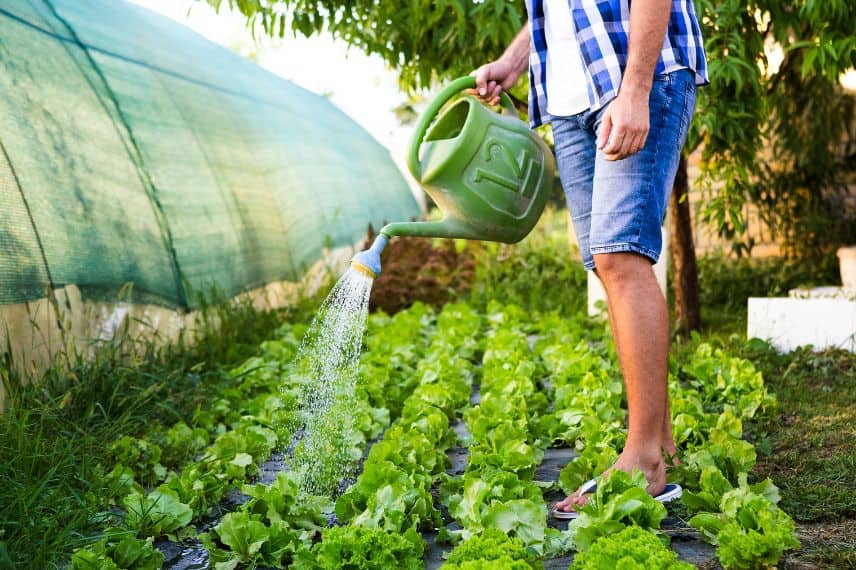
Therefore, it is better to water less frequently but in larger quantities. Obviously, the frequency depends on the region where you grow your vegetable garden, but a good watering of one to two times a week can be sufficient in summer. Three times if you live in the south of France or during a heatwave. However, get your vegetables accustomed to these amounts from the time of planting.
Discover other Vegetable gardens
View all →
Available in 1 sizes
Available in 1 sizes
Available in 1 sizes
Available in 1 sizes
Available in 1 sizes
Available in 1 sizes
Available in 1 sizes
Available in 1 sizes
Available in 1 sizes
Available in 1 sizes
Mulching, an essential practice to reduce water inputs
Certainly, there is a French saying that goes, “One hoeing is worth two waterings.” Indeed, good hoeing of the soil helps aerate the earth, break the crust, and thus facilitate the penetration of rainwater or irrigation. However, hoeing also means effort and, potentially, back pain. Moreover, it will need to be repeated several times. Not to mention the weeds that will thrive and compete with your beautiful vegetables.
Therefore, it is better to mulch than to hoe. Mulching retains some moisture in the soil while limiting the proliferation of weeds. It’s all beneficial for the gardener!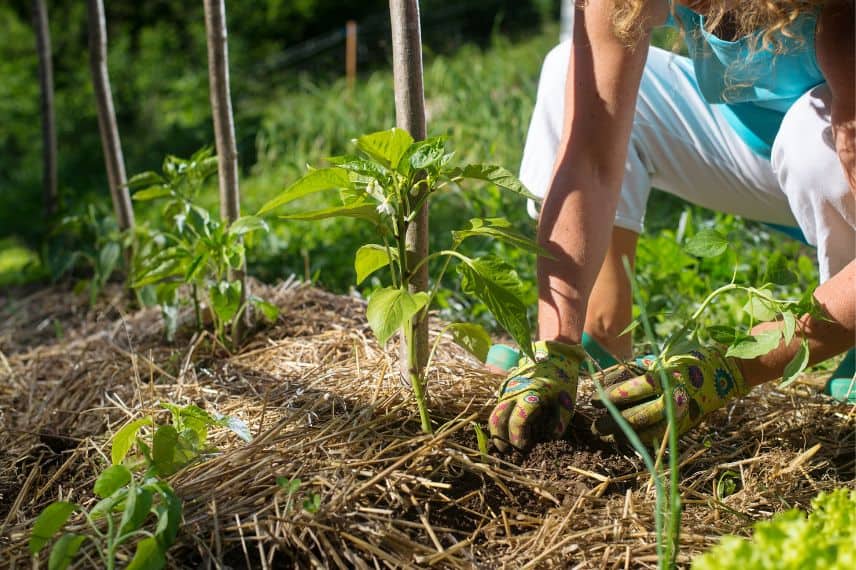
If the idea of mulching seems obvious to you, the next step is to determine which mulch to choose for your vegetable garden and, importantly, when to apply it. You can use straw, autumn leaves that you can slightly shred, dried grass clippings rich in nitrogen, ramial chipped wood (RCW), or commercial mulches like buckwheat husks, or miscanthus, flax, or hemp flakes…
Discover my mulching tips for your vegetable garden.
Seedlings can also be mulched. However, the mulch should be applied when the seedlings have emerged and are strong enough, standing 10 to 15 cm tall. Be sure to remove any weeds before applying your mulch.
Read also
Watering tomatoes: how to do it?Which water should be preferred for the vegetable garden?
In terms of water supply, several options are available for the vegetable garden. If you are fortunate, your garden can be watered using water from a well. Once you have ensured the water’s quality through analysis, this is an economical solution. However, this water, sourced from an aquifer or spring, often has a very cool temperature. Therefore, it is recommended to pump it a few hours before watering to use it at room temperature. Thermal shock can indeed be harmful to vegetable plants.
Another good solution is to collect rainwater, as it has numerous advantages:
- It is free
- It is soft and non-calcareous
- It is at room temperature
- It preserves aquifers
The roof of the house, or even a simple garden shed, chicken coop, or wood shelter, is sufficient to collect rainwater in a barrel or, even better, a water collector equipped with a tap and an overflow. For a 50 m² vegetable garden, a water collection tank of 300 to 500 litres should suffice, but a 1000-litre model is ideal.
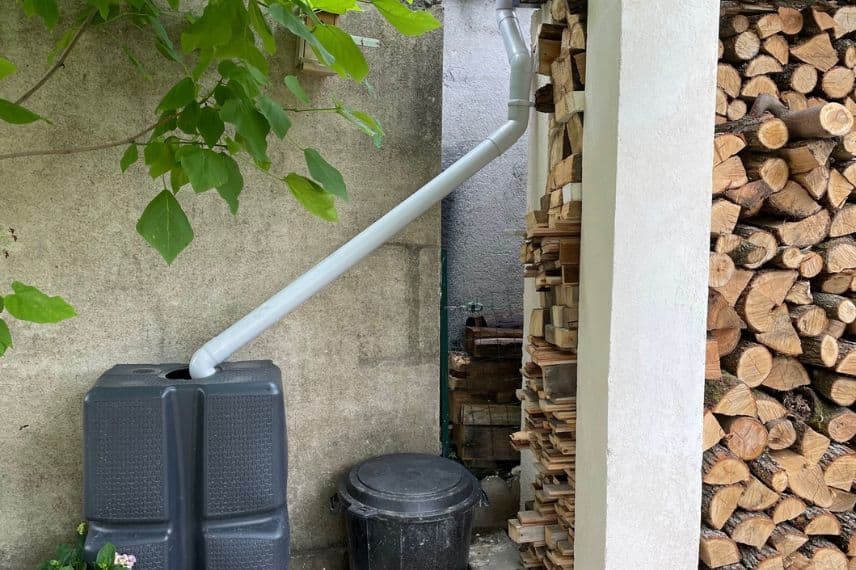 A simple piece of roof allows for rainwater collection[/caption>
On the other hand, water from the public supply is not the best, as it is often calcareous and chlorinated. Similarly, water from rivers can be used provided it is analysed beforehand. You may also be subject to restrictions in the event of a confirmed drought.
Which irrigation system should you choose?
Before anything else, for watering your vegetable garden, we strongly advise you to ban hose watering systems equipped with a lance, pistol, or oscillating or rotating system. Indeed, while these watering systems are very convenient for large areas, they consume a lot of water and, above all, wet the foliage of all vegetables, without distinction. However, watering while wetting the foliage is a source of development for cryptogamic diseases such as downy mildew. Similarly, there is a risk of leaf burn. Therefore, never water the leaves and favour watering at the base.
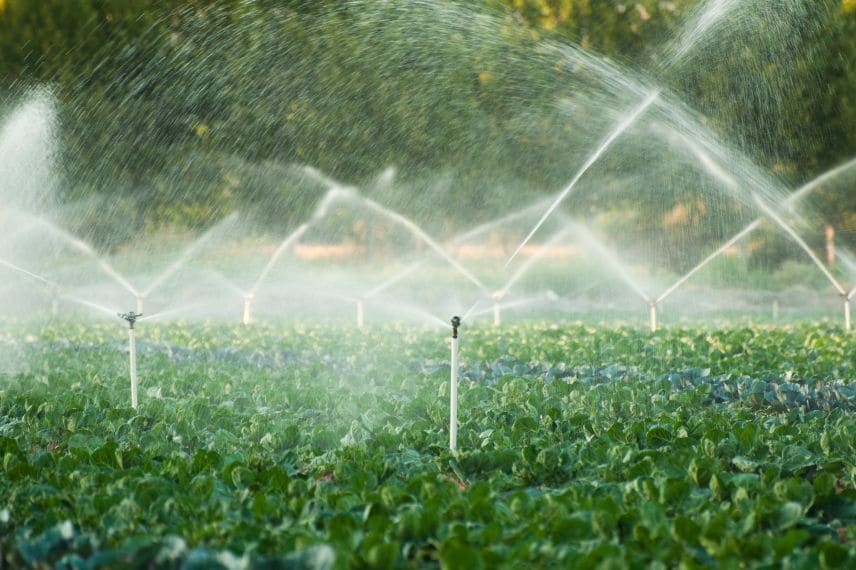
Sprinkler watering should be banned in the vegetable garden
There are several systems available:
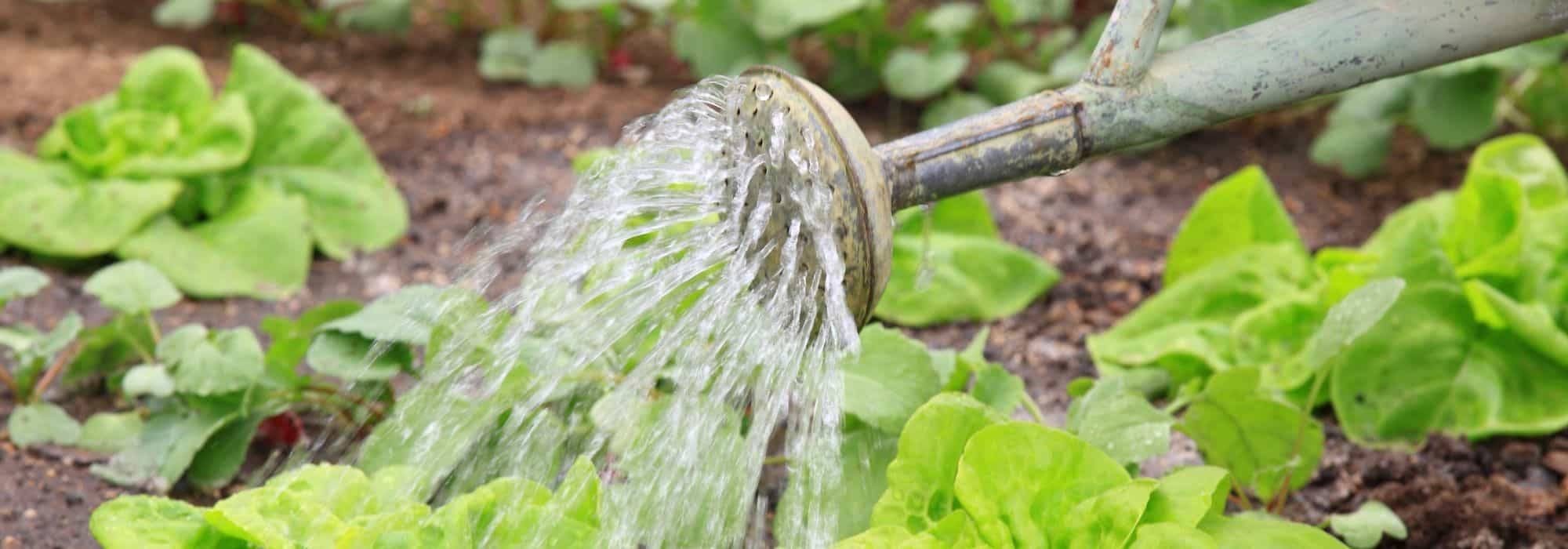
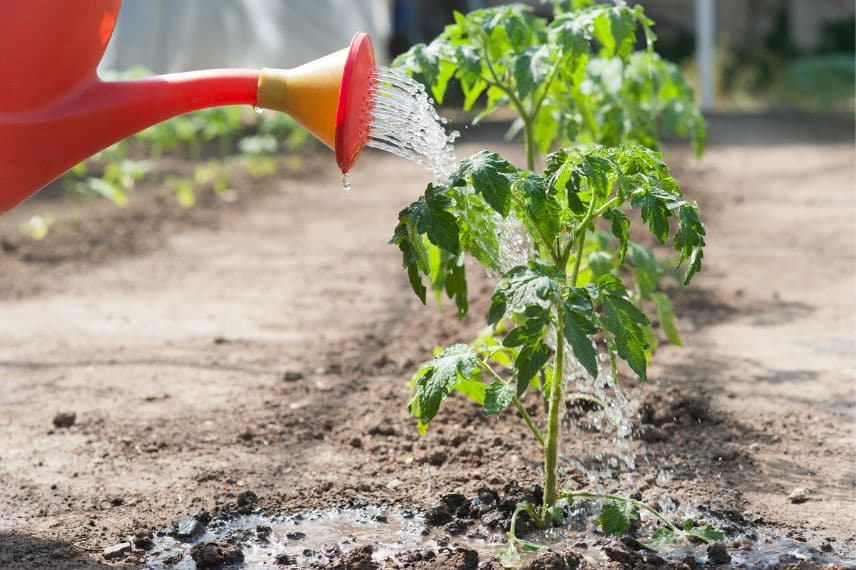
- The good old watering can, ideal for watering at the base and controlling your water supply. For sowing, a watering can equipped with a rose is truly the tool to favour as it allows for a fine spray. For established vegetable plants, watering is done at the neck, avoiding splashes at all costs.
- The perforated or micro-perforated hose: water seeps gently through the walls of the perforated hose. It works on a tap or can be connected to a water collector. This is a good solution for the vegetable garden, although it has the drawback of an irregular flow depending on the garden’s layout.
- The drip irrigation system which operates on the principle of a hose equipped with drippers that allow targeting the plants and adjusting the water supply. However, it keeps the vegetables on a drip feed, and they will not develop their root system deeply.
- The principle of oyas or ollas which allows for deep soil irrigation through these porous terracotta “jars”. Water at room temperature is diffused close to the roots. This is a very interesting system, but it can be costly for a large area. Marion explains everything about ollas or oyas, an efficient and economical watering system.
For further reading: Automatic watering: the different systems, which one to choose?
Adapting your watering to vegetables
In the vegetable garden, it is also necessary to adjust watering according to the plants. Some young plants have high water needs, while others are more undemanding.
Overall, they will need to be watered more:
- Leafy vegetables, as they lose water through evapotranspiration, particularly those with large and beautiful leaves: chard, cabbages, salads, celery, artichokes…
- Fruit vegetables because their development requires extra effort from the plant: tomatoes, aubergines, courgettes and squashes, melons, cucumbers, peppers and chillies.
- Root vegetables like radishes and turnips, as a lack of watering makes the roots hollow and pungent.
- Peas and broad beans also need regular watering, but they generally grow at a time when rains are still abundant. The bean requires generous watering, but infrequently.
Also remember that the needs of vegetables are greater when they are in the fruit or tubercle swelling period than during the growth phase. Sowing also requires a certain degree of moisture.
And watering in a raised or square vegetable garden?
If you are growing a square vegetable garden or a raised bed, all the previous advice obviously applies! However, remember that the volume of soil is less than in a traditional in-ground garden. This soil dries out more quickly, so watering will need to be a little more frequent.
Discover Olivier and Ingrid’s tips: How to make a square vegetable garden? and Square gardening.
- Subscribe!
- Contents
Comments