





























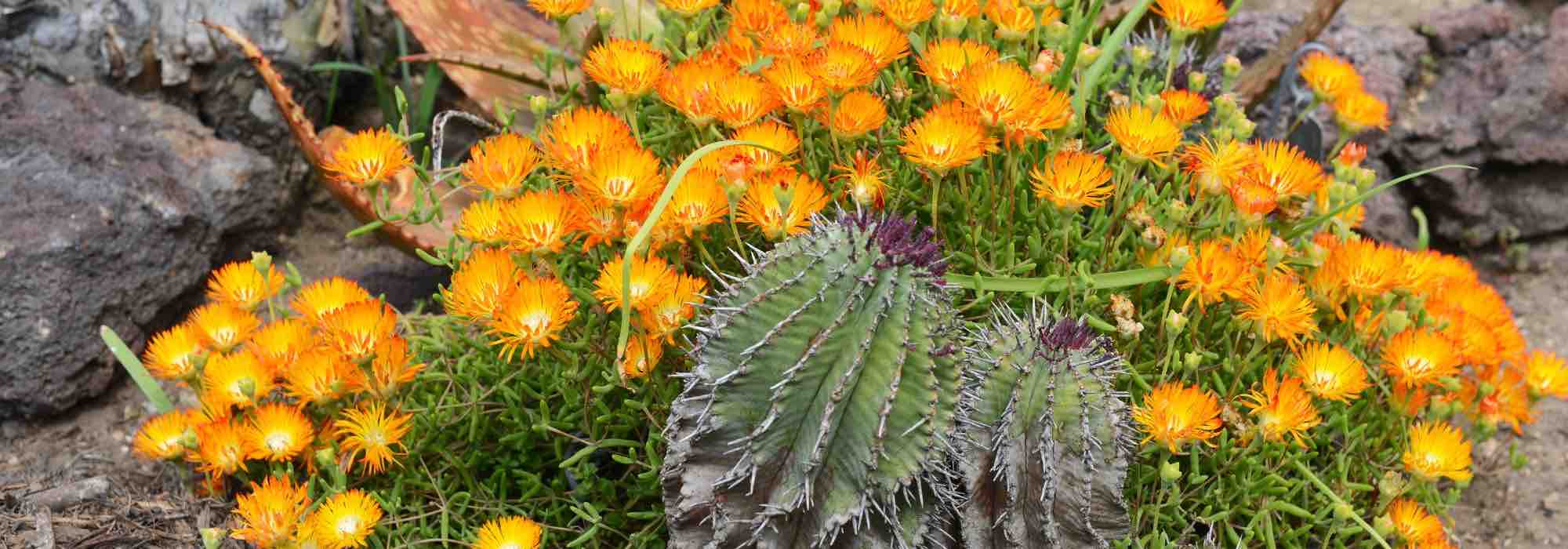
What are the differences between cacti and succulents?
How do you tell a cactus from a succulent plant?
Contents
Often confused or grouped together, cacti and succulent plants, also known as fleshy plants, are nature’s treasures adapted to the extremely harsh living conditions of arid environments. They share a common trait: a high resistance to water scarcity and drought, thanks to their fleshy leaves or stems, specially adapted to store water reserves. Accustomed to withstanding extreme heat, they have another shared trait: they require little watering, well-drained soil and plenty of sun. They are also often not very hardy and sensitive to frost. With a variety of shapes and sizes, they offer a charming diversity for anyone wishing to create an exotic desert-inspired garden. For further reading, discover what defines fleshy plants and cacti and what helps to distinguish them.

What are succulent plants, or fleshy plants?
- Succulent plants, often referred to as succulents, encompass a wide range of plants that share one characteristic: they can store water in their leaves, stems or roots. This capacity enables them to survive in arid environments where water is scarce. Succulent plants exhibit adaptations specific to these extreme conditions. They have thick, fleshy leaves, often small, with a waxy surface or covered in hair and a slow growth. Thanks to these characteristics, they minimise water loss by evaporation.
- Succulent plants, or fleshy plants, group together plants with the same characteristic, but with very diverse forms.
- Succulent plants comprise different botanical families.
For example, under the umbrella of “succulent plants” we group together:
– Crassulaceae such as the Kalanchoe or the Sedums
– the Aloe which form rosettes of evergreen, fleshy leaves such as the Aloe vera
– the Agavaceae such as the agaves or the yuccas
– the Aizoaceae or stone plants
– the Cactaceae or cacti
Cultivation and care of succulents are relatively straightforward: they require a well-drained, light substrate, moderate watering and a sunny position.
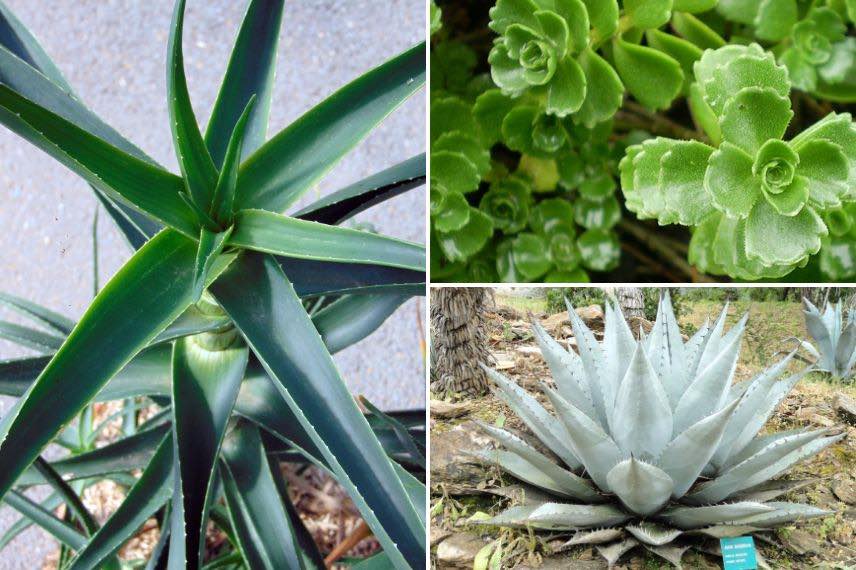
Aloe, Sedum and Agave share the trait of thick, fleshy leaves
What are cacti or cactuses?
- Demonstrating a strong resistance to drought and water shortage, thanks to their fleshy parts where they store water, cacti can be grouped under the category of “succulent plants,” as explained above.
- Cacti or cactuses also belong to the botanical family Cactaceae.
- The botanical family Cactaceae comprises cacti in a wide variety of forms. For example, they are distinguished: — Pad-shaped cacti, which resemble a rounded tennis racket, such as Opuntia, and which can be easily propagated from cuttings. — Columnar or candelabrum cacti, which rise like candles toward the sky, such as the Cereus forbesii ‘Spiralis’. — Ball-shaped or spherical cacti, such as the Mammilaria perbella evoking a small spiny cushion. — Flattened-stemmed cacti such as Christmas cacti.
What visually identifies cacti are the presence of spines as well as areoles—small cushions from which spines, leaves and flowers grow.
Côté culture et entretien, les cactus habitués à des conditions extrêmes ont, comme les plantes grasses, des besoins limités, à savoir un sol bien drainé et léger, une exposition au soleil et peu d’arrosage.
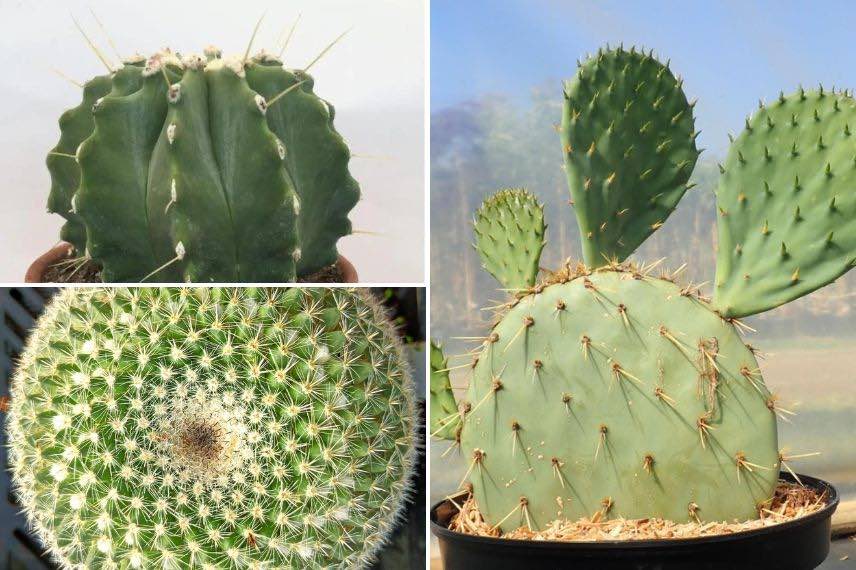
On the left, Ferocactus and Mammillaria, and on the right Opuntia, three cactus species
What is the difference between cacti and succulent plants?
- The main difference, which helps differentiate succulents from cacti, is the presence of thorns in cacti, whereas there are usually none in succulent plants. The thorns observed on cacti are, in fact, old leaves that have transformed, over the course of plant evolution, to reduce the surface area available for transpiration, to conserve water, to protect against animals wishing to eat them, or to create an insulating layer between the air, the sun and the leaf. Small exception: as there are always exceptions to prove the rule, one can still observe a few cacti without thorns, such as the Christmas cactus.
- Another distinction between cacti and succulents: areoles are present only on the former. An areole is a small outgrowth, resembling a tiny cushion, from which spines, hairs, flowers or leaves form. These are small rounded structures that are exclusive to cacti and help identify them easily.
- Another difference that can be noted between succulents and cacti is geographical distribution. Cacti are predominantly native to the American continent, whereas succulents originate from nearly all continents, with substantial diversity in Africa and the Americas.
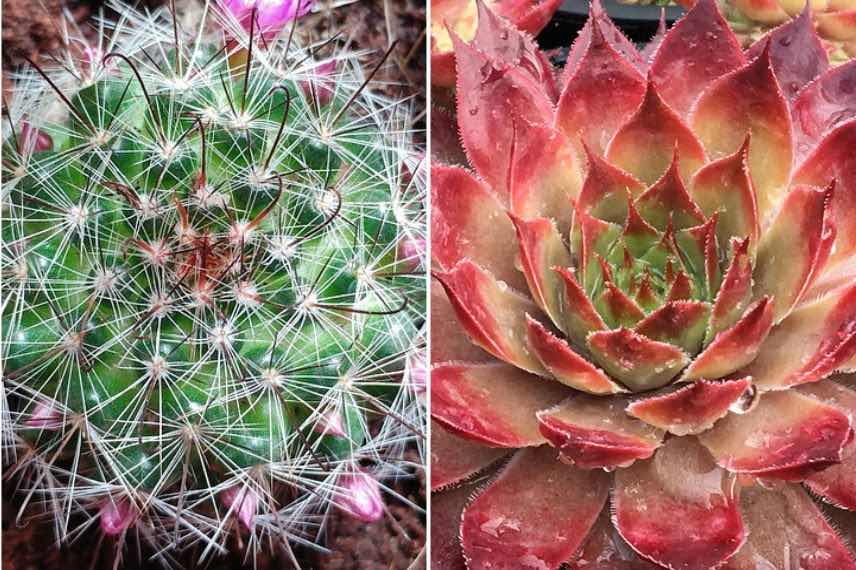
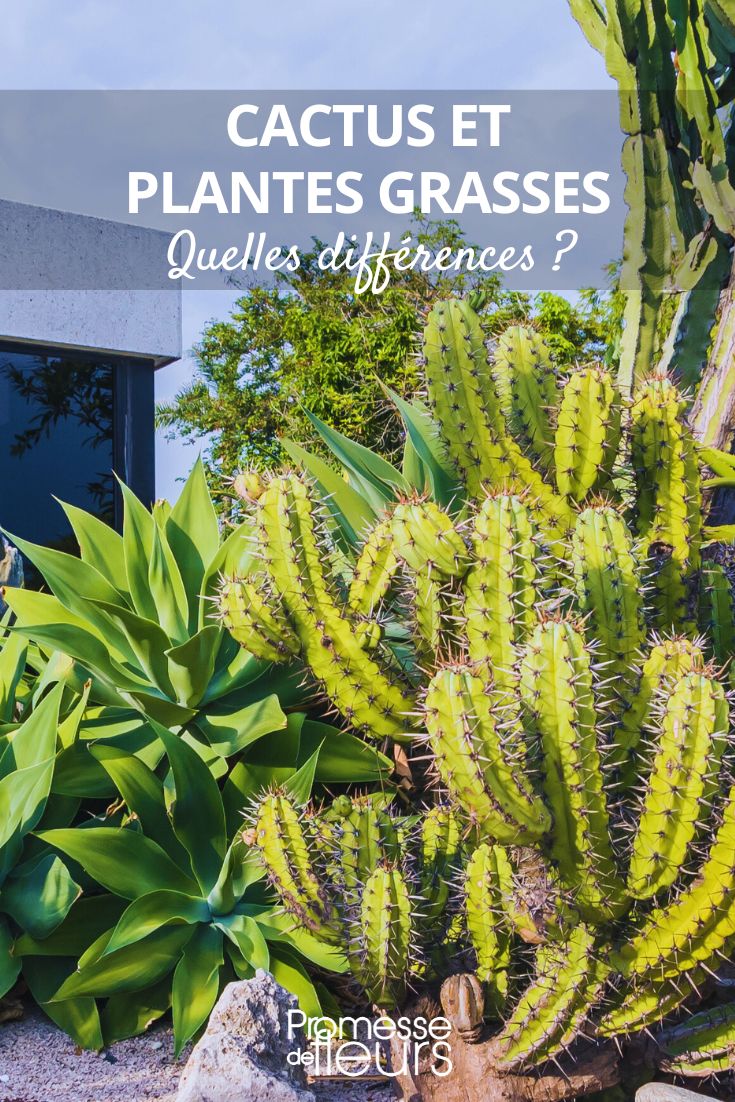
Cacti have thorns unlike succulents.
- Subscribe!
- Contents
Comments