





























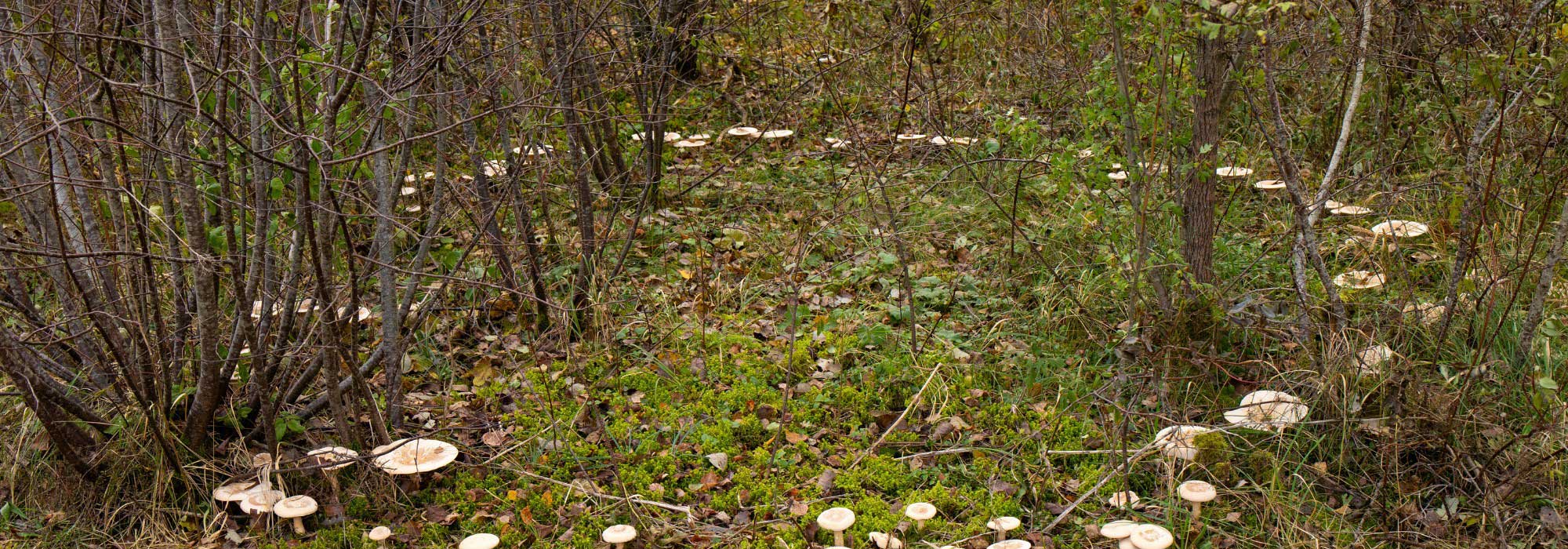
What is a fairy ring? Explanations, legends and mysteries
All about the mystery of 'fairy rings'!
Contents
While strolling in the woods or one morning on your lawn, you may already have noticed an enigmatic circle of mushrooms? The fairy ring, also known as witch or fairy circle, seems to appear out of nowhere, feeding into supernatural tales and mystical beliefs. But what exactly is a fairy circle? Why and how does this mysterious circle form? What happens if you break a fairy circle? And how can you get rid of it in the garden? Let’s explore what lies behind this intriguing natural phenomenon!

What is a fairy circle?
Fairy circle”, “witches’ circle”, “mushroom circle”, or also “faerie ring” — the number of appellations shows just how intriguing this phenomenon is when you tread on it in a forest or on a lawn. A fairy circle presents itself as a distinct circular zone where the vegetation in the centre appears weakened, yellowed, or sometimes even completely dry, contrasting starkly with the outer ring that surrounds it. This outer ring, clearly defined, is characterised by dense, green, and particularly lush grass, as if it were drawing vitality from a hidden source. An appearance that is both intriguing and somewhat otherworldly.
Sorry to burst the myth, but a fairy circle is really just a natural formation where fungi grow in a circle. In scientific jargon, In scientific jargon, people refer to “annular mycelia,” and they are nothing particularly mysterious. They result from the way the mycelium (the underground part of the fungus) through the soil. When a fungal spore germinates, it gives rise to a network of underground filaments (hyphae). These hyphae grow radially from the germination point, at the same speed in all directions, thereby creating an underground circle of mycelium deployed beneath your feet with mathematical precision.
It is only when these hyphae begin to fruit that the mushrooms appear, giving rise to these mysterious rings that have captivated the imagination for centuries. The withering of the lawn is explained by the mycelium gradually exhausting nutrients at the centre, which causes the mushrooms to stop growing there, while the edges continue to spread. The circle can vary in size, from a few centimetres to several hundred metres in diameter, growing over time, with its radius increasing by 5 to 40 cm per year.
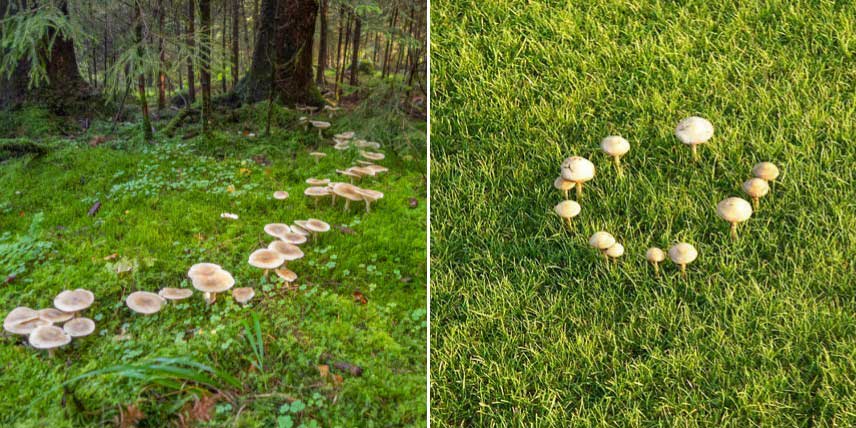
The size of fairy circles varies greatly
Read also
How to drain a lawn that is too wet?Where are fairy rings found?
Fairy circles are found mainly in meadows, pastures, forests and lawns where the conditions for fungal growth are ideal. They can be observed in woodlands, on well-kept lawns, or even in wilder areas. Soils rich in organic matter and moisture promote the formation of these circles. Some fairy circles measure nearly a kilometre in diameter. In the Belfort Forest, one of these tentacular circles spans a diameter of 600 metres. Large fairy circles are also found in North America, notably in the meadows of the United States and Canada, where some circles reach gigantic diameters.
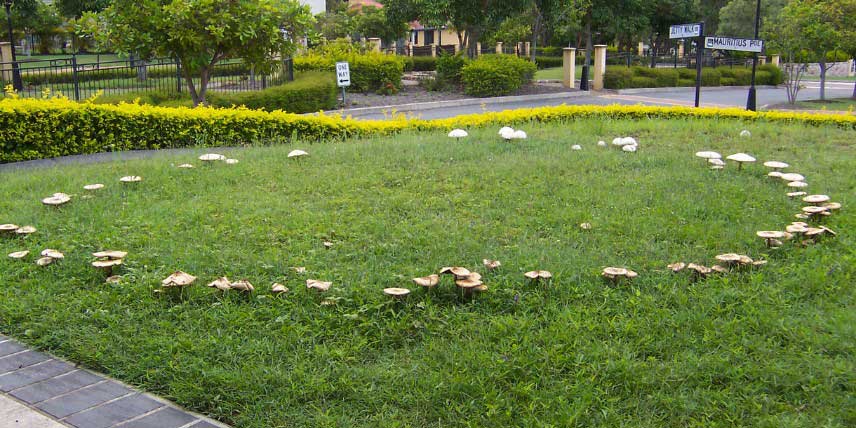
A large fairy circle in a city lawn
Which mushrooms on fairy circles?
Only certain cap-bearing mushrooms, belonging to the Basidiomycetes, are capable of forming fairy rings: species such as Marasmius oreades, also known as the “fairy mushroom” or “false mousseron”, Agaricus campestris (field mushroom), and Lycoperdon perlatum (pearl puffball) among others. These Basidiomycetes have the ability to form a mycelium that grows radially beneath the surface of the soil, thus creating the visible fairy rings. This phenomenon is unique to these mushrooms, as they require specific soil and nutrient conditions for their mycelium to spread in this circular manner. Exercise caution though! While most of these mushrooms are edible, fairy rings can also consist of toxic mushrooms such as Amanita.
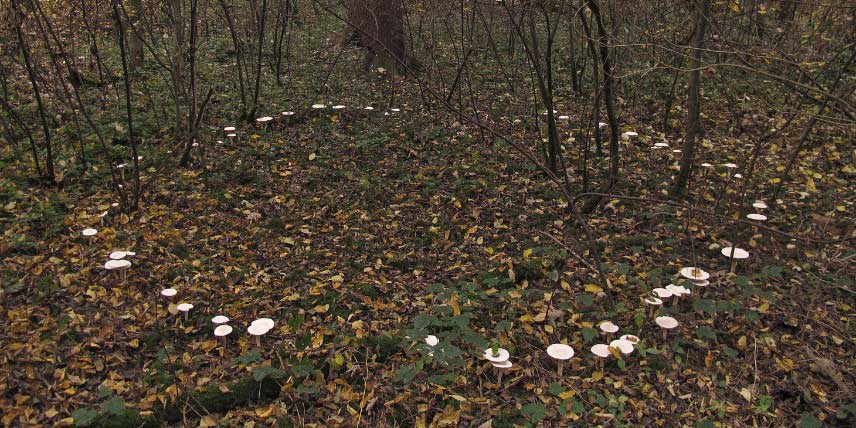
A fairy ring in the forest, formed by the monk’s head mushroom (Infundibulicybe geotropa)
Read also
How to renovate a lawn?What happens if you break a fairy circle?
In folklore, these circles were often associated with magic and warnings against supernatural dangers. According to belief, breaking a fairy circle is generally regarded as a risky, even dangerous, action. In the Middle Ages, these circles were interpreted as places where witches gathered to perform their nocturnal rituals, especially during Sabbats. It was seen as the trace of the witches’ dance or circle to conjure the demon, or that of fairies, Korrigans and pixies. Legends say that disturbing a fairy circle could provoke the anger of those who inhabit it, bringing curses, illnesses or misfortune to the one who dares to break this sacred space. Some tales even suggest that people who break a fairy circle could be carried away and condemned to wander in the supernatural world of genies and other fairy beings (even malevolent ones) for eternity. From a more pragmatic point of view, note that if you break a fairy circle, for example by disturbing the soil at its centre or by removing the mushrooms, this will not necessarily stop the growth process of the underlying mycelium: the mushrooms will relentlessly regrow, which adds even more to the superstition.
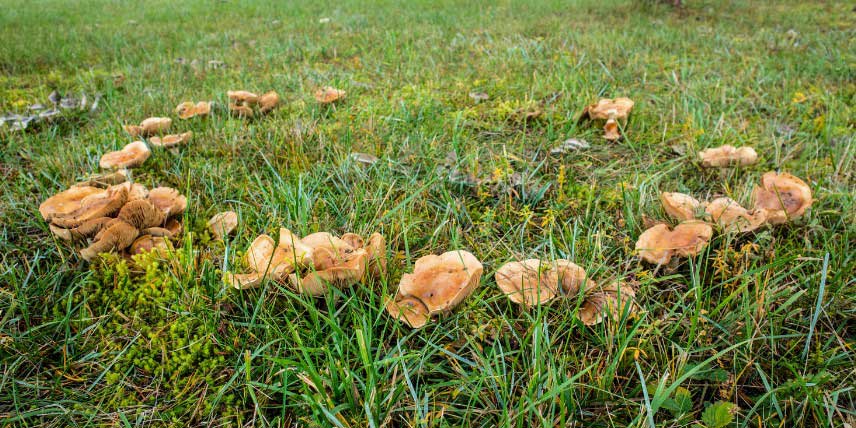
A fairy ring in a lawn
How to treat a fairy ring in your lawn?
Once established, it is very difficult to control this fungus that can become the gardener’s worst nightmare. These rings may indicate poor soil or drainage problems. It is therefore advisable to monitor the health of your lawn. To try to get rid of a fairy ring, it is possible to aerate the soil with a fork, fertilise the soil with potting compost, reseed the damaged areas with a lawn reseeding mix or, in some cases, to remove the mycelium by digging deeply, provided you are not superstitious!
- Subscribe!
- Contents
Comments