





























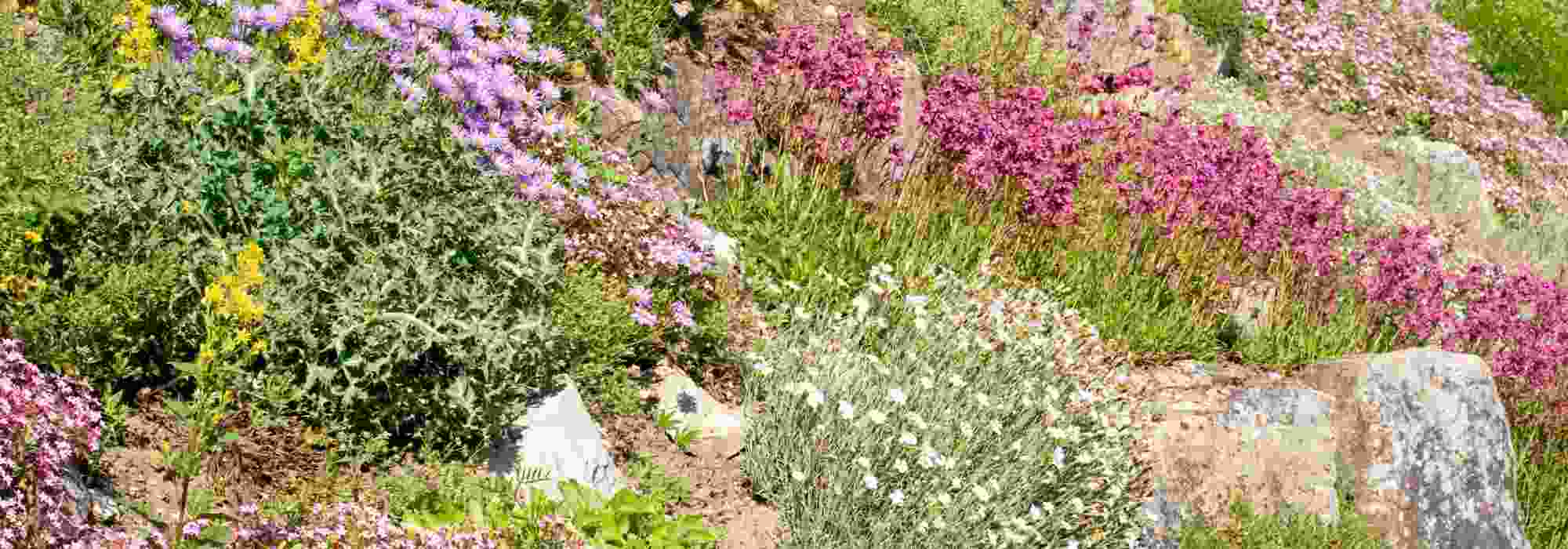
What landscaping ideas can enhance a sloping site?
Our ideas and tips for a vibrant, plant-filled, colourful garden
Contents
For many, a sloping site is seen as an obstacle, a problem, or a difficulty… For others, it can be a genuine opportunity to create a garden that is unique and dynamic, with original, multi-level spaces. Indeed, with a touch of imagination, a dash of creativity, and a lot of effort, you can play with levels, curves and perspectives to soften the slope. Likewise, using a variety of materials and planting suitable vegetation allows you to transform this steep bank, at first glance inhospitable, into an aesthetically pleasing and easy-to-maintain garden.
Discover all our tips and tricks for turning this steeply sloping terrain into a space that is both visually appealing and easy to maintain.

The challenges of a steeply sloping site
Before undertaking any landscaping, it is essential to analyse and take into account the specifics of your steeply sloping site. Indeed, this consideration of the site’s advantages and disadvantages will help you choose the best solutions.
The main issue with sloping terrain is erosion. When it rains, water runs off very quickly, taking soil, various soil particles and nutrients with it. Moreover, this runoff water does not have time to infiltrate the soil to benefit the plants’ root systems. It is therefore essential to manage drainage effectively to prevent rainwater runoff. This is why installing channels, drains or pipes can help to direct rainwater away from sensitive areas. Likewise, planting certain groundcover plants can play a role in stabilising the soil. These plants form a carpet of vegetation that protects the soil from runoff and promotes water infiltration. But we will come back to this in a subsequent paragraph.
To design a slope layout most effectively, it is also essential to know the soil type and the slope angle. It is obvious that clay soil will have different constraints from sandy soil, particularly in terms of drainage and stability. To determine the soil type, there are tests to perform a professional soil analysis to identify its physical (texture) and chemical (acidity, presence of nutrients) characteristics. Olivier also explains a few tips in his text: conducting a soil analysis: why and how?. Do not neglect the orientation of the slope either. You do not plant the same plants in a sloping garden in full sun or in complete shade.
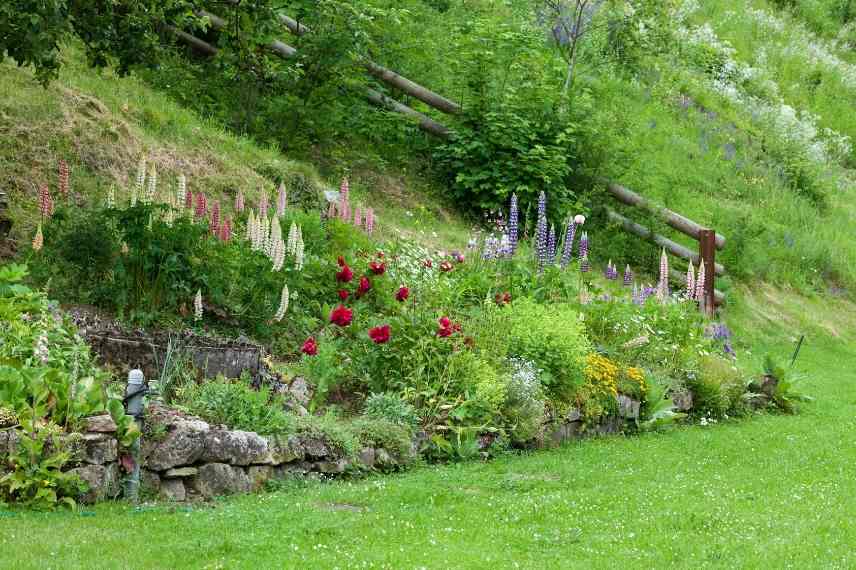
The main difficulties of sloping sites are erosion and water runoff
It is also very important to estimate the slope degree in order to plan the best layouts to prevent erosion or any landslip. Depending on the slope percentage, you will need to identify the most suitable retaining solutions.
Also consider access to the different zones of this garden laid out on a steep slope. Not to mention maintenance. Planting a lawn seems out of the question, as mowing is difficult, if not impossible. Nevertheless, you should not neglect watering or pruning.
Once all these notions have been addressed and analysed, it is essential to draw a schematic diagram or plan to visualise the project as a whole and to define the different zones. Nevertheless, even if this project seems labour-intensive and full of obstacles and difficulties, never forget that a sloping site with its varying perspectives can create a dynamic and original garden. Finally, this sloping site offers you unique viewpoints of the surrounding landscape.
Read also
How to landscape a sloping garden?Softening the slope with suitable landscaping
On a steeply sloping site, rill erosion and surface runoff from rainfall are pronounced. Erosion is at its maximum, cracks and holes can form quickly. Water does not penetrate the soil, carrying away fertilisers. It is therefore essential to landscape this site to make cultivation possible. And the best solution remains terracing or landings that create flat spaces of varying sizes. These flat surfaces are inevitably easier to landscape or use, while facilitating water drainage.
To construct these terraces or landings, there are various methods. Depending on your abilities, you can always enlist a professional to implement these techniques. Indeed, some require knowledge and a certain level of skill, others substantial physical effort. Observing ancient techniques such as dry-stone terraces in the South can be a source of inspiration.
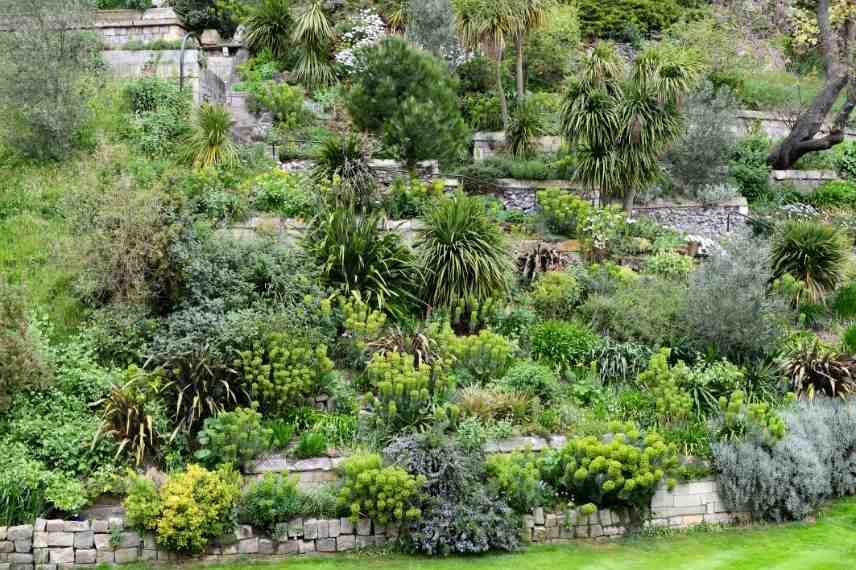
Terracing or landings help to reduce the slope
- Dry-stone walls are ideal in rustic or Mediterranean gardens. This is an ancient structure, inspired by restanques, which has the advantage of being natural, very durable and highly permeable. This technique involves carefully stacking stones that are more or less flat, without adding mortar or binder such as cement. The dry-stone wall is very interesting, as it is flexible, able to withstand movement of the soil, frost or thaw in the coldest regions, without cracking. The shape, size and placement of the stones are carefully chosen to ensure the stability of the structure. Generally, to build these dry-stone walls, local rocks—calcareous, granitic or schistose—are chosen to blend with the landscape, but also to ease sourcing.
- Wooden terraces can be a solution for more modern gardens or smaller spaces. However, these structures have a shorter lifespan, especially in the presence of moisture. That said, if you choose this timber-based solution using logs, boards, planks or battens, you should select timber species such as oak or chestnut, or exotic woods, which are stronger and denser than pine. To increase the life of the timber, it is advisable to add a rot-proof felt before backfilling.
- The option of a concrete retaining wall is feasible, but you can also opt for gabions, these wire cages filled with stones. It is a very trendy solution for effectively stabilising the soil on sloping ground while ensuring natural drainage. It is also a durable, eco-friendly and environmentally sustainable, aesthetically pleasing, modular and fairly easy to install technique.
Imagine access points or pathways
A steeply sloping site requires consideration of functional pathways to facilitate movement and access to the different areas of the garden. Stone, wood or metal stairs can be installed to connect the different terraces and ensure smooth circulation. It is important to choose the location of the stairs carefully, depending on how each space will be used, and on the slope.
Paths can also be laid out using paving slabs, gravel or stepping stones, depending on the aesthetic you wish to give your garden. It is essential that these paths are well-drained to avoid any water pooling and to ensure their durability.
Read also
Which mulch for a slope or sloping bed?Incorporate decorative natural elements to stabilise the slope
To structure the space and, where appropriate, help stabilise the slope, it is also feasible to incorporate natural elements into the slope. These natural elements will not only enhance the terrain but also work with the topography and follow the slope. Among these decorative elements, rockeries and stones can be added to enhance the space. Choose them carefully and preferably from the same material to create a sense of unity. Depending on the region you live in, you can select stones such as sandstone, limestone… The look must stay natural, so the stones should be laid randomly, not too artificial or overly aligned. To anchor these stones in the slope, at least a third of their volume should be buried. The largest rocks should be placed at the bottom, the lighter ones at the top.
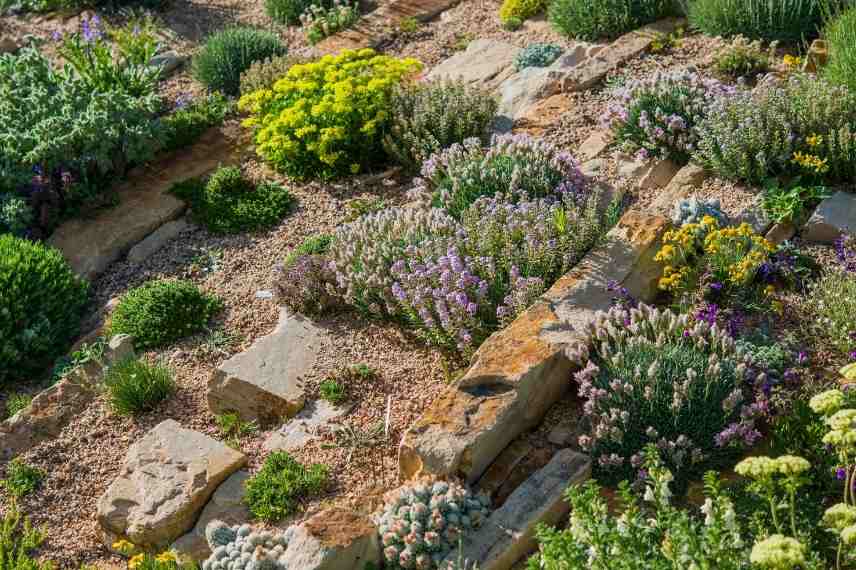
Local stones can be incorporated to support slopes on steep terrain
Another way to make steep slopes very attractive is to install water features such as cascades or artificial streams that follow the terrain’s gradient. These water features bring a touch of freshness while creating a pleasant visual and sound effect. These installations can be enhanced with pebbles or aquatic plants. Installing such features requires careful planning and the purchase of pumps or basins. Subtle lighting can also highlight a slope.
Selecting the best plants
On a steep slope, the choice of plants is crucial to stabilise the soil while creating an attractive effect. As one would expect, we will choose ground-cover plants whose root system holds the soil and limits erosion. But some shrubs or grasses also adapt very well to planting on a slope.
Our planting suggestions :
- Sun-loving ground-cover plants: the ivy (Hedera), the thyme, the phlox, the campanula, the hardy geraniums, the delosperma, the sedum, the ‘aubrieta, the nepeta, the mouse-ear (Cerastium), the bear’s ear (Stachys), the nodular verbena (Lippio nodiflora), the creeping bugle (Ajuga reptans), the sea thrift (Armeria maritima), the ‘ground-cover yarrow (Achillea crithmifolia), the silver basket (Arabis), the vergerette (Erigeron)…
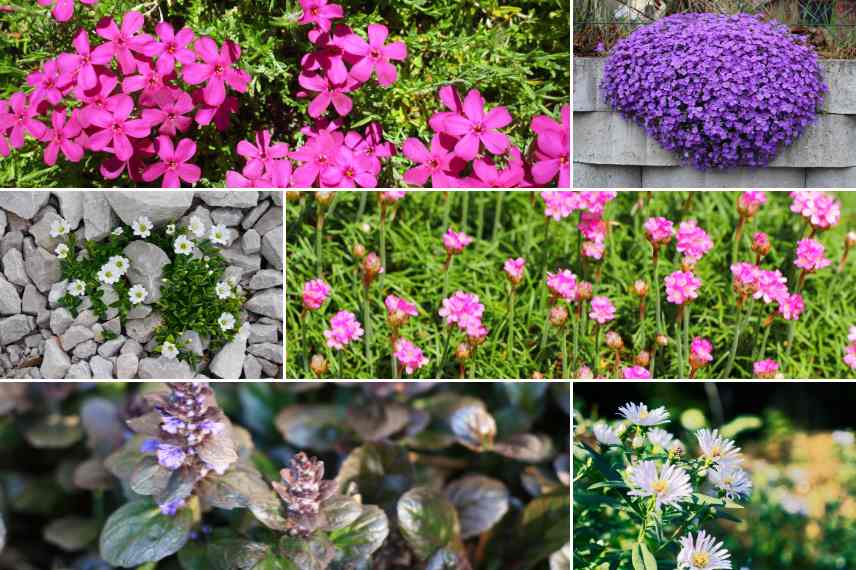
Some ground-cover perennials perfect for steep slopes
- Ground-cover plants for partial shade or shade: the Irish moss (Sagina subulata), the Helxine, the Hosta, the periwinkle, the pulmonaria, the heuchera…
- The grasses: the blue fescue, the carex…
- Shrubs: the lavender, the ground-cover roses, the bushy honeysuckle (Lonicera nitida), the creeping cotoneaster, the creeping juniper (Juniperus horizontalis)…
- Subscribe!
- Contents
Comments