





























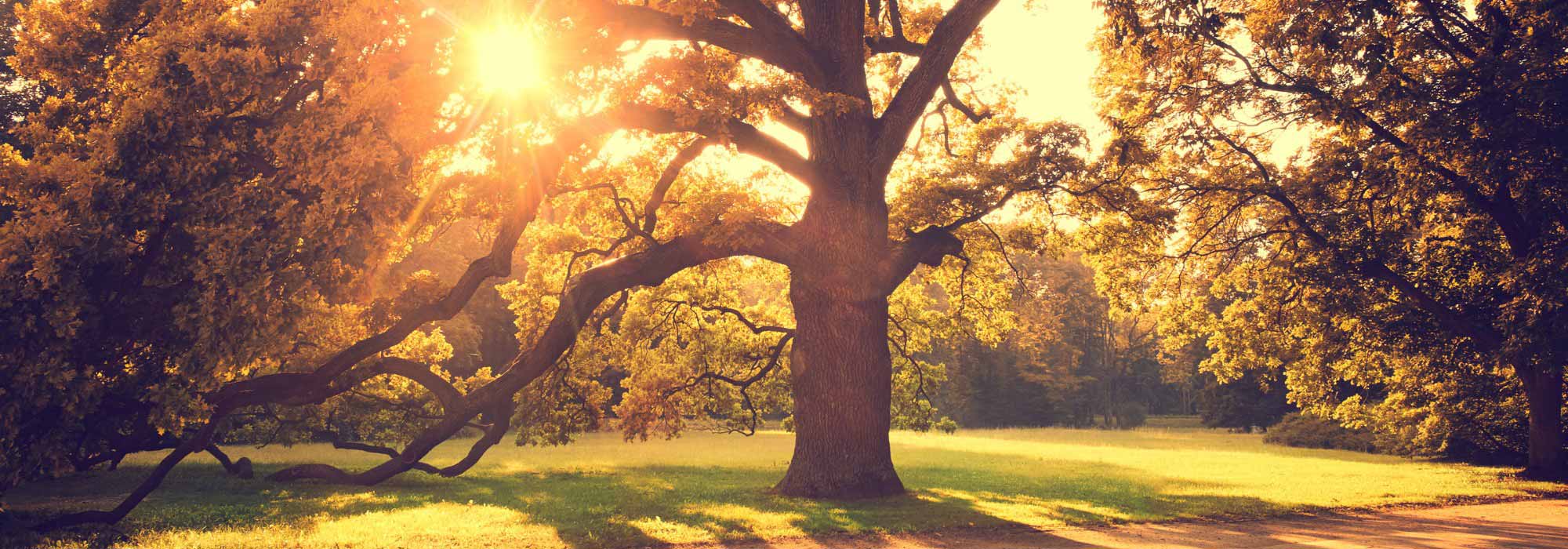
What should you do with old trees in the garden?
How to care for them and when should they be cut down?
Contents
Old trees play a special role in our gardens and deserve particular attention, especially as they begin to show signs of senescence. While some trees have very long lifespans, they are not eternal and can sometimes show fragility, such as branches breaking, cavities forming in the trunk, or diseases appearing. They often have a majestic silhouette and are valuable both for their aesthetics and for the garden’s biodiversity. Yet, when a tree ages, certain questions arise: should we keep it and how to protect it, should it be felled, or perhaps transformed to give it a second life? Discover all our tips on how to look after them and decide what to do with them.

What is an old tree?
It is generally considered that a tree is old when it reaches ripeness or the advanced age specific to its species. For a tree, ageing depends largely on the species and growth conditions. For example, a poplar, which has an average lifespan of 80 to 100 years, will be considered old long before an oak, whose lifespan can reach several centuries. In France, it is estimated that a tree begins to be ‘old’ around half of its natural life expectancy. A beech, for example, is deemed old at around 150 years, while a fruit tree such as the apple tree can be deemed old at 50 years. Signs of ageing in a tree include dead branches, a hollow or weakened trunk, less dense foliage and a general weakening of the structure. These signs are not necessarily indicators of decline; they can also indicate that the tree is entering a new growth phase that is slower yet still vigorous.
Why keep an old tree in your garden?
In a garden, old trees provide more than shade. Their presence contributes to a balanced ecosystem, and their value goes far beyond aesthetics. Here are a few reasons why it can be advantageous to preserve them.
A refugium for biodiversity
An old tree provides an ideal habitat for many species. The cavities in the trunk and in the branches are refugia for birds, bats, and squirrels, and some insects. By preserving an old tree, you foster an environment where different animal species coexist, thus contributing to the biodiversity of your garden. Old trees also attract bees, butterflies, and other pollinators, which helps the plants in the garden to grow healthily. Moreover, the trunks of old trees are often colonised by ivy, which itself plays a very important ecological role. It attracts insects such as wild bees or hoverflies, and is appreciated by many birds that feed on its berries or nest there (blackbirds, blue tits, thrushes, goldcrests…).
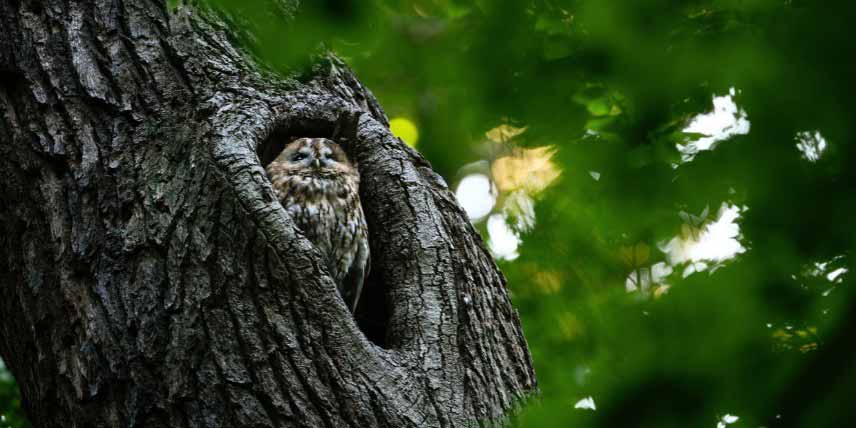
Old trees are precious for biodiversity. When their trunks form cavities, these cavities can shelter certain animals, such as an owl here.
A natural microclimate
Large trees create microclimates by shielding the soil from direct sunlight and by maintaining a certain level of humidity. Their dense foliage and branches shelter other plants, while protecting growing areas from strong winds. The presence of a mature tree helps regulate temperatures, providing coolness in summer and a touch of protection against the cold in winter.
A source of beauty and history
With their majestic silhouette, shaped by the years, old trees are irreplaceable aesthetic features in the garden. They sometimes form a gnarled trunk and a particularly imposing canopy. A tree that has grown for decades, even centuries, has a look that is incomparable to young trees freshly planted. Moreover, an ancient tree may carry significant sentimental or historic value: it is a natural element that can be passed down through generations and evoke particular memories. Preserving it, therefore, represents more than a mere aesthetic choice.
A carbon stock
Trees play a key role in capturing carbon. Old trees, in particular, have stored substantial amounts of carbon in their trunks, branches and roots, helping to combat climate warming. Keeping them therefore contributes to an ecological endeavour, as a mature tree continues to absorb carbon dioxide even as it ages, as long as it is alive and healthy.
A potential support for climbing plants
Old trees are sometimes bare at the base or have dead branches or limbs, and a beautiful way to showcase them is to grow climbing plants on them. The tree will then take on a new aesthetic dimension, adorned for example with flowers in the warmer months, or dressed in the foliage of an evergreen climbing plant during the winter months. Feel free to plant at their bases climbing clematis, honeysuckles, Akebia, climbing hydrangeas, or climbing roses. Discover our advice sheet “8 climbing plants to dress a tree”
How to preserve it?
Preserving an old tree requires some specific care and regular attention. Here are a few techniques to ensure its longevity:
Protecting the roots
The roots of old trees become fragile with time. It is therefore essential not to tread on or compact the soil around the tree. Avoid allowing heavy machinery to pass over it or installing permanent structures, such as terraces. Roots need oxygen to function properly, so keeping the soil well-drained is essential. You can also mulch the base of the tree to retain moisture and protect the roots from temperature fluctuations.
Guying: to support fragile branches
Guying is a technique that involves installing cables or stays to support the heaviest and most fragile branches. This helps limit the risk of breakage, especially in strong winds, and to keep the tree in a balanced structure. Guying is particularly useful for large trees, where some branches show signs of weakness.
It is also possible to install wooden or metal posts to support sagging branches. However, if some branches are truly unbalanced or weakened, it may be wise to prune them.
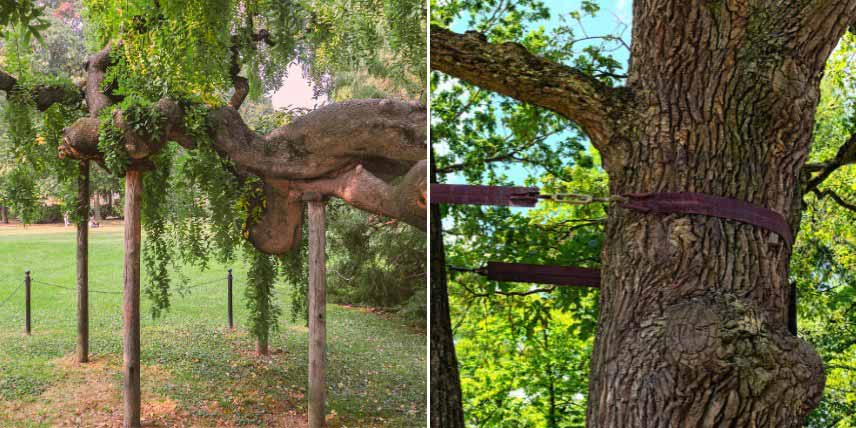
Old trees may sometimes require guying, stakes or straps to support their branches
Should you prune an old tree?
Pruning old trees should be done with care. Avoid severe pruning, as it can weaken the tree and leave it open to diseases and pests. A light thinning of the canopy can, however, be beneficial to remove dead or diseased branches, improve air circulation, and reduce the tree’s overall weight. Remember to disinfect pruning tools and to apply wound sealant on the wounds to limit the risk of diseases. For the larger trees, don’t hesitate to call in a professional arborist.
For trees trained as pollards (pollarded trees) or in cathead form, as is sometimes the case for willows or plane trees, it is preferable to continue pruning in the same manner, by cutting new shoots at the base, flush with the pollards.
Monitoring the health of the tree
Regularly inspecting your tree helps identify signs of disease or infestation. Some common pathologies in old trees, such as wood rot, can be treated if detected early. Also monitor for wood-decaying fungi, which can indicate advanced decay. A professional can then assess the structure and advise on the measures to take.
When you intervene, avoid injuring the tree and remember to treat its wounds with wound sealant to minimise disease risk.
If you notice a cavity in the trunk, do not seal it. Some trees can live very long despite cavities in the trunk (oak, olive trees, lime trees…), and these cavities are valuable for many animals. Birds such as woodpeckers or great tits, and even the little owl (Athene noctua), may nest there, as do squirrels, bats, dormice… For more information, see our advice sheet: “Hollow tree: what to do and should you intervene ?”
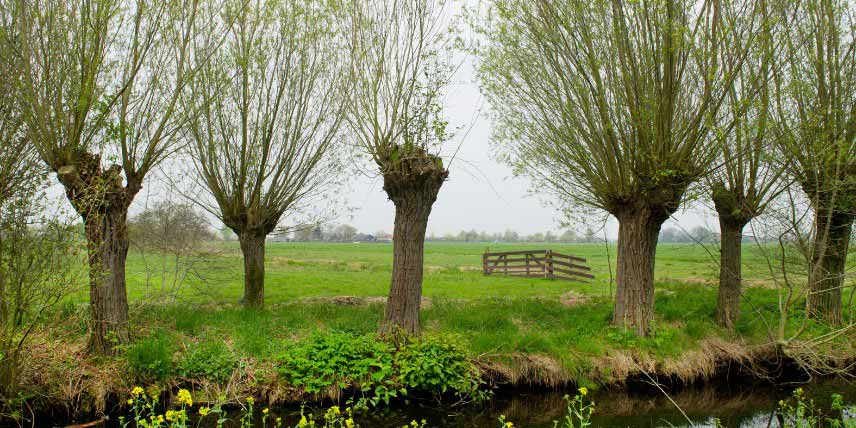
When trees have been trained as pollards, it’s better to continue pruning in the same way, as here with pollarded willows.
In what circumstances should you fell an old tree?
Despite all preservation efforts, felling may be the most reasonable solution for safety, health or landscape reasons. This decision, however, should not be taken lightly. Here are the main situations in which felling an old tree is recommended:
When the tree is diseased or infested
Old trees can be attacked by fungi, pests or diseases that weaken their structure. A rotten trunk, cracked bark or dead branches are signs of weakness that may indicate progressive deterioration of the tree. If branches threaten to fall or if the tree threatens to collapse, it becomes necessary to cut it down. In some cases, it is possible to treat the tree by calling in an arborist, to care for it or to reinforce its weakened parts with guy-wires or cables. However, when the tree is too badly damaged, felling it remains the best solution to prevent the spread of diseases.
In case of danger to people and property
If an old tree stands close to a house, a fence, or a path, it may pose a danger to people and property. Heavy, weakened branches can fall in windy conditions or during heavy rain, causing property damage or injuries. In these situations, it is often best to fell the tree, especially if its stability cannot be guaranteed. Having the tree inspected by a professional will help you assess the risk and determine whether it can be safely retained.
Similarly, a dead tree can remain in place for some time, but it eventually becomes a source of danger due to its fragility. If the tree has not had foliage for several seasons and is starting to deteriorate, it is often safer to fell it. This also helps prevent it from becoming a breeding ground for harmful parasites, which could attack neighbouring trees.
When it blocks the garden’s layout or development
A tree that has grown without constraints can end up occupying a large space, making it difficult to plan other elements in the garden. If its roots take up too much space or interfere with infrastructure (pipes, paths, etc.), it may be necessary to remove it. However, in this case, felling should only be considered after examining possible alternatives, such as pruning certain branches.
Check local legislation before felling an old tree
Some trees are protected: for example the Mugho pine, Fontainebleau service-tree, cork oak or carob tree. If your tree is protected, it will be listed in your local Plan (PLU) and you will need to obtain authorisation from the local council to fell it.
Similarly, if the trunk of the tree measures at least 70 cm in circumference and 1.50 m in height, it is necessary to obtain authorisation from the local council, unless it is dead, blown over by the wind, or poses a danger. Be sure to check in advance before cutting the tree.
How can you give a dead tree a new lease of life?
If you need to fell an old tree, or if parts of it are dead, you can reuse its wood in many ways, giving it a second life in the garden:
- Make it into a sculpture. If you are inspired, old trunks can be carved or transformed into totems and garden artworks. You can also hire a professional sculptor to create a sculpture that will lend a unique character to your garden. This natural decoration will add an artistic touch while keeping a part of the tree as a memory.
- Transform the tree into a bench or garden furniture. The trunks and large limbs of old trees can be cut up and transformed into benches, tables or rustic stools for the garden. A simple trunk cut in two can become a natural bench, perfect for creating a relaxing corner in the garden. This eco-friendly furniture preserves the authentic look of the wood while being practical and durable. You can easily make a stool from the tree’s stump.
- Use it as a support for climbing plants. A dead trunk can become an excellent support for climbing plants such as honeysuckle, ivy, or climbing roses. As they wind around the trunk, these plants will bring it back to life, covering it with foliage and flowers. This kind of transformation is both practical and aesthetic, as it integrates the tree into a new living environment.
- Old trunks and branches can also serve as a structure for creating an insect hotel. By drilling into the wood and adding materials such as twigs, straw, or pieces of bark, you can attract solitary bees, ladybirds and other beneficial garden insects. An insect hotel encourages biodiversity while providing a habitat for pollinators.
Finally, if the tree must be felled, a lovely way to commemorate it is to plant a new tree nearby. Choose a species suited to the climate and available space, and prepare the soil well. This symbolic gesture preserves the memory of the old tree while offering renewal for the garden.
- Subscribe!
- Contents
Comments