





























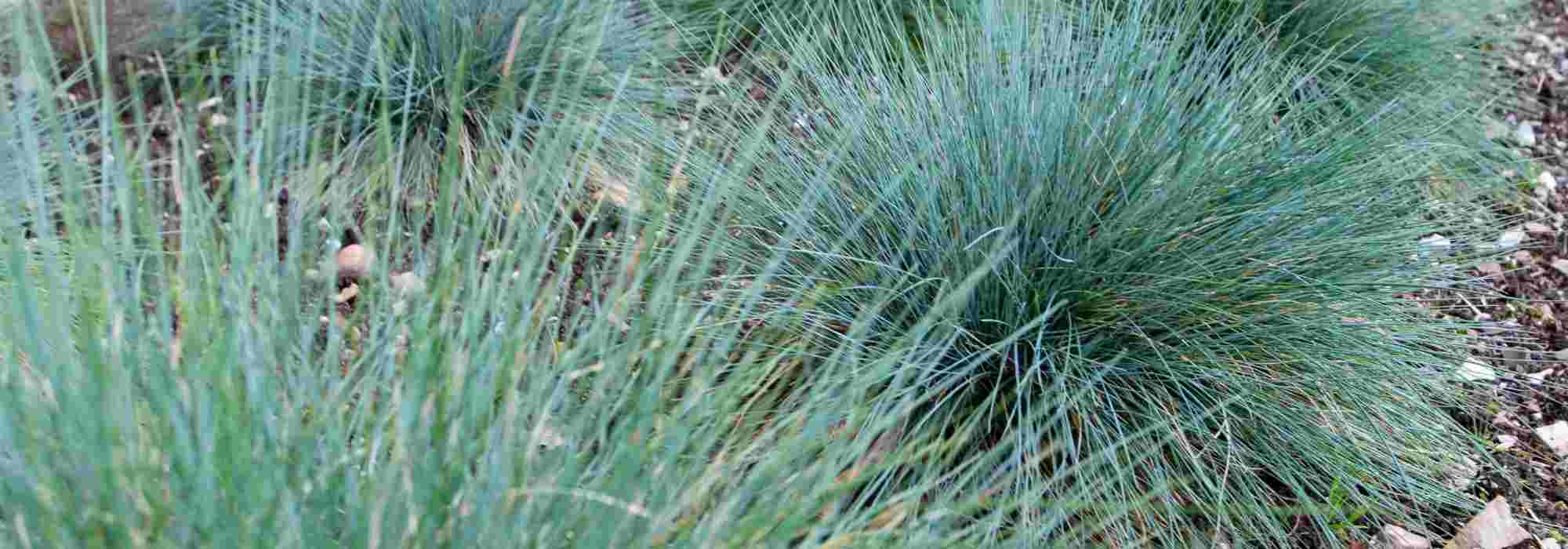
Which grasses to plant in a small garden?
Selection of small grasses with a compact habit for small spaces
Contents
Having a small garden is no curse. On the contrary. That said, you should focus on selecting plants that are striking thanks to distinctive foliage or original and rewarding flowering, durable and evergreen, easy to grow and that do not require intensive maintenance. Likewise, it is important to favour plants that provide display all year round. To this end, grasses can be ideal candidates. Provided you choose them with full awareness of their future growth.
Discover our selection of grasses, light and dense, with distinctive foliage and/or ornamental flowering, ideal for planting a modestly sized garden.

Why are ornamental grasses perfect for a small garden?
With the richness of their foliage, often evolving through the seasons, punctuated by varied colours, sometimes variegated or margined with lighter tones, grasses have their place in a small garden, in town or in the countryside. Typically endowed with late-summer or autumn flowering, at a time when all other perennials bow out, grasses help to enliven the seasons that are less attractive. In winter, the flowering spikes, haloed with frost, bring touches of poetry to soften the cold. In autumn and winter, they also add depth to the garden and give it structure.
These grasses have their place in small gardens due to their lightness, their elegance and their graphic presence. At the slightest breeze, they move with delicate motion.
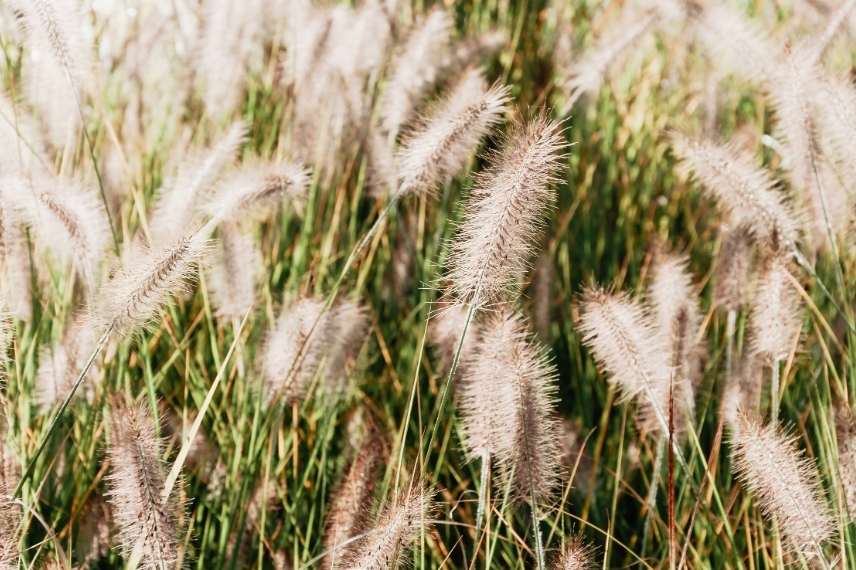
Grasses have their place in small gardens (Here Pennisetum alopecuroides)
To these advantages, one can add the fact that most grasses adapt to tough growing conditions, to dry and poor soils, to scorching sun, or to dense shade. Without demanding extensive maintenance.
Finally, only the wide range of grass species and varieties may complicate life. But you are sure to find the grass or grasses perfect for decorating and enlivening your pocket garden.
Our selection of 10 grass species that are ideal for a small garden
In a small garden where space is inevitably limited, you will need to select grasses with a compact and dense habit, a fairly narrow silhouette and a limited height. Their growth must therefore be restricted. Nevertheless, you can easily find species or varieties that will let you play with delicate flowering or with foliage whose texture and/or colour is ornamental.
Among these grasses, all the short grasses are suitable for planting in a small garden. Among them, it is hard to overlook the various species of Carex, of fescue (Festuca) and of Pennisetum that we invite you to discover without restraint. However, to add a little variety, we have decided to present grasses a little less common than the previous ones, but oh so interesting for pocket-sized gardens. Discover our selection of twelve grass species ideal for small gardens.
Bouteloua gracilis
Bouteloua gracilis is a pretty little grass that forms a very dense habit, for compact dimensions. It reaches 30 cm in spread with a maximum height of 40 cm. Yet it makes its presence felt without any timidity. Indeed, this herbaceous plant forms dense clumps of slender, long leaves, relatively rough, green with bluish-grey tints in spring, golden in summer and bronze-brown in autumn. Beyond this foliage, this grass is distinguished by its unusual inflorescences that appear from July to September. The panicles, comb-shaped, grow almost horizontally. They change colour over the months, shifting from pinkish-red to straw-yellow. They endure through winter.
Very tolerant of air pollution or sea spray, this grass is planted in full sun in well-drained, dry soil.
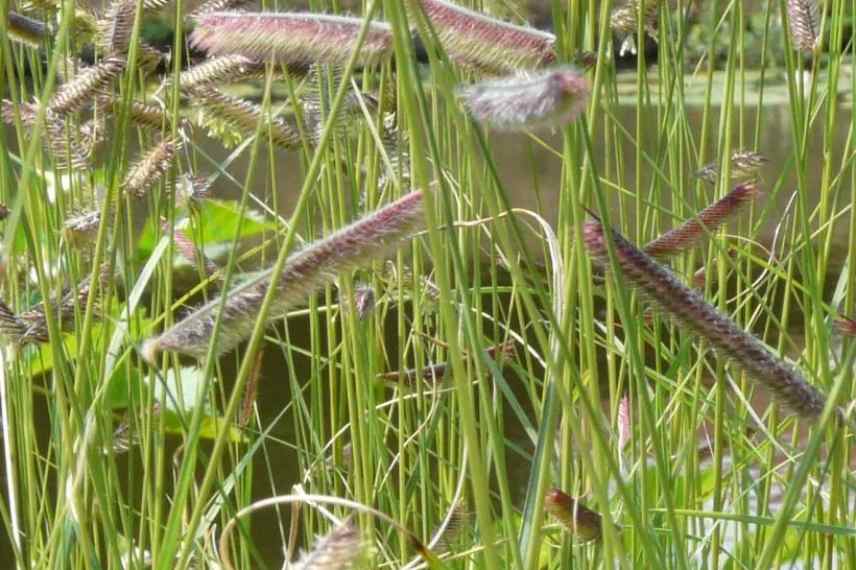
Bouteloua gracilis
Briza media
Briza media is a charming small grass of great lightness that sways at the slightest breeze. It is especially notable for its pretty heart-shaped inflorescences that sway with the wind, imparting gentle sounds to the ears of attentive gardeners. These ears move from green to purple to straw. It forms a dense tuft reaching 45 cm in width and 55 cm in height. Its foliage is rather blue-green, edged with silky hairs. This grass thrives in ordinary, well-drained soil, which can be dry, stony or even calcareous. It adapts to sun as well as to light shade.
The variety ‘Zitterzebra’ offers green foliage edged with white whereas the variety ‘Limouzi’ focuses more on the size of the spikelets, markedly larger than those of the type species.
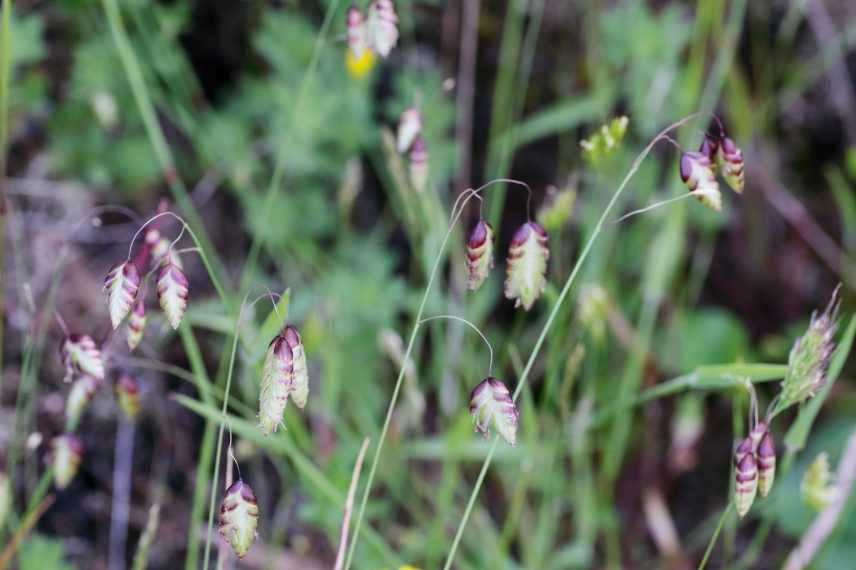
Briza media
Ophiopogon
Certainly, the Ophiopogon is not a true grass, but a perennial that poses as a grass, often called snake’s-beard. There are many species and varieties that never exceed 30 cm in spread and 20 to 25 cm in height. All form ground-covering mats with a dense, compact habit and evergreen foliage, making them decorative all year round. These grasses offer green to almost black foliage, and small bell-shaped flowers in the heart of summer.
For lovers of very dark foliage, the Ophiopogon planiscapus ‘Nigrescens’ and ‘Black Dragon’ are essentials in a small garden.
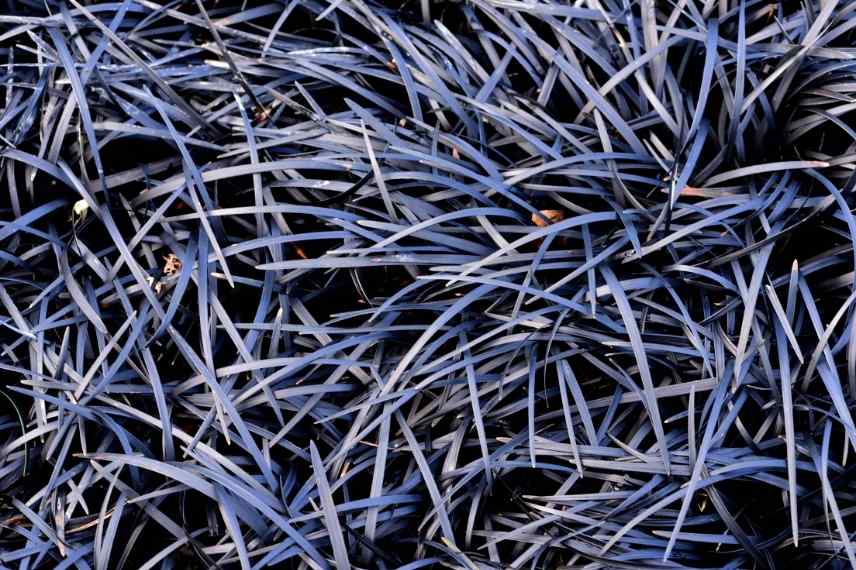
L’Ophiopogon ‘Nigrescens’
Koeleria glauca
Koeleria glauca is a grass, about 30 cm wide and 35 cm tall, with blue-grey foliage, forming a neat, round and dense cushion. Its evergreen foliage keeps it present all year round. In June and July, flower stems topped with fine, light panicles, consisting of silvery-green spikelets that fade to camel-colour as they age.
Very hardy, blue koeleria prefers light, well-drained and rather poor soils. It especially enjoys calcareous soils and full sun.
Anthoxanthum odoratum
Anthoxanthum odoratum is a grass quite common in our meadows. Nevertheless, it deserves a place in gardens with its tuft of slender upright leaves and its straight green flower spikes. Beyond these virtues, as its Latin name suggests, this grass exudes a pleasant hay scent. Known as sweet vernal grass or buffalo grass, this grass persists through winter, all yellow straw-colour in winter. It can reach 40 cm in width and 20 cm in height.
This grass thrives particularly in acidic soil, but dislikes calcareous soils. It will need a fairly poor, well-drained, light soil and full sun.
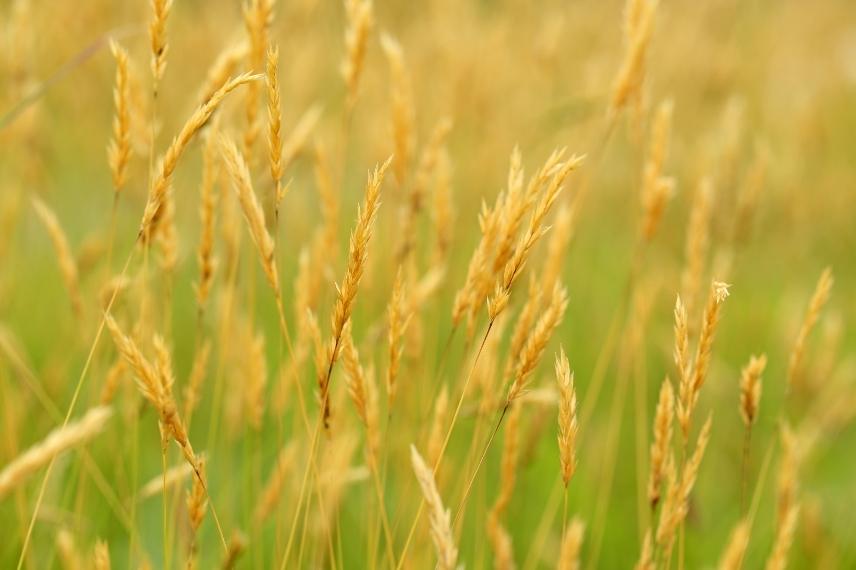
L’Anthoxanthum odoratum
Elymus magellanicus
The Elymus magellanicus, more simply named Agropyron, is a grass with magnificent blue-steel to electric blue foliage that lasts all year round. It is certainly the grass with the most intense blue foliage of them all. At maturity, it reaches 40 cm in width and 60 cm in height. Its leaves are stiff and linear, flat and narrow. In summer, it is topped with panicles as blue as the leaves.
This grass must be planted in dry, well-drained soil in full sun. Without these cultural conditions, it easily withers.
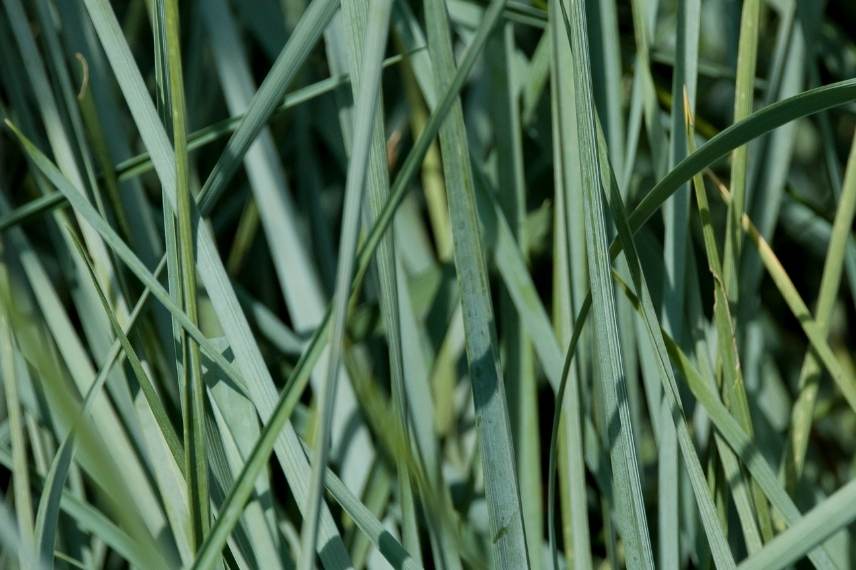
L’Elymus magellanicus
Eriophorum angustifolium
The Eriophorum angustifolium is a very distinctive grass with a silhouette taller than wide. It reaches 40 cm in spread and 60 cm in height, dimensions that allow it to fit into a small garden. With very slender leaves, this grass is especially notable for its fluffy inflorescences that resemble balls of cotton. These flowers, pure white, seem shredded by the wind.
Named narrow-leaved cotton-grass, this grass thrives in damp places, along the banks of a stream, a pond, or a lake.
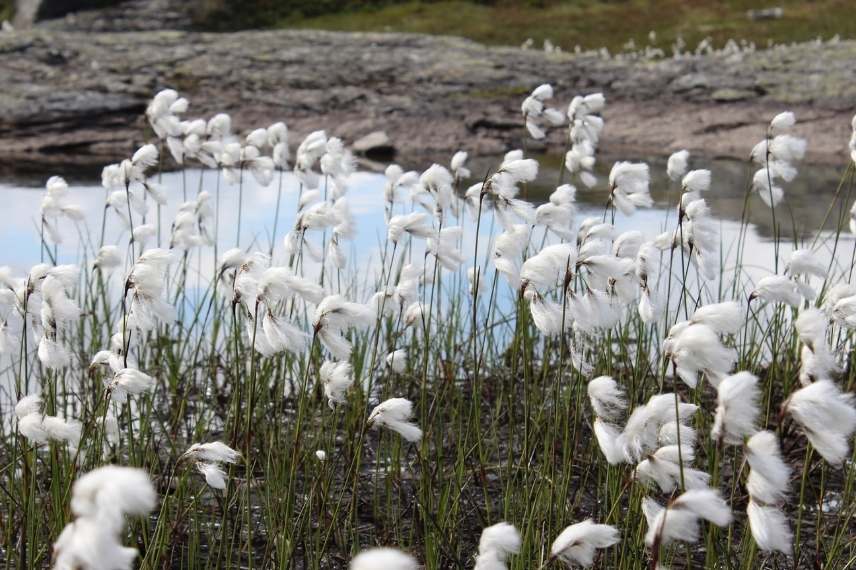
L’Eriophorum angustifolium
Hakonechloa
The Hakonechloa or Japanese forest grass is a grass whose most varieties do not exceed 40 cm in spread. Its dense, arching and linear foliage slopes to form successive waves. In autumn, this foliage takes on autumn colours, in gold, brown or orange depending on the variety. The bamboo-like foliage can also present slightly different tones: Aureola offers green foliage striped with gold and white, Nicolas has green leaves edged with orange and bronze-yellow, Sunflare has yellow leaves speckled with green and purple.
The Hakonechloa prefers cool, semi-shaded conditions and a perfectly drained soil.
Helictotrichon sempervirens
Helictotrichon sempervirens is a magnificent grass that forms a handsome, bristly tuft about 40 cm wide and 50 cm tall. It is especially notable for its bristly tuft of very sharp, stiff foliage that carries a blue-silver hue of striking effect. In summer, the tuft bears inflorescences, as stiff as the leaves, in a soft blonde colour.
This grass thrives in full sun in ordinary, porous and dry soil. This grass, nicknamed blue oats, remains decorative throughout the year thanks to its evergreen foliage.
The Imperata cylindrica ‘Red Baron’
Imperata cylindrica ‘Red Baron’ draws all eyes with its upright, rigid foliage, which, from summer, takes on blood red and then burgundy, the base remaining green. In winter, the leaves turn brown. This grass forms a beautiful, very dense tuft about 20–30 cm wide with a spread of around 50 cm. With slow growth, this grass is never invasive. However, the flowering shows no ornamental value.
This grass should be planted in full sun, in soil that stays moist.
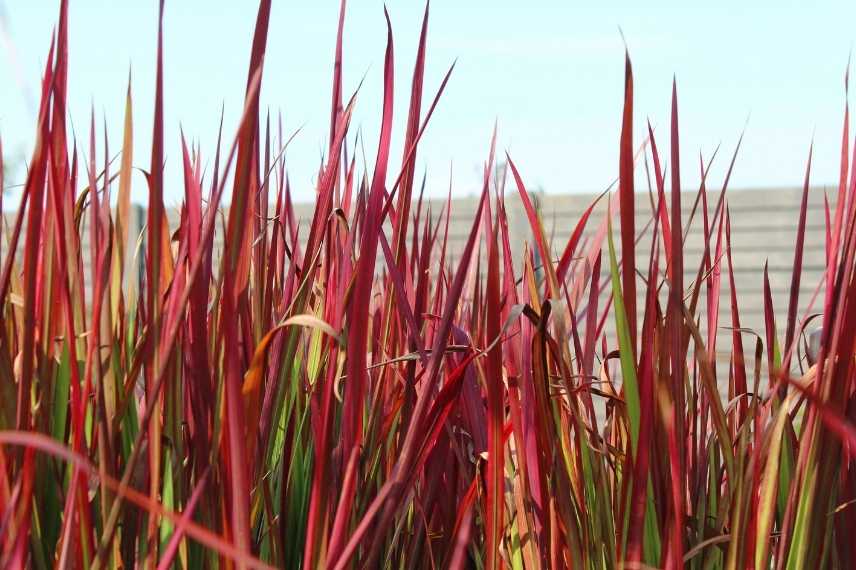
L’Imperata ‘Red Baron’
How to plant and care for these grasses in a small garden?
Of course, you should choose your grasses according to your soil type. Some are suited to acidic soil, others to calcareous soil. Likewise, site should match their needs: full sun, partial shade, shade, or a moist or dry soil. That said, grasses are relatively hardy and most adapt to challenging growing conditions. Planting, however, remains straightforward.
Planting
- Dip the root ball in a bucket of water to moisten it and ease removal from the pot.
- Dig a hole twice as wide as the root ball.
- Remove stones and adventives from the hole and around the edge.
- Place a little compost at the bottom of the hole to enrich the soil.
- Also mix a little compost with the excavated soil, or, if unavailable, with potting compost.
- Remove the grass from its pot, then plant it in the hole, the collar level with the soil surface.
- Backfill the hole with the excavated soil.
- Firm gently to eliminate air pockets and water thoroughly.
Care
Grasses are easy-to-care-for plants. Obviously, they will need a little water in the weeks following planting to help them establish. Some that prefer moist soils will also be watered during periods of high heat or during drought. Fertilising is generally unnecessary.
However, it is important to regularly clean the foliage. Simply remove dead or damaged leaves, usually in late winter, to encourage new shoots. Deciduous varieties can be cut back in late winter. For evergreen varieties, simply brush the clump to remove the dead leaves.
Read also
Grasses: which variety to choose?How to pair ornamental grasses in a small garden?
Ornamental grasses, with their light and airy appearance, are real assets for small gardens. Their elegance and adaptability make them ideal companion plants for creating harmonious and dynamic displays.
To showcase their assets in a small space, pair them with perennial plants with colourful and contrasting flowering displays. The woodland sages (Salvia nemorosa), with their flower spikes in pink, white or blue, will bring a touch of vibrancy. The sedums, with fleshy rosettes and star-shaped flowers, will provide complementary structure and texture.
For a wilder effect, incorporate summer-flowering perennials such as the blanketflowers, the gauras, the Astrantias, the euphorbias or small varieties of rudbeckias. Their warm colours and generous shapes will create a pretty contrast with the feathery plumes of the grasses. In autumn, grasses will benefit from being paired with the dwarf asters or the chrysanthemums.
Don’t forget spring-flowering bulbs, such as tulips or daffodils, which will bring a note of freshness at the start of the season. For a contemporary garden, opt for combinations of grasses with evergreen foliage plants, such as hostas or the heucheras.
- Subscribe!
- Contents

Comments