


Which privacy screens to shield a pool from prying eyes?
Easily create a private, secluded corner in the garden
Contents
An outdoor swimming pool, whether in-ground or above-ground, is the perfect place to relax and cool down in the garden during summer. However, to enjoy it fully, it is important to think carefully about its layout to create a private haven sheltered from prying neighbours’ eyes.
The choice of a privacy screen solution will depend on several criteria:
- space constraints;
- local regulatory constraints;
- available budget;
- the area’s exposure to prying eyes.
And, of course, it will also depend on your preferences. Do you prefer a permanent privacy screen or one that lets light through in winter? Would you prefer an exotic style or a more understated ambience? Do you prefer natural or artificial materials?
Let’s therefore look at the different possible solutions for a private, secluded pool area.
Don't overlook the regulations
Before you start, we would advise you to check with your local council regarding your Local Urban Plan for your area. This document sets out the rules for exterior works (maximum heights, setback distances, materials, etc.). Guidance remains the same whether you live in a housing estate or in a condominium. These rules apply equally to the installation of new buildings as to the planting of vegetation. For further reading, discover our article: Hedges, shrubs, trees: What planting distances?
Read also
Designing poolside areas in 5 stylesTo utilise existing structures to hide from view
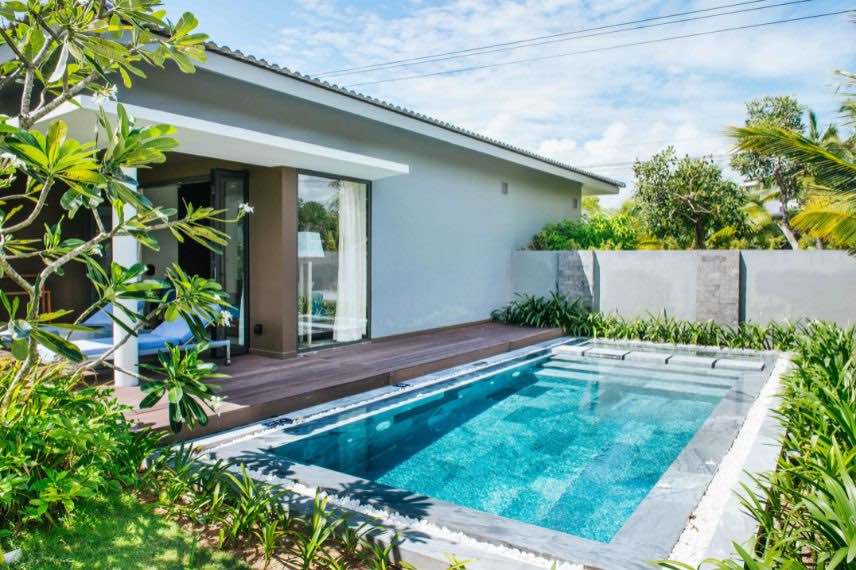
To shield yourself from neighbours, you could opt for a structure that acts as a screen, such as a shed, a utility outbuilding, or a stone wall. Structures 1.75 to 2 metres tall generally provide an effective privacy screen. Do consider the shade they cast, which may impact sun exposure to your pool.
Advantages
- A durable solution, that will last for many years.
- Low maintenance (perhaps some painting and treatments, depending on the materials used).
- These structures fit well in a contemporary-style garden.
Disadvantages
- They can be costly and may require the services of professionals.
- They require substantial space and can be difficult to integrate, if the pool layout is already established.
- The look can be heavy and unnatural.
Install light-blocking screens
More traditionally, you can install barriers or artificial hedges to create privacy around your pool. There are options to suit every style and budget: wooden panels or palisades, aluminium or composite lattice screens, brandes fencing, rolls of reed screening, etc.
Advantages
- A fairly economical and easy-to-install solution.
- A diversity that adapts to all garden styles (contemporary, natural…) and to all budgets.
- Requires little or no maintenance (perhaps some care for wooden elements).
Disadvantages
- These privacy barriers will be more or less long-lasting depending on the materials chosen.
- The result can sometimes look a little artificial and be difficult to integrate with the rest of the garden.
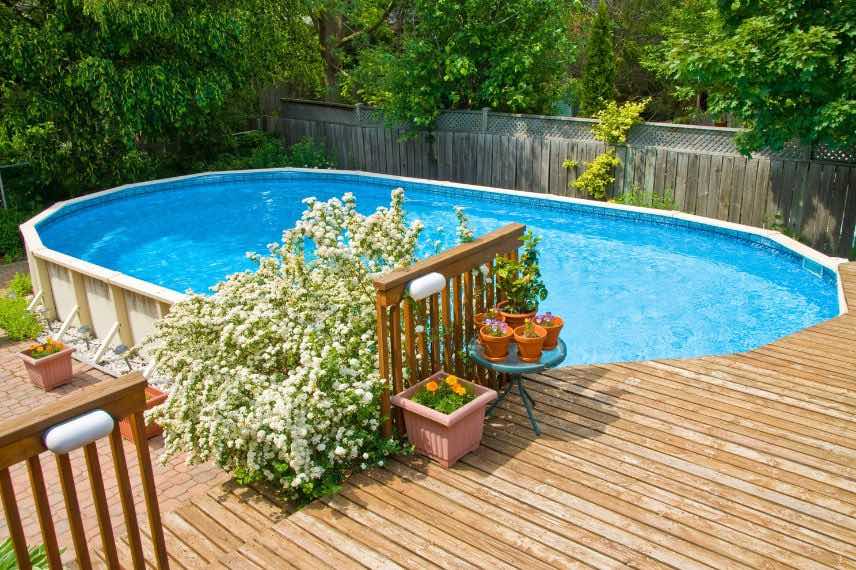
A wooden palisade provides privacy
Read also
How to create a privacy hedge?Invest in movable poolside setups
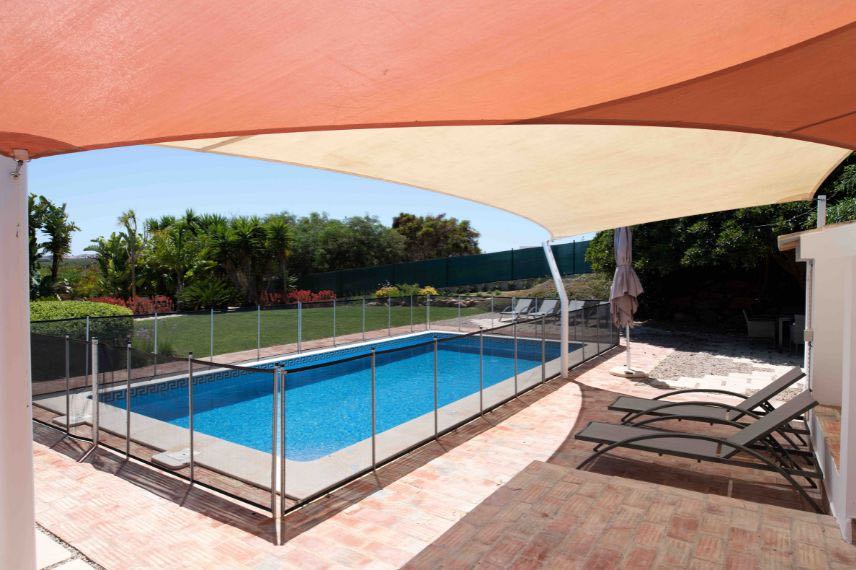
Sometimes the simplest solutions can be the best: it only takes a few things to create a protective screen around the pool. Think of the parasol and shade sails that, when well positioned, can both hide you from prying eyes and shield you from the sun’s burning rays. They are particularly effective for privacy from upstairs neighbours. There are also portable privacy screens or fan-style windbreaks (retractable), which can even be fixed to the side of a wall.
Advantages
- It is an inexpensive solution.
- It is easy to install and to remove at the end of the season.
- It is ideal for small spaces and for concealing views from above.
- These installations are generally not subject to regulation.
- It lets in less light.
Disadvantages
- These installations are often not very durable over time, as they are more susceptible to weather conditions (winds, heavy rain, etc.).
- The look is sometimes not very attractive.
Growing plants to create a natural privacy hedge
Plants have many uses. Here they are mainly suited for creating a beautiful privacy hedge. You can choose a single-species hedge, which will act as a true living wall. But we recommend opting for a mix of different species and varieties, as in an informal or naturalistic hedge. This hedge has several advantages, since it allows:
- to play with colours, foliage, textures, and flowering periods;
- to limit disease development;
- to promote biodiversity;
- to provide a more natural and less monotonous appearance.
The chosen plants must suit climate constraints: strong winds, salt spray, drought, winter frosts, etc. Their foliage should be dense enough to form a well-screening hedge.
If you have enough space, we advise planting in a quincunx pattern rather than in a line, for a fuller, more concealing effect.
Here are a few hedge examples based on your growing conditions and the décor style you want for your pool.
- Different varieties of camellias (C. sasanqua ‘Variegata’, ‘Choji Guruma’ or C. champêtre ‘Cinnamon Scentsation’), Griselinia, Escallonia and Japanese spindles for a coastal hedge. These shrubs are indeed tolerant of sun, wind and salt spray.
- Miscanthus, Panicum, Calamagrostis and Phormium for a grasses hedge, bringing a light, modern touch.
- Myrtles, oleanders, ceanothus, chaste trees, Callistemon and Elaeagnus for a Mediterranean-inspired hedge. It will be well suited to heat and dry soils, which helps reduce irrigation needs.
- Photinia, Cotinus and Pittosporum for a hedge with very decorative coloured foliage.
- Buddlejas, Grevillea, Abelia, Heptacodium miconioides (Seven-Son Tree) and Lagerstroemia (crape myrtle) for a hedge with long flowering from spring to autumn.
- Viburnums, Weigelas, Mexican orange blossoms, mock oranges and cotoneasters for a hardy hedge, suited to temperate climates and that resists winter frosts well.
- Fargesia (non-running bamboos) for a hedge that adds a graphic and exotic touch.
- Leyland cypress, common yew and Japanese cedar for a conifer hedge.
We advise avoiding planting fruiting shrubs near your pool if you do not want to attract wasps or have to regularly clean up fallen fruit.
If you do not have a soil bed near your pool, for example if it is installed on a terrace, it is perfectly possible to grow hedge shrubs in pots. Simply choose large containers and opt for plants regarded as dwarf or compact, not exceeding 2 metres in height in every direction. For example, choose Choisya ternata ‘Snow Flurries’, Photinia fraseri ‘Louise’ and Escallonia ‘Apple Blossom’.
To go further:
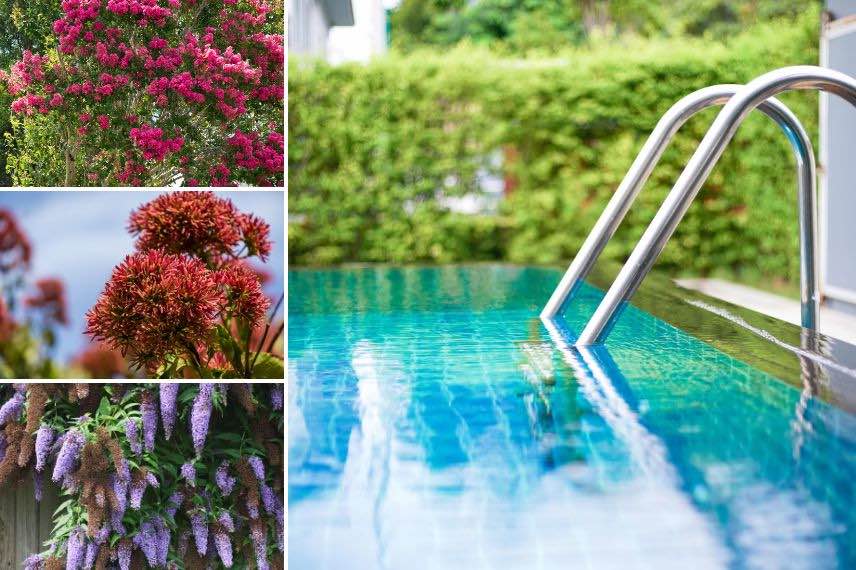
Rather than a monospecific hedge, why not plant a varied hedge? Here, Lagerstroemia, Heptacodium miconioides and Buddleia
Advantages
- A hedge can be created in all sorts of styles to suit every taste.
- It is an aesthetic and natural privacy screen, easy to integrate into the garden.
- This solution can evolve over the months, breaking monotony.
- It promotes biodiversity.
Disadvantages
- A privacy hedge may take a few years to reach the desired height to hide from view.
- Depending on chosen plants, it may require maintenance (watering during drought, fertilising, annual pruning…).
- The price of shrubs, depending on their pot size, can be fairly high.
Choosing climbing plants for a pool with an intimate and lush setting
Climbing plants can easily create aesthetically pleasing privacy screens and transform a garden pool into a lush, colourful space.
For easier installation, favour plants that naturally cling to their support thanks to their twining stems, their tendrils or their climbing roots. They will easily cover fencing, trellises or pergolas. This latter option is ideal if you need to shield yourself from a high-level view coming from above.
For example, choose honeysuckles, passionflowers, the star jasmine, the trumpet creepers or the wisterias (plan a very sturdy support for these latter).
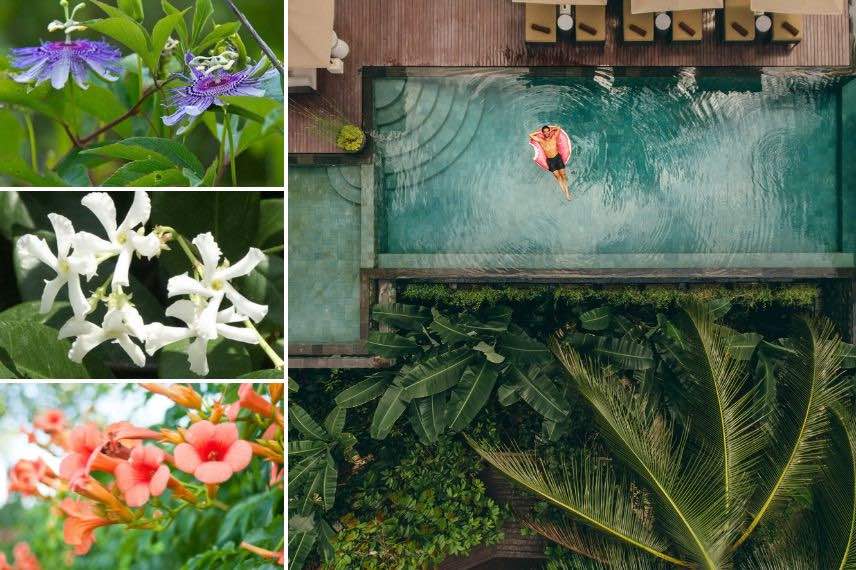
To give your landscape an exotic and luxuriant feel, plant climbing plants such as passionflower, Trachelospermum and trumpet creeper
Benefits
- Installing supports and planting are easy to carry out yourself.
- This solution is suitable for small spaces.
- By choosing fast-growing climbing plants, you can achieve an instant effect.
- It’s a perfect way to create a natural and aesthetic space.
- This solution enhances biodiversity.
Disadvantages
- Climbing plants may require some maintenance (watering during drought, fertilising, annual pruning…).
- The price of plants, depending on their potting, can be quite high.
- Deciduous-leaved varieties won’t provide year-round screening.
- Subscribe!
- Contents
Comments