





























XXL indoor plants
Green plants with maximum impact
Contents
If you’re looking to transform your interior in a striking way, XXL houseplants are the perfect solution. In this article, we will explore why you might opt for these green giants, what impact they can have on your space, and how to choose, care for and showcase these botanical wonders.

Why going for XXL indoor plants?
Tall indoor plants, with their imposing stature, bring many benefits to your living space. Here are a few reasons why you should consider adopting these large green plants:
They make a striking visual impact: large indoor plants act as focal points and lend a dramatic dimension to any room. They usually have an architectural form and dress the space by their mere presence. They are often endowed with large leaves, or have a remarkable tree-like habit. Only these very large specimens possess these striking visual attributes.
By their imposing presence, they always convey a sense of nature indoors, far superior to several smaller plants scattered around a room. Generally more expensive to purchase individually, one very large plant delivers; on the other hand an irreplaceable presence that a few plants put together do not reach. They are typically tropical plants, which also create a strong exotic atmosphere.
These plants can be used to define spaces in large rooms and thus create a more intimate ambience. They can serve as space dividers, for example between a study area and a living room. Even if they do not completely mask the presence of the desk, they are enough to divert attention away.
A very large plant structures the space, it acts as a substantial piece of furniture. Unlike furniture, it also has a beneficial impact on reducing stress and improving overall wellbeing. Gazing at our plants brings us back to a natural outdoor environment that is sometimes lacking, especially in cities. Caring for plants generates the same positive effect.
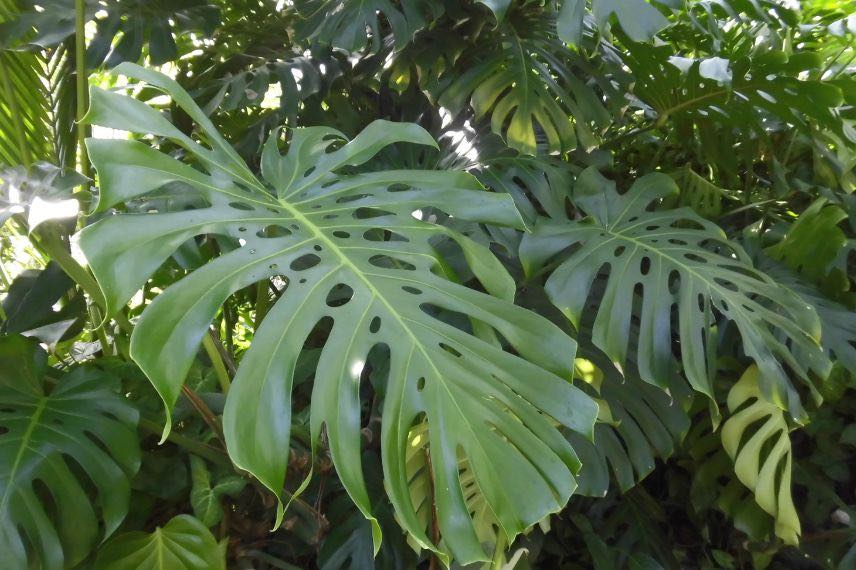
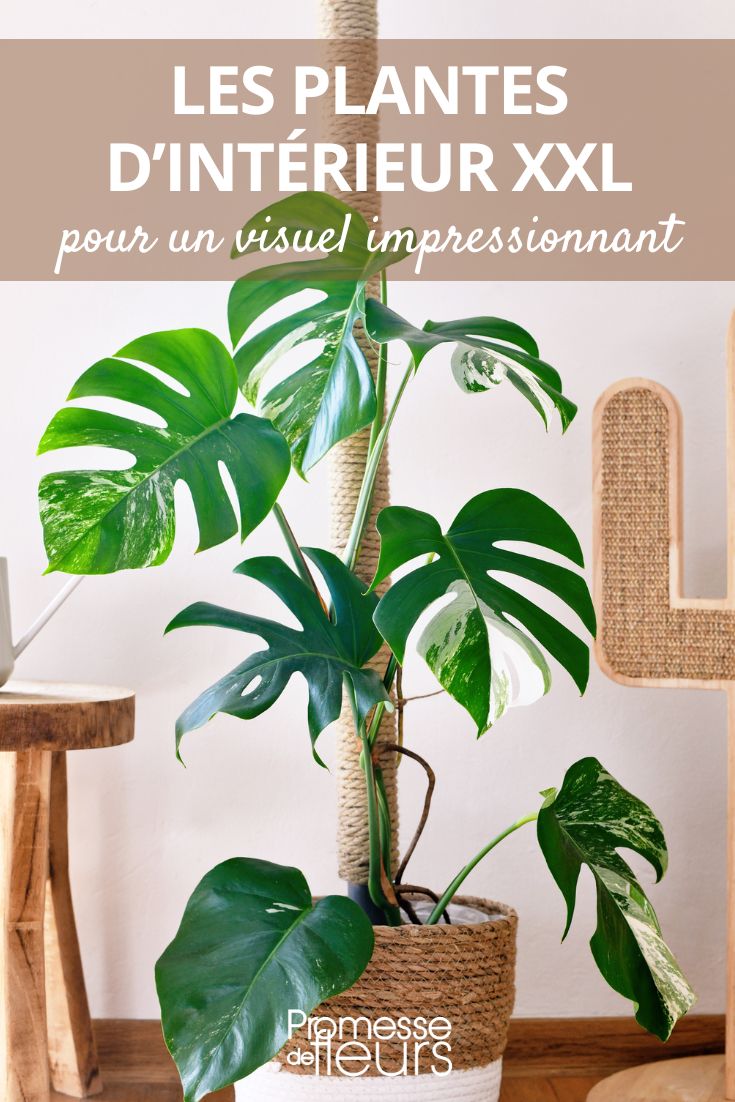
The famous giant perforated leaves of Monstera deliciosa
Read also
Potted plants: what is top-dressing?Some XXL indoor plants
Here are a few examples of XXL houseplants that are fairly easy to obtain:
- The Ficus lyrata has had its moment in the limelight in recent years. And for good reason: with its large, violin-shaped leaves, it’s an elegant plant that brings a touch of distinction to any space. It’s hard not to notice it. Provided you have a very bright room, even a little direct sun (a west-facing exposure is ideal) and regular watering, it can reach impressive dimensions.
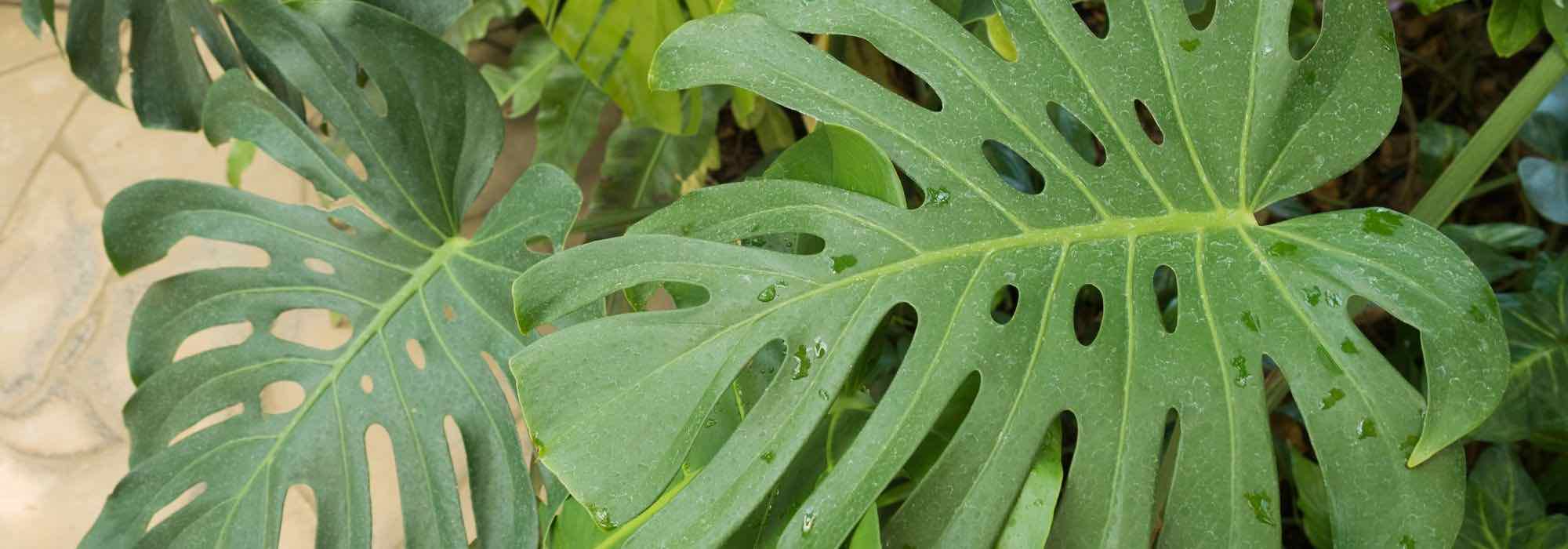
- Another undisputed recent favourite, the Monstera deliciosa is a fast-growing tropical plant, prized for its cut, holey leaves, “fenestrated”. The plain, non-variegated form is fairly inexpensive and easy to grow. The main challenge is to stake it securely so that the weight of its thick stems and large leaves does not cause it to topple and to help it maintain an aesthetically pleasing shape.
- The Yucca elephantipes, very prominent in the 1970s–80s and a bit out of fashion since, is indeed a very interesting plant, with a striking architecture and a desert-plant look. Its majestic silhouette, with sword-shaped leaves, is ideal for bright to very bright spaces. It is also very easy to care for and requires little watering, ideal if you are regularly away.
- Dracaenaes can also form beautiful specimens, fairly lanky or, conversely, robust, depending on whether they are built on three thick trunks or thinner trunks. They are also fairly easy to grow, not particularly demanding, but they do require more water than Yuccas.
- The Pachira aquatica or money tree, always of fairly slender habit, has palmately divided, finely cut foliage. In Asia, it is regarded as a good-luck charm and is a valued gift.
- The Strelitzia reginae forms a very large plant, in keeping with the elegance of its arching stems. Quite demanding, it needs bright light but also warmth to show its best.
- The Ficus robusta, another star of the 70s–80s, is making a comeback in recent years, and rightfully so. It can take a very large volume and carries oval, glossy, tough, very dark green foliage for its classic shape, a sight to behold. If dust is quickly noticeable on its leaves, besides that it is a plant with no pretensions, very resilient and not demanding.
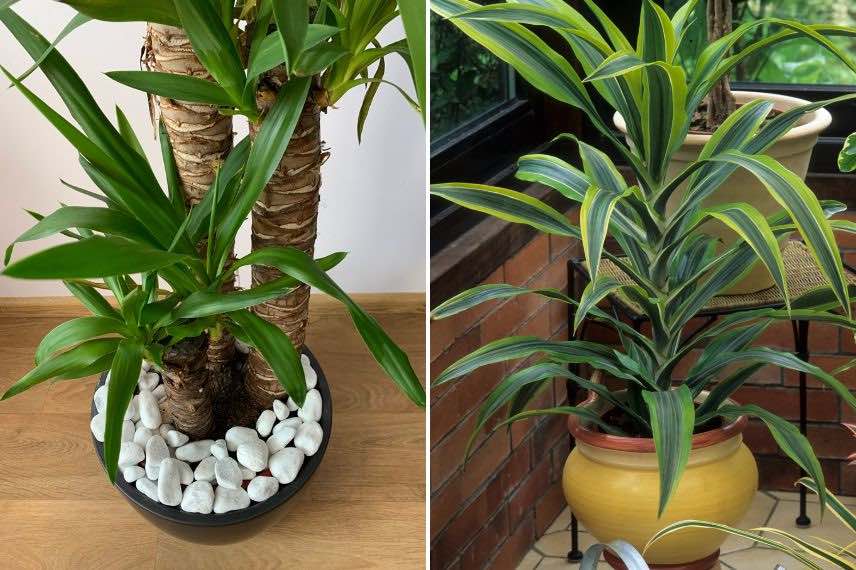
Yucca and Dracaena form large, elegant, exotic specimens
Other imposing plants will nonetheless have a more limited footprint, either because they develop a tuft of leaves raised above a single, straight trunk, limiting the footprint on the ground and in width, or because they have a columnar growth habit, like many climbers, around an artificial trunk.
Finally, there are also plants with fairly modest stems and giant leaves. In this case, the width footprint can become significant as the plant grows. Also note that some plants produce leaves only on the side of the light source and others all around the pot. This also affects footprint and placement.
Examples of single-trunk plants and a tall tuft: Beaucarnea recurvata with a thick trunk and ribbon-shaped leaves, or some stem-mounted plants such as the Ficus ‘Amstel King’ variety.
Araceae family plants often have a climbing habit and are sold on columnar supports, around which they coil. If you do not prune them, they can overrun walls and ceilings. In this case, the footprint on the ground is very small, but the plant is imposing on vertical surfaces. Araceae with very large leaves, such as some Philodendrons, have a footprint not to be neglected once the plant grows. They are, however, more delicate to cultivate than all the plants mentioned above.
Also consider all palm family plants, typically large and tall, such as the handsome Licuala grandis. Also think of the banana plant, with strong exotic and tropical appeal, provided you can meet its needs and allow it to reach its full potential.
Please note that some marketed plants may struggle to find the conditions they prefer indoors, except in very specific environments. Outside these conditions, they will not develop the volume you expect and dream of. In the bullet list above, only Strelitzia and the Ficus lyrata have somewhat more delicate, but affordable, growing conditions; the others should not give you any bad surprises. For Araceae, palms and banana plants, study the species and their conditions before you start.
How to choose your plant?
The choice of your XXL plant will depend on several factors, including available space, light and required maintenance. Here are a few tips to guide you in your selection:
- Don’t underestimate the plant’s dimensions. Large plants can “consume” a substantial amount of space, and not always exactly as you would like. To prevent it from looking cramped, allow for space larger than its current or anticipated measurements. The visual effect will be much more pleasing. Of course, you can always prune it, but don’t start from that premise initially.
- Consider the room’s lighting. Some plants tolerate shade better, while others require substantial indirect light. Some enjoy a little direct sun, others not. The light factor is crucial, as the growth of your large plant depends on it, inevitably light-hungry, all the more so since interiors are always far less bright than the outdoors from which it comes.
- Make sure you choose a plant whose maintenance needs fit your schedule. Some plants require little maintenance, while others demand more regular attention. Watering is a key point. Along with light, it’s the second crucial factor for the plant’s healthy growth.
Before investing in a very large specimen, ensure you can provide the necessary light and watering, otherwise your beautiful plant, in which you have invested financially, will stagnate, then, after some time, perish.
The choice of such a plant is made carefully, all the more so because you will become attached to it and be proud if it rewards you with healthy growth thanks to your attentive care.
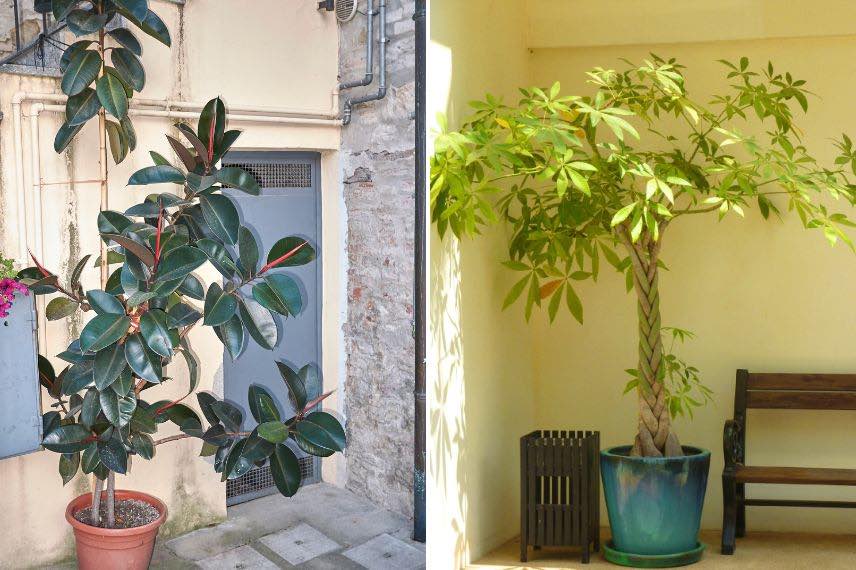
Ficus robusta et Pachira aquatica
Read also
How to grow Monstera deliciosa?Care
Care of giant indoor plants is the same as for all plants, just in an XXL version. Before investing, make sure you can provide the following aspects. Good maintenance is essential to keep these giants healthy and to continue brightening your space, far beyond their beauty when purchased. Here are some basic tips:
- Water regularly, but ensure the pot has good drainage to prevent excess water, which can lead to root rot. Large plants require considerably more water per watering than modest-sized plants. This can amount to around 2 to 4 waterings of 2 litres each, depending on pot size and the plant’s needs. That’s substantial. Make sure there is a water source not too far from the room in which the plant is located.
- Provide nutrients with an indoor plant fertiliser, typically during the growing season (spring and summer). Nothing special about the fertiliser, except that the dose is a little higher.
- Regarding the pot and repotting, this is also a crucial aspect not to be underestimated. A large plant is heavy and difficult to move. Think about future pot sizes. However, rest assured, when a plant becomes truly large, its growth slows, and the pot size required at each repotting stops increasing exponentially. In fact, after a while one is content with top-dressing rather than repotting: replacing the top centimetres of potting mix without changing the pot. Plants do not all have the same root surfaces; some are lighter and more modest in roots. Pachysandra, for example, has a root development considerably more limited than Monstera. And the plant’s weight is much lighter. If in doubt, seek advice in-store or online. Consider roller stands to install under the plant to facilitate moving it.
- Regarding light, indoor plants typically require what is called sustained indirect light. That is, no direct sun, but a very good amount of light. The larger the plant, the more so, especially since very large plants are rarely species with low light requirements. Among plants that tolerate moderate exposure, you can cite ferns or plants in the Marantaceae family (Calatheas, Marantas), which are not part of these XXL plants.
Enhancing your interior
XXL houseplants can be showcased in many ways, depending on your decorating style. Here are a few tips:
As noted above, give it space to breathe and to unfold without appearing cramped, as that would ruin the intended impact.
These giant plants look best when left to themselves, it’s probably the way they are best showcased. But in some cases, surrounding them with other plants is wise, and allows the creation a lush profusion, a ‘jungle’ effect, with a dominant plant that really shows the arrangement to its full potential.
Install them directly on the floor, which, given their size, suits them very well.
In a minimalist interior, a large plant can be the sole decorative element needed to create a visual impact.
XXL plants fit perfectly into rustic interiors, emphasising the natural look of wood.
In a modern interior, large plants bring an organic and balanced touch.
Giant plants soften industrial spaces and add a touch of greenery.
In a bohemian interior, they blend with the room’s ambience.
But they truly have a place in all interior styles, provided there is sufficient space.
- Subscribe!
- Contents
Comments