





























Your red-flowered rose is blooming white or pink, and you think it’s degenerating? Let’s investigate this mystery together and find the origin of this strange phenomenon! With a bit of observation, we’ll see that it’s actually a story of rootstock, “suckers,” and a simple pruning should resolve the issue.
Why these strange flowers?
Which types of roses degenerate?
Only grafted roses are affected by degeneration!
Indeed, we graft when necessary, a well-known and appreciated variety of rose (the scion) onto a botanical rose, valued for its vigour, disease resistance, or soil adaptation (the rootstock). Rose growers who propagate these roses use different rootstocks: Rosa multiflora, Rosa laxa, and Rosa canina are the most common. It’s the hawthorn flowers of the rootstock, white or slightly pink, that you mistake for degeneration.
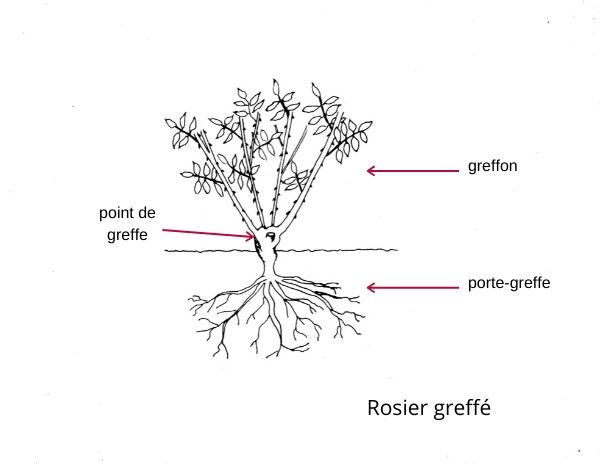
How to identify this degenerated part?
At the base of your rose, just above the soil if it hasn’t been buried, is the grafting point, which looks like a swelling on the stem. This is where the first branches of your beautiful red-flowered rose emerged! But since you haven’t watched it grow every day, the rascal has ended up producing shoots below the grafting point...
They are called “suckers” because they are sap-hungry, drawing it from the source, the roots. Thus, it’s the shoots of the wild rootstock that have developed vigorously! You’ll notice that the colour of the stems is different from that of your beloved rose variety, usually a lighter green. The same goes for its leaves, and let’s not even mention its flowers...
The emergence of these suckers is encouraged by deep digging, which, by injuring the roots of the rootstock, prompts it to activate its dormant buds. That’s why it’s better not to disturb the soil too much around your roses and to stick to superficial hoeing.
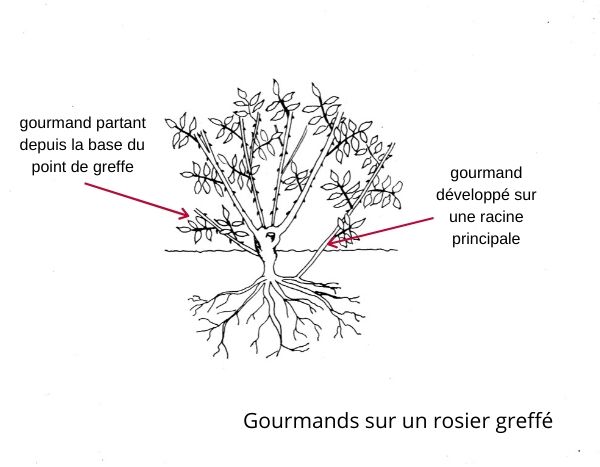
Be careful, in the case of a grafted rose, we talk about "suckers" and not "drageons"! Indeed, the latter results from a natural phenomenon that does not weaken the plant. A rose can produce suckers, of course, but in that case, it was not grafted, unless you buried the rootstock and the rose has freed itself from it.
How to restore my beautiful rose transformed into a hawthorn?
To eliminate this phenomenon, simply cut back the aerial shoots of this wildling, down to the swelling of the grafting point or dig up and remove at the base the sucker that has grown on a main root, to prevent it from re-emerging. If you only cut it, the sucker will strengthen and eventually smother the variety.
Let’s not forget the particular case of the standard or weeping rose, where suckers can also appear along the main stem, below the grafting point that is situated high up. These will also need to be removed.
If there are healthy branches of the correct variety above the rootstock, your rose will eventually regrow. You’ll need to stay vigilant and check that no sucker is poking its head out. Take advantage of pruning, weeding, or cutting flowers to observe all of this. With a bit of practice, you’ll quickly learn to spot the suckers, and you won’t be caught out again!

Comments