


A light mist enveloped the garden this morning... After a surprise heatwave, is autumn already showing its first signs? Anyway, I won't talk about the weather, but about a topic just as vast: tulips! It's the start of the bulb planting season, and the question arises: which tulip to choose from the hundreds of varieties offered in catalogues?
Of course, there’s personal taste to consider, and with 3000 varieties registered and new additions each year, it can be said that when it comes to tulip bulbs, there’s something for everyone! To help you navigate, successive generations of horticulturists have grouped the various varieties into groups or families of tulips, each responding to specific botanical and aesthetic criteria (more or less) precise, as well as usage: depending on the flowering period, your soil, or the style of your garden, you will turn to specific families in which you will seek the most beautiful to your eyes... Discover some tips and landmarks.
1) Choosing tulips according to flowering time
The tulip is one of the most beautiful and famous of the spring-flowering bulbs. Its colours, often vivid and sometimes subtle, brighten the first days of fine weather or, conversely, awaken the sometimes still grey days of early spring. Fortunately, the horticultural classification of tulips also corresponds to the flowering calendar! It is therefore very easy to navigate, and by combining varieties from several families, you can achieve up to 2 months of continuous flowering... what more could you ask for? Of course, the chronological markers on flowering dates provided are not "an exact science" and should be nuanced by the climatic variations observed regionally and from year to year.
In bloom from March-April, the early tulips
- As their name suggests, early single tulips and early double tulips, including the famous hybrids 'Murillo', are among the first to bloom, from early April. They rarely exceed 35cm in height and are thus sturdy enough to withstand bad weather.
- They are, however, preceded by certain botanical species and their hybrids. Among the botanical tulips, there are wild species, although they have unfortunately often disappeared from their natural habitat, with a flowering period that is not uniform and extends from March to June depending on the species. From early to mid-March, you can count on Tulipa tarda, Tulipa humilis and its many varieties, Tulipa clusiana, Tulipa turkestanica... and many others that are rarer! These rarely exceed 10 to 15cm in height.
- The botanical tulips from the greigii group, with marbled black foliage, kaufmanianna or "water lily tulips", and the excellent fosteriana ('Purissima', 'Madame Lefeber', 'Orange Emperor'...) have vivid and varied colours, measuring 20 to 30cm in height, 40cm for fosteriana, they bloom from late March to early April and thus precede the "early" tulips by a little.
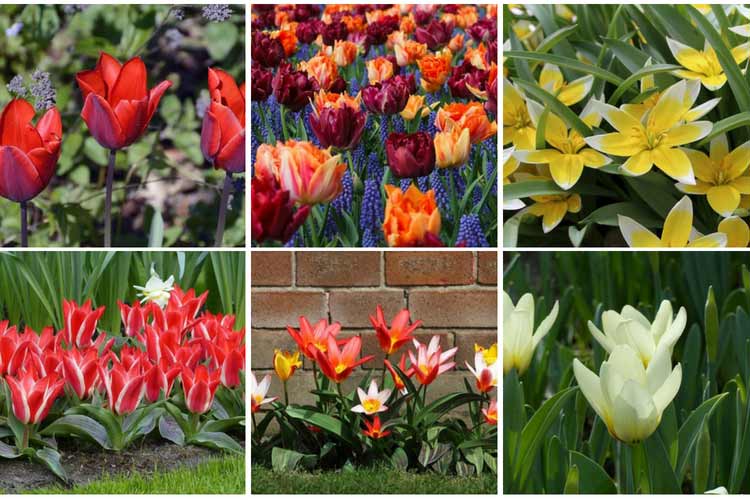 Early single tulip 'Couleur Cardinal' - Early double tulips 'David Teniers' and 'Willem van Oranje' (Murillo) - Tulipa tarda - Greigii tulip 'Plaisir' - Kaufmanniana tulips - Fosteriana tulip 'Concerto'[/caption>
April flowering, the heart of the tulip season
- The Triumph tulip, aptly named, was obtained by crossing an early single tulip and a late tulip, and blooms just in time in April. Triumph tulips now form one of the largest and most diverse groups. 'Attila', 'Princess Irene', 'Shirley', 'Gavota', 'Negrita'... are among the best-known and most appreciated. With an average height of between 40 and 50cm, varieties from this group offer great possibilities for use, in beds as well as in pots and as cut flowers.
- To obtain even more choices in tulips blooming in April, it is also possible to "pick" from the neighbouring groups of parrot tulips and lily-flowered tulips, whose varieties share only their shape. Some are indeed derived from natural mutations of 'Triumph' tulips and have thus changed shape while retaining the same flowering time, such as 'Princess Irene Parrot' for example. 'Ballerina', with orange lily-shaped flowers and a fragrance, also always blooms in the second half of April in my garden.
- The tallest of the "botanical tulips", those measuring about 30cm high, are also in bloom in April: Tulipa praestans, Tulipa whittallii, and the rare and beautiful Tulipa orphanidea 'Flava', to name just a few.
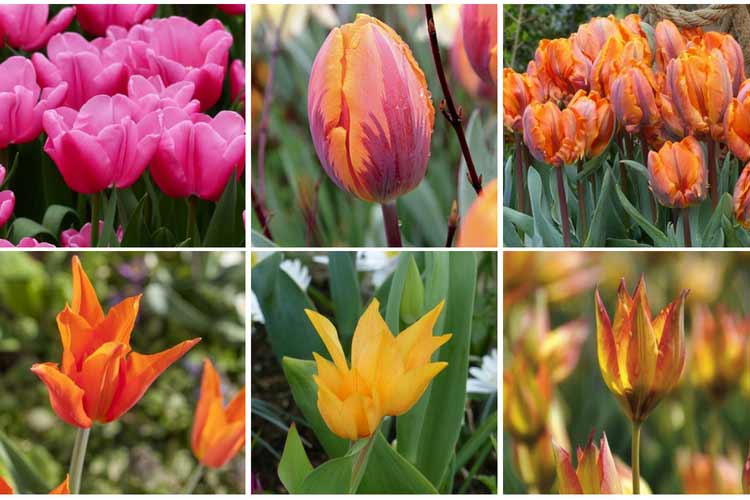 Triumph tulip 'In Love' - Triumph tulip 'Princess Irene' - Parrot tulip 'Irene Parrot' - Lily-flowered tulip 'Ballerina' - Tulip praestans 'Shogun' - Tulipa orphanidea 'Flava'[/caption>
In bloom from late April to mid-May, the late tulips
- The "Darwin" tulips, with large flowers appearing in late April on strong stems that are 50 to 60cm long, are excellent reliable and sturdy garden varieties, always spectacular, but not always to everyone's taste with their pure and contrasting colours ranging from yellow to red, highlighted by a large black heart at the base of the petals ('Apeldoorn', 'Golden Apeldoorn'...).
- The late single tulips, also called "cottage" or "long-stemmed" tulips, reaching 60cm in height or more, and their counterparts, the late double tulips or "peony-flowered" like 'Angélique', bloom in early May. They are the undisputed queens of bouquets! Many varieties are indeed French creations developed for the production of very high-quality cut flowers in the South: 'Avignon', 'Dordogne', 'Ollioules', and of course 'Roi du Midi' are among them.
- The "original" tulips: frilly parrot tulips, elegant lily-flowered tulips, delicate lace or fringed tulips, and fascinating viridiflora tulips like 'Groenland' or 'Spring Green' with flowers striped with a central green band, should be planted in well-maintained beds as these horticultural creations are not always the most resilient.
- Tulipa sprengeri: the exception that confirms the rule, this highly sought-after botanical tulip is always the last to bloom, in June! Its red-orange flowers with slightly pointed petals are both unexpected, elegant, and spectacular. Very rare, it naturalises easily in the sun, provided it is never disturbed by soil work.
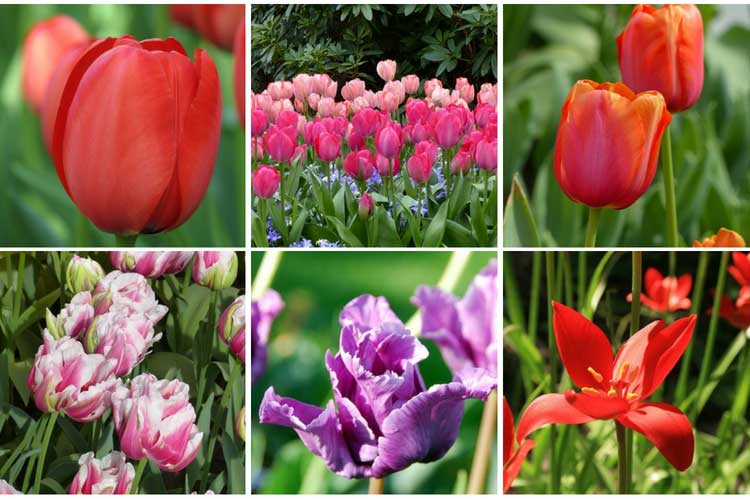 Darwin tulip 'Apeldoorn' - Darwin tulips 'Van Eijk' - Late single tulip 'Avignon' - Late double tulip 'Fantasy Lady' - Parrot tulip 'Blue Parrot' - Tulipa sprengeri[/caption>
2) Choosing tulips according to your soil type
While they thrive in all soils, tulips prefer rich, loose, well-drained soils, warm in summer, without stagnant moisture in winter, with a neutral to alkaline pH (calcareous).
- In a "good garden soil", black and rich, loamy or clay-loamy, as long as there is drainage, all fantasies are allowed, choose at your leisure! You can even leave the bulbs in the ground over winter, without any qualms, except for the most fanciful varieties, your tulip bulbs will return more numerous year after year. If this is the case in your garden, go directly to point 3!
- In heavy clay soil, "sticky" and clinging to fingers and tools... it’s a different story! You can only grow tulips in beds with enriched and amended soil with compost and sand, well worked each year, and on the condition of lifting the bulbs at the end of flowering before drying them for replanting the following autumn. Even doing this, some varieties exhaust themselves faster than others, and you will need to buy new bulbs more often. Of course, you can always circumvent the problem by planting the most precious varieties in pots!
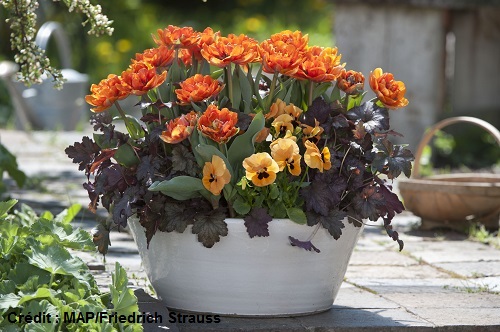 If you have very heavy clay soil, waterlogged in winter, prefer tulips in pots!
- In dry and light soil, sandy, poor, or if your soil is calcareous and shallow, as well as in rockeries, turn to botanical tulips. They take up little space, naturalise, and do not degenerate. Due to their wide range of origin, there is always a species whose growing conditions in nature will be close to those of your garden.
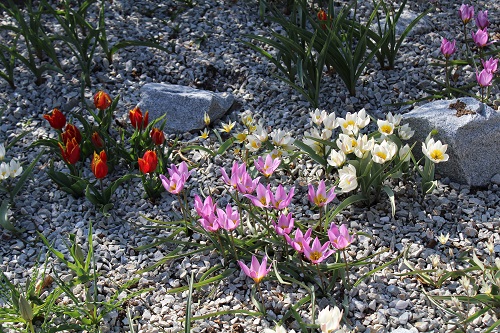 In dry and light soil, poor in nutrients, or in rockeries, small botanical tulips will be your best allies!
3) Choosing tulips according to your garden style
Obvious, you might say? Once you’ve passed the filters of flowering time and soil, you still have to pass a subjective filter, that of your style and your tastes! Classic or contemporary, natural, mineral, small, large, English, French... there's a tulip for almost every garden style, except perhaps the traditional Japanese garden! Not to mention that their possibilities for association are exponential....
- In a contemporary style garden, opt for tulips with well-defined shapes, clean and elegant lines, such as lily-flowered tulips like 'White Triumphator', simple varieties with perfect shapes like 'Maureen', and viridiflora like 'Spring Green'. Add contrast with the black of 'Reine de la Nuit' or 'Fontainebleau' and even 'Dream Touch' for a classic black and white combination. It’s often overlooked, but botanical tulips can also fit well in this style of garden: look towards Tulipa polychroma or Tulipa whittallii whose shapes remind me of some great works of contemporary architecture...
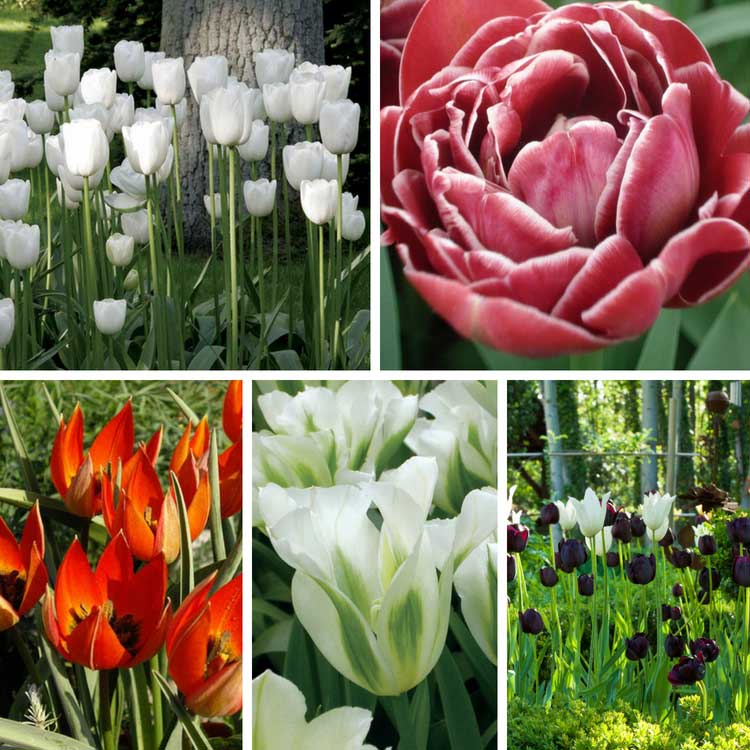 Tulip 'Maureen' - Tulip 'Dream Touch' - Tulipa whittallii - Viridiflora tulip 'Spring Green' - Contrasting tulips: 'White Triumphator' and 'Reine de la Nuit'
- In a romantic style garden, the frills of double flowers, triples, quadruples! The charm of soft colours, pink, mauve, lilac, spotted, the lace of fringed tulips... By combining early and late varieties, it’s easy to have double tulips in bloom for weeks. The eternal 'Angélique' and the precious 'Diamant Bleu' are must-haves to accompany the lesser-known 'Daytona' and 'Huis ten Bosch' in lace, 'Silver Parrot', 'Burgundy'... in a setting of forget-me-nots and fragrant lilacs!
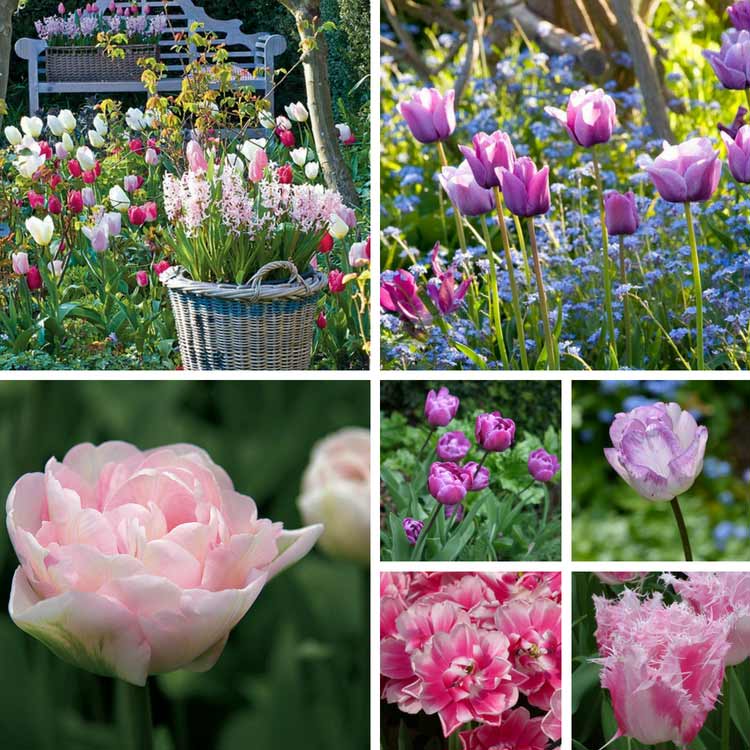 Tulips 'Jazz', 'Synada Amor', 'Page Polka', 'Christmas Dream' and 'Flaming Purissima' create a romantic atmosphere with pink hyacinths - Tulips and Myosotis - Double tulip 'Angélique' - Tulip 'Diamant Bleu' - Triumph tulip 'Shirley' - Early double tulip 'Columbus' - Fringed tulip 'Huis ten Bosch'
- In a natural or naturalistic garden, who said that only perennials and grasses should have a place? The lightness of botanical tulips like Tulipa turkestanica, Tulipa bakeri 'Lilac Wonder', Tulipa clusiana will naturally impose themselves, if I may say so! However, more classic and even almost sophisticated tulips, if well used, planted at controlled densities, will blend in with the brilliance of the greatest virtuosos! For yes, alongside the rose, the tulip is indeed one of the most virtuosic genera we can cultivate in our gardens...
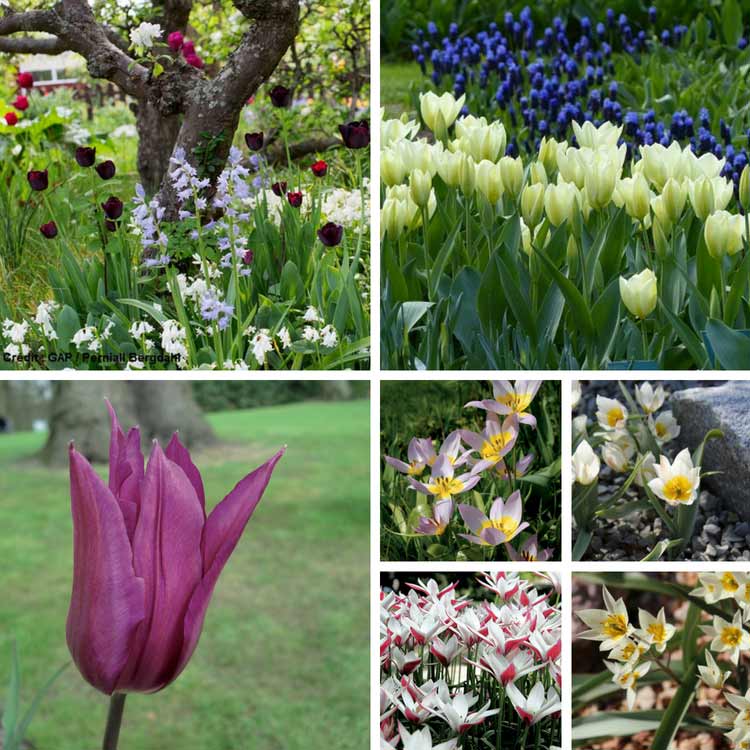 Planted sparsely, these 'Reine de la Nuit' tulips respect a natural effect alongside wood hyacinths - Fosteriana tulips 'Purissima' with Muscari latifolium - Tulip 'Burgundy' - Tulipa bakeri 'Lilac Wonder' - Tulipa polychroma - Tulipa clusiana 'Peppermint Stick' - Tulipa turkestanica


Comments