


This summer, we decided to take you on a journey through plants! Trees, shrubs, conifers, bulbous plants, bamboos, grasses, or perennials… a large number of plants are great travellers that have made their way to us from distant continents, from the Americas to Oceania. They have gradually acclimatised to our climate, a new humidity level, and our cultural conditions to thrive effortlessly in France. Over the centuries, they have naturalised all around the world.
Every Saturday, we will unveil one of these travelling plants… This week, let’s focus on the hydrangea!
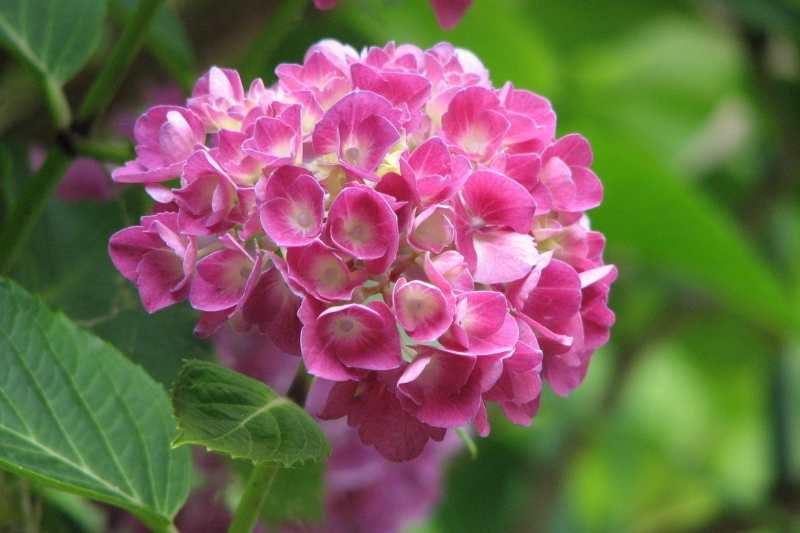
Hydrangeas or hortensias
It could easily be mistaken for a native plant with its large colourful blooms and cheerful appearance. The hortensia, as we call it in French — or Hydrangea in botany — seems very familiar, almost commonplace, as if it were of Breton origin. However, it actually comes from the mountains of the Land of the Rising Sun and has had quite a journey before becoming a very popular bush in Europe. Not to mention that it has many Asian and American cousins!
Its origins
In the 1980s, fossilised sterile flowers of Hydrangea were discovered on the west coast of the United States (Oregon and Northern California), dating back to the Tertiary period… Other fossils have been found in Alaska and northern China (Manchuria). The beauty of hydrangeas was mentioned as early as the 8th century in collections of Japanese poetry…
Like many plants brought back from great maritime expeditions, the hydrangea only arrived in France in the 18th century. It was first mentioned in 1712 by Engelbert Kaempfer, a naturalist physician and German explorer who participated in a voyage to Edo (present-day Tokyo) in 1690. He was one of the first to explore Japanese flora. The first hydrangeas were discovered in Nagasaki Bay. Carl Peter von Thunberg and Philibert Commerson, a French explorer and naturalist, brought back dried samples in the form of an herbarium. The naturalist Philip Franz von Siebold returned to Europe with the first correctly identified Hydrangeas.
Then in 1790, the first living specimens of Hydrangea macrophylla were imported to England. Planted in the greenhouses of Kew Gardens in London, they acclimatised very well thanks to the perfect humidity of the British Isles.
A name shrouded in mystery
Several hypotheses have been put forward to explain the name of the hydrangea… yet none have been truly validated to this day… This name is only used in the French language (sometimes we also refer to Hydrangea macrophylla as "Rose of Japan").
Could it be in homage to Hortense, the sister of Prince Charles of Nassau, who participated in the Bougainville expedition as a French officer? … but her real name was Charlotte-Amélie! The French botanist and explorer Philibert Commerson (1723-1773) initially named the plant Peautia caelestina in reference to Nicole-Reine Lepeaute (a mathematician friend)… knowing that she was reportedly called Hortense. It is also said that the famous Jeanne Barret, Commerson's companion and servant, disguised as a man during the Bougainville expedition, may have also borne the name Hortense… All of this remains unclear. Others argue that the name was inspired by Queen Hortense, Napoleon's daughter-in-law, as the hydrangea became very popular during the First Empire, which is unlikely as it is anachronistic... For some, the name hydrangea simply comes from the Latin hortus, garden, as the plant was cultivated widely in Japan and China… or perhaps because Commerson found it on the island of Mauritius where he had been landed. The legend remains… adding even more mystery and charm to the hydrangea.
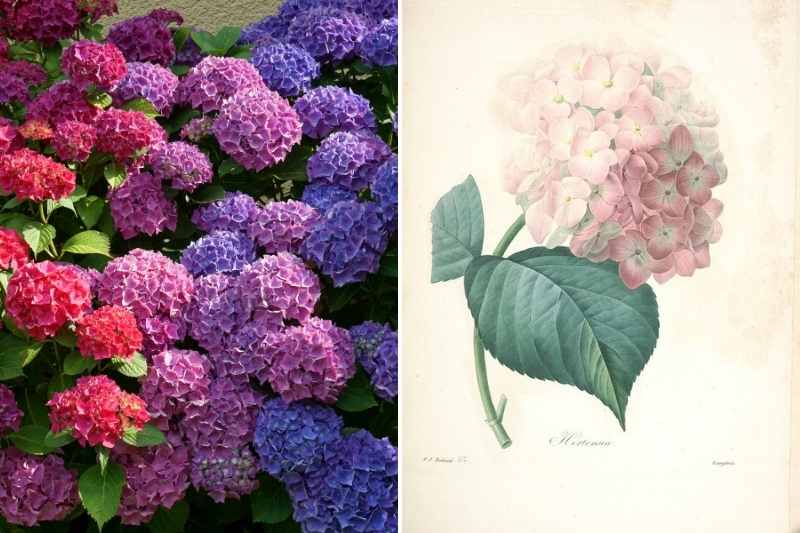
The different types of Hydrangeas
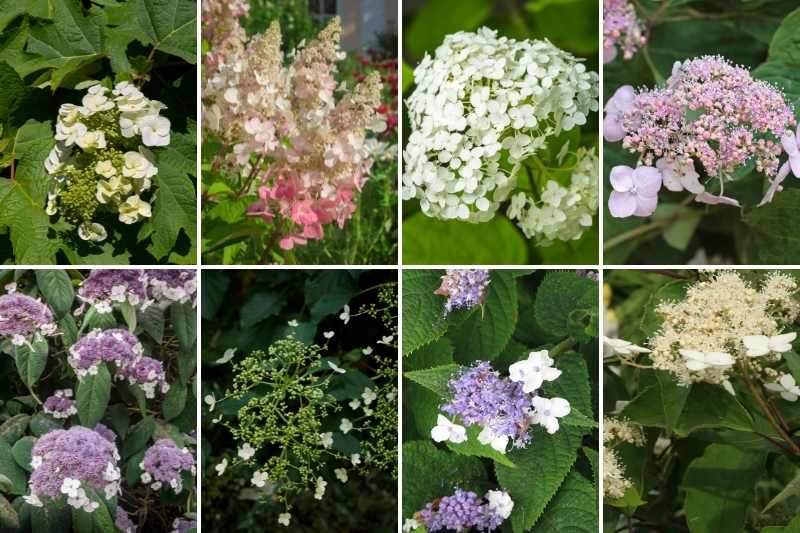
We commonly refer to Hydrangea macrophylla when discussing the hydrangea with globular pink or blue inflorescences, which is of Japanese origin. However, in the vast genus Hydrangea, there are actually nearly 80 species recorded worldwide… enough to confuse anyone! While they are mostly native to East Asia, they also have other species names and come from Nepal or the United States… even Chile. To help you navigate, here’s a little world tour highlighting the main areas of origin of Hydrangeas.

In Japan, you can also find Hydrangea paniculata with cone-shaped flowers, Hydrangea anomala or petiolaris, a climbing hydrangea, and Hydrangea involucrata, with peony-like buds. China is home to Hydrangea aspera and villosa with large villous leaves (also found in Taiwan), Hydrangea sargentiana, and Hydrangea paniculata. From the southeastern United States, we have Hydrangea quercifolia (with oak-like leaves) and Hydrangea arborescens. As for Chile and Argentina, they have an endemic climbing Hydrangea, Hydrangea integerrima or Hydrangea serratifolia.
Hydrangeas are among the most hybridised plants. In addition to these species, there are between ten and a hundred varieties, especially for Hydrangeas microphylla, paniculata, and the American species.
Symbols and traditions
The hydrangea is called ajisai in Japanese, which means "gathering of indigo blue" or "collection of indigo blue" in reference to one of its colours, which is very prominent in Japan.
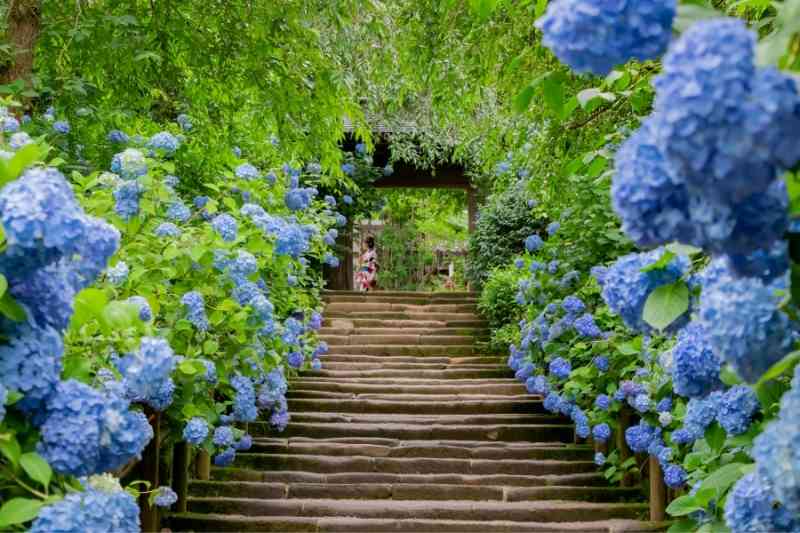
They are dazzling in June, which corresponds to the beginning of the rainy season. The ambient humidity reveals all their splendour. Almost as coveted as the famous katsura - the cherry blossoms - celebrated throughout the archipelago in spring for Hanami, hydrangeas mark the eagerly awaited approach of summer: the Japanese flock to the many temples where they can admire the thousands of hydrangeas on display, lining the paths and flower beds.
The Japanese and Koreans are also great consumers of Hydrangeas in the form of tea! It is called Buddha tea, as it is consumed in his honour, to celebrate Hana Matsuri, his birth in April. This tea, or rather infusion, is made from the sweet leaves of Hydrangea serrata ‘Oamacha’. It has a strong liquorice flavour and is also served during major occasions and religious festivals.
In our gardens, the hydrangea is mainly used dried for decoration, forming magical winter bouquets.
As for the symbolism of hydrangeas, it varies greatly depending on the culture and country, and even according to the colour of their flowers… It’s up to you to choose the one you like! : gratitude, beauty, purity, regret, and even in Japan, inconsistency (due to the changing hues of hydrangeas) or dignity and deep feelings…
Hydrangeas in the garden
We appreciate the hydrangea for its long flowering period and its often changing colours throughout the season in the flowers, and for some varieties, in the leaves. It adapts well to both shade and partial shade as well as to full sun depending on the varieties. It is a bush with very varied species in terms of shapes and sizes. Finally, it shows good hardiness and can be planted in pots for the smaller varieties.
Hydrangeas often appear on bags of heather soil. However, they do not really belong to this category of plants. Indeed, they prefer slightly acidic soil, but neutral soil suits them perfectly, unlike maples and rhododendrons, for example. However, if you wish to maintain the colour of blue varieties, a pH of 4.5 to 5.5 is necessary. Some even tolerate lime, particularly the "American" hydrangeas (arborescens and quercifolia).
Otherwise… they mainly need fresh, rich, and airy soil, well-drained but not heavy, which could harm their roots in winter with stagnant moisture. And water! (let’s remember that Hydrangea comes from hydor in Greek, meaning water)
As for exposure, they are generally classified as shade shrubs, which is mostly true, but some species are more "receptive" to sunlight such as Hydrangea paniculata and quercifolia, as well as the arborescens.
Finally... Did you know?
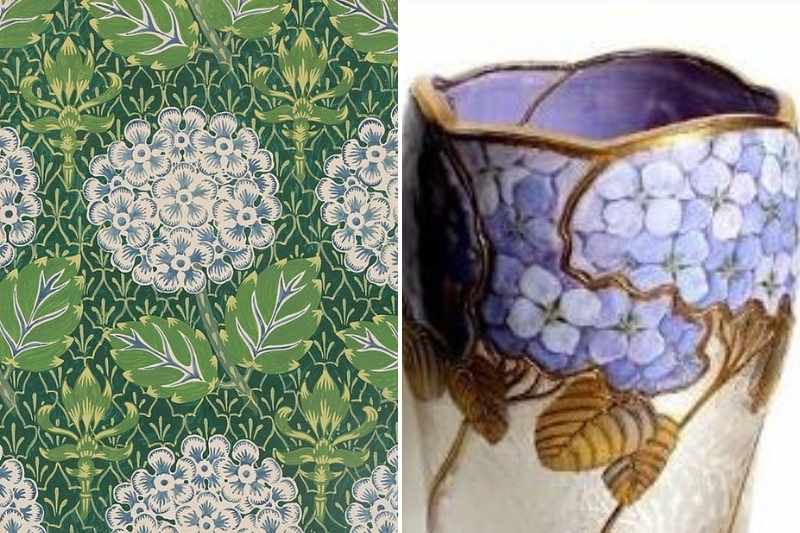
Often depicted in Japanese prints from the 17th and 18th centuries, the hydrangea was also one of the most appreciated flowers in Art Nouveau, an artistic movement from the late 19th century that drew inspiration from plants and their curves. The roundness and design of Hydrangea macrophylla were highly prized by glassmakers (Gallé, Daum…). They are often found on vases, as well as on stained glass in Parisian cafés and restaurants of the Belle Époque, and in wallpapers in the English Arts & Crafts movement (William Morris and his associates).

Comments