





























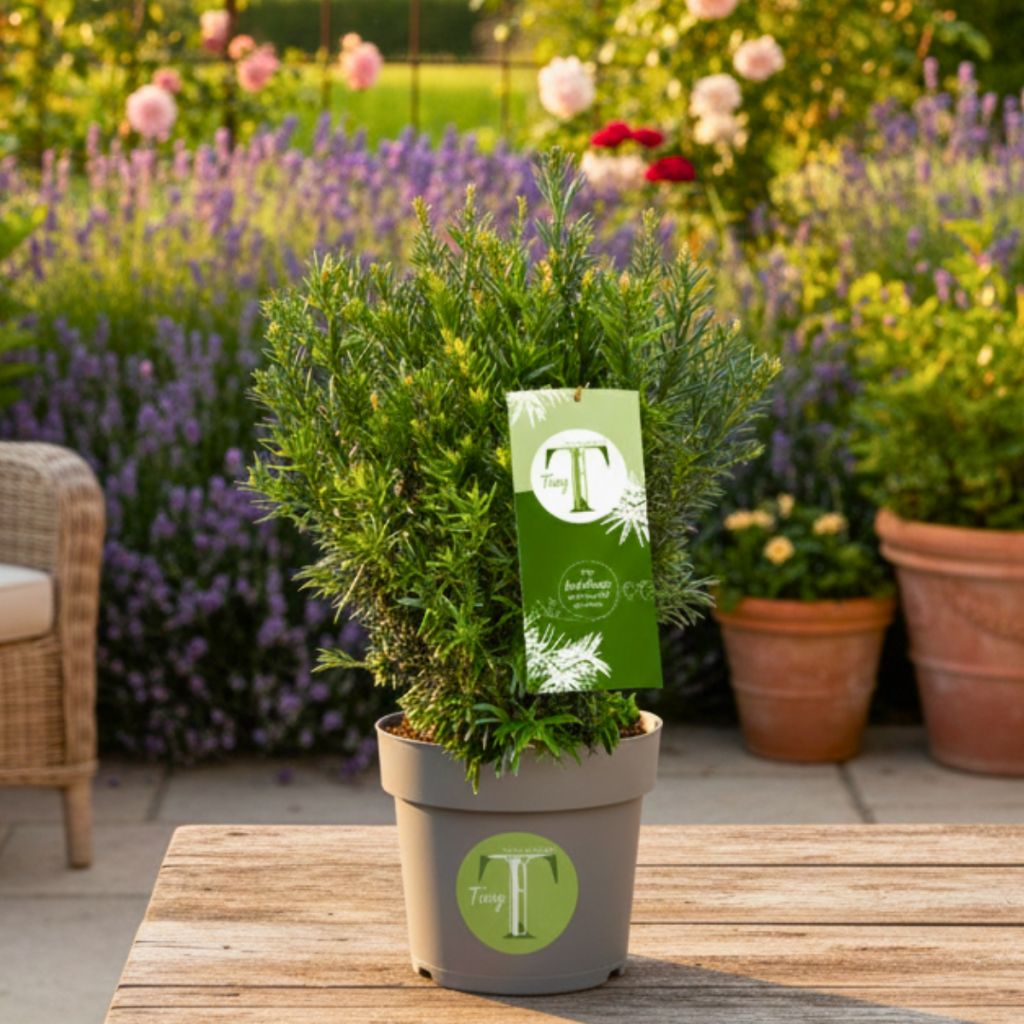
Taxus baccata Tiny T - Dwarf yew
Taxus baccata Tiny T - Yew
Taxus baccata 'HER2016T02' Tiny T
Yew, Common Yew, English Yew, European Yew
Special offer!
Receive a €20 voucher for any order over €90 (excluding delivery costs, credit notes, and plastic-free options)!
1- Add your favorite plants to your cart.
2- Once you have reached €90, confirm your order (you can even choose the delivery date!).
3- As soon as your order is shipped, you will receive an email containing your voucher code, valid for 3 months (90 days).
Your voucher is unique and can only be used once, for any order with a minimum value of €20, excluding delivery costs.
Can be combined with other current offers, non-divisible and non-refundable.
Why not try an alternative variety in stock?
View all →
Available in 4 sizes
Available in 1 sizes
Available in 2 sizes
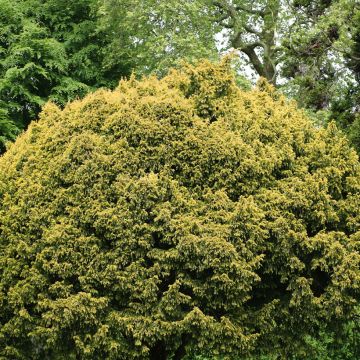
Available in 1 sizes
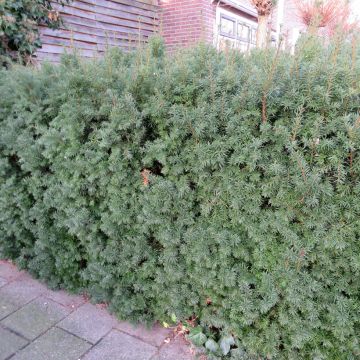
Available in 1 sizes
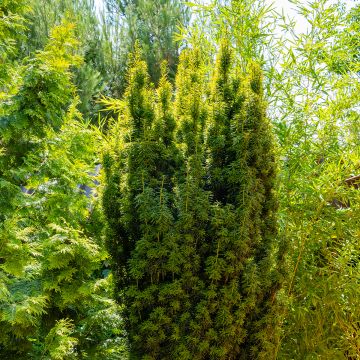
Available in 1 sizes
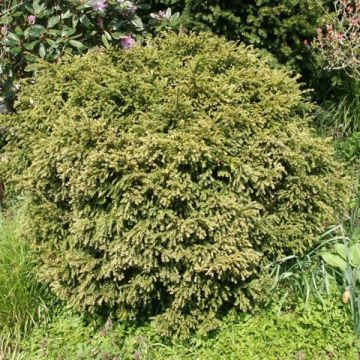
Available in 1 sizes
Available in 2 sizes
Available in 2 sizes
Available in 1 sizes
This plant carries a 24 months recovery warranty
More information
We guarantee the quality of our plants for a full growing cycle, and will replace at our expense any plant that fails to recover under normal climatic and planting conditions.
Would this plant suit my garden?
Set up your Plantfit profile →
Description
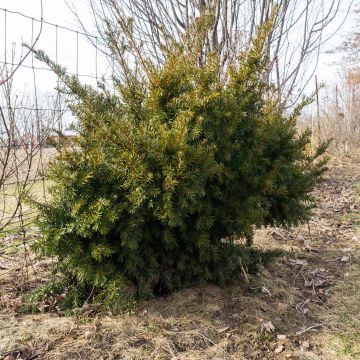
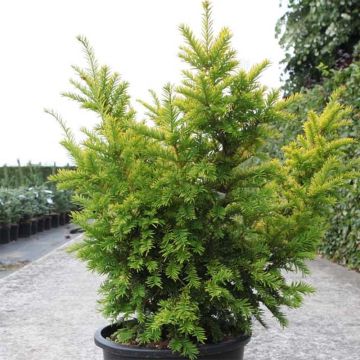
Taxus baccata Tiny T is a dwarf form of common yew that has many advantages. This small conifer with elegant charm, which naturally forms a dense, rounded cushion, is very useful for structuring small spaces, both in the ground and in pots. With its glossy dark green foliage and always neat silhouette, it stands as a reliable choice for low hedges, formal borders, or miniature topiaries. It is also a very versatile plant, undemanding and almost maintenance-free. And a great alternative to dwarf common boxwood!
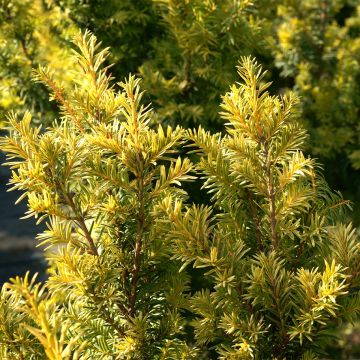
Taxus baccata Tiny T (‘Her2016T02’ PBR) belongs to the Taxaceae family. It is a cultivar developed by Herplant BV via Plantipp®, registered very recently in Europe in February 2022. This very slow-growing yew forms a dense cushion approximately 30 to 50 cm tall and wide at 10 years old. Its structure is strongly branched from the base. It is a true dwarf yew, whose compactness is stable in the long term. According to projections, after 20 or 30 years, it should not significantly exceed 60-70 cm, but there is a lack of long-term data for this recent cultivar. The foliage is evergreen in winter, composed of fine, flat, glossy dark green needles arranged regularly. This dense foliage maintains a neat appearance all year round, and the plant tolerates repeated pruning well, without generating too much waste. Very resistant to cold (down to –25 °C) and to drought once well established, it adapts equally well to sun, partial shade, or even full shade.
The dwarf yew Tiny T does not produce any fruits or fertile seeds. In 2022, it was honoured with the silver medal at GrootGroenPlus.
The common yew in its wild form (Taxus baccata) is a slow-growing European conifer, which can reach 20 m in height at maturity, characterised by a tiered habit and exceptional longevity. Its evergreen foliage, formed of flat needles arranged in two opposite ranks on the twigs, and its bright, toxic fruits (red arils) make it an easily identifiable species. The Taxus genus comprising around thirty species, is appreciated for its tolerance to pruning, its hardiness, and its adaptation to various climates. Tiny T embodies all these qualities in a controlled size, suited to contemporary gardens and small spaces. The common yew belongs to the botanical family Taxaceae.
Understated, elegant, and always impeccable, Taxus Tiny T naturally finds a place in neat small gardens, urban patios, or Japanese-inspired scenes. At the edge of a border or in a large container, it adds substance to displays with its rounded silhouette and dense, dark green foliage all year round. It also works well alongside perennials such as Heucheras with purple foliage, Japanese forest grass (Hakonechloa) or evergreen ferns in a cool, shady atmosphere. Thanks to its resistance to drought and pollution, it is also suitable for city gardens or balconies.
Report an error about the product description
Plant habit
Foliage
Safety measures
Botanical data
Taxus
baccata
'HER2016T02' Tiny T
Taxaceae
Yew, Common Yew, English Yew, European Yew
Taxus baccata 'HER2016T02', Taxus baccata Tiny T
Cultivar or hybrid
ingestion
Cette plante est toxique si elle est ingérée volontairement ou involontairement.
Ne la plantez pas là où de jeunes enfants peuvent évoluer, et lavez-vous les mains après l'avoir manipulée.
Pensez à conserver l'étiquette de la plante, à la photographier ou à noter son nom, afin de faciliter le travail des professionnels de santé.
Davantage d'informations sur https://plantes-risque.info
Planting and care
It is best to plant the Dwarf Yew Tiny T in autumn or spring rather than in winter like other evergreens. It with establishe itself without problems in any well-prepared, drained soil. Dig a generous planting hole much wider than the root ball, without burying the base of the trunk. Water thoroughly to aid establishment. Monitor watering during the first two or three years of cultivation, especially in dry weather, but avoid overwatering.
The Common Yew is truly undemanding, and that is one of its finest qualities. It thrives in sun or partial shade, or even in shade in a hot climate, in ordinary soil, well-loosened at planting, slightly alkaline or acidic, from moist to dry in summer. It easily adapts to all climates and all soils. It can be pruned twice a year, in spring and autumn (the latter allowing for readjustment of the first) in April and August (depending on your climate). The yew withstands wind well, but not salt spray. It tolerates urban pollution well, but dislikes road salt. This conifer is rarely prone to diseases, though it is sometimes prey to scale insects, and its roots can be attacked by vine weevil larvae or, in damp soil, by fungi.

Planting period
Intended location
Care
This item has not been reviewed yet - be the first to leave a review about it.
Similar products
Available in 1 sizes
Available in 2 sizes
Available in 1 sizes
Available in 2 sizes
Available in 1 sizes
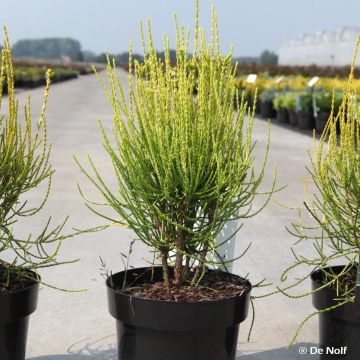
Available in 2 sizes
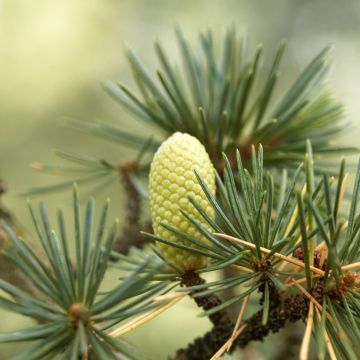
Available in 1 sizes
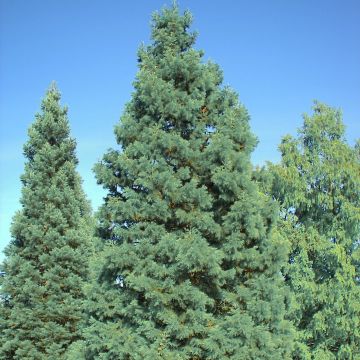
Available in 1 sizes
Haven't found what you were looking for?
Hardiness is the lowest winter temperature a plant can endure without suffering serious damage or even dying. However, hardiness is affected by location (a sheltered area, such as a patio), protection (winter cover) and soil type (hardiness is improved by well-drained soil).

Photo Sharing Terms & Conditions
In order to encourage gardeners to interact and share their experiences, Promesse de fleurs offers various media enabling content to be uploaded onto its Site - in particular via the ‘Photo sharing’ module.
The User agrees to refrain from:
- Posting any content that is illegal, prejudicial, insulting, racist, inciteful to hatred, revisionist, contrary to public decency, that infringes on privacy or on the privacy rights of third parties, in particular the publicity rights of persons and goods, intellectual property rights, or the right to privacy.
- Submitting content on behalf of a third party;
- Impersonate the identity of a third party and/or publish any personal information about a third party;
In general, the User undertakes to refrain from any unethical behaviour.
All Content (in particular text, comments, files, images, photos, videos, creative works, etc.), which may be subject to property or intellectual property rights, image or other private rights, shall remain the property of the User, subject to the limited rights granted by the terms of the licence granted by Promesse de fleurs as stated below. Users are at liberty to publish or not to publish such Content on the Site, notably via the ‘Photo Sharing’ facility, and accept that this Content shall be made public and freely accessible, notably on the Internet.
Users further acknowledge, undertake to have ,and guarantee that they hold all necessary rights and permissions to publish such material on the Site, in particular with regard to the legislation in force pertaining to any privacy, property, intellectual property, image, or contractual rights, or rights of any other nature. By publishing such Content on the Site, Users acknowledge accepting full liability as publishers of the Content within the meaning of the law, and grant Promesse de fleurs, free of charge, an inclusive, worldwide licence for the said Content for the entire duration of its publication, including all reproduction, representation, up/downloading, displaying, performing, transmission, and storage rights.
Users also grant permission for their name to be linked to the Content and accept that this link may not always be made available.
By engaging in posting material, Users consent to their Content becoming automatically accessible on the Internet, in particular on other sites and/or blogs and/or web pages of the Promesse de fleurs site, including in particular social pages and the Promesse de fleurs catalogue.
Users may secure the removal of entrusted content free of charge by issuing a simple request via our contact form.
The flowering period indicated on our website applies to countries and regions located in USDA zone 8 (France, the United Kingdom, Ireland, the Netherlands, etc.)
It will vary according to where you live:
- In zones 9 to 10 (Italy, Spain, Greece, etc.), flowering will occur about 2 to 4 weeks earlier.
- In zones 6 to 7 (Germany, Poland, Slovenia, and lower mountainous regions), flowering will be delayed by 2 to 3 weeks.
- In zone 5 (Central Europe, Scandinavia), blooming will be delayed by 3 to 5 weeks.
In temperate climates, pruning of spring-flowering shrubs (forsythia, spireas, etc.) should be done just after flowering.
Pruning of summer-flowering shrubs (Indian Lilac, Perovskia, etc.) can be done in winter or spring.
In cold regions as well as with frost-sensitive plants, avoid pruning too early when severe frosts may still occur.
The planting period indicated on our website applies to countries and regions located in USDA zone 8 (France, United Kingdom, Ireland, Netherlands).
It will vary according to where you live:
- In Mediterranean zones (Marseille, Madrid, Milan, etc.), autumn and winter are the best planting periods.
- In continental zones (Strasbourg, Munich, Vienna, etc.), delay planting by 2 to 3 weeks in spring and bring it forward by 2 to 4 weeks in autumn.
- In mountainous regions (the Alps, Pyrenees, Carpathians, etc.), it is best to plant in late spring (May-June) or late summer (August-September).
The harvesting period indicated on our website applies to countries and regions in USDA zone 8 (France, England, Ireland, the Netherlands).
In colder areas (Scandinavia, Poland, Austria...) fruit and vegetable harvests are likely to be delayed by 3-4 weeks.
In warmer areas (Italy, Spain, Greece, etc.), harvesting will probably take place earlier, depending on weather conditions.
The sowing periods indicated on our website apply to countries and regions within USDA Zone 8 (France, UK, Ireland, Netherlands).
In colder areas (Scandinavia, Poland, Austria...), delay any outdoor sowing by 3-4 weeks, or sow under glass.
In warmer climes (Italy, Spain, Greece, etc.), bring outdoor sowing forward by a few weeks.